You type “4rd” and something feels wrong. You stare at it. You know “3rd” is correct, so why does “4rd” look so strange? Many writers run into this exact moment of doubt, in emails, reports, presentations, and date lines. At Your Daily American, questions like this come up regularly, because getting the small details right is what makes your English look polished and professional. By the end of this article, you will know why 4th is the only correct form, how the full ordinal suffix system works, how to pronounce “fourth” clearly in American English, and how to use ordinals correctly in professional writing.
You will also be able to tell the difference between “fourth” and “forth”, two words that sound identical but mean completely different things. These are the kinds of details that many native speakers notice even when they cannot explain exactly why something looks wrong.
Why “4rd” is wrong (and why so many people write it)
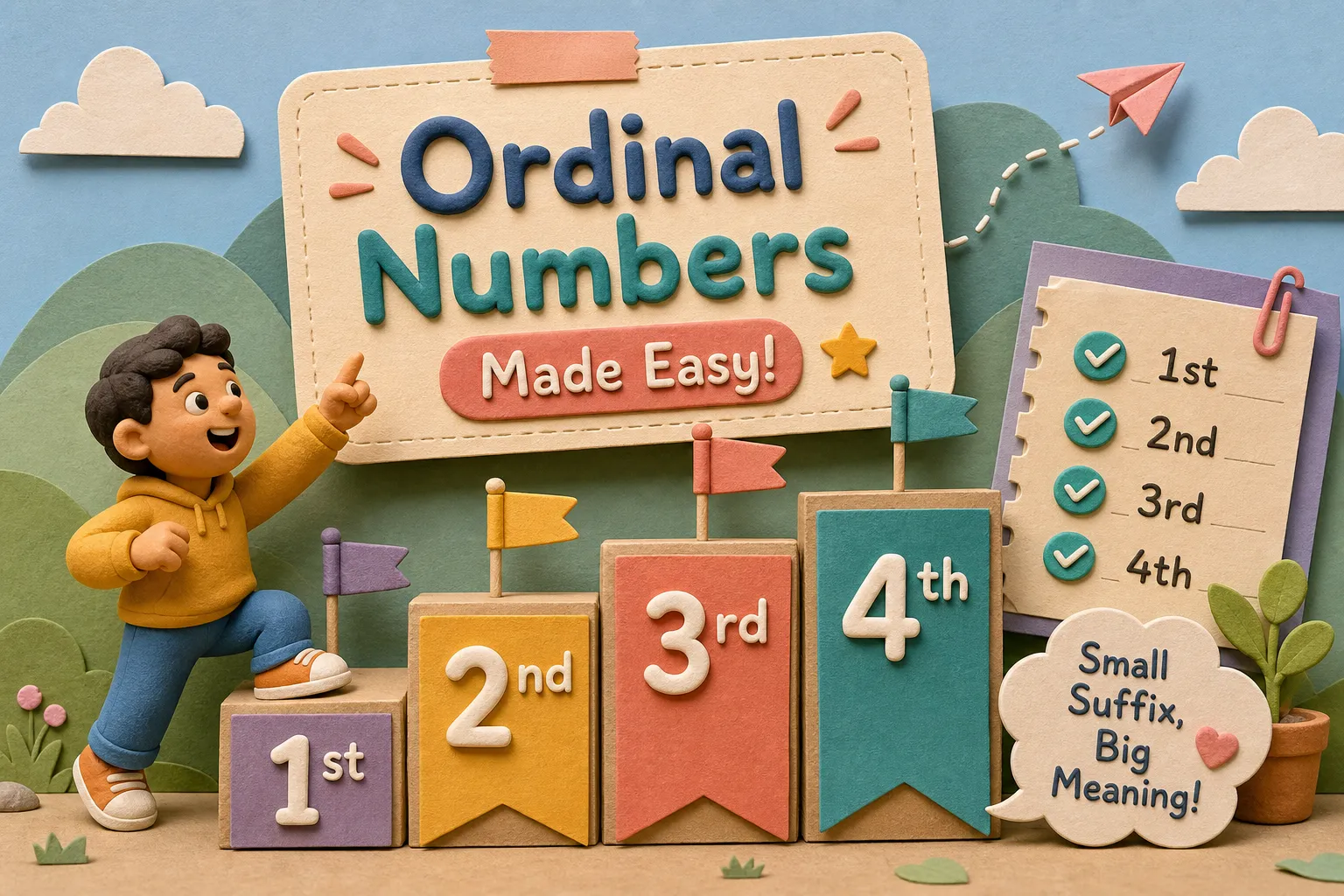
The ordinal suffix in English comes directly from the spoken ordinal word. It is not random, and it does not follow a rotating pattern. Look at how this works: “first” ends in “-st,” so the abbreviation is 1st. “Second” ends in “-nd,” so the abbreviation is 2nd. “Third” ends in “-rd,” so the abbreviation is 3rd. “Fourth” ends in “-th,” so the abbreviation must be 4th. The suffix matches the ending sound of the full ordinal word, not a fixed sequence of letters.
Once you see that connection, “4rd” looks immediately wrong. The word is “fourth,” not “fourd.” There is no “-rd” sound at the end of “fourth,” so there is no reason to write “-rd” after the number 4.
So why do so many people write it? The answer is a pattern that feels logical but is not accurate. When you see 1st, 2nd, 3rd in a row, it looks like the ordinal suffix rotates: -st, -nd, -rd. So when 4 comes next, “-rd” feels like the next step. But there is no rotation. The suffix depends entirely on the spoken ordinal word, and most numbers from 4 onward end in the “-th” sound: fourth, fifth, sixth, seventh, eighth, ninth, tenth. The -st, -nd, and -rd forms are the exceptions. The “-th” form is the standard, which is exactly why 4th is correct and “4rd” is not.
The complete pattern for ordinal abbreviations
The ordinal number rule is straightforward once you know it. Look at the last digit of the number. That digit tells you which spoken ordinal form the number takes, and that gives you the correct suffix.
For a concise how-to on ordinal numbers, see How to Write Ordinal Numbers Correctly.
- Last digit 1 → -st (from “first”): 1st, 21st, 31st, 101st
- Last digit 2 → -nd (from “second”): 2nd, 22nd, 32nd, 202nd
- Last digit 3 → -rd (from “third”): 3rd, 23rd, 33rd, 203rd
- All other last digits → -th: 4th, 5th, 6th, 7th, 8th, 9th, 10th, 24th, 44th, 100th
You can apply this to any number right now. A job posting for a “32nd annual conference” ends in 2, so it takes “-nd.” A building directory showing the “44th floor” ends in 4, so it takes “-th.” A race result showing a runner in “21st place” ends in 1, so it takes “-st.” In each case, look at the last digit and match it to the list above.
Try a few more on your own:
- 54th, last digit 4, so “-th”
- 63rd, last digit 3, so “-rd”
- 71st, last digit 1, so “-st”
- 82nd, last digit 2, so “-nd”
The ordinal rule holds across all of these. There is one exception worth knowing before you apply this anywhere.
The 11th, 12th, and 13th exception you need to know
This is the one part of the rule that surprises even advanced learners. If the last digit of 11 is 1, should it be “11st”? No. The correct form is “11th.” The same applies to 12th and 13th. These three numbers are exceptions because their spoken ordinal forms all end in “-th”: eleventh, twelfth, thirteenth. Even though the last digits are 1, 2, and 3, the ordinal words end in “-th,” so the abbreviation uses “-th.”
The practical takeaway: whenever a number ends in 11, 12, or 13, always use “-th.” This applies at every scale, 111th, 112th, 113th, 211th, 312th. A learner who understands this rule will never write “112nd” or “113rd.” To check yourself quickly, look at the last two digits. If they are 11, 12, or 13, use “-th” every time, regardless of the final digit.
It helps to compare these with the numbers just above them. 121st, 122nd, and 123rd follow the standard rule because their last two digits are 21, 22, and 23. But 111th, 112th, and 113th take “-th” because their last two digits are 11, 12, and 13. When the last two digits are 11, 12, or 13, “-th” is the only correct choice, no exceptions to this exception.
“Fourth” vs. “forth”: two words that sound the same
“Forth” is an adverb meaning forward or onward, it has nothing to do with numbers. In a sentence like “She set forth her main points at the start of the meeting,” “forth” means she presented or stated her points. In “The team moved forth with the project,” it means the team continued moving forward. “And so forth” is a common phrase in both professional and everyday writing that means “and so on.” While “forth” appears in formal writing and fixed expressions, “forward” is more common in everyday American English. Learners usually confuse these two words in writing, not in speech, because they sound identical.
Here is a simple way to keep them straight: “fourth” contains the word “four.” If you can see “four” inside the word, you know it refers to a number. “Forth” contains no number and simply means onward or forward. Compare these two sentences: “She finished fourth in the competition.” and “She moved forth with confidence.” These sentences cannot be swapped. One is about position in an ordinal sequence; the other is about movement forward.
How to pronounce “fourth” in American English
“Fourth” is pronounced /fɔːrθ/ in General American English (per Merriam-Webster). A simple phonetic guide: FORTH, rhyming with “more” plus the “-th” sound from “think.” Two sounds give ESL learners the most trouble, the vowel /ɔːr/ and the final /θ/.
For the vowel, think of the sound in “more,” “for,” or “floor,” where your lips are slightly rounded. The /θ/ sound requires placing the tip of your tongue lightly between your upper and lower front teeth, or just behind your upper teeth, and letting air flow out continuously. Avoid letting it collapse into a /t/ sound, which produces “fort” (a military structure), or a /s/ sound, a common substitution for speakers whose first language lacks the /θ/ phoneme, including Spanish, Portuguese, and many Asian languages. The distinction is a spelling issue only; in speaking, both “fourth” and “forth” sound exactly the same.
For more on stress patterns and pronunciation detail, see Word Stress in American English: A Complete Guide, Your Daily American. You can also compare common problem words in our piece on English Words Non-Native Speakers Mispronounce Most Often, Your Daily American. To hear a clear dictionary pronunciation of “fourth,” listen at the Cambridge entry for the word: Cambridge Dictionary: fourth (pronunciation).
Three pronunciation errors to avoid
- Dropping the /r/ and saying /fɔːθ/: this sounds British, not American. In American English, the /r/ is fully pronounced.
- Replacing /θ/ with /t/: “fort” is a completely different word.
- Replacing /θ/ with /s/: this is a common pattern for speakers whose first language does not have the /θ/ sound.
Ordinals in professional writing: what style guides say
The three main American style guides agree on the basic principle: write out small ordinal numbers as words, and use numerals with the correct ordinal suffix for larger ones. The specifics differ slightly between guides.
AP Style spells out first through ninth and uses figures from 10th onward, 10th, 11th, 22nd, and so on. AP also recommends avoiding ordinal suffixes in dates; in news writing, you write “June 10,” not “June 10th.” The Chicago Manual of Style generally spells out ordinals through the ninety-ninth in running text and uses numerals where numbers are frequent or technical. MLA follows similar logic in running text but permits numerals more readily in citations and references. For practical AP-style guidance related to journalism, see the Purdue OWL’s AP style overview: Purdue OWL, AP Style.
For most professional writing, emails, reports, and presentations, a practical rule covers the majority of situations. Write out small ordinals as words in running sentences: first, second, third, fourth. Use numerals with the correct ordinal suffix for larger numbers or in tables, lists, and rankings: 10th, 21st, 44th, 112th. Whatever approach you choose, stay consistent within one document. The right form for the fourth item is always 4th, never “4rd.”
You can read more about the historical basis for ordinal markers and the general concept of an ordinal indicator if you want the linguistic background.
What you can do with this now
The key points are straightforward. “4rd” is wrong because the ordinal word “fourth” ends in “-th,” not “-rd.” The ordinal suffix always matches the ending sound of the spoken ordinal word, and the rule is based on the last digit of the number. Numbers ending in 11, 12, or 13 are exceptions and always take “-th,” even though their last digits are 1, 2, and 3. “Fourth” and “forth” sound the same in American English but mean completely different things, so spelling and context matter. In professional writing, AP and Chicago both prefer written-out ordinals for small numbers and numerals with the correct suffix for larger ones.
These small details add up. When your ordinal abbreviations are correct, your writing looks careful and professional. For more grammar lessons like this one, clear explanations of punctuation, capitalization, numbers, and real workplace writing, Daily Grammar, Your Daily American covers exactly these topics in practical, easy-to-follow detail.
Practice: Write the ordinal abbreviations for these five numbers: 14, 21, 112, 33, and 101. Check your answers against the rules in this article. The answers are 14th, 21st, 112th, 33rd, and 101st.