You’re scrolling through Instagram and you see a photo of the most amazing-looking sandwich. The caption says: “Best lunch of my life… iykyk.” That’s it. No restaurant name. No location. No explanation. You think, what does that mean? Why didn’t they say more? That’s exactly the point, and once you understand it, hundreds of captions and posts will suddenly make sense.
This kind of real digital American English almost never appears in textbooks or grammar courses. But it’s everywhere online, in captions, texts, memes, and comments. This article focuses on one piece of that language: IYKYK. By the end, you’ll know what it means, where it came from, why Americans use it, and how to use it yourself with confidence, or simply recognize it the next time it appears in your feed.
What IYKYK Actually Means
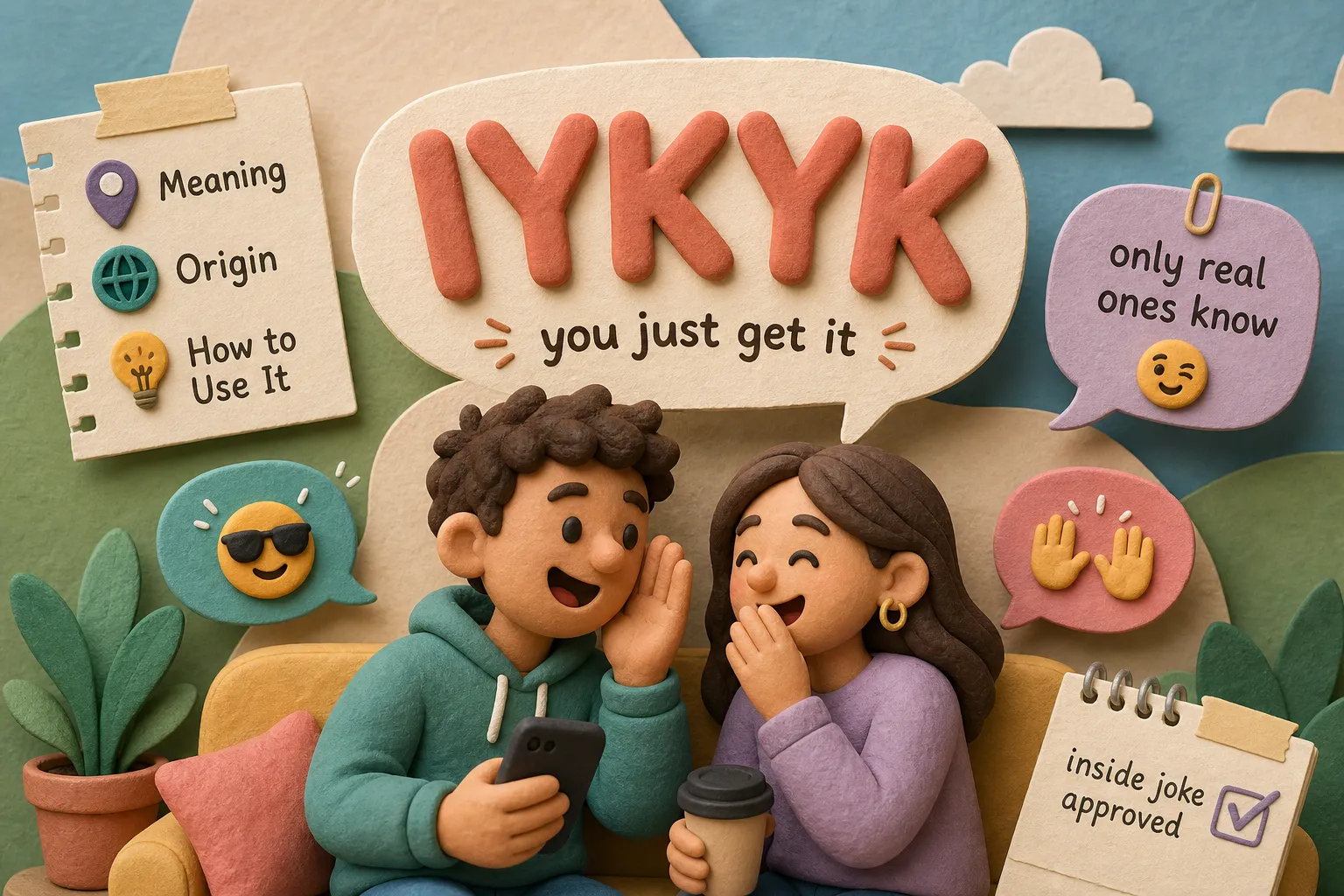
IYKYK stands for “if you know, you know.” Each letter maps directly to the phrase:
- I = if
- Y = you
- K = know
- Y = you
- K = know
There’s no hidden meaning in the letters. It’s simply the phrase written as a fast, five-letter shorthand. Merriam-Webster defines IYKYK as informal language “used to acknowledge some common knowledge or a shared experience.” Dictionary.com adds that it signals an inside joke or reference understood only by a specific group, usually without any further explanation, and that it’s commonly used as the hashtag #iykyk.
The full phrase “if you know, you know” is a way of saying: I’m not going to explain this. The right people will understand. It’s a quiet signal between people who share a memory, an experience, or a piece of inside knowledge. If you were there, you get it. If you weren’t, well, that’s the point.
How to Say It Out Loud
In writing, you’ll almost always see the abbreviation: iykyk or IYKYK. When speaking the full phrase, Americans say “if you know, you know”, pronounced “if yoo NOH, yoo NOH,” with the stress falling on know each time. When referring to the abbreviation itself, though, most Americans say the individual letters: “I-Y-K-Y-K.” Both forms come up in conversation, so it helps to be comfortable with each.
Where IYKYK Came From
The phrase “if you know, you know” is not new. Americans have used it in casual speech for years to signal that something is special or understood only by certain people. It was already part of everyday spoken English long before it became internet shorthand. The abbreviation IYKYK came later, as a natural product of text messaging and social media culture, where people shorten everything to save time and space.
A major turning point came in 2018, when rapper Pusha T released a track titled “If You Know You Know.” The song was widely covered, and the phrase gained significant cultural attention alongside it. After that release, the expression spread across TikTok, Instagram, Twitter/X, and Reddit, helping amplify it from a familiar spoken phrase into a standard caption and hashtag tool. The phrase didn’t start with the song, but the release gave it a much wider audience. You can read more about the song and its cultural reach on Wikipedia.
Since then, other artists have picked it up. B-Lovee released a track called “IYKYK,” and country singer Dierks Bentley used it as a song title as well. Cross-genre adoption like that suggests the phrase has moved well beyond any one group or subculture. By 2025, reports put the hashtag #iykyk at roughly 15 billion views on TikTok alone, a figure that shows just how deeply it has settled into digital American English.
The Cultural Feeling IYKYK Creates
When someone posts IYKYK, they are creating a small circle of people who share something. The message is: this moment is real, it’s personal, and I trust that the right people will feel it too. There’s a sense of closeness in that. It’s a quiet signal between people who were there, whether “there” means a restaurant, a concert, a hard night studying, or a specific moment in pop culture.
This works on two levels at the same time, and ESL learners should understand both. For people in the group, IYKYK feels warm and connecting. It says: you and I share something that others don’t. For people outside the group, it can feel like they’re missing something. That gap is intentional. The phrase is usually not meant to be rude. It’s meant to keep a moment feeling personal and real, not over-explained or performed for a general audience.
In American digital culture, this resonates. Authenticity, being real rather than performative, is something Americans value highly online. IYKYK fits that value because it doesn’t over-explain. It trusts the audience. That combination of warmth, exclusivity, and genuine feeling is why the phrase has stayed popular for years.
How IYKYK Shows Up in Captions, Memes, and Texts
In social media captions, IYKYK almost always appears at the end, after the main point has already been made. Here are some examples you’re likely to see:
- “Best tacos in town… iykyk”
- “That awkward Zoom moment… iykyk”
- “First snow of the year. iykyk ❄️”
- “Studying at 3 a.m. the night before the exam… iykyk 😭”
- “Our table at the back corner. iykyk 🙏”
Notice how none of these captions explain themselves. The writer assumes that the right people, friends, followers, or people who have had that same experience, will understand. Everyone else is simply not the target audience for that post. This is by design.
In meme format, IYKYK works the same way. A relatable image appears, a tired face, a specific place, a familiar situation, and instead of a punchline, the caption just says IYKYK. The humor or emotion comes from recognition. You either laughed because you’ve been there, or you didn’t. No explanation is needed, and giving one would actually break the effect.
In text messages and spoken conversation, the phrase moves easily from online life into real life. A friend might text you: “Just got the breakfast burrito from that place on Fifth… iykyk 😭.” In person, someone might say: “We were at the first game of the season, if you know, you know.” In spoken form, Americans typically use the full phrase rather than spelling out the letters. For tips on writing strong short captions for platforms like TikTok, see this guide to TikTok captions.
When to Use IYKYK, and When to Skip It
IYKYK works well in a few clear situations:
- You’re referencing a shared memory with someone who was there
- You’re posting something your audience will instantly recognize
- You want to signal that a moment is personal without spelling it out
It fits casual digital communication, captions, texts, informal social media posts. As a general rule, avoid it in professional or formal contexts: emails, presentations, work meetings, and academic writing are all places where it will land awkwardly, regardless of the audience.
There is also a tone issue worth knowing. Some people see IYKYK as a gatekeeping phrase, a way of leaving others out on purpose. One real example from X (formerly Twitter) shows a user calling it “exclusionary.” That criticism exists, and it’s worth taking seriously. The difference between IYKYK feeling warm versus feeling dismissive usually comes down to tone and context.
Using it to share a nostalgic memory, a funny shared moment, or a genuine personal experience usually reads well. Using it to signal that you have access to something others don’t, or to show off, can come across as cold or dismissive. In professional settings or cross-cultural conversations, it’s always safer to simply explain what you mean. Save IYKYK for casual moments where your audience will clearly feel included, not confused.
You Know It Now, Here’s What to Do Next
IYKYK means “if you know, you know,” a phrase that signals shared experience, insider knowledge, and a sense of belonging. It started as a spoken expression, grew into internet shorthand, and is now one of the most recognizable pieces of informal American digital language. The hashtag has billions of views. The phrase appears in music across multiple genres. And it shows up in casual texts and captions on a regular basis.
Understanding IYKYK means you can now decode countless captions and posts that might have felt confusing before. You know what the phrase signals, why Americans use it, and when it’s appropriate. That’s real progress in reading English the way it’s actually written online, not just the way it appears in textbooks.
This is exactly the kind of practical, real-world American English that Your Daily American covers every week, from internet slang like this to professional communication, pronunciation, and everyday conversation skills. If you want to keep building fluency that works in real situations, explore more lessons on the platform. And as a small practice step: try writing one IYKYK caption about a personal experience. Keep it short, put it at the end, and don’t explain it. You’ll feel how the phrase actually works, from the inside.