If you’ve ever wondered about the AFK meaning when someone types it in a gaming lobby or work chat, you’re not alone. You open Slack for the first time at a new American company, or you join an online game, and someone types “AFK”, then the conversation keeps moving. Everyone understands except you. This moment is common for English learners, and it can feel a little disorienting.
By the end of this article, you’ll be able to define AFK clearly, use it correctly in gaming and work chat, and recognize related abbreviations like BRB, GTG, and IRL. You’ll also know when AFK is appropriate and when to choose a different phrase.
At Your Daily American, we cover the English Americans actually use every day, including the digital language that fills chat rooms, gaming lobbies, and team channels. Understanding the AFK abbreviation is a great starting point for anyone building real fluency in American digital life.
AFK meaning: what it is and where it came from
The core definition
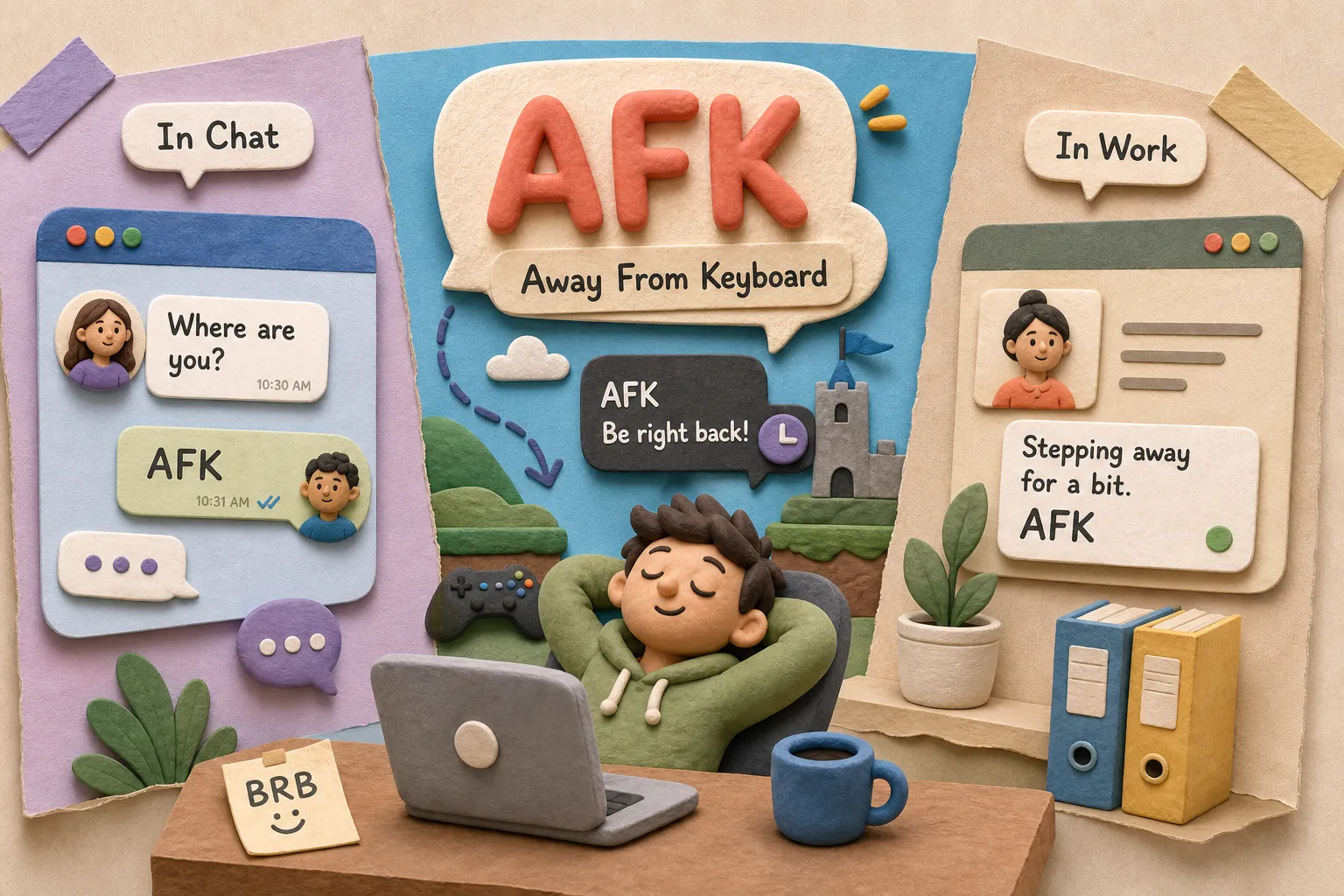
AFK stands for “away from keyboard.” It tells people you are not at your device right now and cannot reply. The key thing to understand: AFK does not mean you logged out or left permanently. It signals a temporary absence.
AFK is also not the same as being offline. When you’re AFK, you’re still connected to the platform or game, you’re just not watching the screen or typing. The abbreviation is spoken as three separate letters: “A-F-K,” though in casual spoken conversation, people may pronounce it differently.
A quick history of the abbreviation
This abbreviation is older than most people expect. The earliest recorded use appeared in a newsletter called FidoNews in 1989, where it meant “away from keys.” At that time, early internet users communicated through systems called BBSs (bulletin board systems, which were early online message boards) and IRC chat rooms. IRC stands for Internet Relay Chat, an early form of group messaging.
By the early 1990s, AFK was already common in those IRC communities. As personal computers became more widespread in American homes, people began saying “away from keyboard” instead of “away from keys.” The abbreviation stayed the same. This is genuinely old internet language, not recent slang.
AFK meaning in gaming and streaming
AFK in multiplayer games
In online multiplayer games like Fortnite, Valorant, or World of Warcraft, typing “AFK” warns your teammates that you’re stepping away briefly during a match. Your team depends on you, so communication matters. If you disappear without saying anything, your teammates won’t know whether you have a connection problem or simply walked away from the screen.
Here are two examples of how players use it in real conversations:
- “BRB, going AFK to grab some food.”
- “Sorry guys, I need to go AFK for a minute to answer the door.”
Many online games also have something called an AFK kick, an automatic system that removes a player who has been inactive for a set period. Timers vary by game; some titles, for example, use roughly 15 to 20 minutes before triggering a removal. The system exists to free server space for active players. Going AFK without warning during an active match is considered poor behavior in gaming communities, and some games even have penalty systems for players who do it repeatedly.
AFK on Discord and Twitch
On Discord, a popular messaging app for gaming communities, people drop “AFK” in a chat channel to let others know not to expect a fast reply. It functions like a quick status update. On Twitch, a live streaming platform, both viewers and streamers use AFK in real-time chat when they’re briefly away from the screen.
Both platforms are widely used in American gaming communities and popular culture. Understanding what AFK means in these spaces helps you follow real conversations and participate naturally.
AFK meaning in the American workplace
When AFK works in work chat
Remote work has brought many gaming terms into professional spaces. In casual Slack or Microsoft Teams channels, AFK now functions as a quick availability signal for many American workers. Here are two common workplace examples:
- “I’ll be AFK for about 10 mins. Need to take a call.”
- “AFK for lunch. Back at 1.”
Is it professional? It depends on your team’s culture. If your American colleagues use it regularly, it’s fine. If you’re new to a team, watch how people communicate first. Their behavior is the best guide before you start using shorthand yourself.
When to use something more formal instead
AFK doesn’t work in every situation. Avoid it in emails, messages to clients, or formal updates to your manager. Better options in formal contexts include “I’ll be unavailable for a short time” or simply using Slack’s built-in Away status with a short custom message.
For longer absences, like vacation or a full day out, Americans use OOO, which stands for “out of office.” OOO is the formal version, used in professional settings and email auto-replies. When you’re not sure whether an abbreviation fits, the safest move is always to write it out fully.
BRB, GTG, IRL, and other abbreviations Americans use
How long are you actually away? A practical comparison
One of the most useful things to know is what each abbreviation signals about your expected absence. The table below shows the four key terms and how they compare:
| Abbreviation | Full phrase | Expected absence | Best context |
|---|---|---|---|
| BRB | Be right back | A few minutes | Gaming, casual chat |
| AFK | Away from keyboard | Minutes to a bit longer | Gaming, work chat |
| GTG | Got to go | You’re leaving now | Gaming, casual chat |
| OOO | Out of office | Hours to full days | Professional only |
The practical takeaway is straightforward. BRB is the briefest signal. AFK means you’ll be away a little longer with no firm return time. GTG tells people the conversation is over for now, not just paused. OOO is the formal workplace version for longer absences. Knowing the difference between BRB vs AFK alone will help you communicate more precisely in both gaming and work settings.
IRL and other terms worth knowing
IRL stands for “in real life.” It describes the physical world, as opposed to online life. You’ll see it in gaming, social media, and casual American conversation. For example: “I met her IRL after talking online for months.”
Idle is another word that comes up in gaming and chat platforms. It means someone’s account shows no activity. Unlike AFK, “idle” doesn’t mean the person intentionally stepped away, it simply means their account has been inactive for a period of time, with no announcement about returning.
Here’s a short chat exchange showing these terms used naturally together:
Alex: “Hey, can we talk about the project?” Sam: “BRB, getting water.” Sam: “Back! But I’ll be AFK in 5 mins for a meeting.” Alex: “No worries. Let’s catch up IRL tomorrow.” Sam: “Perfect. GTG now. Talk later!”
These terms appear in American chat apps, gaming platforms, and even in casual spoken conversation among younger Americans. Recognizing them helps you follow fast digital exchanges without missing a beat.
AFK etiquette: how to use it the right way
When and how to announce that you’re stepping away
The most important rule: tell people before you step away, not after. Include a rough time estimate when you can, and add a short reason if it helps the other person understand. A clear example looks like this: “Going AFK for 10 mins. Need to take a quick call.”
Avoid typing AFK after you’ve already been gone for a while. This creates confusion because people may think you just returned and are now leaving again. Announce your absence before you step away. In gaming, this matters even more, silence causes confusion, and your team won’t know if your connection dropped or if you simply walked away from the screen.
What happens when people ignore AFK etiquette
In team-based games, an unannounced AFK player can significantly hurt a team’s chances of winning a match. Many games respond with penalty systems that include delayed queue times (waiting longer before starting a new match) or temporary bans from joining games. The AFK kick system exists specifically because unannounced absences are a recognized problem in gaming communities.
Now try writing it yourself. Write two short messages using what you’ve learned: first, a message for a gaming chat telling your team you need to step away for a few minutes; second, a message for a Slack channel letting your colleagues know you’ll be back after lunch. Then try writing a short three-line chat exchange using BRB and GTG together. Writing these out is the fastest way to make the terms feel natural.
Now you know the AFK meaning, and how to use it
The AFK meaning is simple: “away from keyboard.” It’s a short, clear signal that you’re temporarily unavailable. It started in early internet communities in the 1980s and is now used across gaming platforms, streaming sites, and American workplace tools like Slack and Microsoft Teams.
Keep these points in mind: use AFK to signal a brief absence before you step away, and match the abbreviation to the situation. BRB is for the shortest breaks, GTG signals you’re done for the session, and OOO is for formal work absences. In gaming, warn your team first. In work chat, follow your team’s tone before reaching for shorthand.
Digital English keeps evolving, and new expressions appear all the time. At Your Daily American, we help you stay current with the real phrases and everyday language Americans use, both online and in person. Explore more practical vocabulary and communication guides on our Everyday American English category to keep building your confidence, one real expression at a time.
Learn more about our mission on the About Your Daily American page.
Frequently asked questions about AFK
What does AFK mean?
AFK stands for “away from keyboard.” It means someone is temporarily unavailable but still connected to the platform or game.
How do you pronounce AFK?
AFK is typically said as three separate letters: “A-F-K.” In casual spoken conversation, pronunciations can vary.
When should I use AFK in Slack?
Use AFK in casual Slack channels when your team already uses informal language. Avoid it in formal messages, client communication, or emails. When in doubt, write out the full phrase or use Slack’s built-in Away status.
What’s the difference between AFK and BRB?
BRB (“be right back”) signals a very short absence of a minute or two. AFK suggests you’ll be away a bit longer, with no specific return time. Both signal a temporary pause rather than an exit from the conversation.
What is an AFK kick?
An AFK kick is an automatic system in online games that removes players who have been inactive for a set period. Timers vary by game, but the system exists to keep servers running smoothly for active players.