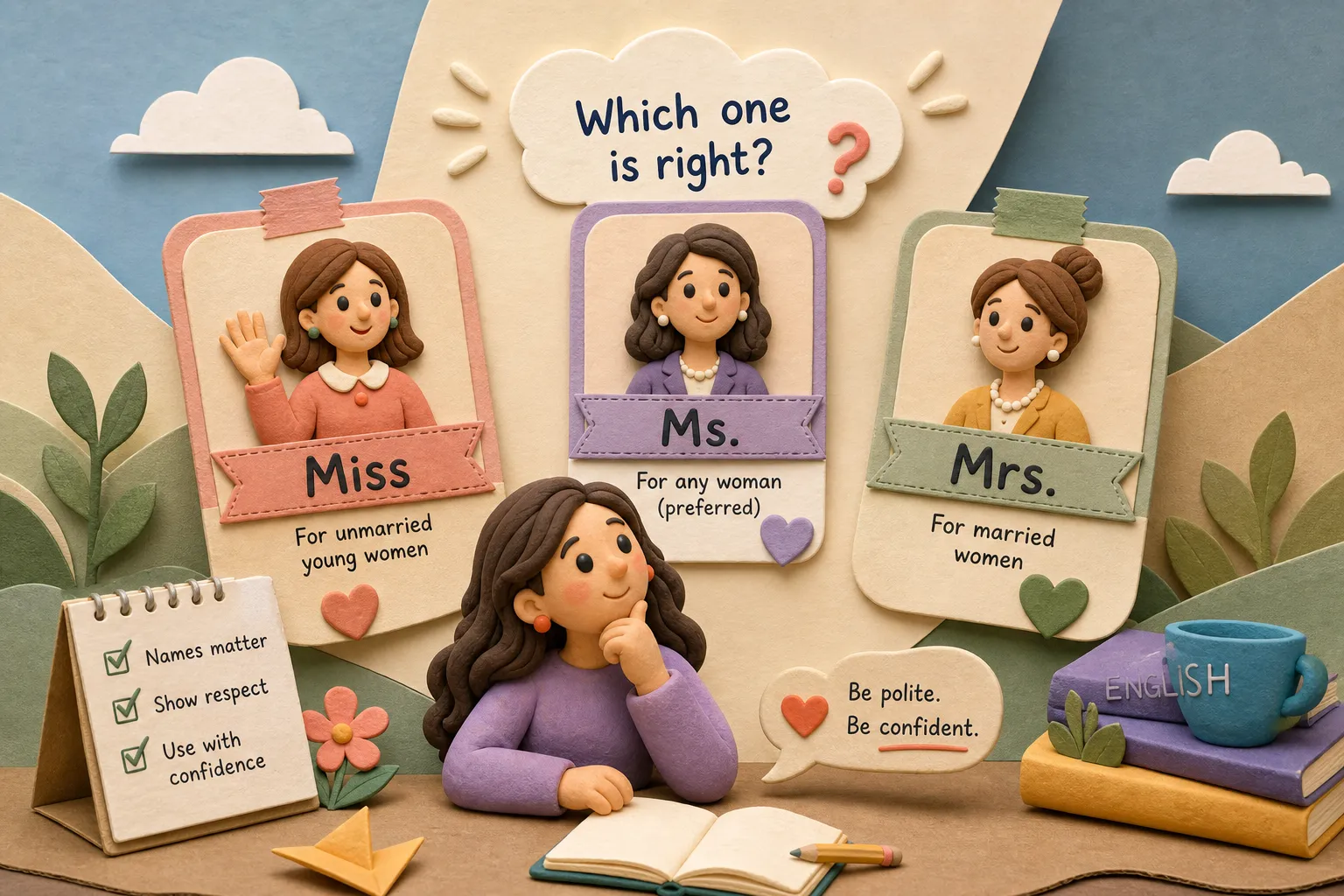
You are writing a professional email to a woman you have never met. You type “Dear Miss…” and then stop. Is she married? Does she prefer something else? Using the wrong title can feel rude or unprofessional, even when that was never your intention.
This is a frequent mistake for ESL learners writing in American English, and it is completely fixable. Miss vs. Ms., which one do you use, and when does Mrs. apply? By the end of this article, you will know exactly what each title means, which one to use by default in professional settings, and how to write correct, confident email salutations. Small choices like these make a real difference in how you come across at work.
Miss vs. Ms. vs. Mrs.: What Each Title Actually Means
Many ESL learners were taught “Miss = unmarried, Mrs. = married” in school, but never got the full picture. Ms. is sometimes left out of those early lessons entirely, yet it is the title you will need most in professional American English contexts. For a concise explainer on the difference between the three titles, see the difference between Miss, Ms., and Mrs. on Study.com.
Miss: the title for unmarried women
Miss is the traditional title for an unmarried woman or girl. It is typically used for younger women or school-age girls. A clear example: “Miss Taylor won the spelling bee.” In American English, using Miss with a married woman can cause offense because it signals she is not married.
There is one regional variation worth being aware of. In parts of the American South, people sometimes use “Miss + first name” as a warm, respectful address, for example, “Miss Sarah.” This pattern is informal and regional, not standard professional English. Avoid this style in formal emails or workplace communication.
Mrs.: the title for married women
Mrs. is pronounced “MIZ-iz” (Merriam-Webster). It is the title for a married woman and is traditionally used with her last name. Example: “Mrs. Johnson will lead the meeting.” Some married women do not use Mrs. because they kept their own last name after marriage, or simply because they prefer a different title. Never assume a married woman wants to be called Mrs.
Ms.: the title that changed everything
Ms. is pronounced “MIZ” (Merriam-Webster). It is a title that does not indicate marital status at all. It was created so that women could be addressed the same way men are with “Mr.”, a title that tells you nothing about marriage. Example: “Ms. Williams sent the report this morning.” The title became widely used in the U.S. during the 1970s, as professional norms shifted and women pushed for equal treatment in the workplace.
Miss vs. Ms.: Why Ms. Is the Professional Default in American English
In professional American life, Ms. has become the safe, respectful, and expected choice when you do not know a woman’s preference. Understanding why helps you use it with confidence.
The Mr. logic: why Ms. makes sense at work
Think about how “Mr.” works. You use it for any man, married or not, and no one questions it. “Ms.” works exactly the same way for women. Style guides including the AP Stylebook recognize Ms. as the standard professional default. When you are not sure what to use, Ms. is never wrong.
Why many American women prefer Ms.
A growing number of American women, including married women, prefer Ms. because it keeps their professional identity separate from their marital status. Using “Mrs.” without knowing a woman’s preference can feel presumptuous. Using “Miss” with a professional adult can sound informal or even condescending, as if you are treating her as a child rather than a colleague.
Ms. avoids both of those problems, as this workplace introduction shows:
Coworker: “Have you met our new project lead?”
Manager: “Not yet.”
Coworker: “This is Ms. Torres. She joined the team last week.”
It is natural, respectful, and appropriate for any professional setting, precisely because it sidesteps assumptions about her personal life. Learn more about applying these norms in workplace contexts in our Professional English for the Modern Workplace.
How to Address Women Correctly in Emails and Formal Settings
Here is how to open a professional email when writing to a woman you have never met, with real examples you can use right away.
Opening a formal email when you don’t know her preference
“Dear Ms. [Last Name],” is almost always the right opening. It is respectful, neutral, and standard in American business writing. Some examples:
- “Dear Ms. Thompson,”
- “Dear Ms. Rivera,”
- “Dear Ms. Chen,”
- “Dear Ms. Okafor,”
Once a woman signs her reply with “Mrs.” or “Miss” before her name, or tells you her preference directly, switch to what she uses. Follow her lead from that point forward.
What is the correct way to start a formal email to a woman whose marital status you do not know?
Default to “Dear Ms. [Last Name].” If you do not know her last name, use “Dear Ms. [Full Name],” or, in a less formal email, “Dear [First Name]” if the relationship allows it. This approach is consistent with guidance from major business communication style guides and keeps the salutation professional regardless of her marital status. For practical tips on how to address a woman in a business letter, consult the referenced business-writing guides.
When you know her preference: follow her lead
The rule here is simple: always use what the person uses for herself. If her email signature says “Dr. Patel,” use Dr. Patel. If she introduces herself as “Mrs. Collins,” use Mrs. Collins. Respect is shown by paying attention to how she identifies herself, not by guessing.
Common Mistakes ESL Learners Make with Miss vs. Ms. and Mrs.
These are the errors that come up most often, especially among learners whose first language handles titles differently. Knowing them in advance helps you avoid them.
Using “Miss” for all adult women
Many learners use Miss as a universal title for women. This happens because their native language has one female title, or because Miss sounds polite and familiar. In American English, using Miss with an adult professional woman can sound infantilizing (treating someone like a child) or signal cultural unfamiliarity.
Here is the correction to practice:
Before: “Dear Miss Anderson,”
After: “Dear Ms. Anderson,”
That one change makes your email sound immediately more professional. For additional guidance on addressing women in formal communication, see this overview of address titles.
Guessing marital status from appearance or age
Some learners assume that older women should be “Mrs.” and younger women should be “Miss.” This is a cultural assumption that does not hold in American professional settings. A woman’s title is her choice, not a reflection of her age or appearance. The safest professional move is always Ms. until she tells you otherwise.
A Quick Reference: When to Use Miss, Ms., or Mrs.
Here is a clear summary you can return to whenever you need it. No guessing required.
In professional settings: emails, letters, meetings
Default to Ms. when writing to a woman professionally. Use her stated preference once you know it. Never assume Mrs. or Miss based on age, appearance, or anything else.
Examples to keep in mind:
- Cold email (you do not know her): “Dear Ms. Carter, I am writing to follow up on our recent project proposal.”
- Reply (she signed as Mrs.): “Dear Mrs. Lee, thank you for getting back to me so quickly.”
- She has a professional title: “Dear Dr. Nguyen, I appreciate your time.”
- You only know her first name: “Dear Ms. [First Name],” or simply “Dear [First Name],” in less formal contexts.
When someone has a professional title like Dr. or Prof., always use that instead of Miss, Ms., or Mrs. Professional titles come first.
In social or everyday situations
In casual American life, most adults use first names and skip titles entirely. You would say “Hi, Sarah” or “Nice to meet you, James,” not “Good evening, Ms. Harris.” Titles like Miss, Ms., and Mrs. appear mainly in formal writing, official documents, or when speaking to someone significantly older.
Here is a short example from a realistic social setting:
Parent at a school event: “My son talks about you all the time. You must be his teacher.”
Teacher: “Yes, I’m Miss Torres. It’s great to finally meet you.”
In this case, the teacher introduces herself with Miss, which is common in school settings. Follow her lead and use Miss Torres when speaking to her. Outside of school or similar structured settings, you will rarely need to choose between these titles in everyday conversation.
Put It All Together
Here is the core takeaway: Miss signals unmarried, Mrs. signals married, and Ms. is the professional default when you are not sure. When the Miss vs. Ms. question comes up in a professional email, the answer is almost always Ms., it is respectful, correct, and widely expected in American workplaces. Getting these titles right is one step in a larger skill: writing clear, professional emails in American English. The more you practice these details, the more automatic they become. For traditional etiquette perspectives, you can also review Emily Post’s guidance on Ms., Miss, and Mrs.
Visit the Your Daily American professional English section to keep building this skill. You will find guides on email structure, tone, closings, and the phrases that American professionals actually use every day, the kind of nuanced detail that moves ESL learners from functional to fluent.
Try it yourself
Practice makes the rule stick. Write four email openings right now:
- A cold email to a woman you have never met (you only know her last name is Brown).
- A reply email, where she signed her first message as “Mrs. Lee.”
- An email to someone whose signature reads “Dr. Patel.”
- An email where you only know the recipient’s first name is Sandra.
Check your answers against what you learned today. If you got all four right, you are already ahead of most non-native speakers writing professional emails in American English.