Read these two sentences. “She was late because her alarm didn’t go off.” “Her alarm didn’t go off, so she was late.” Both sentences describe the same situation, but one focuses on the cause (why it happened) and the other focuses on the effect (what happened as a result). Many ESL learners can understand every word in both sentences and still feel unsure which part is the cause and which is the effect.
This is a very common problem, and it has a clear solution. By the end of this guide, you will be able to identify whether you are dealing with a cause or effect in any sentence, choose the right signal words, and write a precise causal sentence for work or school. At Your Daily American, practical grammar and writing skills like these are exactly what our structured guides are designed to build, from beginner level all the way to professional and academic English.
1. What “cause” and “effect” actually mean
The core difference in plain English
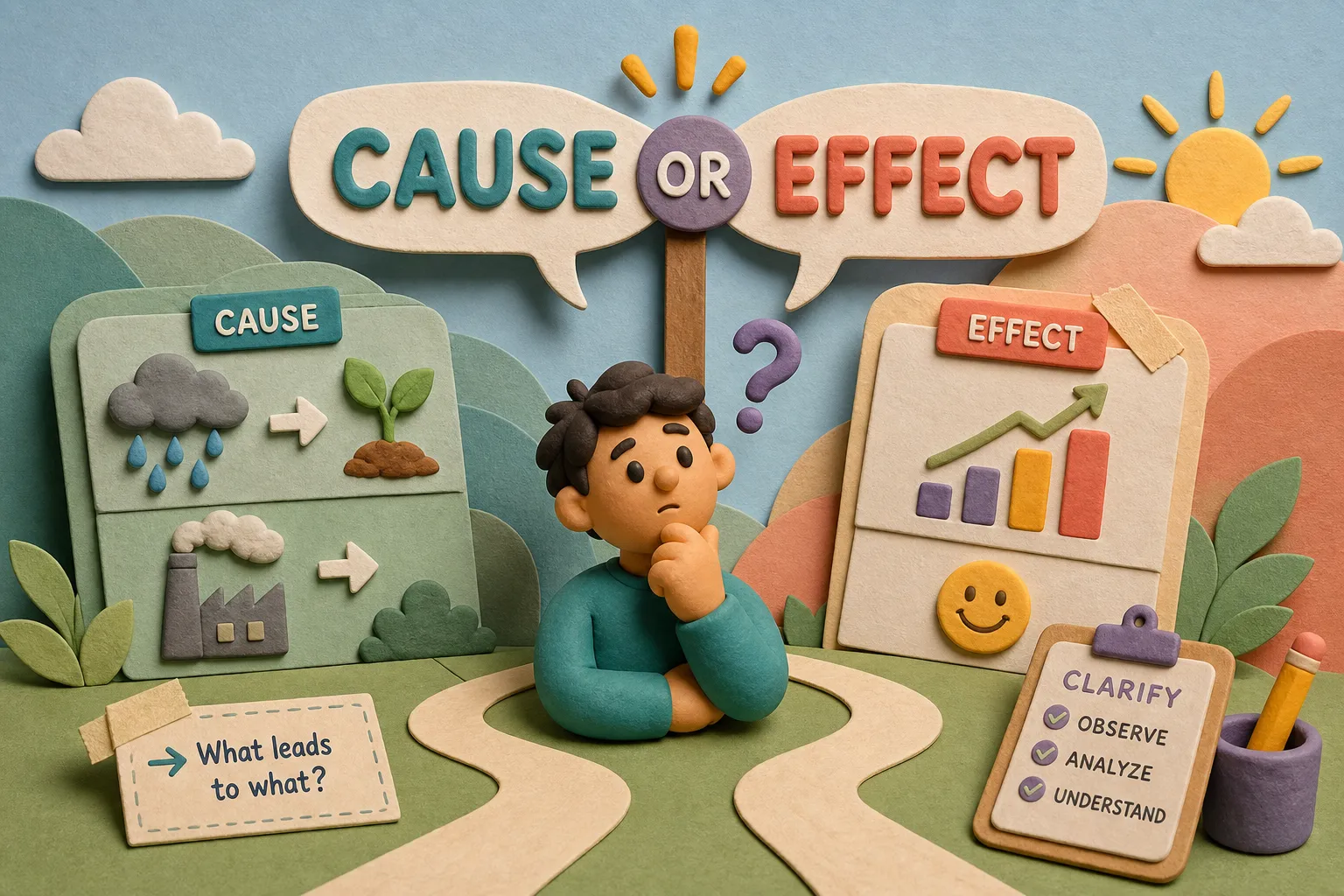
A cause is why something happened. An effect is what happened as a result. A cause typically precedes an effect and explains why it happened, though real-world events may involve multiple causes or linked chains of results. Understanding this causal relationship is the first step to writing clearly about any situation.
A simple way to remember the difference: ask “Why did this happen?” to find the cause. Ask “What happened because of it?” to find the effect. This two-question test works for sentences, paragraphs, and full essays.
Everyday examples that make it click
Here are examples from different situations. In daily life: “It rained, so the ground is wet.” The cause is the rain. The effect is the wet ground. In science: “The plant had no sunlight, so its leaves turned yellow.” No sunlight is the cause. Yellow leaves are the effect. In the workplace: “The report was submitted late, so the client asked for a new deadline.” The late report is the cause. The client’s request is the effect.
In each case, the cause explains why something happened, and the effect shows what happened next. This two-part structure appears in writing at every level, from short emails to long academic papers.
2. Signal words that show cause or effect in a sentence
Words that point to the cause
Signal words are transition words that tell the reader whether a cause or an effect is coming. When you see a cause signal word, you know the reason is about to be stated. The most useful cause signal words to know are: because, since, due to, as a result of, and on account of. These are the ones you will encounter most often in classroom texts and formal writing.
Here are full examples. “She passed the interview because she had prepared for two weeks.” “Due to the server error, the data was not saved.” “Since the team missed the deadline, the manager held a review meeting.” One important grammar point to remember: use “because” before a full clause (“because she prepared”), and use “because of” before a noun phrase (“because of her preparation”). According to standard grammar references such as the Cambridge Grammar of English, these two forms are not interchangeable, and mixing them up changes the sentence structure. For a practical guide to cause-and-effect wording in writing, see ProWritingAid’s cause-and-effect guide.
Words that point to the effect
Effect signal words tell the reader that a result is coming. The most useful ones are: so, therefore, as a result, consequently, for this reason, and thus. For example: “The server went down; as a result, the team lost two hours of work.” “The budget was cut. Therefore, we postponed the new project.” “Customer complaints increased. Consequently, the company updated its return policy.”
Register, the level of formality in your language, matters here. “So” is conversational and works well in spoken English and casual messages, but using it in a formal report can undermine your credibility. “Therefore” and “consequently” are more formal and belong in business reports, academic essays, and professional emails. Always match the signal word to the context you are writing in.
3. Causation vs. correlation: a mix-up that matters
What correlation looks like
Correlation means two things happen at the same time or change together. Causation, what linguists and researchers call a true causal relationship, means one thing directly produces another. These are not the same, and mixing them up weakens your writing. Consider this classic example: ice cream sales and sunburns both increase in summer. They are correlated, meaning they move in the same direction. But ice cream does not cause sunburns. Hot weather causes both.
This distinction matters in any writing where you need to explain why something happened. If you claim a causal relationship without real evidence, a careful reader will question your argument immediately. For a clear business-focused discussion of the difference, read Amplitude’s explanation of causation vs. correlation.
How to tell the real cause apart
When you are not sure whether a relationship is truly causal, ask three diagnostic questions. Did the cause happen before the effect? Can you explain how one produces the other, what is the mechanism connecting them? Could a third variable be driving both? If you cannot answer “yes” to all three, you are likely looking at correlation, not causation.
In business writing, this matters in a practical way. If sales dropped after a marketing change, be careful before blaming the campaign directly. A competitor may have launched at the same time. Always check for other possible causes before stating a causal relationship in a formal document.
4. Sentence templates for business and academic writing
Templates to express a cause or effect
These sentence frames work well in formal written English. Use them in reports, emails, and essays by filling in your own topic.
- “X occurred because [cause].” Example: “The project delay occurred because the requirements were not finalized on time.”
- “Due to [cause], X happened.” Example: “Due to the increase in customer demand, we extended support hours.”
- “X was caused by [noun phrase].” Example: “The communication breakdown was caused by unclear task assignments.”
A quick note on “due to” versus “because of”: some major style guides, including the Chicago Manual of Style and Garner’s Modern English Usage, prefer “due to” in formal written contexts where it follows a linking verb. That said, preferences vary by guide and industry, so check whichever style guide applies to your work and use it consistently.
Templates to express an effect
These templates work for stating results and consequences in formal writing.
- “As a result, [effect].” Example: “As a result, the team completed the project one week behind schedule.”
- “X led to [effect].” Example: “The budget reduction led to a smaller marketing campaign.”
- “Consequently, [effect].” Example: “Consequently, the client requested a revised timeline.”
These effect templates pair naturally with the cause templates above. Use a cause template to explain why something happened, then follow it with an effect template to show what happened next.
Combining both in one sentence
The strongest causal sentences express both the cause and the effect clearly in one statement. Try these two patterns. “Because [cause], [effect].” For example: “Because the supplier was delayed, the launch date was moved to the following quarter.” Or: “[Cause], which led to [effect].” For example: “The system update contained a coding error, which led to a service outage for three hours.”
Writing both sides in one sentence shows precision and confidence. It tells your reader that you understand not just what happened, but why it happened and what it produced. This is a clear mark of strong professional and academic writing in English.
5. How to write a cause-or-effect paragraph
The three-part structure
A cause-and-effect paragraph has three parts. First, a topic sentence that names the event and states whether the paragraph will explain its causes or its effects. Second, two or three supporting sentences that develop the relationship using signal words and specific details. Third, a closing sentence that restates the connection in different words.
Avoid opening your topic sentence with vague phrases like “There are many reasons why…” Instead, name the specific cause or effect directly from the start. Your reader will follow your argument much more easily when you are specific in the first sentence.
A full example paragraph with labels
Here is a model paragraph about a workplace situation, with each sentence labeled so you can see the structure clearly.
[Topic sentence] Many companies have struggled with internal communication since switching to remote work. [Supporting sentence + cause signal] Because team members work in different time zones, scheduling meetings has become more difficult. [Supporting sentence + effect signal] As a result, decisions that once took one day now take several. [Closing sentence] The shift to remote work has changed how quickly and clearly teams can share information.
After reading this, try writing your own paragraph. Choose a simple topic you know well, such as why you decided to study English or what happened when you changed a daily routine. Use the three-part structure and at least two signal words from sections 2 and 4. For extra examples and practice exercises, you might find Study.com’s cause-and-effect lesson helpful.
6. From paragraph to a full cause-and-effect essay
Two patterns for organizing the essay
A cause-and-effect essay uses one of two patterns. The block method groups all causes together in one section, then all effects in another. This works well when your topic has clear, separate causes and effects that do not overlap much. The chain method pairs each cause directly with its effect, then moves on to the next pair. This works better when one effect becomes the next cause, like a series of connected events.
For example: a missed deadline causes a client complaint, which causes a team review, which causes a new process. When events are linked in this way, the chain method keeps the logic easy to follow. Choose your pattern based on how the events in your topic actually connect to each other. For a concise academic perspective on organizing cause-and-effect writing, see Lumen Learning’s cause-and-effect guide.
A simple thesis formula to start writing
Your thesis, the one main sentence in your introduction that states the essay’s purpose, should tell the reader what to expect from the whole essay. Here are two reliable formulas. Cause-focused: “X happened because of A, B, and C.” Effect-focused: “X led to Y and Z.” If your essay covers both sides, you can combine them: “X was caused by A and resulted in Y.”
Here are two examples. “The project failed because of poor planning, unclear communication, and a reduced budget.” “The company’s new remote policy led to higher employee satisfaction and lower office costs.” A strong thesis announces the direction of your essay clearly. Your reader should know from the first paragraph whether you are explaining causes, effects, or both.
Putting it all together
You now have five practical skills. You can define cause and effect, spot signal words in a sentence, avoid the correlation mistake, use formal sentence templates, and structure a cause-and-effect paragraph or essay. These tools are useful for any writing task, from a short work email to a full academic paper.
Put them to use today. Take one template from section 4 and write a sentence about something that happened at work or school this week. Then build it into a full paragraph using the three-part structure from section 5. Writing practice like this moves grammar from something you know about to something you can actually use.
Grammar skills grow fastest with consistent, structured practice. Your Daily American offers a full library of guides designed to help you communicate with precision and confidence in professional and academic English, the kind of targeted support that makes real improvement possible. For workplace-focused lessons, read Professional English for the Modern Workplace. If you need specific help with email tone and format, see How to Write a Professional Email in American English, Your Daily American. You can also browse our broader collection at Professional English, Your Daily American.
The next time you sit down to write an email or a report, ask yourself: am I expressing cause or effect, or both? Then choose the right signal word and write it clearly.