You want to thank a coworker, a mentor, or your manager. You sit down to write and suddenly the words feel either too stiff or too vague. For ESL learners, writing a genuine appreciation message in American English adds another layer of pressure: you want it to sound natural, not translated. In this guide, you’ll walk away with real templates, occasion-specific lines, and a simple personalization formula so your next thank-you message feels warm and culturally on point.
By the end of this article, you’ll be able to choose or write an appreciation message that fits the right tone, channel, and relationship. No more staring at a blank page.
Why Appreciation Sounds Different in American English
In American English, genuine appreciation isn’t just about the words. It’s about specificity and warmth delivered together. Americans tend to express gratitude directly: “Thank you for covering my shift,” not indirectly through formality alone. A generic “thank you for your support” often reads as hollow to an American reader, even when it’s grammatically perfect. For ESL learners used to more formal or indirect expressions of gratitude in their first language, this directness can feel uncomfortable at first, but it’s the key to sounding sincere.
Over-formality is one of the most common mistakes ESL learners make when writing in English. Phrases like “I am writing to express my deepest gratitude” work in a formal letter but sound robotic in a workplace email. On the other side, some learners skip specifics entirely and rely on very short, vague statements that don’t land. The sweet spot in American professional culture is warm, direct, and anchored in one concrete detail about what the person actually did.
How to Write an Appreciation Message: Tone and Channel
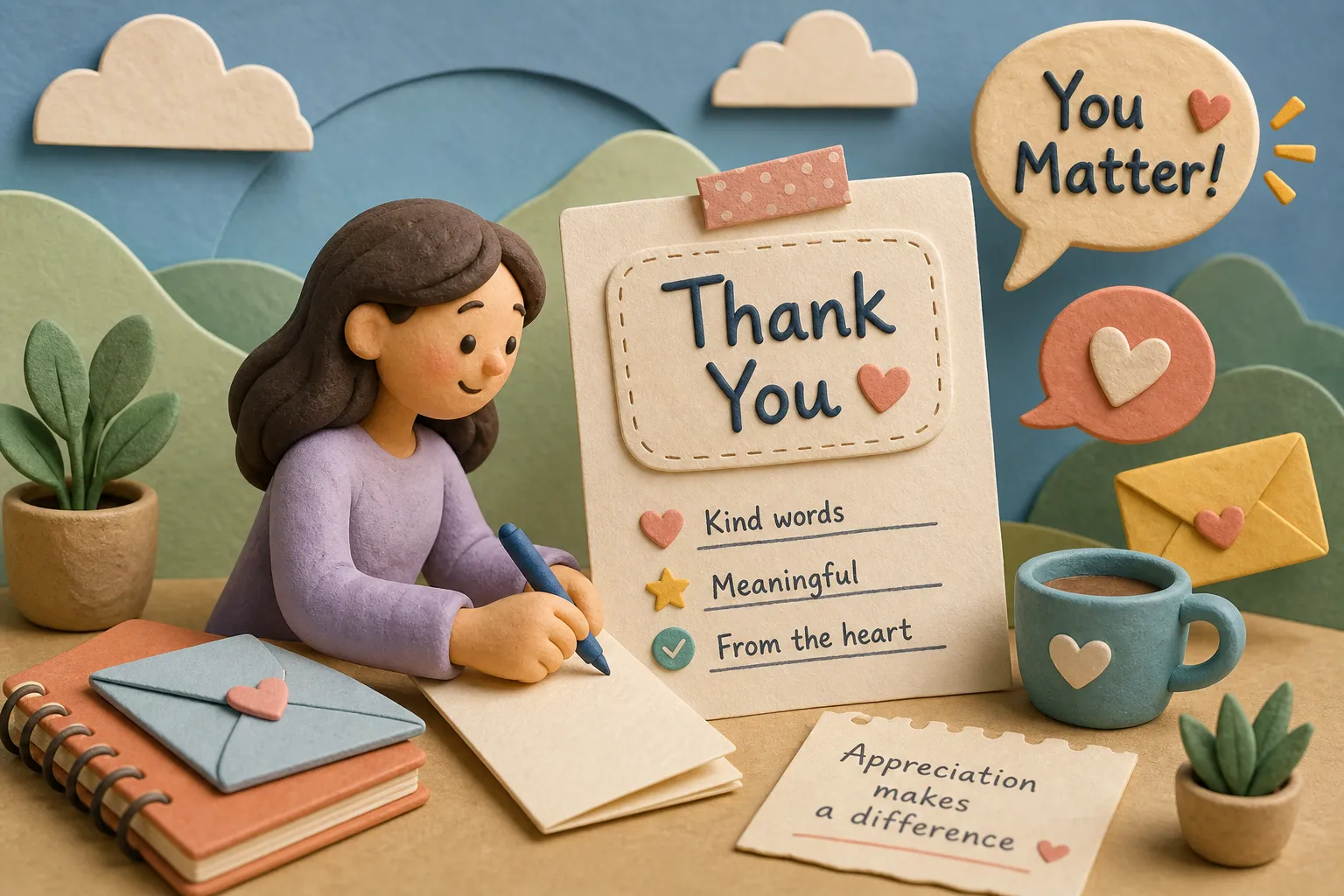
The right tone depends heavily on where the message will live. A text message calls for casual, conversational language: short sentences, natural contractions, and an informal style. (Whether emojis fit depends on your workplace culture and your relationship with the recipient, when in doubt, leave them out.) An email gives you a little more room to be specific and warm without feeling rushed. A handwritten card allows for the most personal and heartfelt tone, where a few genuine sentences outperform a long, rehearsed paragraph. A formal letter, whether for HR recognition or an official reference, calls for polished, professional phrasing throughout. For formal examples, see employee recognition letter samples and templates.
Use this as your rule of thumb: the more formal the medium, the more polished the tone; the more personal the medium, the more natural and heartfelt the language can be. A thank-you text to a coworker after a late-night deadline and a formal employee recognition letter are both appreciation messages, but they live in completely different registers. Knowing which one you’re writing before you type the first word saves a lot of revision.
Ready-to-Use Appreciation Messages for the Workplace
Appreciation Message Examples for Coworkers
For a coworker, you want something warm and collegial without crossing into overly formal territory. These lines work well in a quick email, a Slack message, or a note left on someone’s desk:
- “I really appreciate your help on this, it made a big difference.”
- “Thanks for always being such a reliable teammate.”
- “Your support throughout this project meant a lot. Thank you.”
- “Thanks for stepping in and sharing the workload when it counted.”
Appreciation Message Examples for Managers and Direct Reports
For a manager, acknowledge their guidance or leadership specifically rather than just saying “thanks for everything.” Try: “Thank you for your feedback on my presentation, it helped me think more clearly about the structure.” That single detail transforms a routine thank-you into a genuine appreciation note. For direct reports, recognition that names the behavior and its impact lands well: “Your dedication on this project didn’t go unnoticed. Thank you for consistently delivering quality work.”
Professional Email and LinkedIn Recognition Templates
The strongest employee appreciation messages follow a simple structure: warm greeting, specific action, impact, sincere close. Here’s a template you can adapt directly:
Dear [Name], I want to take a moment to recognize your work on [specific project or task]. Your [attention to detail / initiative / collaboration] made a real difference to the team, and the result speaks for itself. Thank you for going above and beyond, it’s noticed and appreciated. [Your name]
This structure works for outstanding performance, team collaboration, and going-above-and-beyond scenarios. The key is always the middle line: what they did and why it mattered. Without that specific detail, the message reads like a form letter. Many American readers notice when messages lack those specifics and perceive them as less sincere. You can find more sample phrasing in these employee recognition message examples. If you want to expand your overall email skills, check How to Write a Professional Email in American English for more tips on tone and formatting.
On LinkedIn, keep your message public-friendly, polished, and tied to a specific result. Two thank-you message examples that work consistently:
- “Proud to recognize [Name] for their exceptional work on [project]. Their professionalism and attention to detail drove a great outcome for the team.”
- “Big shout-out to [Name] for going above and beyond during [situation]. Their effort made a real impact, and we’re grateful.”
Occasion-Specific Lines That Fit Real Situations
Matching your message to the specific occasion is what makes it feel genuine rather than recycled. For project help, try: “Thank you for your support on [project]. I couldn’t have pulled it together without you.” After receiving a gift in a professional or semi-formal setting, keep it specific and sincere: “Your gift was so thoughtful. Thank you for thinking of me, it really meant a lot.” The phrase “thank you for thinking of me” is especially natural in American English for gift situations because it acknowledges the gesture, not just the object.
For mentorship, a little more warmth is appropriate because the relationship itself carries more weight: “I’ve learned so much from your guidance, and I genuinely appreciate the time and patience you’ve invested in helping me grow.” Notice how that sentence names both the quality (patience) and the outcome (growth). That combination is what separates a meaningful appreciation note from a polite formality.
Going above and beyond is one of the most common workplace appreciation scenarios, and it has its own phrasing conventions in American English. Avoid just saying “great job.” Instead, name the behavior and connect it to the outcome: “Thank you for going above and beyond on [situation]; your effort and initiative kept the project on track.” Or: “Your dedication during [challenge] was impressive, and the whole team appreciated it. We’re grateful.” If you’re preparing for a performance review or need language to describe accomplishments, see How to Talk About Achievements in English During a Review for practical phrasing you can reuse.
The Personalization Formula That Makes Any Template Feel Real
Any appreciation message, whether it’s a two-line text or a full recognition email, becomes more human when it follows this four-part pattern:
- Address the person warmly by name.
- Name the specific action or quality you’re thanking them for.
- State the impact: why it mattered or how it helped you.
- Close with a genuine, brief sign-off.
The fastest way to turn a template into something personal is to swap in one concrete detail at step two. “Thank you for your help” becomes “Thank you for walking me through the quarterly report on Friday.” That one specific line changes everything. It tells the reader you actually noticed what they did, and that’s exactly what makes American-style gratitude feel real rather than reflexive. For additional writing tips for appreciation messages, check that short guide for clarity and tone suggestions.
Not every thank-you happens in writing. In face-to-face settings, Americans commonly pair verbal gratitude with brief specificity: “Hey, I just wanted to say, thank you for covering for me yesterday. That really helped.” Common verbal openers include “I just wanted to say thank you for…”, “I really appreciate you…”, and “I can’t tell you how much it means that you…” Adding a quick reason is a culturally natural habit in American English and signals that your appreciation is genuine.
Put It Into Practice Today
Writing a strong appreciation message isn’t about finding poetic language. It’s about being warm, specific, and real. Use the templates in this article as your starting point, swap in one concrete detail to make it yours, and match your tone to the channel you’re using. Your reader will feel the difference between “thanks for everything” and “thanks for staying late to help me finish the proposal, it made the whole project come together.”
Here’s a simple exercise: think of one person who has helped you recently and write them a three-sentence gratitude message using the four-part formula. Name them, name the specific thing they did, say why it mattered, and close warmly. A brief, specific note like that will read as far more natural and sincere than a longer, generic one, in any language.
If you want to keep building your professional English communication skills, from email writing to workplace conversation, Your Daily American offers a full library of practical phrase guides and professional English lessons designed to help you sound confident and natural every time. Explore more in our Professional English category for lesson collections and example phrases.
For inspiration when you choose a physical card, review a few thank-you card ideas to match tone and layout to your message.