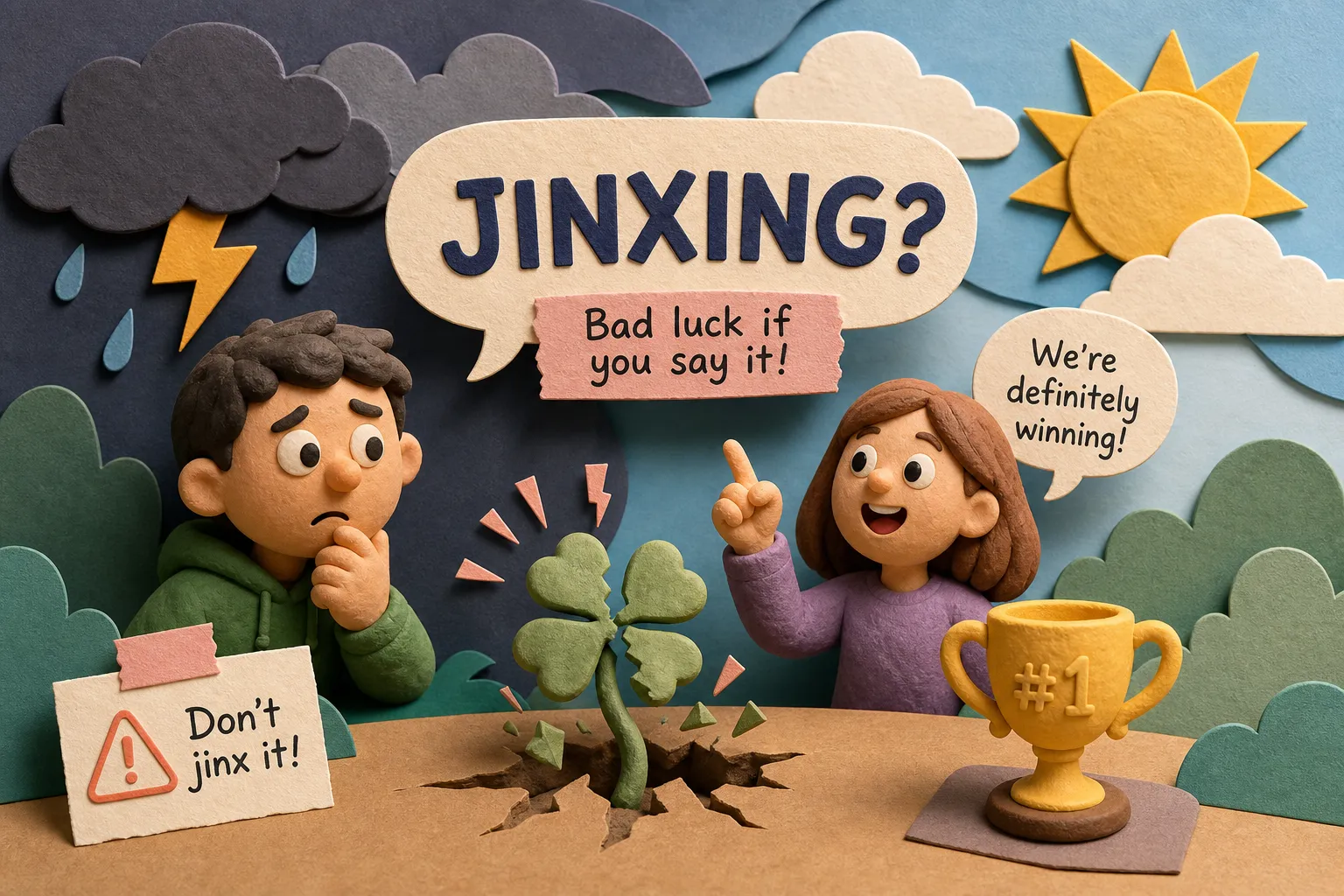
Picture this: you’re watching a football game with American friends. Your team is winning with two minutes left, and someone in the room shouts, “We’ve totally got this one!” The room goes quiet. Someone mutters, “Don’t jinx it.” Then, three seconds later, the opposing team scores. Everyone groans and looks at the person who spoke. That moment is a perfect example of jinxing in American English, and you understood every word but had absolutely no idea what just happened socially.
Note: This article is about the American English word “jinxing” and its cultural meaning. It is not related to Jin Xing (金星), the Chinese dancer and television personality.
That scene, full of superstition, humor, and unspoken rules, is exactly the kind of situation that Your Daily American was built for. Real American English isn’t just grammar and vocabulary. It’s culture, tone, and the invisible social scripts that native speakers follow without even thinking. By the end of this lesson, you’ll know exactly what “jinxing” means, where the word came from, and how to use it (and respond to it) the way Americans actually do.
What “jinxing” means in American English
The basic definition: jinx, jinxed, jinxing
“Jinx” works as both a noun and a verb, which means you’ll hear it used in a few different ways. As a noun, a jinx is a person, object, or action believed to bring bad luck, a kind of curse or hoodoo attached to someone or something. As a verb, to jinx something means to cause bad luck by saying or doing something too soon, usually something confident or hopeful.
Here are the three key forms in action:
- Jinx (noun/present tense): “That black cat is a jinx.” / “Don’t jinx it by talking about it now.”
- Jinxed (past tense / adjective): “You jinxed us when you said we’d win.” / “This project feels completely jinxed.”
- Jinxing (present participle): “I’m not jinxing anything, I’m just saying we look good.”
Why jinxing feels different from just saying “bad luck”
Here’s the cultural detail that most ESL learners miss: jinxing implies that someone caused the bad luck by speaking or acting too soon. It isn’t random misfortune. It’s triggered misfortune, and there’s a specific person responsible. That human cause-and-effect is what gives the word its edge.
Compare these two sentences: “We had bad luck today” versus “You jinxed us!” The first is a neutral observation. The second is an accusation, even if it’s delivered with a laugh. That tone shift is everything.
Where the word “jinx” actually comes from
Ancient roots: birds, witchcraft, and bad omens
The word traces back to the Latin iynx and Greek iynx, which referred to the wryneck bird (Jynx torquilla). In ancient Greek and Roman magical practices, this bird was used in love charms and divination rituals, and it carried strong associations with supernatural influence and spells. Over centuries, “jynx” became linked with curses, bad omens, and ill fortune across European folk belief. The earliest English spelling, jynx or jyng, appeared in the 1690s as a word for a charm or magical spell, evidence that the word carried real weight long before it entered casual conversation.
How “jinx” entered American slang
The modern American spelling and meaning, someone or something that brings bad luck, is first recorded in 1911, inside baseball culture. According to etymology researchers and contemporary sources, a 1911 Technical World Magazine piece described “the ‘jinx,’ that peculiar ‘hoodoo'” affecting players and teams, showing the word was already well-established in the sport’s vocabulary. Baseball was the perfect home for it, since the game has always been deeply tangled up with superstition: lucky socks, pre-game rituals, and unspoken rules about what you can and can’t say during a game.
From the dugout, the word spread into everyday American speech. By the mid-20th century, it was a standard part of casual conversation far beyond any ballpark. That history gives “jinx” real cultural depth; it isn’t throwaway slang. It’s a word with centuries behind it.
The phrases native speakers actually use
“Don’t jinx it!” and other classics
These are the expressions you need to recognize and use. Each one carries a slightly different moment and tone:
“Don’t jinx it!”, Said when someone is about to make a confident prediction before an outcome is decided.
A: “I think we’re definitely going to get this contract.”
B: “Don’t jinx it, we haven’t signed anything yet.”
“You just jinxed us!”, Said right after something goes wrong, immediately following an optimistic statement.
A: “We’ve had zero traffic, we’re going to be so early!”
B: (two minutes later, stuck behind an accident) “You jinxed us. You literally jinxed us.”
“I don’t want to jinx it, but…”, A hedge Americans use before sharing good news they’re nervous about. You’ll hear this one constantly.
A: “How’s the job search going?”
B: “I don’t want to jinx it, but I think I have a really good shot at this one.”
“He’s a jinx” / “She’s a jinx”, Calling a person bad luck. Usually said half-seriously or as a joke.
A: “Every time Marcus comes to the games, we lose.”
B: “He’s a total jinx. Don’t invite him next time.”
“I’m jinxed”, Saying you personally seem to be cursed with bad luck.
“I spilled coffee on my shirt, missed the train, and now my laptop won’t turn on. I’m jinxed today.”
The unspoken rules: when and how to say it
Talk about jinxing is casual. It belongs with friends, family, and close coworkers, not in formal presentations or professional emails. The tone is almost always playful, exasperated, or mock-serious. Think of it as friendly superstition, not genuine belief (for most people).
When someone says “you jinxed us,” the expected American response is a laugh, a pretend-guilty face, or a joking apology like “Okay, okay, I take it back!” Responding with a sincere apology or defending yourself logically (“That doesn’t make any sense”) tends to feel awkward in the moment. Play along with the joke. That’s the social script.
Where jinxing comes up most in American English
Sports, big moments, and “counting your chickens”
Sports culture is where jinx fears run deepest. American fans actively avoid saying “we’ve got this” or “it’s in the bag” while a game is still in progress. Baseball has a well-known superstition around this: many broadcasters and players avoid mentioning that a pitcher is throwing a no-hitter while it’s happening, because saying it out loud is widely believed to end it. The fear is that real.
Beyond sports, Americans worry about jinxing job offers before they’re officially signed, pregnancies before the “safe” announcement window, and any streak of good luck. Weather is a classic trigger: say “it’s been so nice out lately” and someone will immediately blame you when the next storm rolls in.
Everyday moments at work and with friends
The micro-moments are where this word really lives. A customer service rep says “it’s been so slow today” and every colleague groans because now the phones will ring nonstop. Someone at the airport announces “our flight is actually on time!” and everyone near them quietly waits for a delay. A friend says “I think I’m finally over that cold” and then sneezes twice.
These small, everyday moments are where you’ll hear and use jinxing language the most. Start listening for it in American TV shows, office conversations, and group chats. Once you know the word, you’ll notice it everywhere.
What ESL learners often get wrong about “jinx”
Mistaking humor for genuine blame (and vice versa)
A common mistake among ESL learners is treating “You jinxed us!” as a serious accusation and responding with a real apology. Your American friends were being playful. A sincere “I’m so sorry, I didn’t mean to cause problems” will confuse them and deflate the joke. Read the room: if people are groaning and laughing at the same time, you’re in jinx territory, not genuine conflict territory.
The second mistake is using “jinx” in formal or professional settings. Saying “I don’t want to jinx it” in a quarterly business review is too casual for most corporate environments. Save it for conversations where you’d also feel comfortable saying “fingers crossed” or “knock on wood.”
Confusing “jinx” with similar concepts
Jinxing is not the same as hexing, cursing, or giving someone the evil eye, even though they’re all superstition-adjacent. The specific idea behind jinxing is that premature optimism triggers bad luck. You caused it by speaking too soon. That cause-and-effect is what separates it from a general curse or hex, which comes from an outside force.
Also worth knowing: “Jinx!” has a completely separate use as a childhood game. When two people accidentally say the same word at the same time, the first one to shout “Jinx!” wins, and in many versions, the other person owes them a soda or has to stay quiet until someone says their name. Rules can vary by region and by whoever’s playing, but the spirit of the game is the same. Same word, completely different context. If an American friend suddenly shouts “Jinx!” after you both say “I was just going to say that,” now you know why. For a quick look at the different uses and meanings, see the various entries for “jinx”.
Try it yourself
Practice makes these phrases feel natural. Work through these prompts and write out your answers:
- Your team is winning 3, 0 with five minutes left, and your friend announces, “We won!” What do you say?
- Write your own sentence using “I don’t want to jinx it, but…” about something you’re hoping for right now.
- Think of a moment this week when something didn’t go as planned. Could you say, “I think I jinxed it when I…”? Write that sentence out.
You now speak a little more American
You can recognize jinxing when Americans use it, understand the cultural anxiety, equal parts superstition and social humor, that drives it, and use the word naturally in casual conversation. That’s a real skill. Words like “jinx” aren’t just vocabulary; they’re windows into how Americans process hope, fear, and bad luck together in the same breath.
Start listening for it in American sports broadcasts, sitcoms, and everyday office talk. You’ll hear “I don’t want to jinx it” in a team meeting, “don’t jinx it!” during a tense game, and “we’re totally jinxed” after a rough morning commute. Each time you catch it, your ear gets a little sharper. If you want to keep going deeper into American idioms, superstitions, sports language, and the cultural subtext that textbooks leave out, you’re in the right place.
At Your Daily American, this is exactly the kind of lesson we build: not just what Americans say, but why they say it and how to join the conversation naturally. If you want to keep going deeper into American idioms, superstitions, sports language, and the cultural subtext that textbooks leave out, you’re in the right place.