You’re reading an email from a client, or skimming a news article on your lunch break, and you hit a word you’ve never seen. You can’t stop to look it up without losing the thread of the conversation or the task in front of you. Understanding prefixes and suffixes is what lets you decode that word on the spot, without breaking your stride. That moment of freezing on an unfamiliar word is something almost every ESL learner knows well, and it happens far more than it should.
By the end of this lesson, you’ll be able to identify the building blocks of English words, decode unfamiliar vocabulary without a dictionary, and build hundreds or even thousands of new words from a small set of patterns you already half-know. That last point isn’t an exaggeration, it’s what happens when you shift from memorizing words one by one to understanding how words are constructed.
English isn’t a random pile of vocabulary you have to collect item by item. It’s a system built from reusable parts, and learning those parts is one of the highest-return moves any language learner can make. Studies by vocabulary researchers including Paul Nation and Averil Coxhead have shown that more than 60% of English words in general text have Greek or Latin origins, and over 90% of discipline-specific academic and professional vocabulary comes from those same roots. The patterns are everywhere once you know what to look for.
What prefixes and suffixes actually do to a word
The difference between a prefix and a suffix
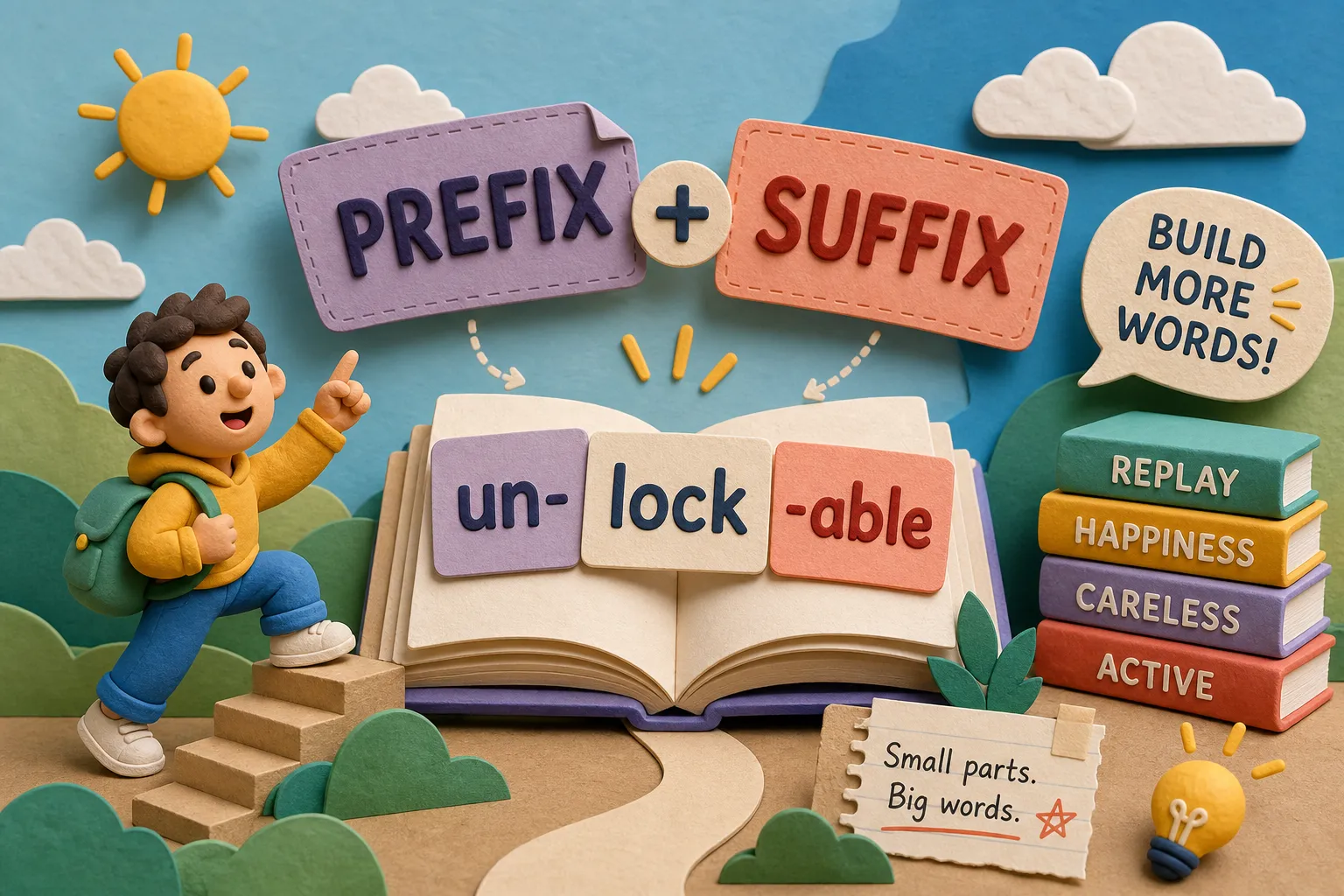
A prefix is a word part attached to the front of a base word. A suffix is a word part attached to the end. The base word, sometimes called the root word, is the core unit that carries the central meaning. Add parts to the front or back, and the base word shifts in meaning, tone, or grammatical role.
Here’s the clearest way to see it in action: happy becomes unhappy when you add the prefix un- to the front. Teach becomes teacher when you add the suffix -er to the end. Same base word, different result depending on where the added part lands.
How prefixes shift a word’s meaning
Prefixes typically change the meaning of a word without changing its grammatical role. The prefix un- means “not,” so it flips clear into unclear and available into unavailable. The prefix re- means “again,” turning write into rewrite and view into review. The prefix pre- means “before,” giving you preview, prepay, and preapprove.
One thing to flag: some prefixes carry more than one meaning depending on context. The prefix in- means “not” in inactive and inaccurate, but it means “into” or “in” in insert and income. That’s a genuine point of confusion for many ESL learners, and the fix is simple: check whether the base word is a real standalone word. If active is a real word, then in- in inactive is doing the “not” job.
How suffixes change a word’s job in a sentence
Suffixes do something different from prefixes: they often change the part of speech entirely. The word happy is an adjective. Add -ness and you get happiness, which is a noun. Add -ly and you get happily, which is an adverb. Same root, three different sentence roles.
This matters in real usage. “She is creative” uses an adjective. “She has a lot of creativity” uses a noun built from the same root. If you know the suffix -ity signals a noun, you can navigate that shift automatically, without stopping to analyze every word.
The prefixes that unlock the most everyday English
The “not” cluster: un-, dis-, non-, mis-
These four prefixes all signal a negative or opposite meaning, which makes them the single most useful pattern for learners to internalize first. Un- is the most frequent prefix in English overall: unclear, unpaid, unapproved, unhelpful. Dis- gives you disagree, disconnect, dissatisfied, discontinue. Non- covers nonprofit, noncompliant, nonverbal. Mis- adds the idea of “wrongly” or “badly”: misunderstand, mislead, miscommunicate.
A common mistake is confusing which prefix to use when building a new word. As a general guide, un- attaches to a wide range of adjectives and past participles, while mis- typically conveys the idea of doing something incorrectly. When you spot a word starting with any of these four prefixes and suffixes, or really, with any of these four prefixes, you can immediately guess the general territory of the meaning before you know anything else about the word.
The “time and action” cluster: re-, pre-, post-
Think of these three as a time axis. Pre- sits before: pre-submitted, precondition, preview. Post- sits after: post-meeting, postwar, postpone. Re- means again or back: reassess, resend, reschedule, reconnect. Once you understand the axis, a sentence like “Please review the pre-submitted draft before the post-deadline revision window” becomes immediately readable, even if you’ve never seen those specific words together before.
Professional English is dense with this cluster. Emails, meeting agendas, and project briefs use re-, pre-, and post- frequently. Recognizing them turns those documents from a wall of text into something you can scan and process quickly.
Why one prefix multiplies into dozens of words
The payoff of learning prefixes isn’t one new word, it’s a key that fits many locks at once. The prefix re- alone connects you to reread, rethink, return, replace, rebuild, review, reconnect, restart, rewrite, resend, and hundreds more. Think about a single busy workday: every email you resend, every meeting you reschedule, every document you resubmit uses that same one pattern. You’re not memorizing a list of words. You’re learning one rule that unlocks all of them.
Prefixes and suffixes that change a word’s role and register
Noun-making suffixes: -tion, -ment, -ness
These three suffixes convert verbs and adjectives into nouns, which is critical for reading and writing in formal or professional English. Communicate becomes communication. Develop becomes development. Kind becomes kindness. Knowing these three suffixes means you can recognize nouns in complex sentences even when you’re not familiar with the specific word.
The -tion family, which includes -sion and -ation, is especially common in academic and workplace writing. Words like application, production, promotion, discussion, decision, notification, implementation all follow the same pattern. If you can spot -tion, you know you’re dealing with a noun before you’ve decoded the rest of the word. For a clear breakdown of common suffix patterns, see the Cambridge Dictionary’s explanation of suffixes.
Adjective-making suffixes: -ful, -less, -able, -ous
The contrast between -ful and -less is one of the clearest in English: hopeful versus hopeless, helpful versus helpless. One means “full of” and the other means “without.” That single contrast gives you twice as many words for the same amount of learning effort.
Add -able (capable of being) and -ous (characterized by) to your toolkit and you’ve covered many of the adjectives you’ll encounter in job descriptions, emails, and everyday conversation: reliable, flexible, affordable, accessible, ambitious, nervous, dangerous, curious. These appear constantly in spoken and written American English.
How recognizing suffixes helps in real-time listening and reading
Suffixes give you a grammar signal even before you’ve fully processed a word. If you hear something ending in -ness, -tion, or -ment, you know it’s a noun. If you catch an ending of -ful, -able, or -ous, you know it’s an adjective. That head start helps you process fast native speech, where you won’t always catch every syllable clearly.
Consider the sentence: “The implementation of the new system was delayed.” Even if implementation is a new word for you, that -tion ending tells you instantly that it’s a noun, the subject of the sentence. Your brain can process the grammatical structure immediately and focus its attention on the meaning.
How to decode an unfamiliar word using prefixes and suffixes
A step-by-step process for any new word
When you hit an unfamiliar word, use this process. First, spot the prefix, if there is one, and note its meaning. Second, identify the suffix and note what part of speech it signals. Third, look at what’s left in the middle: that’s your base or root word. Combine what you know about the prefix and suffix to assemble a working meaning.
Walk through a real example: unreliable. The prefix un- means “not.” The suffix -able means “capable of being.” The root is rely, meaning to depend on. Put it together: not capable of being relied on. You just decoded the word using three pieces of information you already had. No dictionary required.
Using context to confirm your guess
Your word-part analysis is a starting point, not a final verdict. The sentence around the word almost always confirms or sharpens the meaning. “Her unreliable internet connection made the video call difficult” locks in your decoded meaning immediately. Context and word structure work together, and between the two of them, you rarely need to stop and look anything up.
This habit builds reading and listening confidence that passive memorization never does. You’re training yourself to make smart guesses and verify them in real time, which is exactly what fluent readers do.
Common mistakes to watch out for
Not every word that starts with un- contains the prefix. Uncle and under aren’t built on a root called cle or der. Not every word ending in -er means “a person who does”: water and letter are not built from a root plus the agent suffix. The check is simple: ask whether the remaining part is a real, standalone English word. Happy is a real word, so unhappy uses the prefix correctly. Cle is not a word, so uncle doesn’t contain the prefix un-.
Your free downloadable affix reference list
What’s on the chart
The downloadable reference list includes approximately 40 of the most common English prefixes and 35 of the most common suffixes, a broad set of morphemes covering the patterns that appear most often in everyday and professional English. Each entry includes its meaning and two or three example words. Rather than organizing everything alphabetically, the chart groups affixes by meaning: all the “not” prefixes together, all the noun suffixes together, all the adjective suffixes in their own section. Think of it as a prefixes list and suffixes list rolled into one reference tool, organized so it’s actually useful in the moment. That structure makes it much easier to study and use as a working reference. For an additional clear overview of prefixes and suffixes, see this prefix-and-suffix overview.
The chart is formatted to be both print-ready and screen-friendly, so you can keep it open during a study session or pin a printed copy near your desk. It’s designed to be a working document, not something you read once and set aside.
How to use it actively, not passively
Reading through the chart once won’t build retention. The way to make it work is to use it as a checking tool when you meet an unfamiliar word in real reading or listening. Pull up the chart, find the affix, and confirm your guess. That active retrieval step is what converts a pattern from something you recognize in a controlled exercise to something you see automatically in fast native speech.
One habit that produces strong results: choose two new word parts from the chart each week, write three original sentences using each one, and then look for those affixes in something you read or hear that day, whether it’s a news headline, a work email, or a social media post. You’re not just studying the chart. You’re using it to notice the language around you. For more lessons and exercises, check our blog.
Why pairing this strategy with spaced repetition makes it stick
The gap between recognition and real fluency
Many learners can recognize a prefix in a controlled exercise but freeze when they encounter it in a fast conversation or a dense paragraph. That gap between recognition under controlled conditions and recognition under pressure is where most vocabulary learning falls apart. You study a list, feel confident, and then two weeks later the word is gone. Vocabulary acquisition research consistently shows that spaced repetition closes this gap more effectively than traditional massed study or cramming.
Spaced repetition works by bringing vocabulary and patterns back to you just before you’d naturally forget them, which is exactly when memory consolidation is most efficient. Research by Nakata (2011) and others studying adult EFL learners has reported retention rates of nearly 80% after 18 days using spaced review, compared to much steeper drops with conventional study methods. The difference isn’t dramatic in a single session. Over months of regular practice, it’s enormous. If you want practical tips for implementing this, read this guide on how to use spaced repetition.
How Your Daily American builds this into the learning system
At Your Daily American, affix pattern recognition is woven into the vocabulary and word-building lessons throughout the platform. The lessons pair prefix and suffix instruction with structured review, so you’re not just learning what un- means once in isolation. You’re encountering it repeatedly in different contexts, in emails, conversations, and reading passages, until recognition becomes automatic. That’s the shift from knowing a pattern to owning it.
The downloadable reference chart connects to this larger system. The chart gives you the patterns. The spaced repetition approach keeps them active in your memory long enough to show up when you actually need them, in a real meeting, a real email, or a real conversation with a native speaker. If you’d like a structured path that pairs this kind of word-building knowledge with proven retention methods, consider our lesson that explains learning with Anki.
A daily habit to start this week
You don’t need a long study session to make this work. Spend five minutes each day looking at one prefix or suffix from the reference chart, then find it in something you read that day. Write the word down. That’s the whole routine. At that pace, you’ll work through the full list in several weeks to a few months, depending on how many affixes you tackle per session. Combined with regular reading in English, that habit turns passive knowledge into the kind of automatic recognition that fluent speakers have.
Start cracking words open today
You don’t have to memorize thousands of English words one by one. Prefixes and suffixes give you a system for decoding unfamiliar vocabulary on your own, using patterns that repeat across hundreds or thousands of real words. The payoff is not just a bigger vocabulary list. It’s the confidence to keep reading and keep listening without losing your place every time you hit something new.
With the reference chart in hand and a daily habit in place, you’re already doing what fluent readers do. They don’t know every word. They know how words work, and that knowledge travels with them into every article, email, and conversation they encounter.
Here’s your “try it now” prompt: pick any longer word you’ve been unsure about this week, maybe something from a work email or a news headline, and break it apart using what you just learned. Spot the prefix, identify the suffix, look at the root in the middle. Then download the reference chart and start building from there. If you want a structured path that pairs this kind of word-building knowledge with proven retention methods, Your Daily American is built exactly for that. The lessons there will build on exactly what you practiced here and turn it into lasting fluency.