Scared vs afraid: which one should you use in an email to your manager? You type: “Many employees are scared to speak up in meetings.” Then you pause. Would “afraid” sound better? More professional? You delete it and write “afraid,” then wonder if “scared” was actually fine. If you’ve been caught in this loop, you’re asking the right question.
By the end of this lesson, you’ll know the real difference between these two words in meaning, grammar, and tone. You’ll understand which one fits casual conversation, which one belongs in formal writing, and how one of them has a completely unique function in American English that the other cannot replace. That last point is what most learners miss, and it’s the distinction that makes your English sound genuinely natural.
Scared vs Afraid: What These Words Actually Mean
The core meaning both words share
Both words describe fear. Merriam-Webster defines “scared” as being in a state of fear, fright, or panic, and “afraid” as filled with fear or dread. That overlap is why learners get confused, because in most sentences, both words work. “She is scared of heights” and “She is afraid of heights” mean the same thing, and any native speaker would understand either one without hesitation.
So if they’re interchangeable most of the time, why learn the difference? Because “most of the time” isn’t “all of the time,” and the cases where they aren’t interchangeable are the moments when your word choice reveals whether you’re an advanced speaker or still working from a textbook.
The tonal difference most learners miss
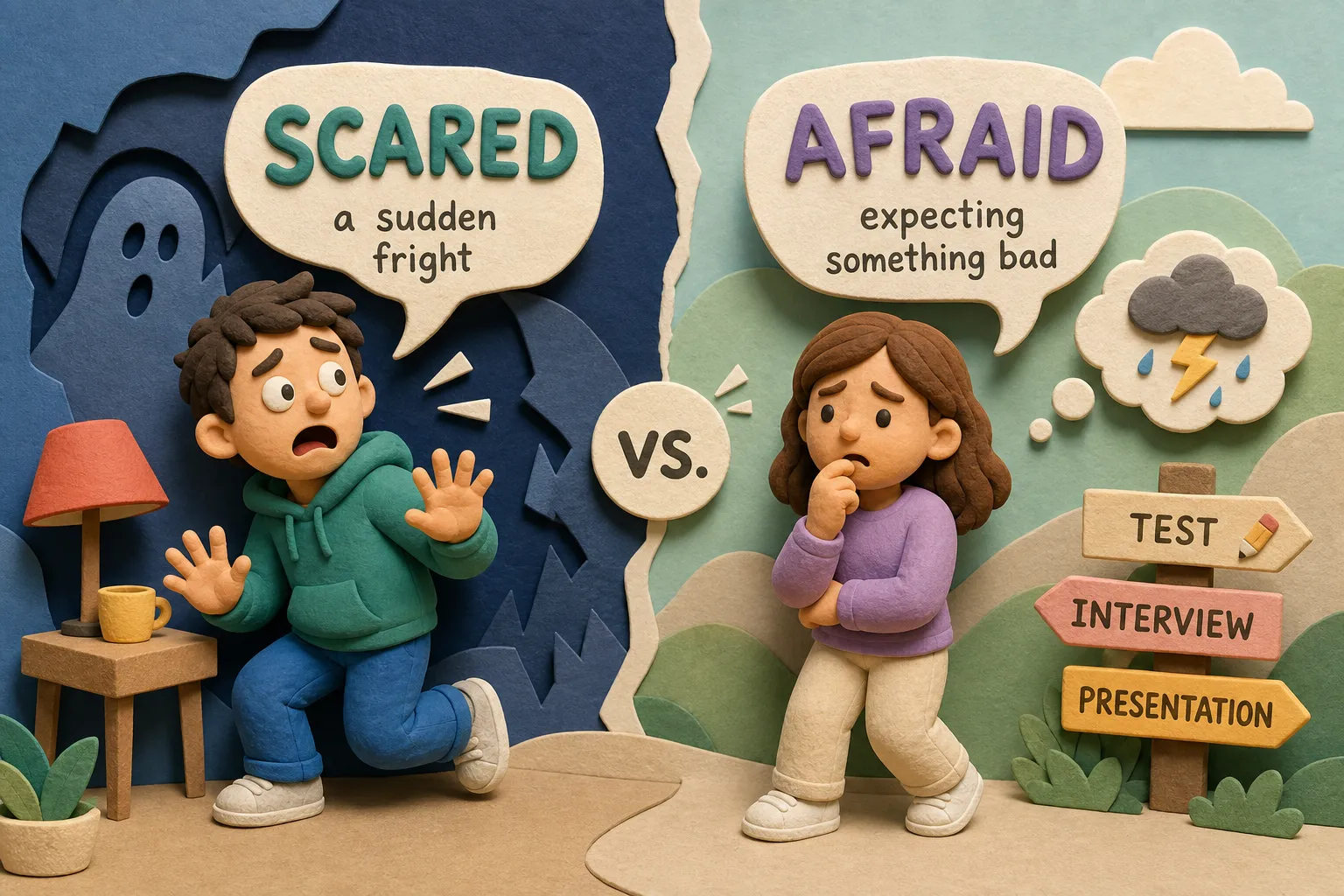
“Afraid” carries a slightly more composed, neutral tone. It describes a state of fear without sounding panicked or urgent. “Scared” feels more immediate and emotional, as if the fear is right in front of you, happening now. Think of it this way: if someone jumps out from behind a door and startles you, you’ll probably say “You scared me!” not “You afraid me!” The word “scared” lives in the moment. “Afraid” reflects on the feeling from a slight distance.
Merriam-Webster also notes that “afraid” can suggest hesitance or reluctance, a usage note distinct from simple fear, which is why it sounds natural in more reflective contexts. Compare: “I’m scared!” shouted right after something startling, versus “I’m afraid of commitment” said thoughtfully in a conversation about a relationship. Both express fear, but the tone is completely different. That tonal gap is what guides native speakers when they reach for one word over the other.
Grammar Patterns Every Learner Needs to Know
Scared of vs afraid of: using these words with nouns
Both adjectives pair naturally with “of + noun” to name the source of the fear. “Scared of dogs” and “afraid of dogs” are both correct and both common. The subtle difference is that “scared of” tends to sound more situational and vivid, as if the threat feels close. “Afraid of” sounds slightly more general or habitual, describing a fear someone carries over time.
Consider: “I’m scared of that dog” versus “I’m afraid of dogs.” The first sounds like a specific dog is standing right there. The second describes a general, ongoing fear. Native speakers follow this pattern naturally without thinking about it, but recognizing it helps you choose more precisely.
Afraid to vs scared to: using these words before a verb
Both words also pair with “to + infinitive” to express reluctance driven by fear. “She was afraid to speak up in the meeting” and “She was scared to speak up” carry the same meaning. The difference is register. “Afraid to” is slightly more common in writing, while “scared to” sounds more natural in spoken conversation. Neither is wrong, but matching your word to the setting makes you sound more fluent.
One pattern unique to “afraid”: the polite softener
“I’m afraid that…” is a completely separate function that “scared” cannot replicate. In American English, “I’m afraid” is a standard, polite way to introduce bad news, a refusal, or a disagreement. The speaker is not literally frightened. The phrase signals regret and softens the impact of what comes next. You’ll hear it constantly in professional and service contexts.
Here are a few real examples:
- “I’m afraid we’re fully booked tonight.” (restaurant host)
- “I’m afraid I can’t approve that budget.” (manager in a meeting)
- “I’m afraid that position has already been filled.” (recruiter)
- “I’m afraid I have to disagree.” (colleague in a discussion)
If you substitute “scared” in any of those sentences, it sounds strange and confusing. “I’m scared we’re fully booked tonight” suggests the host is personally frightened about the reservation system. This polite-softener distinction rarely appears in beginner vocabulary lists, which is precisely why so many learners overlook it. For this pattern, prefer “afraid”, “scared” is uncommon here and likely to be misinterpreted.
Register and Formality: Which Word Fits Where
When “afraid” sounds more appropriate
“Afraid” is the more neutral, formal choice. It belongs in writing, professional communication, and careful speech. Corpus data from COCA (Corpus of Contemporary American English) supports this: “afraid” appears at roughly 66 per million words overall and is especially prominent in news writing, academic prose, and edited text. When you’re writing a report, a formal email, or an analysis, “afraid” fits the tone better.
Compare these two versions of the same idea: “Many employees are afraid to voice concerns” reads smoothly in a workplace report. “Many employees are scared to voice concerns” works too, but it sounds slightly more journalistic or narrative. The first version signals a measured, analytical register. In professional writing, that distinction matters.
Why “scared” dominates spoken American English
In everyday conversation, “scared” is the word most Americans reach for. It sounds real, immediate, and unfiltered, qualities that casual speech calls for. COCA spoken-register data shows that “scared” appears relatively more often in conversational and fiction-dialogue contexts compared to “afraid,” even though “afraid” remains highly frequent overall. When two friends are talking about a scary movie, a job interview, or a first date, “scared” tends to be the natural choice.
A quick conversation example:
Friend A: “Are you nervous about the presentation tomorrow?” Friend B: “Honestly? I’m kind of scared. I’ve never presented to that many people before.”
That exchange sounds completely natural. Replacing “scared” with “afraid” wouldn’t be wrong, but it would feel slightly more formal than the moment calls for. In casual American speech, “scared” is typically the default.
The Intensity Spectrum: Where These Words Sit
Everyday fear: scared and afraid at baseline
“Scared” and “afraid” both sit at the low-to-medium end of the fear intensity range. They cover everyday fear: the kind you feel before a performance review, during a thunderstorm, or when you spot a spider in the bathroom. Neither word alone signals extreme or overwhelming fear. At this level, they’re largely interchangeable in meaning, with the distinctions coming from tone and register rather than intensity.
Moving up: “frightened” and “terrified”
“Frightened” steps up in intensity and carries a slightly more formal, literary quality. It often describes a stronger, more vivid fear response. “Terrified” sits at the top of the scale, signaling overwhelming, paralyzing fear. Here’s how the same scenario sounds with all four words:
| Word | Example sentence | Intensity | Register |
|---|---|---|---|
| Afraid | She was afraid to go on stage. | Low to medium | Neutral, general |
| Scared | She was scared to go on stage. | Low to medium | Conversational, immediate |
| Frightened | She was frightened by the crowd. | Medium to high | Slightly formal or literary |
| Terrified | She was terrified to walk out there. | Very high | Emphatic, strongly expressive |
Knowing this scale helps you avoid overstatement. If you say you were “terrified” every time you felt a little nervous, the word loses its impact. Matching the word to the actual intensity of the feeling makes your English more precise and more expressive.
For a clear, practical comparison of “scared,” “frightened,” “afraid,” and “terrified,” see the Cambridge Dictionary discussion on these words and their typical usage.
Real American English Dialogues
Casual everyday conversation
These are the kinds of exchanges you’ll actually hear. Notice how “scared” sounds natural and immediate in each one:
A: “Did you watch that horror movie everyone’s talking about?” B: “No way. I got scared just from the trailer. I had to turn it off.”
A: “How was your first day at the new job?” B: “Honestly, I was a little scared walking in. I didn’t know anyone.”
A: “Why didn’t you say anything when he was being rude?” B: “I don’t know. I guess I was scared of making things worse.”
More formal and professional contexts
Here, “afraid” does the work, especially in the polite softener pattern:
Doctor’s office: “I’m afraid we’ll need to run a few more tests before we can give you a clear answer.”
Business call: “I’m afraid that timeline won’t work for our team. Could we discuss pushing the deadline to the 15th?”
Work meeting: “Many team members are afraid to raise concerns directly, which is something we want to change in Q3.”
Notice how “afraid” in these examples makes the speaker sound composed and measured, even when delivering difficult information. That quality is what professional communication calls for. For another accessible comparison of these fear-related adjectives, consider the Oxford Language Club’s guide.
Practice: Test Yourself Right Now
A quick self-check
Read each sentence and choose the better word. Say them out loud. The difference becomes clearer when you hear it, not just read it.
- “She’s _______ of flying, so she always takes the train.” (scared / afraid)
- “I’m _______ I won’t be able to join the 4 p.m. call.” (scared / afraid)
- “He jumped back, he was _______ by the loud bang.” (scared / afraid)
- “I’m _______ to ask for a raise, even though I deserve one.” (scared / afraid)
- “I’m _______ that isn’t quite right. Let me show you the correct version.” (scared / afraid)
Answer guide: 1. Either works; “afraid of” is slightly more general. 2. “Afraid” only, this is the polite softener. 3. “Scared” feels more immediate here. 4. Either works; “scared to” sounds more spoken, “afraid to” more written. 5. “Afraid” only, polite softener again.
Going deeper with American English nuance
The scared vs afraid distinction is one small example of something larger: the vocabulary gaps that separate intermediate learners from speakers who genuinely sound fluent. Other pairs work the same way, “make” vs. “do,” “bring” vs. “take,” “say” vs. “tell.” Each pair has its own grammar pattern, register difference, and cultural logic that no single dictionary definition fully captures.
For authoritative definitions and quick thesaurus help, check Merriam-Webster’s definition of “fear” and the Merriam-Webster thesaurus entry for “scared”.
At Your Daily American, this is the kind of learning the platform is built for. Not just definitions, but real usage, cultural context, and the patterns native speakers follow automatically. The vocabulary and everyday English sections go deep on these distinctions, organized so you can work through them systematically rather than stumbling across them one by one. If this lesson resonated, that’s where to go next.
Putting It All Together
Here’s what the scared vs afraid comparison comes down to:
- Both words describe fear and overlap in most sentences, but they differ in tone and register.
- “Afraid” is the more neutral and formal choice, and it serves an exclusive function as a polite softener that “scared” cannot replace.
- “Scared” is the natural choice in everyday American conversation, where it sounds immediate and genuine.
Understanding this distinction is the kind of detail that takes your English from “grammatically correct” to “sounds like you actually live here.” The meaning is easy. The nuance is what makes the difference. Go back and try the self-check prompts out loud before moving on, and pay attention to how each sentence feels, not just what it means. That feeling is fluency in progress.