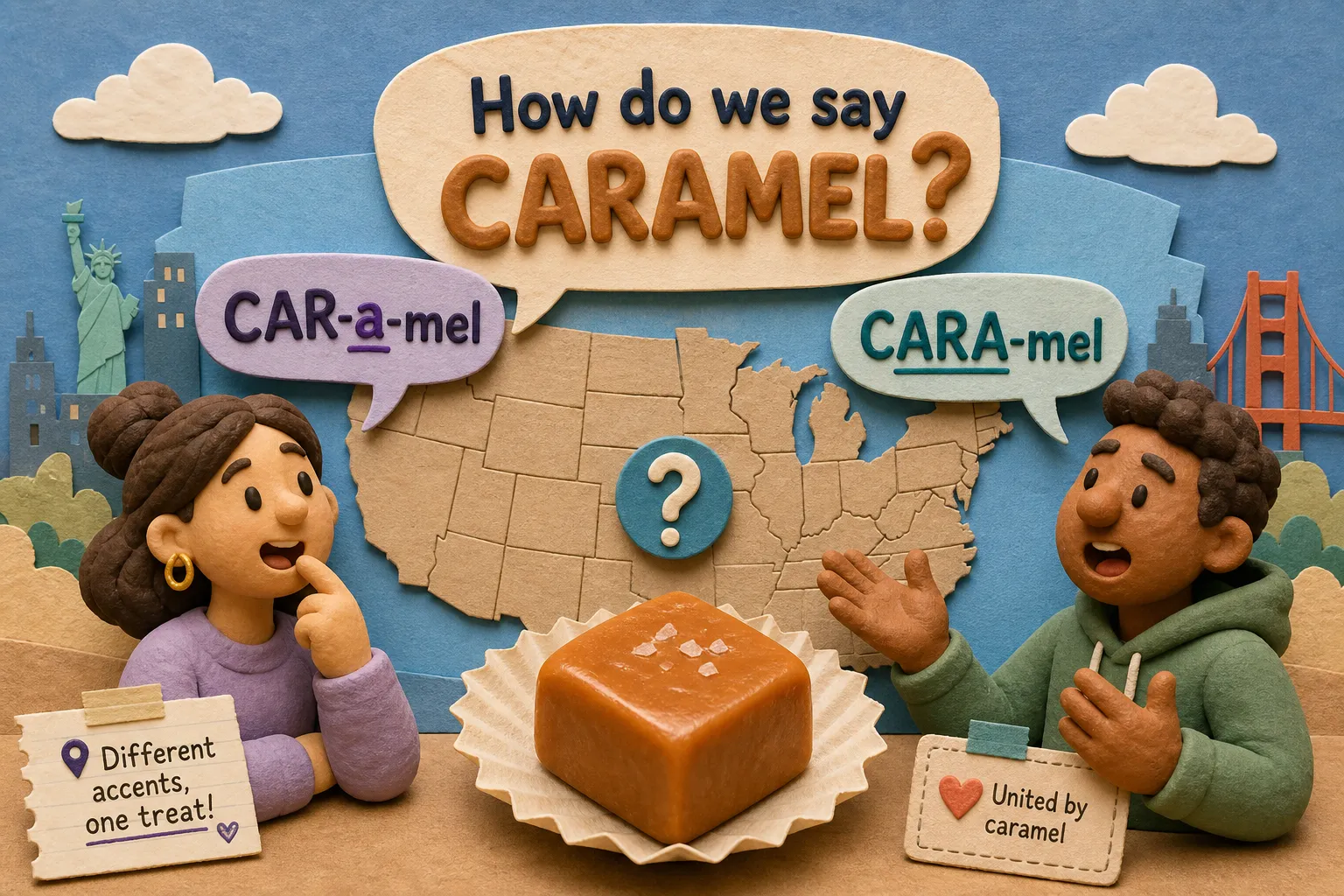
You walk up to the coffee counter and order a caramel latte. You say it one way, then the barista repeats it back with a completely different number of syllables. For a split second, you wonder: “Was I wrong?” The answer is no. You were both right.
Caramel pronunciation in American English is genuinely split, and that split trips up native speakers just as often as ESL learners. This guide explains both accepted American pronunciations of “caramel,” the IPA and easy respellings for each, which regions of the U.S. lean which way, and exactly how to practice whichever version feels natural to you. Both KAR-muhl and KAR-uh-muhl are fully standard, and understanding why separates textbook English from how Americans actually speak.
The Two Pronunciations Merriam-Webster Actually Accepts
Before diving into regional habits or personal preferences, it helps to know what the authorities say. Merriam-Webster, a major reference for American English, lists multiple pronunciations for “caramel,” and none of them are marked as informal, nonstandard, or incorrect. You can verify this directly in Merriam-Webster’s caramel entry, which shows variants including /ˈkɑːr-məl/ and /ˈker-ə-məl/ without any usage label on either.
CAR-muhl: The Two-Syllable Version
The two-syllable form is the pronunciation Cambridge Dictionary lists as the common American English pronunciation: /ˈkɑːr.məl/, with the easy respelling KAR-muhl. The middle syllable simply disappears in natural speech. This isn’t sloppy or lazy, it’s a process called vowel reduction, and it happens throughout American English constantly. Stress falls on the first syllable, and the word lands with a clear, open “ah” vowel followed by a soft “muhl” at the end.
KAR-uh-muhl: The Three-Syllable Version
The three-syllable form keeps all the beats you see in the spelling. In IPA: /ˈkær.ə.məl/ or /ˈkɑːr.ə.məl/, with the easy respelling KAR-uh-muhl. Stress still lands on the first syllable. The middle “uh” is a very short, relaxed vowel, linguists call it a schwa, and it’s the same sound as the “a” in “about.” Don’t overdo that middle syllable; keep it light and quick, and the word flows naturally.
What About “CARE-uh-mel”?
Some Americans use a third form where the first vowel sounds more like the vowel in “care”, roughly KARE-uh-muhl. It’s heard in certain parts of the country, but major dictionaries don’t list it as a primary form. It won’t confuse anyone, and it isn’t incorrect, it’s just less common. For practical purposes, the two forms above are the ones worth focusing on.
The key takeaway: no major American dictionary marks either the two-syllable or three-syllable pronunciation as wrong. Both are fully standard.
Regional Caramel Pronunciation Patterns Across the U.S.
The most reliable data on this question comes from the Harvard Dialect Survey (Bert Vaux, 2003), a large crowdsourced study of American pronunciation and vocabulary patterns. Worth noting: as a self-selected, non-random sample, the survey captures broad tendencies rather than statistically precise national percentages. With that caveat in mind, the caramel results are striking. Roughly 38% of respondents reported using the two-syllable form, 38% used the three-syllable form, and 17% said they use both interchangeably. That near-even split explains why both versions sound completely natural to native ears.
The East Coast and South Tend Toward Three Syllables
New England, the Mid-Atlantic states, and much of the South show higher rates of KAR-uh-muhl. The three-syllable form is one of the stronger dialect markers for New England specifically, and the pattern extends down the East Coast from Maine through Florida and into parts of the Deep South. Eastern dialects tend to preserve more syllables in words borrowed from Romance languages, which is part of the historical reason for this pattern.
The West and Midwest Lean Toward Two Syllables
Western states and the inland North show higher rates of KAR-muhl. The two-syllable form reflects a broader tendency in American English to reduce unstressed vowels in casual speech, a pattern that’s especially strong in Northern and Western dialects. This is the same process that turns “chocolate” into “CHOK-lit,” “comfortable” into “KUMF-ter-buhl,” and “family” into “FAM-lee.” The syllable doesn’t disappear because speakers are being careless; it disappears because unstressed vowels naturally weaken in connected speech.
Regional patterns are tendencies, not rules. You’ll find plenty of KAR-muhl speakers in New York and plenty of KAR-uh-muhl speakers in California. The data shows geographic trends, not hard boundaries.
Is Saying “Car-mel” Actually Wrong?
Many learners, and plenty of native speakers, have been corrected for using the two-syllable version. Someone hears KAR-muhl and says, “Actually, it’s car-a-mel.” The correction is well-intentioned, but it doesn’t hold up linguistically.
Why the “Wrong” Label Doesn’t Stick
Both forms appear in authoritative American dictionaries with no usage labels like “informal” or “nonstandard.” Merriam-Webster includes both without marking either as secondary. A Los Angeles Times language column summarizing that dictionary treatment put it plainly: the two-syllable form is “every bit as acceptable” as the three-syllable one. The reduction of an unstressed middle syllable is a natural feature of American English, not a deviation from it.
Consider how common this pattern is in everyday speech. “Every” often sounds like “EV-ree.” “Different” often sounds like “DIFF-rent.” “Restaurant” frequently becomes “REST-rant.” These are normal, accepted reductions, not errors, and caramel follows the same pattern.
The Carmel vs. Caramel Question
One source of confusion worth clearing up: “Carmel” without the first “a” is a proper noun. It refers to towns, streets, and geographic features, Carmel-by-the-Sea in California, Mount Carmel in the Middle East. In everyday speech, many Americans pronounce both “Carmel” and “caramel” the same way: KAR-muhl. Context handles the distinction. If you’re talking about a coffee drink or a candy, no one is going to think you mean a city. Pronouncing “caramel” as KAR-muhl is not a spelling mistake carried into speech, it’s a legitimate American English pronunciation.
How American and British Pronunciations Differ
If you learned English from British-produced textbooks, British teachers, or a mix of both, you may have absorbed a pronunciation that leans toward three syllables. That’s worth understanding in context, because the American and British forms have a documented difference that goes beyond just syllable count.
Cambridge Dictionary is explicit about this. It lists the UK pronunciation as /ˈkær.ə.məl/ and the US pronunciation as /ˈkɑːr.məl/. Two differences stand out. First, syllable count: British English keeps three syllables in the citation form, while American English commonly reduces to two. Second, the first vowel shifts: British English uses a short “a” sound /æ/ (like the vowel in “cat”), while American English uses the broader “ah” vowel /ɑː/ (the same sound as in “car” and “bar”).
For ESL learners, this matters practically. If you say KAR-uh-muhl with the three-syllable form, you’re using a pronunciation that’s completely standard in both American and British English. If you say KAR-muhl, you’re using the form Cambridge lists as the common American pronunciation. Either way, you’re correct in an American English context. The goal isn’t to eliminate your current pronunciation, it’s to recognize both when you hear them so you’re never caught off guard mid-conversation.
How to Practice Caramel Pronunciation
Now that you understand what both forms are and where they come from, the practical question is: how do you actually say them? Here are mouth-position tips for each version, plus a quick self-check you can do right now.
Mouth Position for KAR-muhl (/ˈkɑːr.məl/)
Start with the wide-open “ah” vowel. Drop your jaw like a doctor asking you to say “ah,” keep your tongue low and flat, and make the “r” with the back of your tongue slightly raised. Then glide directly into the soft “muhl” ending. The key is not inserting any vowel in the middle, just let the two parts run together. If you pause between them, you’ll accidentally add a syllable back in.
Mouth Position for KAR-uh-muhl (/ˈkær.ə.məl/)
This version has three distinct beats. Start the same way, with stress on the first syllable. The middle “uh” is a schwa, extremely short and relaxed, produced with your mouth barely open and your tongue resting in a neutral position. Don’t hold it or stress it. Then end with the same soft “muhl.” Think of it as 1-2-3, where beat two is barely there.
A Quick Self-Check to Try Right Now
- Say “car” out loud, then “muhl,” now blend them together: KAR-muhl. That’s version one.
- Say “car,” then “uh,” then “muhl”: KAR-uh-muhl. That’s version two.
- Record yourself on your phone, then find a native speaker clip on YouTube and compare. Your ear is your best tool here.
Both versions will start to feel natural quickly once you’ve repeated them a few dozen times in real sentences: “Can I get a caramel latte?” “I’d like the caramel sauce.” “These caramel apples are incredible.” Put the word in motion, not just in isolation.
The caramel debate is a perfect example of what the pronunciation guides at Your Daily American are built for: not isolated sounds in a vacuum, but the real patterns of how American English varies across regions, speakers, and situations. The guides go deep on connected speech, vowel reduction, and the kinds of sound shifts that change how words like “caramel,” “chocolate,” and “comfortable” actually come out of a native speaker’s mouth, the variation that dictionaries note but never fully explain.
Frequently Asked Questions About Caramel Pronunciation
What is the correct caramel pronunciation in the U.S.?
Both KAR-muhl (/ˈkɑːr.məl/) and KAR-uh-muhl (/ˈkær.ə.məl/ or /ˈkɑːr.ə.məl/) are correct caramel pronunciations in American English. Merriam-Webster lists both without any usage label marking either as informal or nonstandard.
Why do some Americans say “car-mel” instead of “car-a-mel”?
The two-syllable form results from vowel reduction, a natural process in American English where unstressed vowels weaken or disappear in connected speech. It follows the same pattern as “chocolate” becoming “CHOK-lit” or “comfortable” becoming “KUMF-ter-buhl.”
Is KAR-muhl or KAR-uh-muhl more common?
According to the Harvard Dialect Survey (Vaux, 2003), the split is nearly even: roughly 38% of respondents used the two-syllable form, 38% used the three-syllable form, and 17% used both. The survey is crowdsourced rather than a random national sample, so treat these figures as broad indicators rather than exact statistics.
How is caramel pronounced in British English?
Cambridge Dictionary lists the British English pronunciation as /ˈkær.ə.məl/, three syllables with a short “a” vowel /æ/ in the first syllable (like “cat”). The American form /ˈkɑːr.məl/ uses a broader “ah” vowel and typically drops the middle syllable.
If you’d like a short practical guide with step-by-step tips on how to pronounce caramel, that article gives clear examples and audio cues to try alongside your practice.
The Bottom Line on Caramel Pronunciation
Both KAR-muhl and KAR-uh-muhl are standard American English pronunciations, backed by Merriam-Webster and supported by dialect research. Neither one marks you as wrong, uneducated, or out of place in any American setting. The Harvard Dialect Survey data shows that roughly 38% of respondents favor each form, with another 17% using both, close enough to a split that both versions are equally unremarkable to American ears.
Pick the version that feels natural to you, or learn both so you can recognize either one when you hear it. Variation like this is everywhere in American English, in how people say “route,” “pecan,” “either,” and dozens of other everyday words, examples you can explore in our piece on English words non-native speakers mispronounce most often. Learning to navigate that variation, rather than freezing in front of it, is what separates textbook fluency from real-world confidence.
So next time someone “corrects” your caramel pronunciation, you have the data to smile and say you’re right either way. If you’re curious about the historical side of the word, the etymology of “caramel” is an interesting read on how the word traveled into modern English. It’s one of those clear examples of how alive and varied American English really is.
For more reading on the cultural side of the argument, the not-so-great caramel debate is an engaging overview that captures why the topic keeps resurfacing at coffee shops and online.