If you’ve ever typed “lifes” and wondered whether it looked right, you’re not alone. The lives vs lifes question trips up even advanced English learners, and the answer is more useful than a simple correction. By the end of this article, you’ll know exactly why “lifes” is wrong, why “lives” is right, when to use “life’s” instead, and how to tell the difference when speaking out loud. These are the details that separate confident English writing from writing that makes a reader pause.
Many English learners write “lifes” without a second thought because that’s how most plurals work. You add an -s and move on. But “life” doesn’t follow that rule, and the reason why opens a window into a whole category of words that behave the same way. Understanding the pattern means you’ll never second-guess these words again.
At Your Daily American, this type of irregular grammar pattern comes up constantly, even among advanced learners. Once you see the logic, it sticks fast. Here’s the most important answer first.
Lives vs Lifes, Why “Lifes” Is Not a Word in English
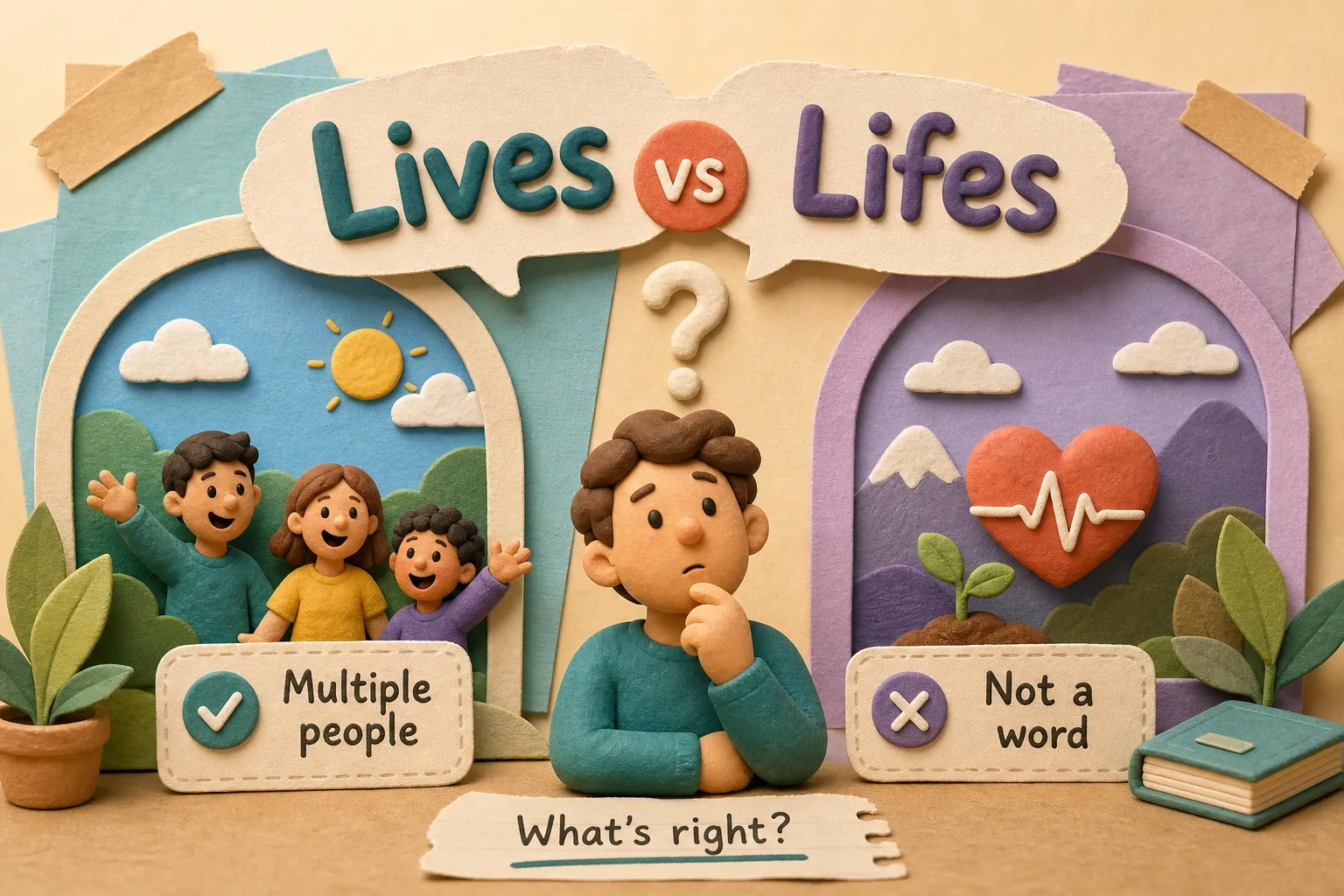
“Lifes” is not recognized as correct in standard American English. The plural of “life” is “lives,” full stop. There are no exceptions in everyday writing or speech.
The confusion is completely understandable. Most English plurals follow a simple rule: add -s or -es to the end of the word. That works for “book → books,” “house → houses,” and hundreds of other nouns. So learners naturally assume “life → lifes” follows the same logic. It doesn’t, because “life” belongs to a specific group of irregular nouns with their own pluralization pattern.
“Lifes” could theoretically appear in a brand name or proper noun, like a store called “Second Lifes,” but in everyday English writing and speech, it is treated as an error. In standard written English, “lifes” is a spelling mistake, and readers familiar with correct usage will likely notice it. The correction is always “lives.”
The -f → -ves Rule: An Irregular Plural Pattern Worth Knowing
English has a group of nouns that end in -f or -fe, and when you make them plural, the -f or -fe changes to -ves. A concise guide to irregular plural nouns explains how this pattern works across common words, and “life → lives” follows this exact pattern. Once you see the full group of words that work this way, the rule becomes much easier to remember and apply.
Here are common words that follow the same -f → -ves pattern:
- knife → knives
- shelf → shelves
- elf → elves
- half → halves
- leaf → leaves
- wolf → wolves
- wife → wives
- loaf → loaves
- thief → thieves
Each one drops the -f and adds -ves to form the plural. “Life → lives” is just one member of this group. Seeing them together makes the life pluralization rule (-f → -ves) click in a way that memorizing one word at a time never does.
This pattern is rooted in Old and Middle English spelling conventions, where the -ves ending became the established written form for this group of nouns. It’s a piece of real English history hiding inside the most common everyday words. If you’d like another short discussion of the specific “lifes vs lives” confusion, LanguageTool’s write-up is a helpful second perspective.
When f-Ending Nouns Don’t Follow the -ves Rule
Once you learn the -f → -ves pattern, it’s tempting to apply it everywhere. Not every noun ending in -f changes to -ves, though. Some just take a regular -s, and knowing which ones do what will save you from a different kind of mistake.
Several common nouns ending in -f or -ff simply add -s:
- roof → roofs
- belief → beliefs
- proof → proofs
- chief → chiefs
- cliff → cliffs
These words do not change their -f to -v. “Rooves” or “beliefves” would sound wrong to any fluent speaker. A few archaic forms like “rooves” technically existed in older English, but modern American English uses “roofs” consistently.
There’s no single phonetic rule that reliably predicts which group a word falls into. The practical approach is this: the most common everyday nouns (knife, life, wife, shelf, leaf) tend to follow the -ves pattern. Words with a stronger French or Latin origin, like “belief” or “chief,” usually just take -s. When in doubt, review common errors in irregular plurals and look it up once, the correct form will usually stick through repetition.
Lives vs Life’s: Two Forms with Completely Different Jobs
“Lives” and “life’s” look nearly identical on paper, but they do completely different work in a sentence. Before diving into the examples, here’s the core distinction: “lives” is a plural noun, while “life’s” signals either possession or a contraction. Mixing them up changes your meaning in ways that can confuse readers.
Use “lives” (no apostrophe) when you mean more than one life. This is the standard plural form, and it’s the one you’ll use most often:
- “The new law will improve the lives of millions of Americans.”
- “The documentary explores the lives of three families in rural Texas.”
- “Many lives were saved because of the firefighters.”
Use “life’s” (with an apostrophe) in two specific situations. First, when “life” possesses something: “Life’s challenges are worth facing.” Second, as a contraction of “life is” or “life has” in informal speech or writing: “Life’s been good to me lately.” A quick test: if you can replace “life’s” with “life is” or “life has” and the sentence still makes sense, the apostrophe belongs there. If not, you want the plural “lives.”
“Our Life” vs “Our Lives”: A Subtle but Important Choice
Both forms are grammatically correct, but they signal something different. The right choice depends on whether you mean a shared experience or individual experiences happening within a group.
Use “our lives” when you’re talking about each person’s individual life within a group. This is the more common and generally the safer choice in American English:
- “Our lives changed completely after we moved to Chicago.”
- “Technology has made our lives easier in many ways.”
Each person has their own life being affected, which is why the plural fits. A simple test: if you can substitute “each of our” without changing the meaning, “our lives” is correct.
Use “our life” only when you want to emphasize a single shared existence or way of living as one unit: “Our life in the village was simple and quiet.” When you’re not sure which to choose, “our lives” is almost always the right call in everyday American speech.
How “Lives” Is Pronounced: The Detail That Trips Up Even Good Listeners
“Lives” is spelled the same whether it’s a noun (the plural of life) or a verb (she lives in Dallas), but the pronunciation is completely different. Getting this right matters for both speaking clearly and following fast native speech. If you want to improve your listening and stress patterns, see our word stress in American English guide for focused practice.
Noun Pronunciation
When “lives” is the plural noun, it rhymes with “hives” or “drives.” The vowel sound is the long /aɪ/, the same sound as the word “eye.” Say it as LYVZ. Example: “She has nine lives.” The -ves ending adds a buzzing -z sound at the end.
Verb Pronunciation
When “lives” is the third-person verb, the vowel shifts to the short /ɪ/, the same sound as the word “it.” Say it as LIVZ, rhyming with “gives.” Example: “She lives in Atlanta.” That vowel is noticeably shorter and tighter than the noun form.
“Life’s” is a third option, pronounced /laɪfs/. It uses the same long /aɪ/ vowel as the plural noun, but ends in a clean -s sound rather than the buzzing -z of “lives.” Think of it as simply saying “life” and adding a light -s at the end. Context almost always clarifies meaning in a sentence, but training your ear to hear the vowel difference between LYVZ and LIVZ will make you a noticeably better listener of fast American English.
Lives vs Lifes: Quick Cheat Sheet and Practice Prompts
Here are the three rules to carry with you:
- Plural of “life”: always “lives” (never “lifes”). The -f changes to -ves.
- Possessive or contraction: always “life’s” (with an apostrophe).
- Pronunciation: plural noun = /laɪvz/ (LYVZ, rhymes with “drives”); verb = /lɪvz/ (LIVZ, rhymes with “gives”).
Now try it yourself. Write three sentences: one using “lives” as a plural noun, one using “life’s” as a possessive or contraction, and one using the verb “lives” to describe where someone is. Then read them out loud and pay close attention to the pronunciation shift between the noun and verb forms. That shift is subtle, but it’s exactly the kind of detail fluent speakers internalize.
The lives vs lifes mix-up is one of dozens of irregular patterns that surface even at intermediate and advanced levels. The -f → -ves group alone gives you around a dozen high-frequency words that all follow the same logic. Learning one unlocks the rest. For more examples drawn from everyday usage, see our piece on Most Common American Slang Words Used in Daily Life, which shows how small changes in words can change meaning in conversation.
Frequently Asked Questions About Lives vs Lifes
Is “lifes” ever correct in English?
No. In standard American English, “lifes” is always a spelling error. The correct plural of “life” is “lives.” It may appear in informal brand names or creative contexts, but in any formal or professional writing, use “lives.” For a focused comparison of the forms, Grammarly’s lives vs. lifes guide is a useful reference.
Why is the plural of “life” spelled “lives” and not “lifes”?
Because “life” follows the -f → -ves pluralization rule, an older English spelling convention shared by words like knife, wife, and leaf. These nouns drop the -f and add -ves to form the plural, rather than simply adding -s.
What is the difference between “lives” and “life’s”?
“Lives” (no apostrophe) is the plural noun: more than one life. “Life’s” (with an apostrophe) is either a possessive (“life’s challenges”) or a contraction of “life is” or “life has.” The apostrophe is the key visual signal.
How do I pronounce “lives” correctly?
It depends on which word you mean. The plural noun “lives” is pronounced /laɪvz/, rhyming with “drives.” The verb “lives” (as in “she lives here”) is pronounced /lɪvz/, rhyming with “gives.” The vowel sound is the clearest difference between the two.
For more breakdowns like this one, grounded in how American English is actually used, with real examples from everyday and professional settings, Your Daily American’s grammar content is built around exactly this kind of structured, practical explanation. It’s a reliable way to fill the gaps and build confidence through understanding rules, not just memorizing isolated words.