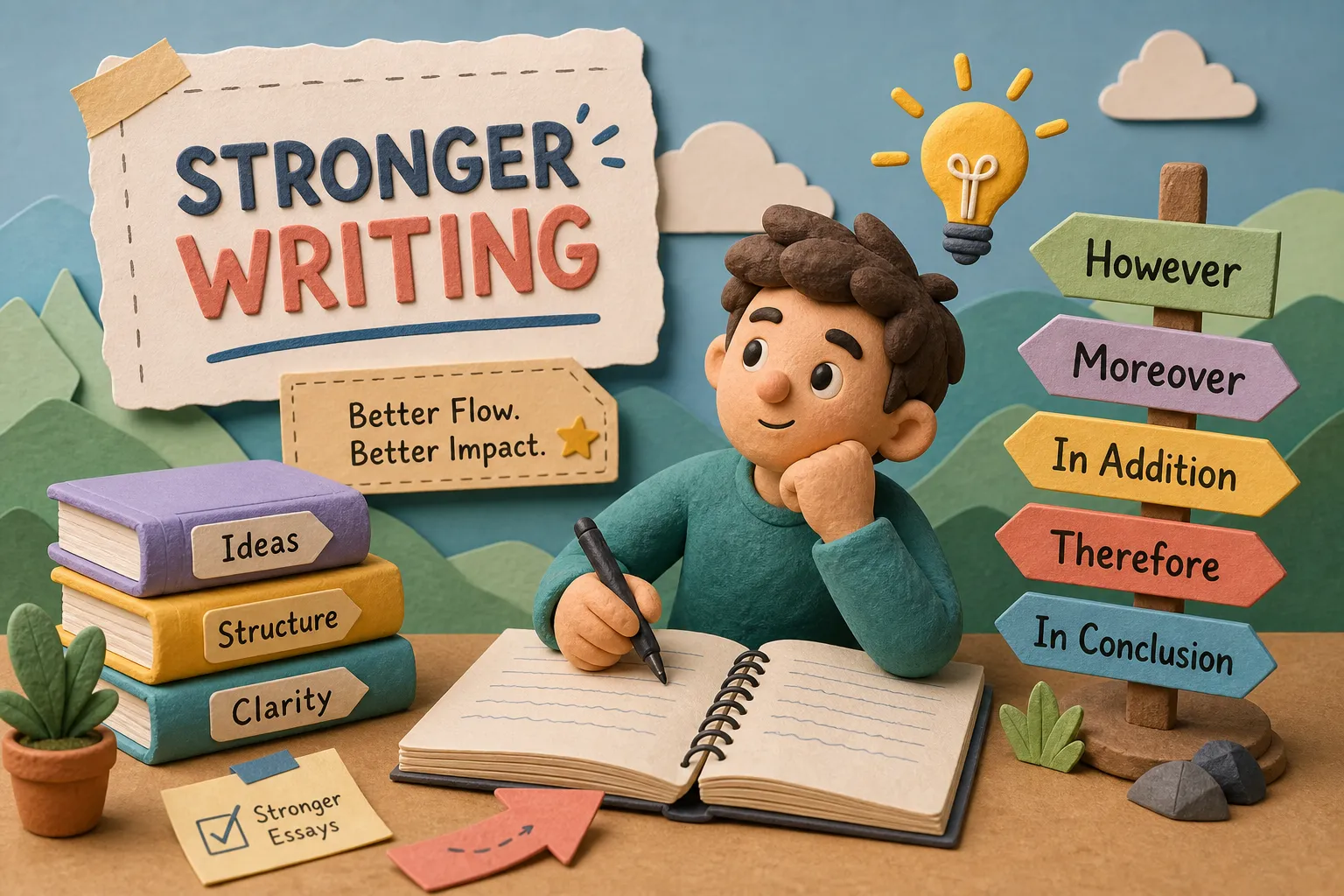
You’ve done the research. Your argument is solid. But when you read it back, something feels off: the ideas don’t connect. One sentence ends, another begins, and the reader has to figure out on their own how the two relate. That gap is exactly what essay transition words, also called linking words or transitional expressions, are designed to close.
Transitional expressions are the connective tissue of good writing. They don’t just make sentences “flow”; they tell the reader the logical relationship between ideas before the reader has to guess. That one difference is what separates writing that reads smoothly from writing that stumbles.
Here, the focus is always on practical English that works in real situations. These same phrases show up in workplace presentations, academic discussions, and professional meetings, so learning them on the page makes you more confident using them out loud too. This article covers six functional categories: addition, sequence, example, contrast, cause and effect, and conclusion. By the end, you’ll know which phrase to choose, where to place it, and how to punctuate it correctly.
Why essay transition words matter more than you think
What a linking phrase actually signals to the reader
A well-chosen sentence connector does much more than smooth out your writing style. It communicates a logical relationship: this idea adds to the last one, contradicts it, results from it, or illustrates it. Without that signal, the reader does the inferential work that the writer should be doing.
Compare these two versions of the same passage. Without transitions: “The medication reduced symptoms. Patients still reported side effects. The trial was extended.” Now with them: “The medication reduced symptoms. However, patients still reported side effects. Consequently, the trial was extended.” The facts are identical. The second version tells the reader exactly how each sentence relates to the one before it.
How placement changes the effect
Cohesive devices can go at the start of a sentence, in the middle, or at the end, and each position produces a slightly different effect. At the start, the transition sets the logical relationship before the idea is stated: “However, the results were inconsistent.” In the middle, it links two clauses without interrupting the main flow: “The study was thorough; it did not, however, account for long-term effects.” At the end, it adds a reflective or emphatic note: “The evidence was weak, as a result.”
Start-of-sentence placement is the most common in academic writing because it frames the reader’s expectations immediately. Middle placement works well for a subtle qualification. End placement is less common but useful when you want to underscore a consequence.
Essay transition words for addition, sequence, and examples
Adding information and reinforcing a point
Addition transitions signal that you are building on the previous idea, not shifting direction. Think of them as saying: “here’s more evidence for the same point.” The core options are also, additionally, moreover, furthermore, in addition, besides, and equally important.
Not all of these carry the same weight. Also is the weakest and most casual. Moreover and furthermore carry more rhetorical force and are better suited to formal academic writing when the added point is substantive. Two examples that show the difference in effect:
- “The report confirmed the initial findings. Furthermore, it identified two new risk factors.”
- “The program reduced costs. In addition, employee satisfaction improved significantly.”
Ordering ideas and showing sequence
Sequence transitions guide the reader through steps, stages, or events in order. The main options are first, second, next, then, afterward, subsequently, finally, meanwhile, before, and after. These are especially useful in process descriptions and narrative writing.
One common mistake for ESL writers: stacking “firstly, secondly, thirdly” past three items makes the writing feel mechanical. Once you pass the third point, switch to additionally or “another key consideration” to keep the prose natural. Two examples:
- “First, collect the data. Next, organize it into categories. Finally, analyze the patterns.”
- “The policy was announced in March. Subsequently, three departments revised their procedures.”
Giving examples and illustrating a point
Example transitions make abstract claims concrete and show evidence in action. The key phrases are for example, for instance, such as, namely, specifically, to illustrate, and in particular. There is an important punctuation difference between them: such as is followed directly by the example with no comma after it. For example and for instance are set off with commas. For a focused explanation of commas with “such as,” see a short guide on commas before “such as”.
- “Several industries have adopted this technology, such as healthcare, logistics, and finance.”
- “The author uses vivid imagery throughout the novel. For instance, the opening scene describes the city as ‘a jaw of broken glass.'”
Essay transition words for contrast, cause and effect, and conclusions
Showing contrast and acknowledging opposing ideas
Contrast transitions signal that the next sentence contradicts, qualifies, or complicates the previous point. The main options are however, but, although, yet, nevertheless, on the other hand, in contrast, conversely, whereas, despite, and even though.
However and nevertheless are not interchangeable. However introduces a contrast or limitation and moves past it. Nevertheless accepts the opposing point and then argues forward anyway; it carries more concessive weight. Choosing between them changes the rhetorical effect of your sentence; for a clear comparison of these two words, see this explanation of “however” versus “nevertheless”.
- “The data showed a clear trend. However, the sample size was too small to draw firm conclusions.”
- “Some critics argue the policy is costly. Nevertheless, the long-term benefits outweigh the initial investment.”
Showing cause and effect relationships
Cause-and-effect transitions make the logical link between a cause and its result explicit, rather than leaving the reader to infer it. The core options are because, since, therefore, thus, consequently, as a result, accordingly, hence, and for this reason.
One common ESL error is using because of and because interchangeably. Because introduces a full clause with a subject and verb: “The trial failed because the sample was contaminated.” Because of introduces a noun phrase: “The trial failed because of contamination.” Mixing them up creates grammatical errors. Two correct examples:
- “The experiment was inconclusive. Consequently, the team repeated the trial with a revised method.”
- “Funding was cut significantly; therefore, the project was delayed by six months.”
Wrapping up with conclusion and summary transitions
Summary transitions signal that you are synthesizing ideas, not introducing new ones. The main options are in conclusion, to sum up, in summary, overall, on the whole, in short, and taken together.
An important distinction: in conclusion belongs in a final paragraph. Overall and on the whole work mid-essay when wrapping up a section before moving to the next. Using in conclusion in the middle of an essay confuses the reader about where the argument stands:
- “In conclusion, the evidence strongly supports the need for policy reform.”
- “Overall, both methods produced reliable results, though Method B was more efficient.”
Getting punctuation right with transition words
The semicolon-and-comma rule for conjunctive adverbs
Conjunctive adverbs, words like however, therefore, moreover, and consequently, follow a specific punctuation pattern when they join two independent clauses in one sentence. The rule: semicolon before the adverb, comma after it. The pattern looks like this: Independent clause; however, independent clause. For a focused guide on conjunctive adverbs and punctuation, see the University of Wisconsin writing center’s overview on conjunctive adverbs.
Example: “The team met its deadline; however, the final product required significant revisions.” A comma alone between the two clauses creates a comma splice, one of the most common errors in ESL academic writing. The comma tells the reader the sentence continues; it does not signal the logical turn the way a semicolon does.
When to start a new sentence instead
Using a period instead of a semicolon is always grammatically correct and often reads more cleanly. “The team met its deadline. However, the final product required significant revisions.” Both versions work; the two-sentence version is simpler and never wrong.
Multi-word transitions like for example, as a result, and on the other hand follow the same logic: semicolon-comma when joining two clauses in one sentence, or period-comma when starting a new one. If you find semicolons confusing, use a period every time. The writing will be clear, and you’ll never produce a comma splice.
Transitions to stop using (and what to write instead)
The weakest offenders in academic writing
The most overused transitions in student essays are also, and, but, then, so, and finally. These words are grammatically fine, but they signal very little about the actual logical relationship between ideas. Relying on them is a missed opportunity: the reader has to infer the connection rather than having it clearly named.
Frequency compounds the problem. Using also four times in a single paragraph signals imprecision, not a rich vocabulary. Weak transition words leave the reader doing the analytical work that the writer should be doing.
Precise replacements that do more work
Choose the transition that names the relationship, not just the direction. Here are the most useful substitutions:
- Also → moreover, furthermore, in addition (for a substantive added point); equally important (when both points carry the same weight)
- But → however (to qualify or limit); nevertheless (to argue forward despite a concession); in contrast or whereas (to compare two different situations)
- So → therefore, consequently, as a result (for cause-and-effect relationships)
- Then → subsequently, next, afterward, thereafter (for sequencing events or steps)
- Finally → in conclusion, to conclude, in summary (when closing an argument)
Every time you write one of the weak options, pause and ask: what is the exact relationship between these two ideas? The answer tells you which transition words for essays to use instead. For practical guidance on why and how to use transition words, see this guide on using transition words.
Put it into practice
The six categories, addition, sequence, example, contrast, cause and effect, and conclusion, cover almost every logical relationship you’ll encounter in academic writing. The goal isn’t to memorize a long list; it’s to train yourself to name the relationship first and then choose the word that fits it.
Try this short self-check with these three sentence pairs. Choose the correct transition from the two options given:
- “The project was delivered on time. _______, it came in under budget.” (However / Moreover)
- “The initial test was promising. _______, the second trial produced different results.” (Furthermore / However)
- “The server crashed during the presentation. _______, the team had to reschedule the demo.” (As a result / In addition)
(Answers: 1. Moreover, 2. However, 3. As a result)
Mastering essay transition words is one of the most practical upgrades you can make to your academic writing, and the same skills transfer directly to spoken English. Knowing when to say “however” versus “on the other hand” in a presentation or team meeting carries real professional weight. For an accessible overview of transitional words and how to apply them in academic papers, the University of Wisconsin provides a helpful transitions guide.
Your Daily American covers the spoken side of Professional English in depth, including how native speakers use these linking phrases naturally in real conversations and workplace settings. If you want your speech to sound as polished as your writing, that’s the natural next step. Start with our article 25 Small Talk Phrases Americans Use Every Day, Your Daily American.