You’re proofreading a work email and you stop cold on one sentence: “My experience is different from/than yours.” You know what you mean, but you genuinely don’t know which word belongs there. You try both versions out loud. They both sound fine. So which one is actually correct?
This confusion about different from or different than trips up even advanced English learners, and it catches plenty of native speakers too. By the end of this lesson, you’ll know exactly which form to use, when each one is acceptable, and how to play it safe in formal writing when the stakes are high.
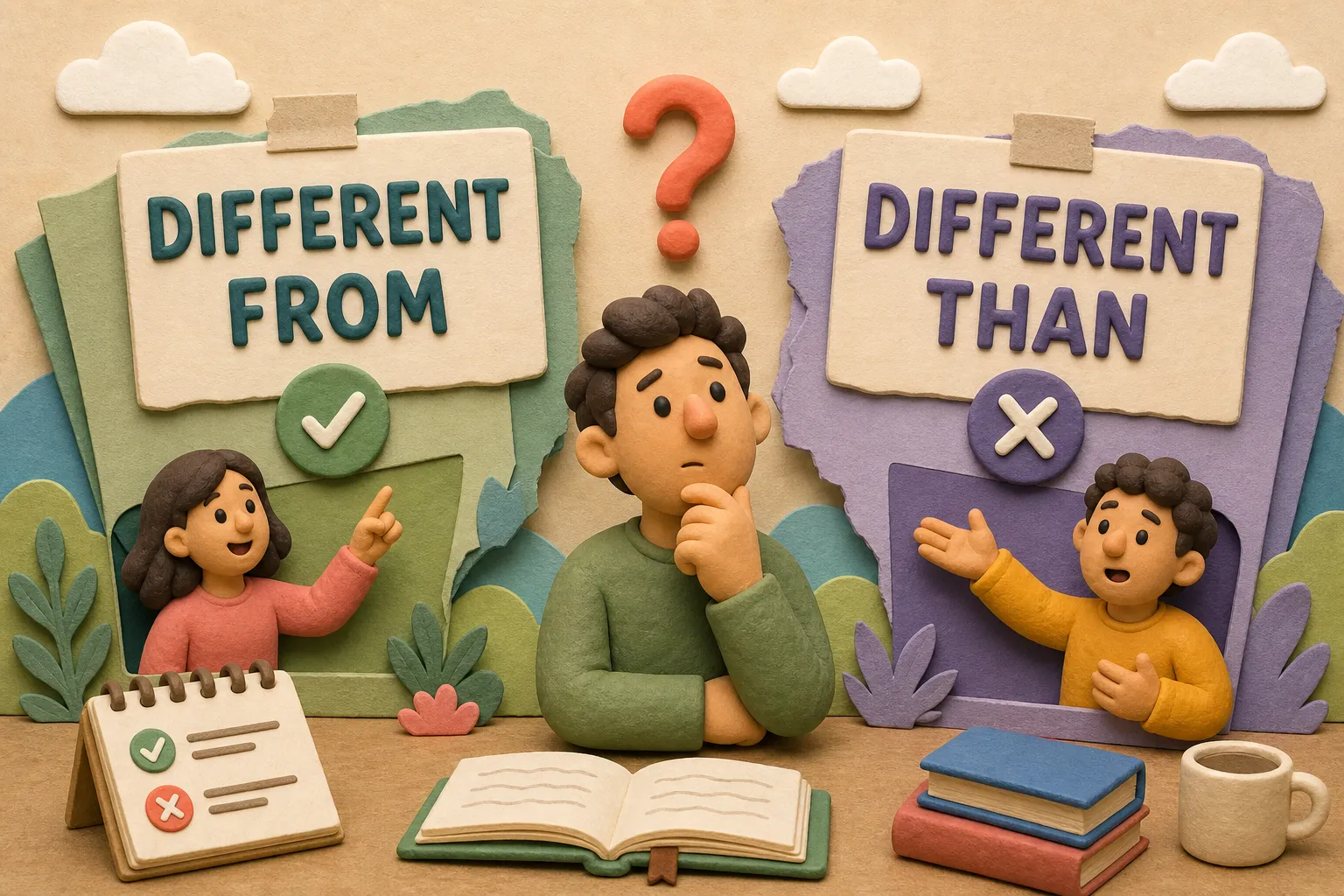
The short answer: are both forms actually correct?
Yes, both are correct. But they’re not interchangeable in every situation, and one is safer than the other as a default. Here’s the honest breakdown.
Why “different from” works in nearly every situation
“Different from” is the safest, most widely accepted form in both American and British English. It works before noun phrases, in formal writing, in casual speech, and across every register you can think of. Merriam-Webster’s usage notes describe it as the standard neutral form, and its own entry notes it is widely recognized as such. If you commit to always using “different from,” you will almost never be wrong.
Why “different than” isn’t a mistake either
“Different than” is not a grammar error. It’s a fully established form in American English with, as Merriam-Webster notes in its usage discussion, “centuries of use by reputable writers.” The key is understanding when it sounds natural and when it creates friction, because dropping it into the wrong spot in a formal document can still raise eyebrows. The sections below show you exactly when each form fits.
What American English actually prefers
American English is more tolerant of “different than” than most other English varieties. Here’s where the major dictionaries land.
How Merriam-Webster, Oxford, and Cambridge handle this
Merriam-Webster treats “different than” as standard American usage and explains that it’s especially common in U.S. English when followed by a clause or when “from” would sound awkward. Oxford frames “different from” as the primary neutral form but recognizes “different than” in American usage.
Cambridge presents “different from” as the main form without treating “different than” as ungrammatical in American contexts. The practical message: all three dictionaries recognize both forms, and none of them labels “different than” as wrong in American English.
The American vs. British English gap
American English accepts “different than” much more freely than British English does. In Britain and Australia, the everyday spoken form is actually “different to,” as in “this is different to what I expected.” That phrasing sounds off to most American ears, and in a U.S. professional context it can indicate to many readers that someone’s writing reflects British rather than American norms. For learners specifically working on American English, understanding this regional split removes a significant source of confusion when you encounter English from multiple sources. See this overview of British and American English for more on common differences.
The clause rule: when “different than” is the better choice
Once you grasp this one distinction, the question of different from or different than stops feeling arbitrary.
Clause vs. noun phrase: how to spot the difference
The rule is straightforward. When “different” is followed by a noun phrase (a person, a thing, a place, an idea), use “different from.” When “different” is followed by a full clause (a subject plus a verb), “different than” flows more naturally and avoids awkward phrasing. Look at these pairs side by side:
- “This project is different from the last one.” (noun phrase: the last one)
- “The results were different than I expected.” (clause: I expected)
- “Her approach is different from mine.” (noun phrase: mine)
- “The city felt different than it did five years ago.” (clause: it did five years ago)
Try reading those aloud. Swapping the prepositions creates clunky constructions: “The results were different from I expected” sounds broken, while “Her approach is different than mine” feels slightly informal without being wrong. The distinction is real, and once you notice it, it becomes automatic.
The safe workaround: “different from what…”
There’s a reliable trick that lets you use “different from” in any situation, including clause contexts, so you never have to choose. Add the word “what” to turn the clause into a noun phrase: “The results were different from what I expected.” “The city felt different from what it was five years ago.” Both sentences are clean, natural, and fully formal. If you’re writing something high-stakes and want to avoid the question entirely, this workaround always works.
“Different to”: the British English option worth knowing
You don’t need to use “different to,” but you do need to recognize it, because you’ll encounter it regularly in British books, films, and professional emails.
Where “different to” is used and accepted
“Different to” is standard in British and Australian English. Native British speakers use it naturally in everyday conversation: “This version is different to the one I used before” or “Her style is quite different to mine.” It’s not slang or informal usage; it’s simply the preferred British form. When you see it in writing from a British colleague or in a BBC article, it’s not an error, it’s regional convention.
Why it sounds wrong in American English
In American English, “different to” sounds unnatural. To many American readers it reads like a mistake, even though it isn’t one in its native context. For learners targeting American English fluency and U.S. workplace communication specifically, this form is best left alone. Understand it when you hear it, but don’t produce it in American professional writing.
What style guides say for formal writing
When you’re writing a report, an academic paper, or a piece of professional content, personal preference gives way to institutional standards. Here’s where the major guides land.
The Chicago and MLA position
Both the Chicago Manual of Style and MLA treat “different from” as the default form in formal writing. These guides are commonly used in academic publishing, book editing, and college-level writing. When you’re writing for a professor, an editor, or a publishing context, “different from” is the consensus safe choice.
The AP Style approach
The Associated Press Stylebook, which governs journalism and press writing, handles this differently. AP tends to avoid the construction altogether when possible, preferring rephrased sentences that sidestep the choice. This is useful context for learners writing professional communications, press releases, or news-style content: if you can rephrase naturally, do it.
The practical takeaway for formal writing
In formal American English writing, use “different from” as your default. Reserve “different than” for clause constructions where “different from” would genuinely sound awkward, or use the “different from what…” workaround to avoid the question entirely. That combination covers every situation you’re likely to encounter.
Real examples and a quick self-check
Seeing the rule in action across real contexts locks it in faster than any explanation. Read through these, then test yourself below.
Noun phrase contexts: use “different from”
These sentences all follow a noun phrase after “different,” so “from” is the correct choice in each one:
- Casual: “His apartment is different from mine.”
- Professional English email: “Our proposal is different from the original brief.”
- Academic: “The findings are markedly different from previous studies.”
- Everyday: “This coffee tastes completely different from what I usually get.”
Clause contexts: use “different than”
Each of these sentences is followed by a subject-verb clause, which is where “different than” earns its place:
- “She sounds different than she did on the phone.”
- “The onboarding process was different than we anticipated.”
- “The market behaved differently than analysts had predicted.”
- “The job turned out to be different than I thought it would be.”
Notice the last example in the noun-phrase list: “different from what I usually get.” That “what” is doing the conversion work, turning what could be a clause into a noun phrase. That’s the workaround in action.
Try it yourself: quick self-check
Choose “different from” or “different than” for each sentence. Check your answers below.
- “The final report is different _____ the draft we submitted last week.”
- “The interview felt different _____ I had imagined it would.”
- “His communication style is very different _____ his manager’s.”
Answers: 1. from (noun phrase: “the draft we submitted last week”). 2. than (clause: “I had imagined it would”). 3. from (noun phrase: “his manager’s”). If you got all three right, the rule is already working for you. If number two tripped you up, re-read the clause section above; that’s the one that catches most people.
Put this to work immediately
The rule boils down to three reliable defaults: use “different from” before noun phrases and as your go-to in formal writing; use “different than” in American English when a full clause follows; and when you’re not sure, restructure to “different from what…” and the problem disappears.
Both forms are part of natural American English, and native speakers switch between them in conversation without thinking about it. Being able to choose correctly in formal writing, and to explain why, is a real sign of fluency, the difference between knowing English and knowing how it actually works. For a related deep-dive on pronunciation patterns that affect fluency, see Word Stress in American English: A Complete Guide, Your Daily American.
That’s the kind of nuanced, context-driven understanding that Your Daily American is built around. Go back to that work email now. You know exactly which word belongs there.