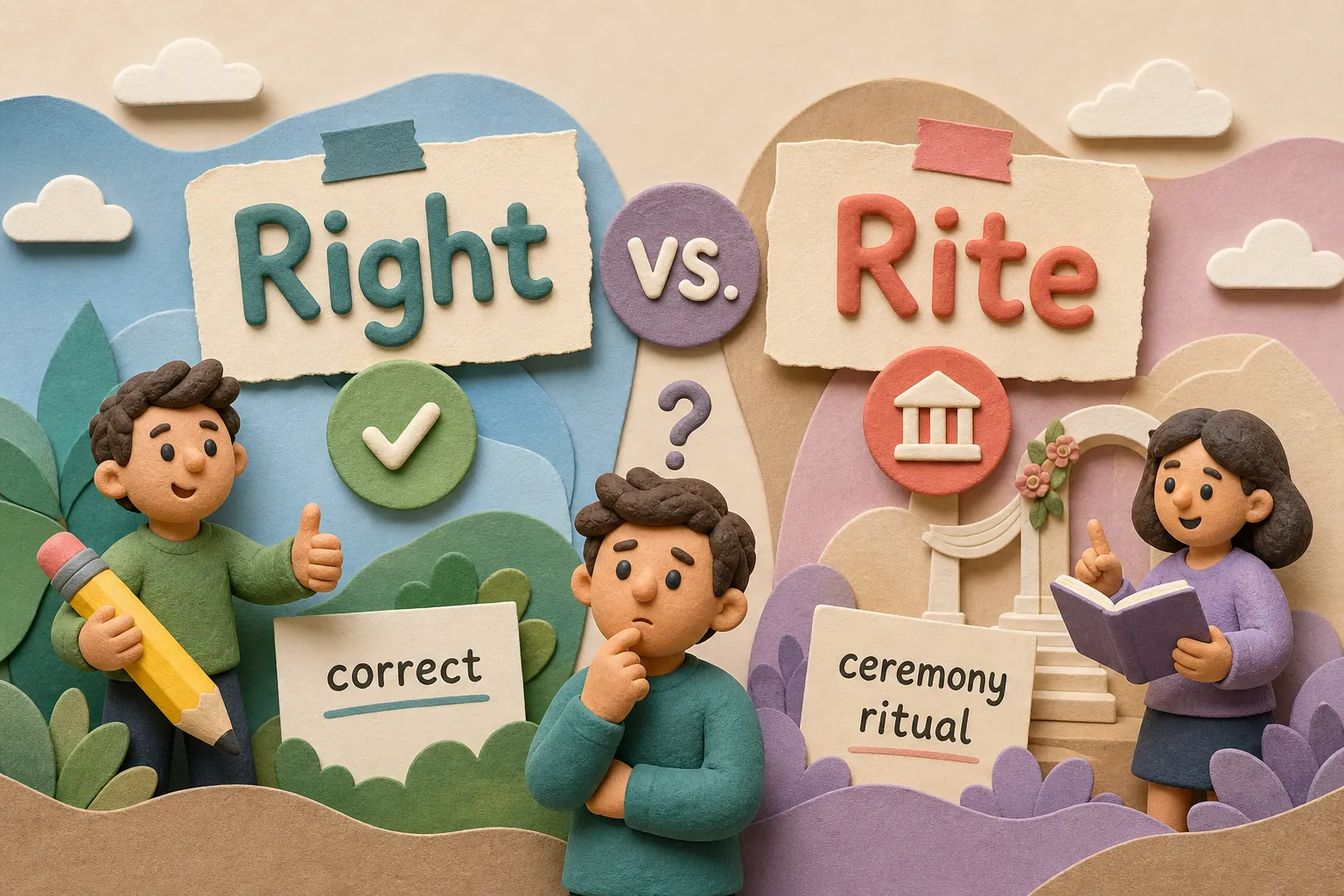
If you’ve ever hesitated over whether to write “a right answer” or “a rite answer,” you’re not alone, and that hesitation is exactly what this lesson on right vs. rite is designed to solve. These two words are homophones: they sound exactly alike but carry completely different meanings and can never be swapped. This is one of those English pitfalls where your ears won’t save you; only your knowledge of the word will.
By the end of this lesson, you’ll be able to identify each word’s part of speech, use both correctly in sentences, and apply two memory strategies that make the difference stick. These are the kinds of precision skills that separate a competent English user from a truly confident one, and getting a handle on this pair is a solid place to start.
They all sound the same: the /raɪt/ homophone group
In standard American English, “right,” “rite,” “write,” and “wright” are all pronounced identically: /raɪt/, or “RYTE” if IPA symbols are unfamiliar to you. There is no difference in stress, vowel quality, or ending sound, zero audible distinction. This creates a writing problem specifically, not a speaking problem. Native speakers rarely confuse these words in conversation because context makes the meaning obvious. But in writing, the wrong spelling may affect how readers perceive your vocabulary knowledge, and for ESL learners working in professional or academic settings, that perception carries real weight. (For a focused look at the American /r/ sound, see The American R: Why It Sounds So Different, Your Daily American.)
Two members of this group are worth naming briefly before moving on. “Write” means to form words on a surface or create text, and it’s common enough in everyday English to deserve its own dedicated lesson. “Wright,” on the other hand, is a noun meaning a maker or builder. You’ll find it in compound words like “playwright” and “shipwright,” but it seldom appears as a standalone word in modern American English. Most learners rarely need to use it independently. The focus here is the right vs. rite pair, but knowing all four exist means nothing in this group will catch you off guard later.
What “right” actually means: one word, many jobs
“Right” is by far the most versatile and frequently used word in this group. As an adjective, it means correct, morally proper, or on the side opposite the left. As an adverb, it means exactly, directly, or immediately. Consider these examples across both functions:
- “You made the right decision.” (adjective: correct)
- “Hold the pen in your right hand.” (adjective: directional)
- “She arrived right on time.” (adverb: exactly)
- “I’ll be right back.” (adverb: immediately)
That last example is one you’ll hear constantly in American daily life. “Right now,” “right away,” “right here,” “right there”, these adverb phrases appear throughout casual and professional speech. They’re natural, efficient, and firmly embedded in everyday American English. Getting comfortable with them makes your English sound grounded and fluent rather than translated. (For a set of common usages and phrases, see Common American Expressions Every English Learner Should Know, Your Daily American.)
“Right” also functions as a noun and a verb, two uses that often catch ESL learners by surprise. As a noun, it refers to a legal or moral entitlement (“Every employee has the right to a safe workplace”) or to a directional turn (“Take the first right after the traffic light”). As a verb, it means to correct a wrong or restore proper order (“The company righted the error by issuing a full refund”). The plural noun “rights” shows up consistently in American civic, legal, and workplace contexts, so recognizing it as a form of “right”, not “rite”, matters for both reading and writing. (For a concise dictionary entry describing these senses, see the Cambridge Dictionary definition of “right”.)
What “rite” means and where it actually belongs
“Rite” is strictly a noun, and it has one core meaning: a ceremonial or formal act, especially one tied to religion, tradition, or cultural practice. The word comes from the Latin ritus, meaning “religious observance” or “ceremony,” which entered English through Old French in the 14th century. “Rite” is not casual or everyday language; it belongs in formal, ceremonial, or descriptive contexts where rituals and traditions are the subject. Examples include “the rite of baptism,” “a funeral rite,” and “an ancient purification rite.” (See the Oxford Learner’s Dictionaries entry for “rite”.)
One phrase learners should know well is “rite of passage,” which appears frequently in American usage. It describes a significant life experience that marks a transition from one stage to another. Getting a driver’s license is often called a rite of passage. So is graduating high school, starting a first job, or leaving home for college. Here’s how those sentences look in practice:
- “For many American teenagers, getting their driver’s license is a true rite of passage.”
- “The graduation ceremony felt like an important rite of passage for the whole family.”
- “Starting your first full-time job is a rite of passage that teaches you things no class can.”
Outside of ceremonial, religious, or cultural contexts, “rite” is relatively uncommon. That limited range is actually useful: if the sentence you’re writing has nothing to do with a ceremony, ritual, or life transition, you almost certainly need “right,” not “rite.”
Right vs. rite, usage examples in real American sentences
“Right” appears across nearly every kind of American communication. A few realistic examples show how naturally it moves between roles:
- “You made the right call in that meeting.” (adjective: correct decision)
- “Turn right on Oak Street and look for the blue sign.” (adverb: direction)
- “Every worker has the right to overtime pay.” (noun: entitlement)
- “I’ll be right back, just grabbing a coffee.” (adverb: immediately)
- “The new manager righted the scheduling problem within a week.” (verb: corrected)
Notice how each sentence involves correctness, direction, entitlement, timing, or restoration, none of them involve ceremony. That distinction is the heart of the lesson.
“Rite” shows up in a much narrower set of situations. You might read it in a news article about a religious community, an anthropology text, a graduation speech, or a conversation about cultural traditions. “The burial rite was performed at dawn.” “The initiation rite marked the young men’s entry into the tribe.” “Prom night has become something of a modern rite of passage in American culture.” If the sentence involves a ceremony, ritual, or marked life transition, “rite” is likely the word you want. If it involves anything else, default to “right.”
Memory tricks for right vs. rite
The first strategy is the Latin root trick. “Rite” comes from Latin ritus, and both “rite” and “ritual” share the same root and the same first three letters: R-I-T. If the word you need relates to a ritual or ritualistic ceremony, “rite” is almost certainly correct. Ask yourself: “Is this about a ritual?” If yes, choose “rite.” If no, use “right.” This works because it connects spelling to meaning rather than asking you to memorize an arbitrary rule. “The funeral rite” involves a ritual, the R-I-T connection holds. “The right answer” has nothing to do with ritual, so use “right” with the -ght ending.
The second strategy is the elimination check. Before you write either word in formal or professional writing, ask one simple question: “Am I describing a ceremony or traditional observance?” If the answer is yes, consider “rite.” If the answer is no, write “right.” In the vast majority of everyday American writing, emails, reports, texts, social media, instructions, the answer will be no, and “right” is your word. This check takes half a second, and it catches the most common error patterns: “rite answer,” “turn rite,” “rite away,” and “she was rite” are all cases where the elimination question would have flagged the mistake immediately.
Common mistakes and a quick practice
A commonly observed error is writing “rite” in high-frequency phrases that actually require “right.” Learners write “the rite answer,” “turn rite,” “she was rite,” and “do the rite thing”, usually because the words sound identical, so the correct spelling doesn’t feel obvious when writing quickly. This is a vocabulary precision issue, not a pronunciation issue. Building that precision takes practice and real exposure to how words function across different contexts, not just memorizing a definition once and moving on. That’s the approach behind lessons at Your Daily American, where words appear across multiple real-life situations until the right choice feels natural rather than calculated. (Read English Words Non-Native Speakers Mispronounce Most Often, Your Daily American for more examples and practice tips.) Also see Grammarly’s guide to right vs. rite for a short confusion checklist.
Now try these three sentences. Choose “right” or “rite” for each blank:
- “Getting your first apartment is a real ________ of passage.”
- “Turn ________ at the intersection and the building will be on your left.”
- “Every student has the ________ to ask questions during the session.”
Answers: 1. rite (ceremonial transition), 2. right (direction), 3. right (entitlement). Once you’ve checked your answers, try writing one original sentence using “right” and one using “rite,” drawn from something in your own life or work week. Generating your own examples is one of the most effective ways to move vocabulary from recognition into real use.
The takeaway
The right vs. rite distinction is straightforward once you know what each word actually does. “Right” is a high-frequency, multi-role word that means correct, proper, or directional. “Rite” is a specialized noun reserved for ceremonies and rituals. They sound identical, which is exactly why the difference matters in writing. Your ears won’t help you here, but your knowledge of the word will.
Use the two strategies together: the Latin R-I-T connection reminds you that “rite” belongs with rituals, and the elimination check confirms that nearly every other situation calls for “right.” Practice both until the check becomes automatic.
Getting comfortable with commonly confused words like these, one pair at a time, in real context, is one of the clearest markers of advanced English fluency. It signals that you don’t just understand the language; you use it with precision. If you want to keep building that kind of vocabulary awareness, Your Daily American has lessons built around that goal: real-context American English that shows you what words mean, when to use them, and how native speakers actually deploy them.
Frequently asked questions: right vs. rite
- When do I use “rite” vs. “right”?
- Use “rite” when referring to a ceremony, ritual, or formal cultural observance (e.g., “a rite of passage,” “a burial rite”). Use “right” in every other situation, when you mean correct, directional, immediate, or an entitlement.
- Are “right” and “rite” pronounced the same way?
- Yes. Both are pronounced /raɪt/ in standard American English. There is no audible difference between them, which is why spelling them correctly depends entirely on meaning, not sound.
- What is the most common right vs. rite mistake?
- The most common error is substituting “rite” for “right” in everyday phrases such as “the rite answer,” “rite away,” or “turn rite.” Because the words sound identical, writers sometimes choose the wrong spelling when working quickly.
- What does “rite of passage” mean?
- A “rite of passage” is a significant experience or event that marks a transition from one life stage to another, for example, getting a driver’s license, graduating high school, or starting a first job.
- How do I remember the right vs. rite difference?
- Try the Latin root trick: “rite” and “ritual” both start with R-I-T and share the same Latin root. If your sentence is about a ritual or ceremony, “rite” is likely correct. If it isn’t, use “right.” For more background on the words’ histories, consult etymological and dictionary resources such as the Online Etymology entry for “right”.