Imagine you’re checking your mail and you see a package label with “Tulsa, OK 74101” on it. Then an hour later, your American coworker sends you a text: “OK, see you at 3.” Same two letters. Completely different meanings. If you paused for even a second wondering whether those two “OKs” were connected, you’re not alone. Understanding how OK in the US works, both as Oklahoma’s official postal code and as one of the most versatile words in everyday speech, is one of the most practically useful things you can learn as a student of American English. This confusion comes up constantly in real life, and most textbooks skip right past it.
By the end of this lesson, you’ll know exactly what “OK” means in each context. You’ll understand when it refers to a U.S. state, when it’s a word in conversation, where the word actually came from (the origin is genuinely funny), and how native speakers use it every single day. This is the kind of practical, real-world knowledge that textbooks skip over because they assume you already know it. You won’t need to assume anything after this.
OK in the US: two meanings, one abbreviation
Written American English uses “OK” in two entirely separate ways, and context is your best guide to telling them apart. The first meaning is geographic and official: “OK” is the two-letter USPS postal code for the state of Oklahoma. You’ll see it on mailing addresses, government documents, tax forms, and official records. The second meaning is linguistic: “OK” (also spelled “okay”) is one of the most used words in all of American English, appearing in conversations, text messages, emails, and everyday speech dozens of times a day.
These two meanings almost never cause real confusion in practice, because the settings are so different. A zip code line on an envelope (“Oklahoma City, OK 73102”) looks nothing like a casual text (“OK, I’ll be there in 10”). Your brain reads the surrounding context automatically, and once you know both meanings exist, you’ll never mix them up again.
How context tells you which “OK” you’re reading
When “OK” appears alongside a city name and a five-digit zip code, it’s always the state abbreviation. When it appears in a message, sentence, or spoken exchange, it’s always the word. Here’s the contrast in two quick examples:
- State abbreviation: “Please ship to 450 Main Street, Norman, OK 73069.”
- The word: “Is Thursday OK with you for the meeting?”
One lives on address labels and official forms. The other lives in nearly every conversation you’ll ever have in the United States.
Why this matters for people learning American English
ESL learners often encounter “OK” in both settings in the same week, sometimes the same day, and feel a flicker of uncertainty about which version they’re looking at. Reading American news, filling out state government forms, and texting a friend are all very different contexts, but they all use the same two letters. Knowing the distinction removes that uncertainty and lets you move forward with confidence.
Oklahoma at a glance: what you need to know about the OK postal code
Oklahoma is a state in the South Central region of the United States with a population of approximately 4.02 million people. Its capital city and largest city are both Oklahoma City, which is why the state and its capital share such a close identity in American conversation and media. Oklahoma became the 46th U.S. state in 1907, and its two-letter postal code, OK, has been the official USPS abbreviation ever since standardized state codes were introduced.
If you ever need to access Oklahoma state services, the two main official portals are Oklahoma.gov and My.OK.GOV. USA.gov is the standard federal starting point for residents navigating federal services. These are worth knowing if you’re a new resident, navigating government paperwork, or helping someone who lives in Oklahoma.
OK vs. OKC: state abbreviation vs. city shorthand
“OK” and “OKC” look similar, but they refer to different things. OK is the state, it’s the official two-letter postal code used in addresses and standardized documents. OKC is the city, it’s an informal shorthand for Oklahoma City, used in news, sports, business, and everyday conversation when the city itself is the focus. You’ll see this distinction clearly in real usage:
- Using OK (the US postal code): “Send the check to 1200 N. Lincoln Blvd., Oklahoma City, OK 73105.” (Here, OK identifies the state on the address.)
- Using OKC: “Did you watch the OKC Thunder game last night?” (Here, OKC refers to Oklahoma City, home of the NBA team.)
Once you know that OK is the state code and OKC is city shorthand, you’ll read both correctly without a second thought.
The surprisingly funny origin of the word “OK”
The word “OK” didn’t come from some ancient Latin root or a serious linguistic development. It started as a newspaper joke in 1839. On March 23 of that year, the Boston Morning Post published “o.k.” as a humorous abbreviation for “oll korrect,” a deliberately misspelled version of “all correct.” This was part of a fashionable trend among educated young Bostonians at the time: creating jokey abbreviations for intentionally misspelled phrases. “OW” meant “oll wright,” “KG” meant “know go,” and so on. For a lively popular account of that early history, see the article on the hilarious history of “OK”.
Most of those fads disappeared within months. “OK” survived, largely because of a lucky political boost. In the 1840 presidential campaign, supporters of Martin Van Buren formed “OK Clubs,” playing on his nickname “Old Kinderhook” (he was from Kinderhook, New York). The campaign put “OK” in front of a national audience right when the abbreviation was still fresh. Opponents used it too, in political attacks, which only spread it further. The combination of a catchy joke and a major national election gave “OK” exactly the momentum it needed to become permanent.
The 1839 newspaper joke that launched a word
Linguist Allen Walker Read confirmed the Boston Morning Post origin in the 1960s, tracing the abbreviation back to editor Charles Gordon Greene’s satirical item. By the end of 1839, “OK” had already appeared in newspapers in Boston, New York, and Philadelphia, showing it was spreading fast even before the Van Buren campaign picked it up. For more on the documentary detective work that uncovered these roots, read about how the obscure origins of “OK” were discovered.
How “Old Kinderhook” made OK stick
The Van Buren campaign didn’t invent “OK,” but it absolutely helped it survive. Political slogans during major elections reach millions of people, and “OK” was suddenly appearing in pamphlets, rallies, and newspaper coverage across the country. The word moved from a Boston in-joke to a national expression over the course of a single election cycle. From there, it spread into everyday speech gradually through the 19th century’s growing mass media, and eventually into the global vocabulary it occupies today.
One word, four different jobs: how “OK” works grammatically
“OK” is one of the most grammatically flexible words in American English. Most learners know it as a simple “yes” or agreement word, but native speakers use it as four different parts of speech depending on context. Understanding each function makes your English sound noticeably more natural, because you can use the right version of “OK” in the right situation instead of defaulting to the same pattern every time.
“OK” as an adjective and adverb
As an adjective, “OK” means acceptable or satisfactory, but not impressive. “The food was OK” signals mild approval; the speaker isn’t thrilled but isn’t complaining either. This is an important cultural and register point: when an American says something is “OK,” they usually mean it was fine, not that it was great. If something were actually great, they’d say “great” or “really good.” As an adverb, “OK” works the same way: “She did OK on the test” means she passed or performed adequately, not that she aced it. If you ask someone “How are you?” and they say “I’m OK,” read that as neutral, not enthusiastic.
“OK” as a verb: “I’ll OK it”
“OK” can function as a verb meaning to officially approve or authorize something. This use appears more in professional and written contexts than in casual conversation. Two clear examples:
- “Can you OK this expense report before Friday?” (= approve it)
- “The manager OK’d the request yesterday.” (= gave official approval)
You’ll hear this in workplaces, offices, and business conversations. It’s direct, efficient, and very American.
“OK, so…” as a discourse marker in American English
“OK, so…” is one of the most natural-sounding openings in American English. When a native speaker starts a sentence with “OK, so,” they’re not commenting on whether something is acceptable, they’re launching a new topic, transitioning between ideas, or getting the listener ready for what’s coming next. “OK, so here’s what happened at the meeting” is a natural way to begin a story. “OK, ready? Let’s start” uses “OK” to signal a shift in attention. This use is extremely common in spoken American English, and practicing it is one of the quickest ways to sound more fluent in conversation.
How native speakers actually use “OK” in daily conversation
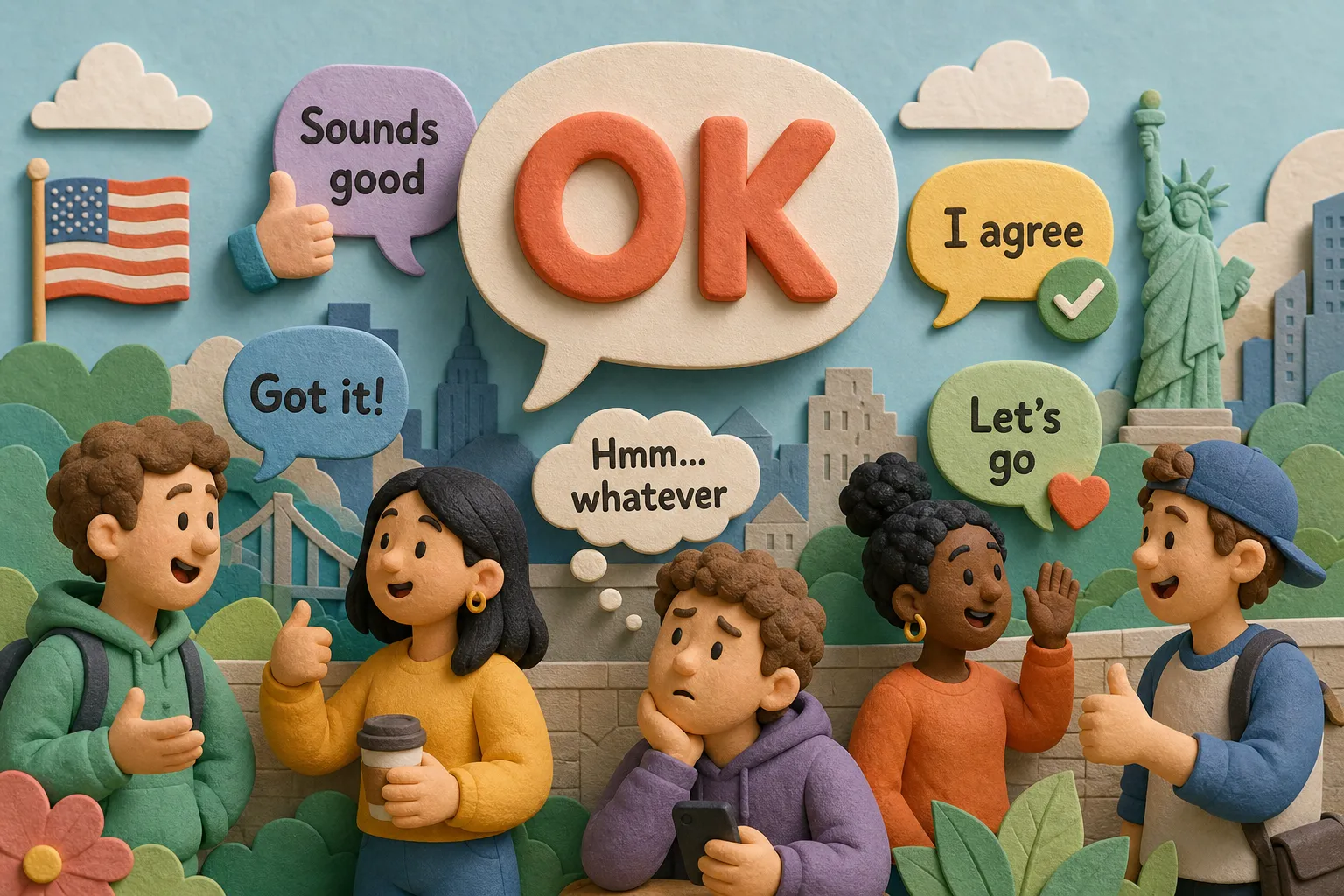
Knowing the grammar is one thing. Hearing how “OK” actually sounds and functions in real American conversations is what makes it usable. The same word carries different weight depending on tone, speed, and context. A bright, enthusiastic “OK!” sounds like excitement or agreement. A slow, flat “OK…” can signal reluctance, doubt, or mild irritation. Native speakers pick up on these differences instantly, even in text, based on punctuation and phrasing. Start calibrating your own “OK” usage by paying attention to these common patterns.
“Are you OK?” and other common check-in phrases
“Are you OK?” is one of the most frequent check-in phrases in American English. Americans use it genuinely when someone seems upset or unwell, but also casually as a social reflex. “You don’t look OK, what’s wrong?” is a concerned response to someone who seems off. “I’m OK, just tired” is a standard, low-key reply that reassures without going into detail. Culturally, this phrase operates on a spectrum from deep concern to a polite, greeting-level check-in, so don’t overthink it when someone asks you.
“OK, so…” as a natural conversation starter
Starting a sentence or story with “OK, so…” immediately signals that something is about to be explained, described, or shared. “OK, so this is what I need you to do” sets up an instruction. “OK, so I was at the store and the weirdest thing happened” pulls the listener into a story. This opener is casual, common, and sounds natural from a native speaker. Practicing it out loud is one of the most effective small steps you can take toward sounding more fluent in everyday American conversation.
When “OK” means just okay, not great
Pay attention to this one, because it trips up a lot of learners. When someone responds to “How was the movie?” with “It was OK,” they’re not saying it was good. They’re saying it was mediocre, passable, or underwhelming. “OK” in an evaluative context almost always signals mild dissatisfaction or lukewarm acceptance. Contrast it with “It was really good,” “I loved it,” or “It was great”, all of which signal genuine enthusiasm. Calibrating this helps you both interpret what Americans say and express yourself accurately without accidentally sounding unenthusiastic when you mean to give a compliment.
Putting “OK” to work: practice it in your own conversations
Small, high-frequency words like “OK” are the connective tissue of natural American English. Learners who focus only on advanced vocabulary often sound formal or stiff in conversation, not because their grammar is wrong, but because they’re missing the little words that hold real speech together. Mastering “OK” in all its forms is a concrete, immediate step toward sounding like someone who actually lives the language.
Try it yourself: three quick practice prompts
Try these out loud or in writing, each one targets a different use of “OK”:
- Your friend asks how your weekend was. It was fine but nothing special. Respond using “OK” as an adjective.
- Your manager needs to approve a request. Write a one-sentence message using “OK” as a verb.
- Start a short story about something that happened to you this week using “OK, so…” as your opener. Say it out loud and notice how natural it feels.
Why the small words are the hardest, and most important, ones
Discourse markers, response words, and conversational fillers like “OK” are almost never taught in formal lessons, but native speakers use them constantly in every single interaction. These are the words that signal your fluency level more reliably than your vocabulary size or grammar accuracy. Use them naturally and in the right situations, and you sound like you belong in the conversation. Skip them, and even perfect grammar can sound slightly off.
This is exactly the kind of everyday language that About, Your Daily American focuses on: not abstract grammar rules, but the real words and phrases Americans use all day, in every kind of situation, from casual texting to professional meetings. Explore more in our Everyday American English, Your Daily American category. For more practical phrases, see Common American Expressions Every English Learner Should Know, Your Daily American.
Wrapping up: OK in the US, from postal code to everyday word
You now have the full picture on “OK” in the US. When you see it on an address, it’s the official USPS postal code for Oklahoma, a state of about 4.02 million people in the South Central U.S. with Oklahoma City as both its capital and largest city. When you see OKC, that refers specifically to Oklahoma City. For state services, Oklahoma.gov and My.OK.GOV are the official portals to know.
When you see or hear “OK” in conversation, you’re dealing with one of the most versatile words in the language, one that started as a Boston newspaper joke in 1839 and spread across the country through a presidential campaign. As a word, it works as an adjective, adverb, verb, and discourse marker. It signals mild approval, official authorization, conversational transitions, and genuine concern depending on context and tone.
Two letters, two jobs, and now you know both well enough to use them with confidence in real American life. That’s OK in the US, fully decoded.