Understanding a vs an is simpler than most learners expect, once you know the real rule. Most people pick it up early: “a” before consonants, “an” before vowels. It works for simple cases, and then it completely breaks down the first time you see “an hour” or “a European.” Both seem to break the rule. Neither one actually does. The real rule is not about letters at all. It is about sound, and once you understand that, every confusing case clicks into place.
By the end of this lesson, you will know exactly when to use “a” versus “an”, not just in the easy cases, but in the tricky ones too: silent H words, acronyms, numbers written as numerals, and hyphenated compounds. Virtually all standard cases follow the same logic. You just need the right starting point.
A vs An: The One Rule That Explains Everything
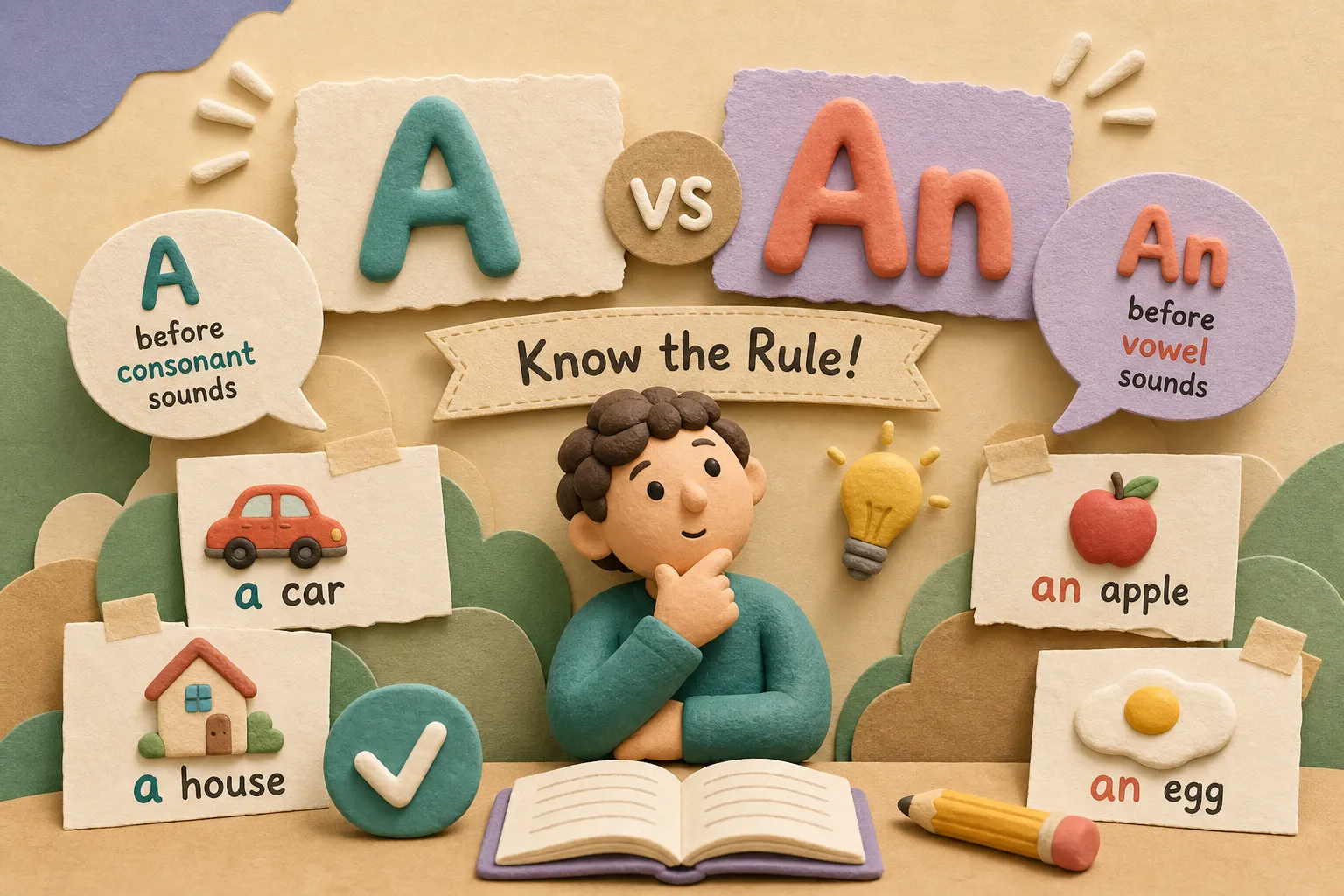
The choice between “a” and “an”, the two forms of the indefinite article, is based entirely on the sound that follows, not the letter. That one shift resolves every confusing case in this entire lesson. If the next word starts with a vowel sound, use “an.” If it starts with a consonant sound, use “a.” The spelling on the page is irrelevant.
Vowel sounds in English are the open sounds your mouth makes: “ah,” “eh,” “ih,” “oh,” “uh,” and sometimes “oo.” Consonant sounds are everything else, including sounds made by letters you might expect to be vowels. This is where the spelling trap bites most learners. The letter “e” starts both “elephant” and “European,” but those two words open with completely different sounds. “Elephant” starts with a short “eh” vowel sound, so you say “an elephant.” “European” starts with a “yoo” sound, which is a consonant sound, so you say “a European.” Same letter, different sounds, different articles.
The pattern holds across similar pairs: “an umbrella” but “a university” (which opens with “yoo-nih-VER-sih-tee”). “An orange” but “a one-time offer” (which opens with “wun”). The letter does not decide. The sound does.
The “say it aloud” test
Before you choose the article, say the next word out loud and pay attention to the very first sound your mouth makes. If your mouth opens into a vowel sound, use “an.” If you feel a consonant at the start, use “a.” This is not a rule native speakers recall consciously. It is something they feel in the rhythm of the sentence. When you read aloud enough and listen enough, you start to feel it too. That instinct is exactly what you are building toward.
The Silent H Trap: Why “An Hour” Is Not an Exception
Many learners assume “an hour” breaks the rule because H is a consonant. It does not break anything. It proves the rule perfectly. The H in “hour” is silent. The first sound you actually say is “ow-er,” which is a vowel sound. Because the article follows the sound and not the letter, “an” is the correct choice. The rule has not changed. The word just does not pronounce its first letter.
H words that take “an” because the H is silent
A small group of common English words drop the H entirely in pronunciation. These are the ones you need to know:
- an hour / an hourly rate
- an honest mistake / an honestly run business
- an heir / an heiress
- an honor / an honorable decision
In each case, the H is written but never spoken. Your mouth goes straight to the vowel sound that follows it, and the article connects to that vowel. If you say “an heir” out loud, it flows smoothly: “uh-nair.” That smoothness is the signal you are using the right article.
H words that keep “a” because the H is pronounced
Most English words that start with H have a fully voiced H, and in standard American English those generally take “a”: a house, a hotel, a hospital, a history. In American English, “a historic” is the correct form because the H in “historic” is pronounced. You say “hih-STOR-ik,” so the article is “a,” not “an.” Major American style guides, including AP and Chicago, agree on this point.
One important American English note: the word “herb.” In the U.S., the H in “herb” is silent, so Americans say “an herb.” In British English, the H is pronounced, making it “a herb.” If you are learning American English specifically, go with “an herb” and you will sound exactly like a native speaker from the U.S.
A vs An with Acronyms and Initialisms: Letters Are Sounds Too
The same article usage rules apply to abbreviations. You simply apply the sound-based test to the name of the first letter, not to the word that letter stands for. This trips up many learners who try to look at the full word behind the acronym instead of the abbreviation itself.
The test is simple: say the abbreviation out loud, then choose the article based on the first sound you hear. FBI is pronounced “eff-bee-eye.” The letter F is named “eff,” which begins with a vowel sound. So it is “an FBI agent.” NASA is pronounced as a word: “nah-suh.” That opens with a consonant sound, so it is “a NASA mission.” The rule is the same. You are just applying it to spoken letter names or spoken acronym sounds instead of regular words. For additional guidance on this point, see using articles before acronyms and initialisms.
Here is a quick reference for the most common cases you will encounter in professional and academic writing:
- “an” group: an MRI (“em”), an FBI report (“eff”), an HTML file (“aitch”), an OSHA inspection (“oh”), an X-ray (“eks”), an MBA (“em”)
- “a” group: a NASA launch (“nah”), a UNESCO site (“yoo”), a USB drive (“yoo”), a CEO (“see”)
Notice that USB and UNESCO both start with the letter U, but that letter is named “yoo,” which is a consonant sound. So both take “a,” not “an.” Spelling does not decide. Sound does.
A vs An with Numbers and Hyphenated Compounds
Numbers written as numerals follow the exact same sound-based logic. You say the number in your head, listen to the first sound, and choose accordingly. There is no separate rule for numerals.
Why “a one-time event” and “an 11-year-old” both make sense
The numeral 1, spoken as “wun,” starts with a “w” consonant sound. That makes it “a one-time event,” “a 1-year subscription,” “a one-off mistake.” The numeral 11, spoken as “ih-LEV-un,” opens with a short vowel sound. That makes it “an 11-year-old” or “an 11-month project.” A few more examples to lock it in: “an 8-hour shift” (“ate”), “a 12-month plan” (“twel-v”), “an 18-month period” (“ay-teen”).
Some writers mistakenly write “an 100” because the digit looks like it starts with a vowel. But 100 is spoken as “one hundred,” which starts with that “w” sound. So the correct form is “a 100-page report” or “a 100-year-old building.” Say it out loud. The answer becomes obvious.
Hyphenated compounds: just listen to the first word
Hyphens create no special exception. The article is chosen based on the first spoken sound of the first word in the compound, and the hyphen is completely invisible to the rule. “A well-known author” takes “a” because “well” starts with a “w” sound. “An old-fashioned idea” takes “an” because “old” opens with a vowel sound. “An X-rated film” takes “an” because the letter X is named “eks,” a vowel sound. “A one-off mistake” takes “a” because “one” sounds like “wun.” Follow the first sound, and the hyphen takes care of itself. For more on hyphenation and compounds, consult Merriam-Webster’s hyphen rules.
Why Fluent Speakers Rarely Hesitate, And How You Can Get There Too
Native American English speakers typically do not run through these rules before they speak. The choice feels automatic because of how spoken English flows. Understanding that flow is the difference between memorizing a rule and actually internalizing it.
In natural American speech, the articles “a” and “an” are rarely stressed. They are reduced, quiet, and linked to the words around them. Try saying “a apple” out loud. There is an awkward stop between the two words, a little catch in your throat. Now say “an apple.” The phrase glides forward smoothly because the “n” in “an” connects directly to the vowel that follows it. That smoothness is why speakers reach for “an” instinctively before vowel sounds. It is not a grammar rule they are recalling. It is the path of least resistance in connected speech.
This is part of a larger system in American English called connected speech, which governs how sounds link, reduce, and blend in natural conversation. (See Leonardo English’s guide to connected speech.) If this sound-first approach resonates, there is a lot more of it waiting for you at Your Daily American. The Pronunciation and Listening section goes deep into exactly this territory: how articles and function words connect to content words, how sounds shift in real speech, and how to train your ear so these patterns feel natural rather than effortful. Also see our English Words Non-Native Speakers Mispronounce Most Often, Your Daily American. When you understand how American English flows as spoken sound, grammar rules like this one stop being things you recall and start being things you hear. (See our Word Stress in American English: A Complete Guide.)
Try It Yourself: A Quick Self-Check
Fill in the blank with “a” or “an” in each sentence. Say each one out loud before you answer. The sound will guide you.
- “She has ___ MBA from ___ well-known university.”
- “It was ___ honest mistake.”
- “He works for ___ FBI field office.”
- “That was ___ one-off situation, not ___ ongoing issue.”
Answers: 1. an / a, 2. an, 3. an, 4. a / an. If you got all of those right, you have the rule. If one surprised you, go back to that section above and say the phrase out loud. The sound will confirm it.
The a vs an rule has exactly one consistent logic: follow the sound, not the letter. That single principle covers the basic cases, the silent H words, the acronyms, the numerals, and the hyphenated compounds. Mastering these article usage rules is one of the fastest wins available to English learners, because once you shift from looking at spelling to listening for sound, the rule becomes one of the most reliable in all of English grammar. For a thorough external reference, see Scribbr’s guide to a vs an. And that shift from letter-thinking to sound-thinking is exactly what building real fluency feels like.