The ship vs sheep contrast catches ESL learners off guard more often than any other vowel pair in American English. Imagine telling your coworker, “I live on this ship,” when you meant to say, “I leave on this ship.” One vowel. Two completely different messages. This kind of mix-up rarely causes laughter. It causes confusion, repeated clarifications, and that uncomfortable feeling that something went wrong but you’re not sure what.
By the end of this lesson, you’ll know exactly what your mouth should be doing for each sound, why your brain has been treating them as one sound, and you’ll have a targeted practice list you can start using today. The vowels in “ship” and “sheep” are among the most commonly confused pairs in American English for ESL learners, and the contrast is fixable with the right approach.
What’s Physically Happening in Your Mouth for Each Sound
You don’t need a linguistics degree to fix this. You need to know what your tongue, jaw, and lips are doing for each vowel. Once you feel the difference, you’ll start to hear it.
The /ɪ/ Sound in “Ship”: Relaxed and Short
IPA: /ʃɪp/ | Phonetic respelling: shihp
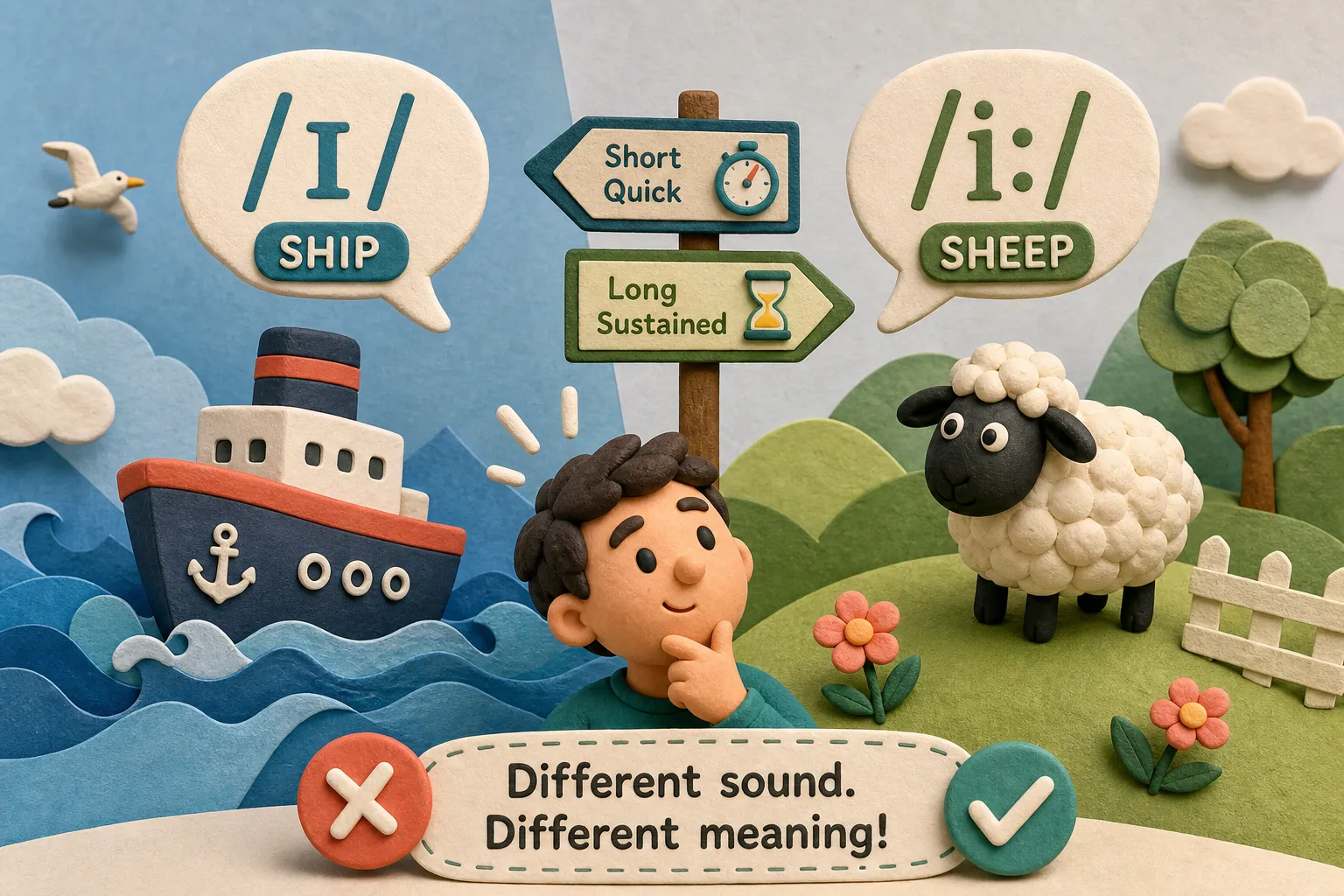
For this sound, your jaw drops slightly, your tongue sits in a high position in the front of the mouth but stays relaxed, and your lips are neutral, no spreading, no rounding. Think of this vowel as one you don’t hold: you say it and let it drop immediately. The key word is lax. The moment you tense your tongue for this sound, you start drifting toward /iː/ territory, which is the most common production mistake ESL learners make.
The /iː/ Sound in “Sheep”: Stretched and Held
IPA: /ʃiːp/ | Phonetic respelling: shiyp
For this sound, your jaw closes slightly more than for /ɪ/, your tongue rises higher toward the front of the mouth, and the corners of your lips pull back, almost like the very beginning of a smile. This vowel is tense. Your tongue is actively pressing upward, and the vowel has a slightly longer duration than /ɪ/. You can feel the contrast between the two: /ɪ/ drops, /iː/ stretches.
Vowel Length: A Real Cue, But Not the Only One
Here’s something that surprises a lot of learners: in fast, natural American speech, the length difference between “ship” and “sheep” can shrink to just a few milliseconds. Vowels shorten before voiceless consonants like /p/ and lengthen in other environments. If you rely on length alone to tell these sounds apart, you’ll make mistakes regularly. The reliable signal is vowel quality, meaning tongue height and lip position, combined with duration. Side by side in IPA: /ɪ/ vs /iː/. The colon after the /i/ signals a longer, tenser vowel, but the tongue position is doing the real work.
Why So Many Learners Hear These as the Same Sound
If you’ve been collapsing “ship” and “sheep” into one sound, you’re not making a careless mistake. You’re doing exactly what a human brain is supposed to do: fitting new sounds into familiar categories.
The One-Vowel Problem
Many languages, including Spanish, Portuguese, and Mandarin, have one high-front vowel, often written as /i/. When you encounter English’s two high-front vowels, your brain maps both of them onto that single familiar category. The result: you produce “sheep” when you mean “ship,” or you hear both words and they sound identical. This is called L1 transfer, and it’s a completely normal part of language learning. It doesn’t mean you have poor hearing or low ability. It means your brain is doing exactly what it learned to do in your first language.
Which Language Backgrounds Are Most Affected
Spanish, Portuguese, Catalan, and Mandarin speakers are among the learners who struggle most with this contrast, because their native languages don’t have a separate category for the lax /ɪ/ vowel. Persian speakers face a similar challenge, since Persian has a single high-front /i/ that maps to both English sounds. Japanese and Finnish speakers tend to have a slightly easier time because both languages already use vowel duration as a meaningful distinction. German and Norwegian speakers also tend to find the contrast more accessible, since their native vowel inventories already separate lax and tense high-front vowels. Knowing your starting point makes your practice more efficient because it tells you exactly where to focus.
Ship vs Sheep: Training Your Ear Before Your Mouth
Most learners jump straight to producing the sounds. That’s the wrong order. If you can’t reliably hear the difference between /ɪ/ and /iː/, you can’t self-correct, and your ear and your mouth stay disconnected from each other.
The Listen-First Approach
Start with a simple identification drill: listen to a word, decide whether it contains /ɪ/ or /iː/, then check your answer. Use clearly spoken audio at a normal pace before moving to faster, natural-speed input. Keep your practice anchored to one accent in the early stages, specifically General American, so your ear calibrates to one consistent sound model rather than bouncing between American and British versions of the same sounds. Both accents handle these vowels slightly differently, and mixing them up early on slows down your progress.
Shadowing and Repetition After a Model
Once you can identify the sounds reliably, start shadowing. Play the word or sentence, pause immediately, repeat out loud while focusing on your mouth position, then compare your version to the original. If you’re struggling to catch the vowel quality, slow the audio down to 0.75x speed using the playback settings in YouTube or any podcast app. The full sequence is: listen to identify, shadow to produce, then move to sentence-level practice. Don’t skip the listening stage, even if it feels passive. That ear training is what makes the production stick.
Ship vs Sheep: The Minimal Pair List to Drill This Contrast
A minimal pair is two words that differ by exactly one sound. That’s what makes them so effective for pronunciation practice: you isolate the one difference that matters and train your brain on that contrast alone. Work through two or three pairs per session rather than the full list at once. Deep focus on fewer pairs consistently beats a surface-level run through many.
Core Pairs That Follow the Same /ɪ/ vs /iː/ Pattern
| /ɪ/, short, lax | IPA | /iː/, long, tense | IPA |
|---|---|---|---|
| ship | /ʃɪp/ | sheep | /ʃiːp/ |
| bit | /bɪt/ | beat | /biːt/ |
| dip | /dɪp/ | deep | /diːp/ |
| live (verb) | /lɪv/ | leave | /liːv/ |
| sit | /sɪt/ | seat | /siːt/ |
| chip | /tʃɪp/ | cheap | /tʃiːp/ |
| fit | /fɪt/ | feet | /fiːt/ |
| pitch | /pɪtʃ/ | peach | /piːtʃ/ |
Practice Sentences for Real-World Context
Isolated words are a starting point, not the finish line. Move to full sentences as quickly as you can, because that’s where these sounds actually live in American speech. Say each sentence out loud, slow down only on the target vowel, then build back up to natural speed.
- “I want to sit in my seat before the movie starts.”
- “This chip is surprisingly cheap at that grocery store.”
- “She’s going to leave next month. She doesn’t live here anymore.”
- “Beat the eggs first, then dip the bread into the mixture.”
- “My feet don’t fit in these shoes.”
That last sentence is especially useful: both sounds appear side by side, forcing your mouth to switch between /iː/ and /ɪ/ within a single breath. That kind of back-to-back contrast is one of the most effective drills you can do once you’re past the identification stage.
Taking the Sounds From Drills to Natural Speech
Controlled drills work. But the brain has a frustrating habit: it learns to produce a sound correctly in an exercise and then reverts under the pressure of real conversation. This is normal, and it’s not a sign you’ve failed. It means you need the next stage of practice.
Why Word-Level Drills Aren’t Enough on Their Own
Progressive practice is the bridge between isolated drills and real speech. Work through three stages in sequence: single words, then sentences, then spontaneous speech with these sounds in natural context. Don’t rush the transitions, but don’t stay at the word level longer than you need to either. Recording yourself for 30 seconds of natural speech and then listening back specifically for /ɪ/ and /iː/ accuracy is one of the most effective self-study techniques you can use. You’ll catch things in the playback that you completely missed while you were speaking. Most learners are genuinely surprised by what they hear.
Using Your Daily American to Practice American Sounds Systematically
This lesson covers the core of the ship vs sheep contrast, the /ɪ/ vs /iː/ distinction, but pronunciation is a system, not a single sound. The Pronunciation and Listening section at Your Daily American is built to take you beyond isolated sounds and into connected speech, contractions, and the vowel patterns that show up in real American conversations. You’ll hear how sounds like /ɪ/ and /iː/ behave when words run together, when sentences speed up, and when stress shifts the whole rhythm.
The lessons are organized progressively, so you build from individual sounds up to the natural flow of spoken American English, with real conversational context built in so the practice stays grounded. You can also start with the free proficiency test on Your Daily American to pinpoint which pronunciation areas need the most attention, so your practice is targeted from day one.
Quick Self-Check Before You Go
Here’s the core takeaway: the ship vs sheep contrast is not about length alone. The real key is tongue height, lip position, and vowel quality. /ɪ/ is lax and quick, you drop it immediately. /iː/ is tense and stretched, with the tongue actively pressing upward. Both cues matter together.
Try these three steps right now:
- Say “bit” and “beat” out loud. Does your lip position change between them? It should: “beat” pulls the corners of your lips back slightly more than “bit.”
- Record yourself saying “I want to leave” vs “I want to live.” Play it back and listen for the vowel difference between those two key words.
- Choose two pairs from the list above and use each word in a sentence out loud today, not in your head: out loud.
Mastering this contrast takes repetition, not talent. Your ear learns first, your mouth follows. Give both the consistent practice they need, and the ship vs sheep difference will click.