You’re filling out a job application or writing a professional email in English. Everything looks good. Then you stop at one word. Should you write “licence” or “license”? Both spellings look familiar. Neither one looks obviously wrong. You stare at the screen for a moment and then guess.
This happens to English learners every day, and it happens to native speakers too, especially when they move between countries or write for international audiences. The good news is that this is not a random spelling question. It follows a clear, logical rule based on two things: where your audience is, and how the word is used in the sentence. By the end of this article, you’ll know which spelling to use in the US, the UK, and Canada, understand a similar pattern in other word pairs, and have a quick memory tool to use from now on. At Your Daily American , we focus on American English as it’s actually written and used in real life, and spelling decisions like this one are exactly where that precision matters.
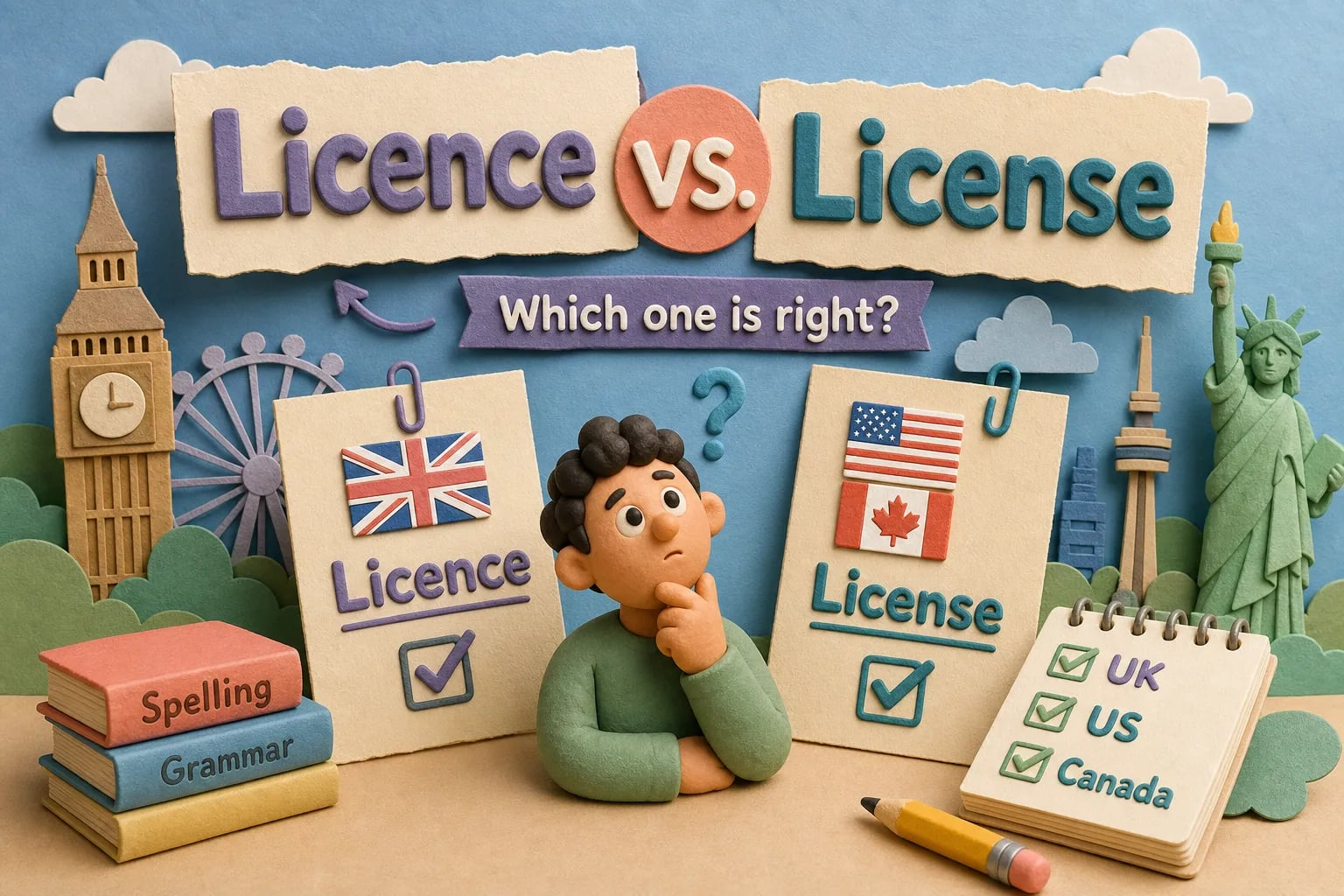
Licence vs. License, The Core Rule
The rule itself is straightforward. Once you understand the logic, the examples will make perfect sense. (For a concise comparison that walks through the same distinctions, see ProWritingAid’s explanation of licence vs. license.)
American English: license (noun and verb)
In American English, “license” is always spelled with an S, no matter how the word is used. It doesn’t matter if it’s a noun (a thing you have) or a verb (an action someone does). The spelling is always “license.” This is the rule you need if you live, work, or study in the US. The spelling “licence” with a C does not exist in American English. Using it would be treated as a spelling error.
British and Commonwealth English: licence (noun) vs. license (verb)
In British, Canadian, and Australian English, the spelling depends on the word’s grammatical role in the sentence. “Licence” with a C is the noun form. “License” with an S is the verb form. The same word carries two different spellings depending on whether it names a thing or describes an action. This is where most learners get confused, because both spellings look so similar and sound exactly the same.
Licence vs. License, How Each Region Spells It
Seeing the rule in real sentences makes it easier to apply. Here is how each region handles the word.
American English: always “license”
In the US, “license” covers every situation. Here are four examples:
- “She has a driver’s license .” (noun: the document)
- “The city licenses all restaurants.” (verb: the action of granting permission)
- “He applied for a liquor license .” (noun)
- “The FDA licensed the new drug last year.” (verb)
The spelling never changes. Whether “license” is the subject, the object, or part of a verb phrase, it’s always spelled the same way in American English.
British, Canadian, and Australian English: the noun/verb split
In these varieties of English, you need to identify whether the word is a noun or a verb before choosing the spelling. Here is how that looks in practice:
- Noun: “May I see your driving licence , please?” (British)
- Noun: “She holds a medical licence .” (Canadian)
- Verb: “The council will license the new shop next month.” (British)
- Verb: “The government licenses companies to sell alcohol.” (British/Canadian)
The pattern is consistent across British, Canadian, and Australian English: C for the noun, S for the verb. Canada follows the British pattern, as confirmed by government publications from the Translation Bureau and The Canadian Style guide. Australia does the same.
Real-World Situations Where This Comes Up
The rule shows up in a handful of specific, high-stakes situations where getting it wrong is noticeable. Here are the most common ones.
The document most people know: the driver’s license
The driving document is probably the most familiar example of this spelling difference. In the US, the official document is a driver’s license. In the UK, it’s a driving licence. In Canada, it’s a driver’s licence. All three phrases refer to the same physical document, but each country spells the key word differently. This single example illustrates the regional split clearly: the noun form in two countries, the same spelling rule in both.
Other common uses: software, business, and medicine
You’ll also encounter this word in professional and digital contexts. A software license (US) or software licence (UK/Canada) is the legal agreement that lets you use a program. A business license (US) or business licence (UK/Canada) is the permit a company needs to operate. Medical credentials follow the same pattern. In every case, American English uses “license,” and British and Canadian English use the C spelling for the noun form. If you are writing for an American employer, an American university, or a US-based client, always use “license.”
Other Word Pairs That Work the Same Way
The licence/license distinction is not a random exception. It reflects a broader pattern in British English where a C marks the noun and an S marks the verb. Recognizing this pattern helps you handle similar words correctly.
Practice vs. practise
This pair works exactly the same way. In American English, “practice” is used for both the noun and the verb. In British English, “practice” (with a C) is the noun, and “practise” (with an S) is the verb. Here are examples of each:
- American: “She goes to practice every day.” (noun) / “You should practice more.” (verb)
- British noun: “She goes to football practice every day.”
- British verb: “She needs to practise more before the exam.”
In British English, C marks the noun and S marks the verb. In American English, one spelling covers both uses, the same logic you just learned for licence/license. This pattern also tends to trip up American learners when they encounter British documents, since “practise” can look like a misspelling at first glance. For a clear overview of the practice/practise distinction, see Grammarly’s guide to practice vs. practise.
Advice vs. advise (and why this pair is different)
This pair looks similar to the others, but it works differently. “Advice” is always the noun (a thing you receive), and “advise” is always the verb (an action you do). This rule applies in every variety of English, not just British. There is no regional variation here. Both American and British writers use “advice” for the noun and “advise” for the verb.
It’s worth flagging this clearly so you don’t apply the British/American pattern to this pair. The -ce/-se difference in “advice/advise” is about grammar, not geography. A quick way to check: “advice” and “advise” are pronounced differently (“AD-vice” vs. “ad-VIZE”), which makes them easier to keep separate. “Licence” and “license” sound exactly the same, which is why the spelling confusion is far more common with that pair.
What Major Style Guides Recommend
If you write for work, school, or publishing, style guides make this decision easy. They are the books that set the rules for professional writing in each region.
American guides: AP Stylebook and Chicago Manual of Style
Both of these guides follow Merriam-Webster as their dictionary authority, and both are clear: use “license” for all uses, noun and verb. There is no entry for “licence” as a valid American English spelling. If you write for US journalism, business communication, or academic publishing, the answer is always “license.” No exceptions. See the AP Stylebook’s guidance for more on regional spelling and usage choices.
British and international guides: Oxford and Canadian government
The Oxford English Dictionary confirms “licence” as the British noun spelling and “license” as the British verb. Canadian government publications, including The Canadian Style from the Translation Bureau, give the same guidance: “licence” for the noun, “license” for the verb. The key takeaway is simple: your spelling should match your audience’s country, not your own preference. If you write for a UK company or a Canadian government agency, follow their regional rules.
A Simple Way to Remember the Licence vs. License Rule
Rules are easier to apply when you have a quick mental tool to check your work. Here is one that holds up well for this word pair.
The memory trick that works
For British English writers and learners, focus on the letter itself. In “licence,” the C marks the noun. In “license,” the S marks the verb. Think of C as a label for a thing, and S as a label for an action. When you write the word, ask yourself: am I naming a thing or describing an action? Then match the letter to the answer.
You can also use “advice/advise” as a reference point. If you already know that “advice” (with a C) is the noun and “advise” (with an S) is the verb, apply the same logic to “licence/license” in British and Canadian English. The pattern is the same.
For American English learners, the rule is even simpler
If you are learning English specifically for life in the United States, work, study, immigration, or daily use, you only need one spelling: “license.” Always. No noun-verb check required. No C version exists. This is one of many places where American English is more consistent than its British counterpart, which makes it a little easier to learn in practice.
The Short Answer
Here is the licence vs. license rule in two sentences. In American English, “license” is always correct for both the noun and the verb. In British and Canadian English, use “licence” (with a C) for the noun and “license” (with an S) for the verb.
Remember the similar pairs: “practice/practise” follows the same British pattern, while “advice/advise” stays consistent in every variety of English. When in doubt, check which country your audience is in before you write. Your spelling should match your reader’s region, not your own default.
If you are building your American English skills for work, life, or study in the US, spelling is just one piece of the picture. Pronunciation, grammar, workplace phrases, and understanding fast native speech all matter just as much. Your Daily American brings all of those elements together in one place, organized so you can start at your level and build from there. Learn more about the site on the About, Your Daily American page. If pronunciation is a priority, check Word Stress in American English: A Complete Guide, Your Daily American, and for a quick list of commonly mispronounced items by non-native speakers, see English Words Non-Native Speakers Mispronounce Most Often, Your Daily American. Building this kind of precise, practical knowledge, knowing not just vocabulary but the exact spelling, grammar, and usage that American readers expect, is exactly what the platform is designed to help with. Take the free proficiency test and find out exactly where to focus your energy next.