Picture this: you’re in a meeting at work. You point to a document on your desk and say, “Look at that report.” Your American colleague pauses, looks confused, then hands you the wrong file. You both meant the same thing, but one small word sent the message in the wrong direction.
Most English learners know “this” and “that” exist. What takes more practice is choosing between them quickly and correctly, the way native speakers do without thinking. Understanding that vs this sits right at the center of what separates “technically correct” from “sounds natural.” At Your Daily American, we focus on exactly these small grammar choices, because when you use pointing words well, your English feels more confident and clear.
By the end of this lesson, you’ll know the core near/far rule for that vs this, how to use both words with a noun or on their own, how “that” can signal emotional distance, and how to fix the most common mistakes learners make.
That vs This: The Core Near/Far Rule
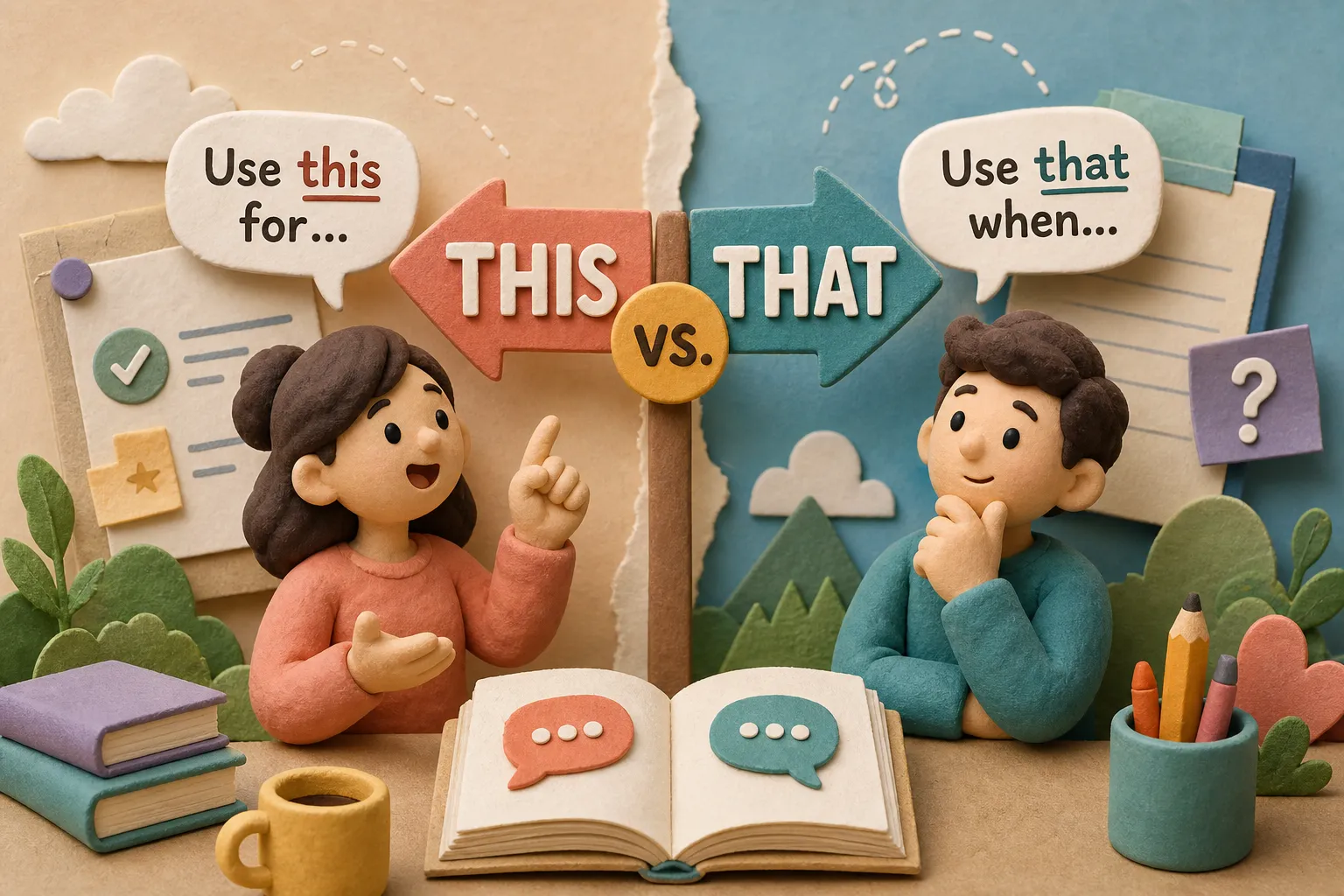
Linguists call these words demonstratives, which simply means “pointing words.” A pointing word shows which thing you mean. Think of it like using your finger: “this” points at something close to you, and “that” points at something farther away. That physical idea is the foundation of everything.
Researchers call the close position proximal (near the speaker) and the far position distal (away from the speaker). You don’t need to memorize those terms, but knowing the concept helps. This idea of using language to point to things even has a technical name: deixis (DEK-sis), meaning how language locates or points to people, places, and things. The simple version: “this” = here, “that” = there.
Here are some clear examples to show the contrast:
- “This coffee is too hot.” (The cup is in your hand.)
- “Pass me that coffee on the counter.” (The cup is across the room.)
- “I love this neighborhood.” (You’re standing in it.)
- “That neighborhood across town is really quiet.” (You’re talking about somewhere else.)
- “This chair is comfortable.” (You’re sitting in it.)
- “That chair by the window looks broken.” (You’re looking at it from a distance.)
The distance does not have to be physical. “This” feels close and present, in space, in time (“this week”), or in conversation (“this point I’m making”). “That” feels removed or separate, physically distant, already past (“that week”), or emotionally detached (“that point you raised earlier”). Keep that feeling in mind as we go further.
Two Jobs These Words Can Do
Both “this” and “that” can work in two ways: with a noun or standing alone. The meaning stays the same, but the job changes.
Used with a Noun
When “this” or “that” comes directly before a noun, it modifies that noun. It acts as a pointer that helps you identify which specific thing you mean. Grammarians call this the demonstrative determiner role, but you can just think of it as “with a noun.” For a clear grammar overview, see the English Grammar Handbook.
- “This meeting is running late.”
- “That email was very confusing.”
- “This plan makes sense to me.”
A quick test: if a noun follows right after “this” or “that,” the word is doing the “with a noun” job.
Used Alone (Without a Noun)
When “this” or “that” stands alone, it replaces the noun entirely. Grammarians call this the demonstrative pronoun role. A helpful test: if you can naturally add “one” after it (“this one,” “that one”), then the word is standing alone as a pronoun. For more on pronouns and how they work, check this pronouns guide.
- “This is what I meant.” (This = the idea or thing at hand.)
- “That was a great presentation.” (That = the presentation that just ended.)
- “I’ll take this.” (This = the item near you.)
Both uses are extremely common in everyday American English. Listen for it the next time a coworker says, “I’ll take this one” at a meeting, you’ll start recognizing the pattern in real time.
That vs This When There’s Nothing to Point At
The near/far rule works perfectly when you have a physical object nearby. But what about phone calls or conversations where there’s nothing in front of you? This is where many learners feel less sure.
Introducing Yourself or Someone Else
In American English, the standard way to identify yourself on a phone or video call is “This is [name].” Phrases like “I am Maria” or “Here is Maria” sound unnatural in this context and are not the convention. In standard American phone etiquette, “This is [name]” is the customary opener; in very casual situations, speakers may simply say “It’s me” or “Hey, it’s Maria.” Also practice common filler phrases every American English learner should know. For practice phrases and phone tips, see telephone calls in English.
Here is how a typical call sounds:
“Hello, this is Marcus from the sales team.”
“Oh, hi Marcus, is that Laura?”
“Yes, this is she. What can I do for you?”
Note: “Yes, this is she” is the traditional, formal construction. In informal American speech, you’ll also hear “It’s me” or “Speaking” as common alternatives. Notice how “that” refers to the person on the other end of the line. The speaker uses “this” for themselves (close, present) and “that” for the other person (at a distance, not physically visible).
Pointing Backward or Forward in Conversation
In conversation, “that” often points backward to something already said. “This” points forward to something new or currently happening.
Office setting:
“We need to cut the budget by 20%.”
“That‘s going to be a tough conversation with the team.”
Casual setting:
“This is what I think we should do: call him directly and explain the situation.”
When “that” follows what was just said, it tells the listener, “I heard you, and I’m reacting to that past point.” When “this” leads into something new, it signals, “Pay attention, here comes the key idea.”
How “That” Creates Distance in American Speech
Here is something native speakers do naturally that most learners haven’t been taught: “that” can push something away not just physically, but emotionally. When a speaker wants to show they are not interested, not involved, or slightly dismissive, they often choose “that” over “this.”
Compare these two sentences:
- “This plan is exactly what we need.” (The speaker is engaged and enthusiastic.)
- “That plan might work, I guess.” (The speaker sounds doubtful or uninterested.)
The object is the same plan. The word choice changes the emotional message completely. Other examples of this distancing effect:
- “I don’t want to talk about that.” (Pushing the topic away.)
- “That‘s not really my problem.” (Separating yourself from the issue.)
- “Oh, that‘s fine.” (Said flatly, this often means “I don’t care.”)
How Stress Shifts the Feeling
In spoken English, where you place stress on these words changes the tone significantly. Stressing “THIS” signals strong current relevance or contrast. Stressing “THAT” can show surprise, disbelief, or rejection.
Pay attention to these patterns in American movies, TV shows, and everyday conversations:
- “You chose THAT? I told you THIS was better.” (Disapproval + strong preference.)
- “THIS is the plan we agreed on. THAT was the old version.” (Current vs. past.)
- “She passed THAT test?” (High stress + rising pitch = disbelief.)
For now, just listening for these stress patterns in American TV and film is enough to start internalizing them naturally. If you want to study stress and pitch more formally, check this stress and intonation resource.
Common Mistakes and How to Fix Them
Here are the errors learners make most often with that vs this, along with clear corrections. For a related detailed article, see Which or That? Mastering This Common Grammar Mistake.
The This/These and That/Those Mix-Up
“These” is the plural form of “this,” and “those” is the plural form of “that.” The rule is simple: if the noun is plural, you need the plural pointing word.
- Wrong: “This books are on my desk.”
- Right: “These books are on my desk.”
- Wrong: “That ideas are interesting.”
- Right: “Those ideas are interesting.”
A useful check: if you can count the noun and there’s more than one, switch to “these” or “those.”
The Uncountable Noun Trap
Uncountable nouns (words like furniture, advice, water, information, news) are always singular in English. They do not take an “s,” and they pair with “this” or “that”, never “these” or “those” directly. If you want to reference multiple items, use a unit phrase: “these pieces of advice” or “those items of information.” For common learner errors, see this guide on common mistakes with count and noncount nouns.
- Wrong: “I like these furnitures.”
- Right: “I like this furniture.”
- Wrong: “Can you give me these advices?”
- Right: “Can you give me this advice?” or “Can you give me a piece of advice?”
- Wrong: “I need those informations.”
- Right: “I need that information.”
Try It Yourself
Choose the correct word for each sentence. Say them aloud or write your answers in a notebook.
- “___ coffee in my hand is cold.” (This / These)
- “Did you hear ___ announcement they made yesterday?” (this / that)
- “___ shoes by the door are mine.” (Those / That)
Answers: 1. This. 2. that. 3. Those.
Frequently Asked Questions: That vs This
- When do I use that vs this?
- Use “this” for something close to you in space, time, or conversation. Use “that” for something farther away, already mentioned, or emotionally distant. If you’re holding it or introducing it, reach for “this.” If you’re referring back to it or separating yourself from it, “that” is your word.
- Can “this” and “that” replace a noun entirely?
- Yes. When used without a noun (demonstrative pronoun role), both words stand in for the thing you mean. A quick test: if you can say “this one” or “that one” and it still makes sense, the word is acting as a pronoun.
- What’s the difference between “that” and “it”?
- “It” is a neutral pronoun that refers to something already established in context without adding any sense of distance or emphasis. “That” actively points, either backward in conversation or away emotionally. Compare: “It was a good meeting” (neutral reference) vs. “That was a good meeting” (slight backward glance, mild emphasis).
- Do I always need “this” or “that” with uncountable nouns?
- Yes, uncountable nouns like advice, furniture, and information always take “this” or “that,” never “these” or “those”, unless you use a unit phrase like “these pieces of advice.”
You’re Closer to Fluency Than You Think
Here are the four ideas to keep with you when deciding that vs this: “this” is near, “that” is far; both words can work with a noun or stand alone; “that” can create emotional distance, not just physical distance; and plural nouns need “these” or “those,” while uncountable nouns always stay with “this” or “that.”
Two small words carry a lot of meaning in American English. When you use them correctly and confidently, native speakers notice, even if they can’t say exactly why your English sounds natural. It’s one of those details that quietly signals fluency.
This is exactly the kind of lesson you’ll find throughout Your Daily American. The platform focuses on the real, practical English that native speakers actually use, from small grammar choices like this one to full conversations, pronunciation, and professional communication. Explore the site to find lessons matched to where you are right now.
Before you move on, go back to those three practice sentences, say them out loud one more time, and notice how natural “this” and “that” already feel.