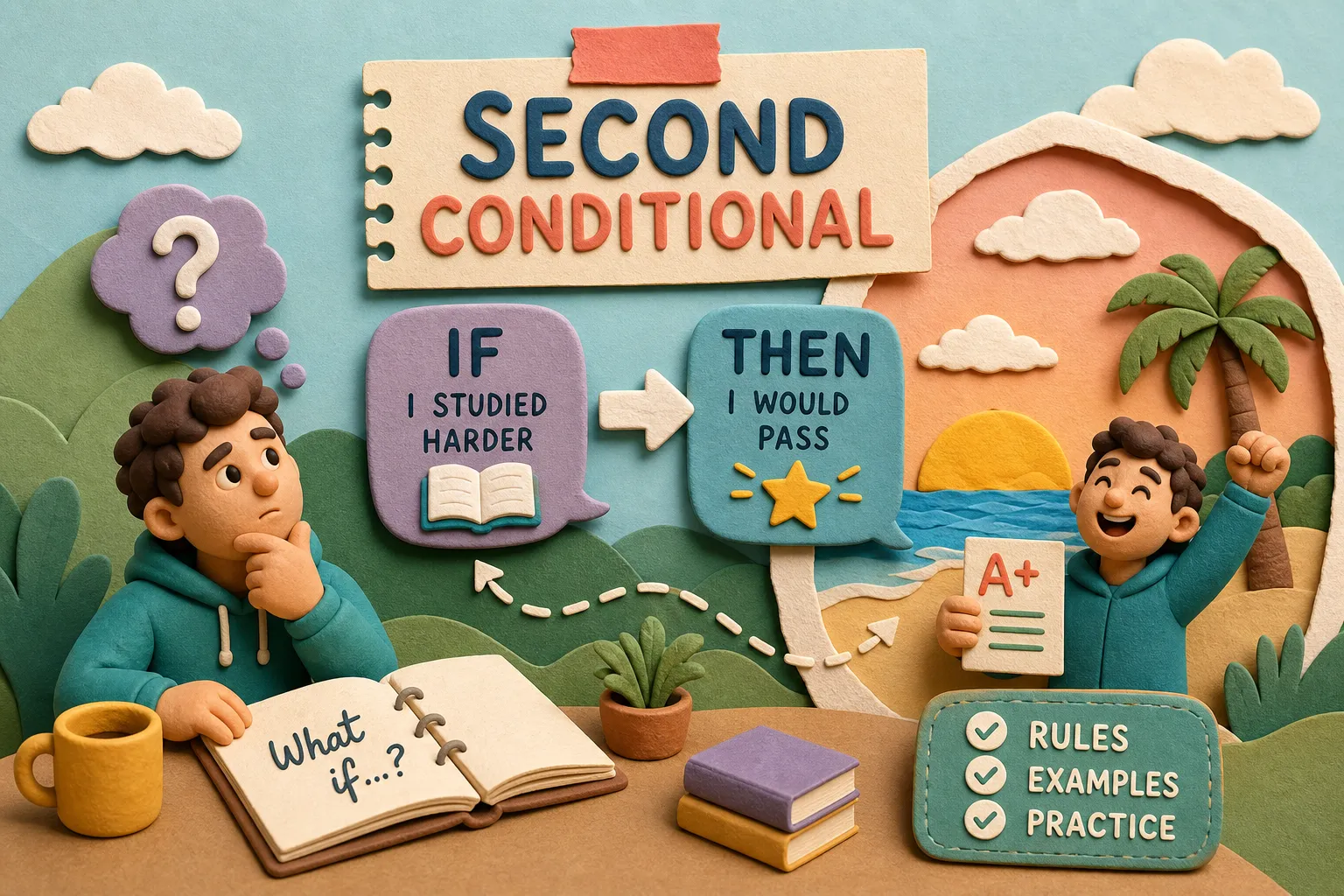
By the end of this lesson, you will be able to form the second conditional correctly, use it in real American conversations, and avoid the most common mistakes. Many learners study this grammar in a textbook and feel confident, then a job interviewer asks a hypothetical question and the words disappear. The formula is straightforward: if + past simple, would + base verb. But knowing a formula and using it naturally are two different things, and grammar makes much more sense when you see it in real situations. That is the approach this lesson takes throughout.
Also called the type 2 conditional, this structure is particularly useful for hypotheticals, polite suggestions, and interview questions, situations that come up constantly in American professional and social life. Master it here, and you will notice these conditional sentences everywhere.
How the second conditional is built
This conditional structure talks about situations that are not real right now. You use it to imagine something or to describe something you think is unlikely. The core formula is if + past simple, would + base verb. The if-clause states the imaginary condition, and the main clause states the result. You can put either clause first without changing the meaning.
Affirmative form
The affirmative structure is simple once you see it in action. Here are two examples set in everyday American life:
- “If I lived in New York, I would take the subway every day.”
- “If she had more experience, she would apply for that position.”
Notice that the verb in the if-clause is in the past simple, even though the sentence is about an imaginary present situation. This is normal and correct in English.
Negative form
You can make the if-clause negative, the main clause negative, or both. Contractions like wouldn’t are common and natural in spoken American English. Here are three clear examples:
- Negative if-clause: “If I didn’t work on weekends, I would have more time to study.”
- Negative main clause: “If they had children, they wouldn’t travel so much.”
- Both negative: “If I didn’t want to go, I wouldn’t tell you.”
Question form
To form a question, move would to the front of the main clause. In spoken American English, the would-clause often comes first. For example: “Would you change careers if you could start over?” The past simple still stays in the if-clause, and only the word order shifts.
“Were” vs. “was”: the rule and real-world usage
This point confuses many learners. When the verb be appears in the if-clause of a type 2 conditional sentence, the grammatically preferred form is were for all subjects: I, he, she, it, we, they. This form comes from the subjunctive mood, a verb form that signals unreality or imagination. English uses it in only a few specific situations, and the second conditional is one of them.
When to use “were”
“Were” is the safe choice in formal writing, professional emails, and job interviews. Use it with any subject when the condition is imaginary or impossible:
- “If I were in charge, I would change the meeting schedule.”
- “If she were available, I would call her right now.”
- “If he were here, he would know what to do.”
When Americans use “was”
Many native American English speakers say “was” in casual conversation. “If I was you, I’d talk to the manager” is something you will hear often. This is accepted in relaxed, everyday talk, but it sounds less formal. The rule of thumb: use were in writing and in job interviews; was is fine in relaxed daily conversation. Spanish and Portuguese speakers often slip into “was” in formal contexts, so this distinction is worth remembering.
Second conditional vs. first and third conditionals
The key difference between these three conditional forms is not the grammar, it is the meaning. Ask yourself: is the situation possible, imaginary, or about the past? That answer tells you which structure to use.
First vs. second: possible vs. imaginary
Compare these two sentences:
- First conditional: “If I get the job, I will start on Monday.” (You applied. It is possible.)
- Second conditional: “If I got the job, I would start on Monday.” (You haven’t applied, or you think it is unlikely.)
The verb form in your if-clause tells the listener how real you think the situation is. Present simple = possible. Past simple = imaginary. (See our guide to 12 English Verb Tenses for more on how verb choices affect meaning.)
Second vs. third: present imagination vs. past regret
This conditional structure is always about the present or future. The third conditional is always about the past. Look at this minimal pair:
- Second conditional: “If I had more time, I would study for the exam.” (Imaginary now or in the future.)
- Third conditional: “If I had had more time, I would have studied for the exam.” (About the past; you cannot change it now.)
The third conditional uses had + past participle in the if-clause. The type 2 conditional uses only the past simple. Keep this difference clear, and you will avoid one of the most common mixing errors. For additional explanations and practice with zero, first and second conditionals, see the British Council’s conditional guide.
How Americans use the second conditional in real life
This structure does two important things in American communication. It lets you think out loud about hypothetical situations, and it makes requests or suggestions sound more polite and less direct.
In job interviews
American interviewers often use hypothetical questions to see how you think and solve problems. A common example: “What would you do if a client became frustrated with you?” A strong answer uses the same structure back: “If that happened, I would listen carefully and try to understand their concern.” This response shows calm, professional thinking. Practice this pattern before any interview in English.
In workplace discussions and polite suggestions
The second conditional softens advice so it sounds less like a command. “If I were you, I would send a follow-up email” is much gentler than “Send a follow-up email.” Here are two more workplace examples:
- “If the budget weren’t so tight, we would hire more people.”
- “It would be great if you could join the call tomorrow.”
Building this kind of practical, situational grammar is exactly what Daily Grammar focuses on, every lesson connects to how the language is actually used in daily American life, not just abstract rules on a page.
In casual “what if” conversations
The second conditional is also a great tool for small talk. Americans use “what if” questions to connect with people and share ideas. Two common examples: “If you could live anywhere, where would you go?” and “What would you do if you won the lottery?” These questions are fun, low-pressure ways to practice the structure in real conversation, and the more you use it informally, the more naturally it will come out when it counts.
For more everyday phrases you can use in these conversations, see our list of Common American Expressions.
Common mistakes and how to fix them
These are the errors learners make most often. Read each one and check whether you recognize your own pattern.
“Would” in the if-clause
This is the most common error: the if-clause always uses the past simple, never would .
- Incorrect: “If I would know the answer, I would tell you.”
- Correct: “If I knew the answer, I would tell you.”
The rule is firm: would never goes in the if-clause. Spanish and Portuguese speakers make this error often because their native languages sometimes allow the conditional form in both clauses. For a clear, accessible overview of conditional sentences and their typical mistakes, read Grammarly’s guide to conditional sentences.
Mixing up second and third conditionals
A mixed sentence like “If I studied more, I would have passed the exam” does not fit either conditional correctly. If you are talking about the past, use the third conditional: “If I had studied more, I would have passed.” If you are talking about an imaginary present habit, stay fully in the type 2 conditional: “If I studied more, I would feel more confident.” Pick one time frame and stay in it. For a list of typical conditional errors and short explanations, see the Cambridge Dictionary’s guide to typical conditional errors.
A quick note on other errors
Two smaller errors to watch for: “unless if” is never correct because unless already means if not, so just write “unless” alone. Also, remember not to add to after would, could, or might: “would travel,” not “would to travel.”
Second conditional exercises: quick practice
Complete each sentence with the correct forms of the verbs in parentheses. Try each one before reading the answer. This is not a test; it is a self-check to help you see where you are confident and where you need more practice. If you want more targeted practice exercises on the second conditional, try the worksheets and drills at Perfect English Grammar.
- If I _______ (be) you, I _______ (talk) to the manager directly.
- If he _______ (have) enough money, he _______ (buy) a bigger apartment.
- If she _______ (not / be) always late, she _______ (get) promoted.
- If I _______ (speak) perfect English, I _______ (have) more confidence in meetings.
- She _______ (be happier) if she _______ (have) more time for herself.
- _______ you _______ (accept) the job if it _______ (require) relocation?
Answer key
- were / would talk. “Were” is the grammatically preferred form in the if-clause for hypothetical situations in formal and written English; “was” appears in informal speech. “Would + base verb” goes in the main clause.
- had / would buy. “Had” is the past simple of “have.” “Would buy” is the hypothetical result.
- weren’t / would get. The negative of “be” in the if-clause is “weren’t” in formal second conditional sentences.
- spoke / would have. “Spoke” is the past simple of “speak.” “Would have” shows the imaginary result.
- would be happier / had. The main clause can come before the if-clause. The same rules apply regardless of clause order: “would + verb” and past simple.
- Would you accept / required. Full sentence: “Would you accept the job if it required relocation?” In questions, “would” moves to the front, and “required” is the past simple in the if-clause.
You can use this grammar now
You can now form this conditional structure in all three forms: affirmative, negative, and question. You know when to use “were” and when “was” is acceptable in casual speech. You can also tell the difference between a first conditional (possible future), a type 2 conditional (imaginary present or future), and a third conditional (past regret), and you can spot and fix the most common errors before they happen.
The real power of this grammar comes from using it in actual conversations, not just exercises. This week, listen for these conditional sentences in American TV shows, workplace conversations, or podcasts. When you hear “If I were you…” or “What would you do if…,” you will recognize the structure immediately. Try writing your own example, something real to your life, and that recognition becomes production.
If you want to keep building this kind of practical grammar knowledge in real American contexts, explore Your Daily American. Every lesson is built around how the language is actually spoken and used in daily American life, so the grammar you learn connects directly to the conversations you want to have.