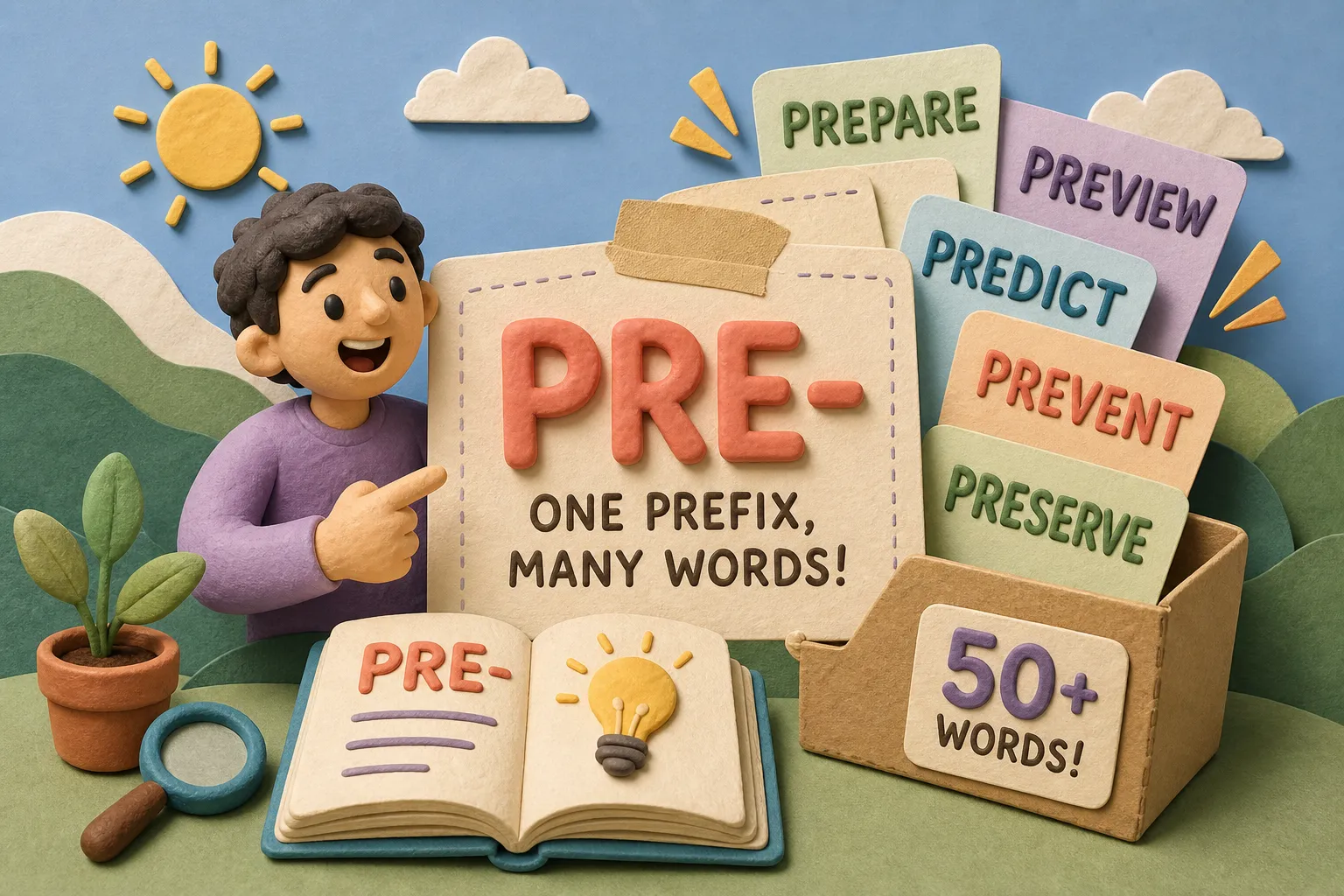
The pre- prefix means “before”, and that one piece of knowledge helps you decode dozens of English words the moment you first see them, no dictionary required. This prefix appears in hundreds of English words (though a smaller subset are common in everyday use), and once you understand how it works, new vocabulary stops feeling like guesswork.
By the end of this lesson, you’ll be able to define the prefix, recognize it across a wide range of common words, and use those words correctly in daily conversation and at work. This is exactly how vocabulary is taught at Your Daily American: not as long, forgettable lists, but as patterns that stick because they make sense.
What the pre- prefix means (and where it comes from)
The prefix pre- means “before” or “in advance.” That’s it. One meaning, many words. Look at these four examples and you’ll see the pattern immediately:
- preview = see before (others do)
- preheat = heat before (you cook)
- prepay = pay before (you receive something)
- preschool = school before (regular school starts)
Every one of those words follows the same simple rule. Once you see it, you can’t unsee it.
The Latin root: prae-
The prefix pre- comes from the Latin word prae-, which also meant “before” or “in front of.” When Latin words entered English, the a was dropped and prae- became the simpler pre-. This happens with many Latin prefixes in English. The meaning stayed exactly the same; only the spelling got shorter. (For a concise etymology of the root, see Membean’s page on the root “pre-“.)
The one rule every learner needs
Here is the most useful habit you can build: when you see pre- at the start of a word, ask yourself, “before what?” The root word right after pre- almost always answers that question. For example, predict = pre + dict (from Latin dicere, “to say”) = to say something before it happens. Prevent = pre + vent (from Latin venire, “to come”) = to come before a problem and stop it.
You don’t need to know Latin to use this rule. Just look at the root, ask “before what?”, and you’ll get the meaning in seconds. That mental habit is the fastest way to decode new words when you’re reading or listening.
Pre- prefix word list: 50+ examples by real-life situation
Lists of words in alphabetical order are hard to remember. Your brain holds vocabulary better when you can picture a real situation. Here are words built with the pre- prefix grouped by where you’d actually use them. Note that the total includes both high-frequency everyday words and common derived forms, the core everyday vocabulary is smaller, but every word below is worth knowing. (If you want an extended alphabetical list for quick reference, see this vocabulary list of pre- words.)
Words you use in daily life
These high-frequency words appear in everyday reading, listening, and conversation. Each one follows the “before” rule.
- preview: see something before it’s released (“I watched the movie preview.”)
- prepare: get ready before an event (“She prepared for the test.”)
- predict: say something before it happens (“He predicted rain.”)
- prevent: act before a problem to stop it (“Wash your hands to prevent illness.”)
- precaution: a step taken in advance to avoid danger (“Wear a seatbelt as a precaution.”)
- prefer: like one thing more than another before choosing (“I prefer coffee to tea.”)
- preschool: school before regular school (“Her daughter goes to preschool.”)
- premade: made before you buy or use it (“I bought a premade salad.”)
- prepay: pay before receiving the service (“You can prepay for parking online.”)
- preorder: order something before it’s available (“I preordered the new phone.”)
- prehistoric: from before written history (“The museum had prehistoric bones.”)
- preowned: owned before by someone else (“They sell preowned cars.”)
- preheat: heat before cooking (“Preheat the oven to 350 degrees.”)
- preset: set in advance (“The TV has preset channels.”)
- prewash: wash before the main wash (“This shirt needs a prewash.”)
- precooked: cooked before you buy it (“The precooked rice saves time.”)
- preteen: the years just before the teenage years (roughly ages 9, 12)
- prejudice: an unfair opinion formed before knowing the facts
- prefix: letters added before a root word (like pre- itself)
Words for the workplace and professional English
These words appear regularly in emails, meetings, and professional conversations. Learning them will help you sound natural and confident at work.
- prerequisite: something required before you can do something else (“A driver’s license is a prerequisite for this job.”)
- predecessor: the person who had a job before you (“My predecessor left detailed notes.”)
- preliminary: coming before the main part (“We had a preliminary meeting to plan the project.”)
- preapprove: approve something before the official process (“The bank preapproved her loan.”)
- precondition: a condition that must exist before something happens (“Trust is a precondition for a good team.”)
- prescreen: check or test before the main selection (“HR prescreens all applicants before the interview.”)
- predetermined: decided in advance (“The meeting agenda was predetermined.”)
- presume: believe something is true before you have proof (“I presume you received my email.”)
- predominant: the most common or powerful (“English is the predominant language in our meetings.”)
- prequalify: meet the basic requirements before a full review (“She prequalified for the mortgage.”)
- prearranged: arranged in advance (“The driver arrived at the prearranged time.”)
Words for school and academic English
You’ll see these in textbooks, lectures, and academic articles. They look longer, but they still follow the same pre- = before logic.
- precede: come before something in order (“Chapter one precedes chapter two.”)
- preclude: make something impossible before it happens (“Bad weather precluded the outdoor event.”)
- premise: a statement used as the starting point before building an argument
- premeditated: planned before doing something (“The attack was premeditated.”)
- preemptive: done before something bad can happen (“They took preemptive action to stop the problem.”)
- premonition: a feeling about something before it happens (“She had a premonition that something was wrong.”)
- prescient: knowing or predicting things before they happen (“His prescient analysis was proven correct years later.”)
Pre- vs. post-: a quick comparison
Understanding the prefix pre- (“before”) gets even sharper when you set it next to its opposite: post-, which means “after.” These two prefixes show up as a pair across many fields, so recognizing both at once doubles your decoding power.
- preseason vs. postseason: the period before a sports season vs. after it
- prewar vs. postwar: before the war vs. after the war
- pretest vs. post-test: a test before instruction vs. a test after
- prenatal vs. postnatal: before birth vs. after birth
When you spot either prefix, the root word tells you what, and the prefix tells you when. Pre- = before. Post- = after. That combination covers a huge share of professional and academic vocabulary.
Simple spelling and pronunciation rules for words with pre-
Adding the prefix to a root word is one of the more straightforward rules in English spelling. In most cases, no spelling changes are needed.
Spelling: just add it directly
Attach the prefix to the root word with no changes at all. The pattern is simple: heat becomes preheat, test becomes pretest, view becomes preview. There is one consistent exception: use a hyphen when the prefix comes before a capitalized proper noun. You write pre-Columbian (before Columbus) and pre-Civil War with a hyphen. This is standard across major American style guides. For a clear overview of prefixes and common style notes, see the Grammarly guide to prefixes.
One more note: when the prefix ends in e and the root word starts with e, style guides differ. Some recommend a hyphen, pre-existing, while others accept the closed form preexisting. Both are widely used, and the meaning is the same either way. When in doubt, check whichever style guide your workplace or school follows.
Pronunciation: two sounds for pre-
In American English, this prefix has two common sounds. Knowing which one to use will make you sound much more natural.
- /priː/ (long e, sounds like “free”), IPA: /priː/, phonetic: “PREE”, used in compound words you build yourself: preheat, pretest, preschool
- /prɛ/ (short e, sounds like the e in “red”), IPA: /prɛ/, phonetic: “PREH”, used in older Latin-rooted words: prepare, prevent, predict
A practical guideline: if you can clearly see a base word attached to the prefix (like pre + heat), use the long “PREE” sound. If the word came from Latin and doesn’t have a clear base word in modern English (like pre + dict), the “PREH” sound is more common. Stress usually falls on the root, not the prefix: pre-SCHOOL, pre-DICT, pre-VENT. Note that this is a general guideline; individual words may vary, and listening to native speakers is always a good check. If you find pronunciation tricky, our article on English words non-native speakers mispronounce most often offers helpful examples and tips.
When pre- doesn’t mean “before” (and how to spot it)
Most words with this prefix follow the “before” rule perfectly. But a small group of older Latin words uses the prefix in a different way. Knowing these exceptions will stop you from making wrong guesses.
Pre- as “over” or “more”
In some words, this prefix carries the sense of “over” or “above” rather than “before.” These words came directly from Latin, where prae- had a slightly broader meaning.
- preponderance: a greater amount or weight (“a preponderance of evidence” = more evidence than the other side)
- predominant: the most powerful or common (here the prefix means “over/above,” not “before”)
- precipitate: to cause something to happen suddenly (from Latin prae- + caput, “head”; the prefix here means “down,” not “before”)
In these words, the prefix became part of the root centuries ago. You can’t split them apart and get the modern meaning from that process alone. Learn them as complete words.
How to tell the difference
Here is a useful heuristic: remove the prefix from the word. Do you have a real English word left? If yes, you’re likely looking at the “before” meaning. Pre + heat = heat. That’s a real word, so preheat means “heat before.” If not, the prefix is built into the root. Pre + cipitate = cipitate. That’s not a real English word, so precipitate needs to be learned as a whole unit. Keep in mind this is a helpful starting point, not an absolute rule, a few words will pass the test but still have irregular meanings, so context always wins.
Two or three words like this won’t slow you down. The “before” meaning works for the vast majority of words you’ll meet in everyday American English.
How to learn pre- words so they actually stay with you
Knowing the rule is step one. Remembering the words is step two. These two steps need different approaches.
Learn in context, not just on lists
Isolated word lists are easy to forget because your brain needs a situation to connect the word to. Words learned inside real sentences stick better than words from lists alone, your brain needs context to anchor new vocabulary: who said it, where, and why.
At Your Daily American, vocabulary is always taught inside real situations, a workplace email, a conversation at a store, a sentence from a news article. The pattern works the same way. Instead of just studying “prescreen = screen in advance,” read it in a sentence: “We prescreen all applicants before the interview.” The situation gives the word a home in your memory. That’s what makes it stick. If you prefer a quick reference list to scan after reading, see this curated list of words with the prefix pre.
When you read in English this week, look for words with the prefix in context. Every time you spot one and connect it to a real situation, you’re building a stronger memory of it.
A quick practice to try right now
Active recall, pulling an answer from memory rather than just reading it, is one of the most effective methods for building vocabulary. Try these five prompts right now. Don’t look at the answers first.
- What does preorder mean? Use the “before” rule to figure it out.
- Fill in the blank: “She took a _______ before driving in the snow.” (A step to avoid danger.) What’s the word? (Answer: precaution)
- You see the word prearranged in a work email. What does it mean?
- Is the prefix in preposterous detachable or part of the root? Try the test: remove it, is “posterous” a real English word? (No, it isn’t, so the prefix is part of the root here.)
- Think of one word with this prefix that you’ve seen or heard this week. What does it mean?
If you worked through those prompts, your brain was actively processing the words, not just reading about them. That kind of engagement is what turns short-term knowledge into long-term vocabulary. For additional teaching techniques about prefixes and classroom strategies, this helpful article on explicitly teaching prefixes offers practical tips (especially for teachers and tutors).
If you’d like more ways to study, try combining this pattern approach with targeted practice activities and curated lists like the ones above, they reinforce each other and speed learning.
You now have a tool you can use every day
The pre- prefix means “before,” and that single piece of knowledge helps you decode a wide range of English words, from everyday conversation to professional emails to academic texts. When you see an unfamiliar word starting with pre-, ask “before what?” and the meaning is usually right there.
Starting today, look for these words in everything around you: articles, emails, menus, signs, social media posts. Each one you spot and understand reinforces the pattern a little more. The more you notice it, the faster your vocabulary grows.
If you want to keep building this way, with patterns and real context instead of isolated lists, Your Daily American is the right place to continue. Every lesson is designed to give you practical American English you can actually use, whether that’s in a conversation, a meeting, or a job interview. You can also broaden your active vocabulary with targeted exercises like Essential Phrasal Verbs You Must Know. Start exploring at Your Daily American and keep the learning going one pattern at a time.
You already know more English than you did 10 minutes ago. That’s real progress.