Your coworker walks in looking exhausted. You ask, “Have you been working all night?” A friend shows up with paint on her hands and says, “I’ve been redecorating my apartment.” You understand every word. But when it’s your turn to speak, you pause. Why not “I worked”? Why not “I have worked”? Why “have been working”?
This guide answers that question completely. By the end, you will be able to build the present perfect continuous correctly, choose it over the simple form with confidence, recognize its most common signal words, and avoid the errors that trip up most learners.
At Your Daily American, grammar is taught the way native speakers actually use it, through real situations, clear rules, and examples that reflect how people actually talk. That’s exactly how this lesson works.
What the present perfect continuous actually means
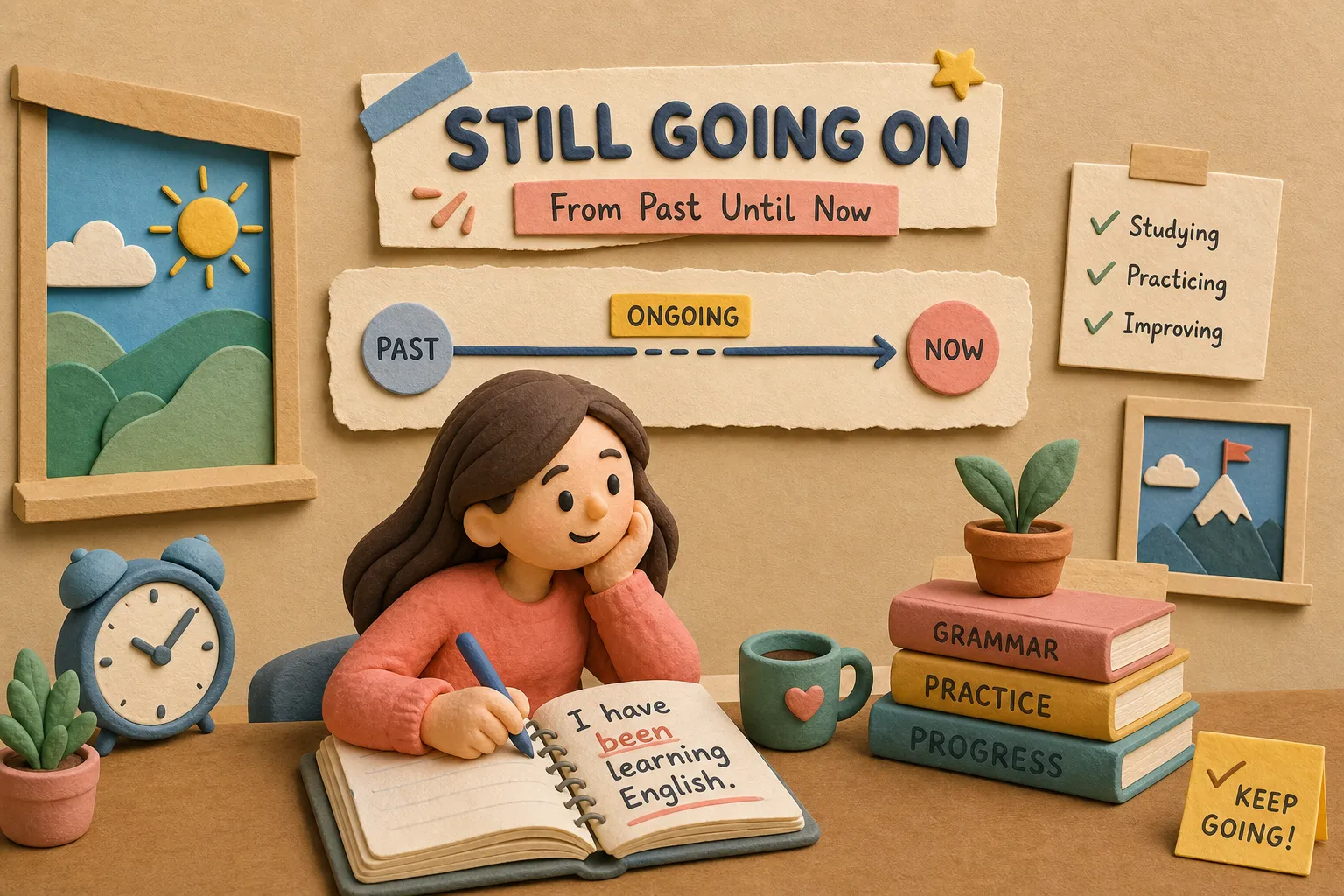
This tense describes an action that started in the past and is still happening now, or that just stopped very recently. The key focus is on the duration or the activity itself, not the final result. Think of it as a spotlight on the process, not the finish line.
Here’s a concrete example. Someone walks into the office looking tired and out of breath. They say, “I’ve been running.” The run may have just ended, but the point isn’t that it’s done. The point is the activity and how long it lasted. That’s the heart of this tense.
American speakers use this tense naturally in everyday conversation and at work: “She’s been running that department for two years.” “We’ve been trying to fix this bug all week.” If you skip this tense and always use the simple past or present perfect instead, your English sounds correct but unnatural. Mastering this form is one of the clearest steps toward sounding like a fluent speaker.
How to build the present perfect continuous
The formula is simple: subject + have/has + been + verb-ing. Use “have” with I, you, we, and they. Use “has” with he, she, and it. “Been” never changes. Then add the main verb with -ing at the end. Notice how the subject determines which helper verb you need in each of the examples below:
- I have been studying English for three years.
- She has been working on that project all morning.
- They have been waiting for two hours.
In spoken American English, contractions are completely normal and expected. Native speakers say “I’ve been,” “she’s been,” and “they’ve been,” not the full form. Using the full form all the time sounds formal and stiff in casual conversation.
Here’s how the three main sentence types look:
| Type | Structure | Example |
|---|---|---|
| Affirmative | Subject + have/has + been + verb-ing | He has been reading all day. |
| Negative | Subject + have/has + not + been + verb-ing | I haven’t been sleeping well lately. |
| Question | Have/Has + subject + been + verb-ing? | Have you been waiting long? |
For negatives, insert “not” between have/has and been. For yes/no questions, move have/has to the front. For wh- questions, add the question word first: “How long have they been working on this?”
If you need a quick reference for how this tense fits into the full system of verb forms, check our 12 English verb tenses guide.
When to use the present perfect continuous
The most common use is showing how long something has been going on. The action started in the past and is still continuing at the moment of speaking, or stopped just a short time ago. “I’ve been studying English for three years.” “He has been living in Chicago since 2021.” Both sentences put the spotlight on duration.
The action doesn’t have to be happening at the exact second you speak. If someone just stopped and you can still see the results of the activity, this tense still applies. “You look tired. Have you been exercising?” “I’ve been cooking. The kitchen is a mess.” Compare this to “I cooked” (simple past: done and gone, no connection to now) or “I have cooked” (present perfect: focused on the finished result, not the process). The continuous form keeps the focus on the activity and its visible effects.
This tense also works well for temporary situations that are different from normal. “She’s been taking the bus lately because her car is in the shop.” This signals a recent change, not a permanent state. It tells the listener: this is new, and it probably won’t last. Without the continuous form, this nuance disappears.
Signal words that go with this tense
“For” and “since” are the two most important time expressions for this tense. They are easy to confuse, so keep this rule clear: “for” goes with a period of time; “since” goes with a starting point.
- I’ve been working here for two years. (period of time)
- I’ve been working here since 2024. (starting point)
- She has been studying for three hours. (period of time)
- She has been studying since this morning. (starting point)
One of the most common errors is “since two years.” This is always wrong. Two years is a period of time, so use “for”: for two years.
Other signal words to recognize and use include: all day, all morning, all week, lately, recently, these days, and how long. “Lately” and “recently” are especially common in American English conversation. “I haven’t been sleeping well lately.” “We’ve been getting a lot of rain recently.” These words signal recent, ongoing activity. When you see or hear them, the present perfect continuous is almost always nearby.
Present perfect continuous vs. present perfect simple
This is where many learners get stuck. The rule is direct: use the simple form when the focus is on the result or completion; use the continuous form when the focus is on the activity and how long it lasted.
Look at these two pairs:
- “She has cleaned the house.” (Done. Result: clean house.)
- “She has been cleaning the house.” (She spent time doing it. She may still be going.)
- “I have read the report.” (Finished. Ready to discuss.)
- “I have been reading the report.” (Still working through it.)
The simple form also answers “how many times?” not “how long?” “I have eaten three tacos.” That’s about quantity, not duration. You can’t use the continuous here.
One important rule: stative verbs (verbs that describe states, not actions) must always use the simple form. Stative verbs include: know, love, own, believe, want, understand, and remember. Because these verbs describe conditions rather than activities, the continuous structure doesn’t apply to them. “I have known her for years.” Never “I have been knowing her.” “He has owned that car since 2020.” Never “He has been owning that car.”
If you want a clear comparison and more practice questions on when to choose each form, see this explanation of the present perfect simple vs. present perfect continuous.
This is one of the most common errors for Spanish and Portuguese speakers, because in those languages the continuous structure is often used for duration where English uses the simple form. When you’re unsure which form to use, ask yourself one question: “Am I focusing on the result, or on the activity and how long it took?” That answer decides the tense.
Common mistakes and how to fix them
The single most frequent structural error is forgetting “been.” Many learners write “I have working here for a year” and leave out the essential middle piece. Remember: the formula always has three parts, have/has + been + verb-ing. Drop “been” and the sentence is wrong.
Also watch adverb placement. Words like “always,” “never,” and “still” go between have/has and been, not after been.
- Wrong: “I have been always working late.”
- Right: “I have always been working late.”
A second common error is using the continuous when the action is clearly finished. If the report is sent and done, say “I have written the email,” not “I have been writing the email.” The continuous form suggests the action is still in progress. Using it for a completed action sends the wrong message. Here are two corrected pairs:
- “I have been writing the email.” (Still writing, not sent yet.)
- “I have written the email.” (Done. Sent.)
Finally, never pair this tense with specific past time markers like “yesterday” or “last year.” Those words require the simple past. “I visited Paris last year.” Not “I have been visiting Paris last year.” Specific past times break the connection to the present, and that connection is the whole point of this tense.
Put it into practice
You can now build the present perfect continuous correctly with the have/has + been + verb-ing formula, choose it over the simple form when the focus is on duration or ongoing activity, and keep stative verbs in the simple form every time. The key signal words, for, since, lately, recently, all morning, how long, tell you exactly when this tense belongs in a sentence.
This tense shows up constantly in American English, in the workplace, at home, and in everyday small talk (see our Professional English section for workplace examples). Getting it right makes a real difference in how natural you sound. Every grammar guide at Your Daily American is built the same way: grounded in how real speakers communicate, not just how textbooks describe the language.
For additional explanations and example sentences, you may find these helpful: Cambridge Dictionary’s guide to the present perfect continuous and the Grammarly article on the present perfect continuous tense, both of which offer clear examples and extra practice.
Now try it yourself. Write two sentences using the present perfect continuous about something in your own life right now. Use “for” in one sentence and “since” in the other. Then check them against the rules in this guide. That one small step is exactly how real fluency gets built. If you want to polish how you sound as you speak, don’t forget to review our word stress in American English tips to help your sentences flow naturally.