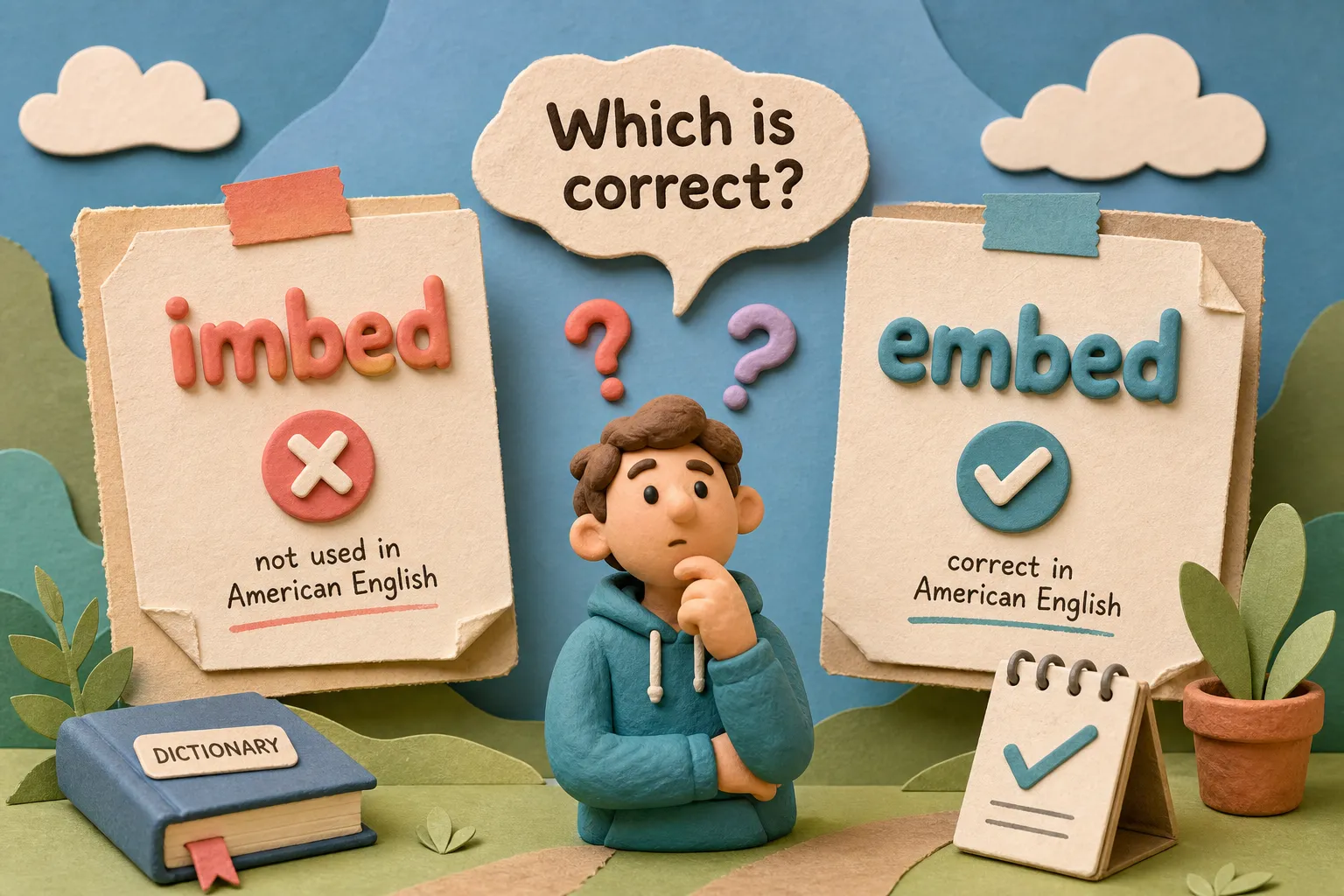
You’re writing something and you pause. Should you type “imbed” or “embed”? Both look like real words. Both feel like they could be correct. So which one do you actually use? This is the imbed vs embed question, and the answer is clearer than you might expect.
The answer is embed. It is the standard spelling in modern American English, used consistently by style guides, dictionaries, and professional writers. “Imbed” exists and is not technically wrong, but it is the older, much less common form.
By the end of this lesson, you will know what both words mean, what major style guides recommend, how usage changed over time, the correct past-tense form, and real examples across different writing situations. Knowing which spelling to use, and why, is exactly the kind of precise vocabulary knowledge that marks a confident writer. Building that accuracy, one word at a time, is at the core of what Your Daily American is designed to help you do.
Imbed vs embed: two spellings, one meaning
“Imbed” and “embed” mean exactly the same thing. Both words describe fixing something firmly inside another object or environment, only the spelling differs.
The word works in physical and figurative situations. A nail is embedded in wood. A habit can be embedded in a daily routine. A chip is embedded in a credit card. In every case, something is placed firmly inside something else so it stays there and becomes part of it.
The exact same definition, written two different ways
Both forms appear in major American dictionaries. Merriam-Webster lists “imbed” as a variant of “embed,” meaning it is an accepted but less common spelling. (You can verify this directly at Merriam‑Webster.) It is not a separate word with a different meaning, it is simply an older way to write the same word, and the dictionary’s listing order signals that you should prefer “embed” in most situations.
Where the “im-” prefix comes from
The prefixes “em-” and “im-” both derive from the Latin root in-, meaning “in” or “into.” When “in-” appears before certain consonants, it assimilates, shifting to “em-” or “im-” depending on the period and dialect in which it was borrowed. English picked up both forms at different points in its history, and over time, as usually happens with competing variants, one form became dominant. With this particular word, “embed” is now overwhelmingly the standard in modern usage.
Imbed vs embed: what style guides and dictionaries recommend
This is the question most writers want answered first. Contemporary usage and independent reference sources consistently favor “embed” as the preferred spelling. For a concise take on common confusions like this, see the helpful overview at Grammarly’s guide on imbed vs. embed.
What professional usage shows
Across journalism, academic writing, and digital publishing, “embed” is the safe and standard choice. Using “imbed” in professional work may look outdated to an editor, even if it is not technically wrong. There is no professional context in American English where “imbed” is preferred, and major style resources, including AP style, Chicago, and MLA, either use “embed” exclusively in their own prose or do not recognize “imbed” as a standard form.
How dictionaries classify “imbed”
A primary spelling is the main, recommended form. A variant spelling is accepted but less common. Merriam‑Webster classifies “imbed” as a variant of “embed.” It appears in the dictionary, but not as the first choice. For ESL learners who rely on dictionaries to confirm correct usage, this distinction matters: when a dictionary marks a word as a variant, it is signaling that you should use the primary form in most situations.
How “embed” became the standard spelling over time
“Imbed” was actually the more common spelling for centuries. Then, in the early 1900s, “embed” began appearing more often in print. After a short period where both forms competed, “embed” became the clear standard and has stayed dominant ever since.
The 1920s turning point
This kind of shift is a normal part of how English works. Two spelling variants compete for years, and one gradually becomes standard while the other fades. Data from the Google Books Ngram Viewer, a tool that tracks word frequency across millions of digitized books, shows this shift clearly: “imbed” was favored first, “embed” overtook it, and after a brief back-and-forth, “embed” secured dominance around the 1920s. (Search “imbed,embed” in the Google Books Ngram Viewer to see the graph yourself; note that the tool works best as a rough trend indicator rather than a precise count.) That lead has only grown wider in the decades since.
Why this shift matters for writers today
The longer “embed” has been standard, the more unusual “imbed” looks to modern readers. Editors, teachers, and professionals are accustomed to seeing “embed.” The technology industry reinforced this further: HTML embedding, embedded video, and embedded content all use the “e” spelling consistently. Digital communication did not invent the word, but it locked in the spelling for a new generation of writers and developers.
“Embedded” or “imbedded”? Getting the past tense right
The past tense follows the same logic as the base word. Since “embed” is the standard spelling, “embedded” is the standard past tense and past participle. “Imbedded” is technically valid, but it is uncommon enough that editors and spell-checkers may flag it as non-standard.
The full verb pattern: embed, embeds, embedding, embedded
Here is the complete pattern for this verb, along with an example sentence for each form:
- embed, base form (“I need to embed this video.”)
- embeds, third-person singular present (“She embeds a map on every location page.”)
- embedding, present participle (“He is embedding the code now.”)
- embedded, past tense and past participle (“They embedded the chip inside the card.”)
“Embedded” is the correct and standard past-tense form in both American and British English, and the one that appears in style guides, published journalism, and technical documentation without exception. Use it every time.
Imbed vs embed, usage across professional American writing
Three specific collocations appear constantly in American media and technology, and all three use the “e” spelling. An embedded journalist is a reporter who travels and works alongside a military unit to cover a story from the inside. An embedded video is a video placed directly inside a webpage or article so users can watch it without leaving the page. Embedded systems refers to software built directly into hardware, such as the computer inside a car or a smart home device.
All three terms use “embedded” almost exclusively in modern American usage. The spelling is settled and consistent across industries and contexts. “Imbedded” does still appear in a small number of older geological and scientific texts, but it is rare and not recommended for current writing.
Real examples of “embed” in everyday American English
Seeing a word in real sentences is one of the best ways to make it stick. Here are examples across three common writing contexts.
In technology and digital content
Technology writers use “embed” constantly. These sentences reflect the kind of language you will find in web development guides, content marketing, and digital publishing:
- “To embed a YouTube video in your article, paste the iframe code into your HTML.”
- “The developer embedded a Google Map directly on the contact page.”
- “The site uses embedded code to display live pricing data.”
Notice that “embedded” appears here as both a past-tense verb and an adjective. Both uses are common and natural in technical writing.
In journalism and professional writing
“Embed” appears often in news reporting and formal writing, both in its literal and figurative senses. A journalist might be embedded with a military unit, meaning they are physically inside the group, living and traveling with them. A quote can be embedded in a longer text, meaning it is placed within the surrounding paragraphs. Both uses follow the same core meaning: something is placed firmly inside something else.
- “She was embedded with the unit for three months, reporting from the field.”
- “The editor embedded a direct quote from the memo within the analysis section.”
Both sentences use “embedded” naturally, with no awkwardness, and no sign of “imbedded” anywhere.
In language learning and daily practice
Think about how you build real fluency: you embed the language into your daily life. That means reading it, hearing it, writing it, and speaking it every day, not just during a dedicated study session once a week. The word describes the process as well as any instruction manual could.
Your Daily American is built around exactly this idea. Explore our Everyday American English resources to see practical examples and lessons that make vocabulary stick. If you want to focus on pronunciation and rhythm, check our Word Stress in American English: A Complete Guide, Your Daily American for a deep dive into how stress shapes natural speech. For learners curious about common problem words, our article on English words non-native speakers mispronounce most often is a helpful, practice-focused resource.
The clear answer: use “embed”
Use “embed.” It is the standard spelling in modern American English, supported by professional usage, dictionary classifications, and over a century of consistent print dominance. For the past tense, use “embedded,” not “imbedded.”
“Imbed” is not wrong. But it is old and uncommon enough that using it in formal, academic, or digital writing draws attention for the wrong reason. Editors and readers expect “embed.” For most modern and professional contexts, there is little benefit to choosing the less familiar form.
When deciding between imbed vs embed, the right call is always “embed”, and “embedded” for the past tense. For ESL learners, knowing this distinction is a small but real sign of fluency. It shows that you understand not just what a word means, but how it is actually used by professional writers in American English. That is the level of detail that takes your writing from grammatically correct to naturally confident.