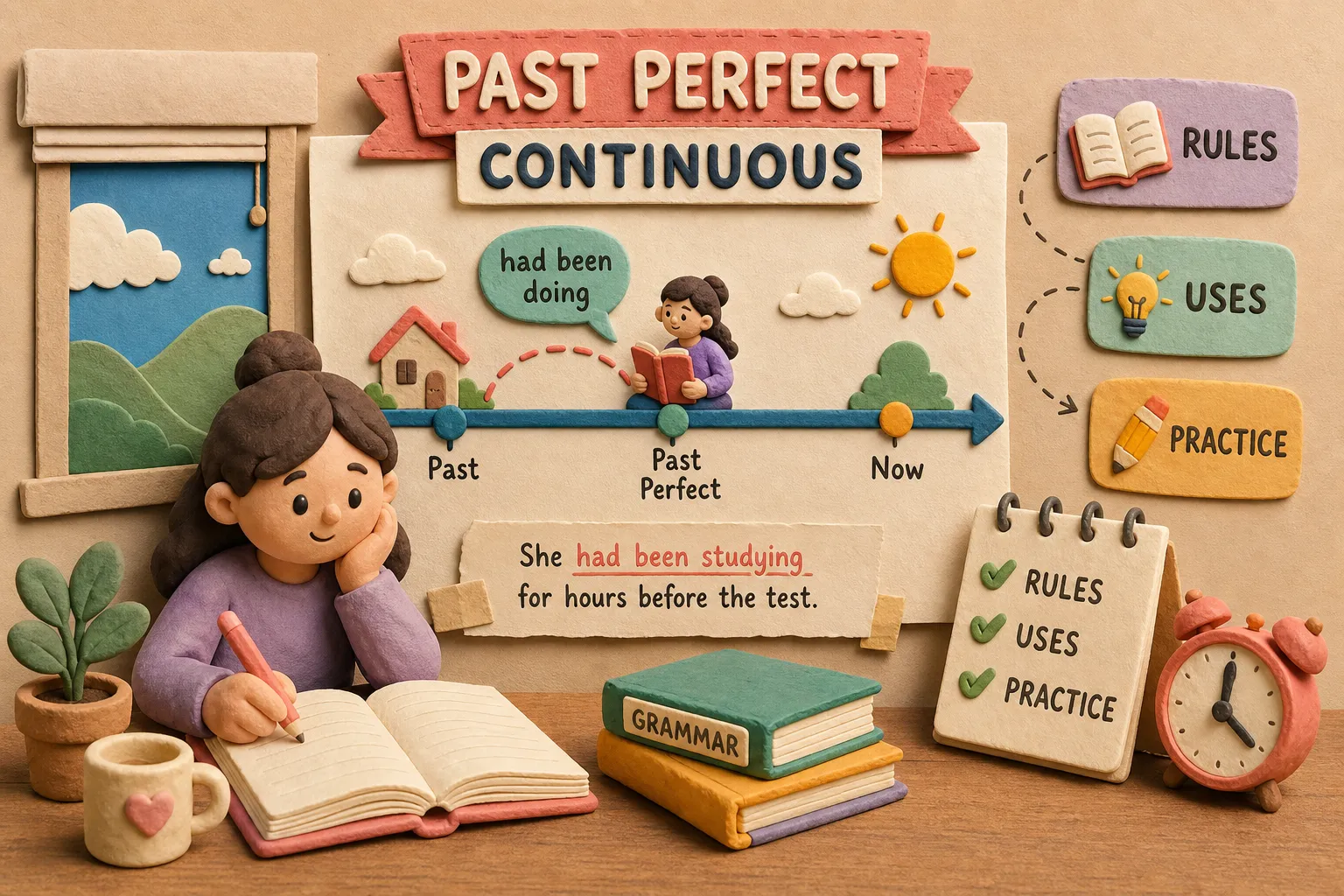
You arrive at work. Your eyes are red. Your colleague looks at you and asks, “Are you okay?” You could say, “I was crying this morning.” But that sentence leaves a lot out. The more natural, complete answer is: “I had been crying for an hour before I left home.” That one extra step does something important, it tells your colleague not just what happened, but how long it went on and why you look the way you do right now. That is the past perfect continuous at work (also called the past perfect progressive): a tense that connects a past action to another past moment by showing duration, cause, or background.
By the end of this lesson, you will be able to form this tense correctly, choose it over similar past tenses, and use signal words like “for,” “since,” and “by the time” with confidence. You will also know the most common mistakes and how to avoid them. This is the kind of grammar work that moves you from intermediate English into truly precise, natural-sounding expression, and it is exactly what structured lessons at Your Daily American are built to help you do.
How to form the past perfect continuous
The core formula: had been + verb + -ing
The formula is simple: Subject + had been + [verb + -ing]. The auxiliary verb “had” never changes, no matter who the subject is. Whether the subject is I, he, she, we, or they, you always use “had been.” Here are two examples:
- “She had been working for two hours before the meeting started.”
- “They had been waiting outside in the rain for 20 minutes.”
Notice that the main verb always ends in -ing. This is non-negotiable. The tense always requires that three-part structure: had + been + verb-ing. Once you know the structure, everything else gets easier.
Negatives and questions
To make a negative sentence, add “not” between “had” and “been.” In spoken American English, the contraction “hadn’t” is very common. To form a question, move “had” to the front of the sentence, before the subject.
| Type | Formula | Example |
|---|---|---|
| Affirmative | Subject + had been + verb-ing | “He had been studying all night.” |
| Negative | Subject + hadn’t been + verb-ing | “He hadn’t been sleeping well.” |
| Question | Had + subject + been + verb-ing? | “Had he been working there long?” |
How contractions sound in real American speech
In everyday spoken American English, “had” is almost always contracted. Native speakers say “I’d been,” “she’d been,” “they’d been,” not the full “they had been.” The contraction sounds quick and natural. If you use the full “had” form in conversation, it is not wrong, but it can sound a little formal. Practice saying “I’d been waiting” and “she’d been crying” out loud until they feel comfortable. For natural spoken fillers and pauses, see our article on filler phrases.
Four situations where this tense works
Knowing the formula is step one. Knowing when to use it is step two. Here are the four main situations where the past perfect continuous is the right choice.
Showing how long something lasted before a past moment
This is the most common use. You are describing how long an action went on before something else happened. The signal word “for” almost always appears here. For example: “He had been driving for six hours before he stopped for gas.” The focus is on the length of the drive, not just the fact that he drove. This use answers the question: how long?
Explaining the cause behind a visible past result
Sometimes you need to explain why something looked or felt a certain way in the past. The ongoing action is the reason. For example: “Her eyes were red because she had been staring at a screen all evening.” The red eyes are the result. The hours of screen time are the cause. This is one of the most natural uses in everyday American English, and it makes your explanation sound complete rather than abrupt.
Setting a background action before an interruption
You can use this tense to describe an action that was already in progress when something else suddenly happened. For example: “They had been talking for an hour when the manager walked in.” The conversation was the background. The manager’s arrival was the interruption. This use is similar to the past continuous (“they were talking”), but it adds the idea of duration before the interruption. More on that distinction in the comparison section below.
Giving context for how things reached a certain state
Sometimes you need to explain the situation leading up to a specific past moment. For example: “By the time the ambulance arrived, the doctors had been treating the patient for 20 minutes.” The phrase “by the time” signals that the treatment had already been going on before the ambulance got there. This use sets the scene and gives the reader or listener important background.
Signal words that go with this tense
Certain time expressions almost always appear with the past perfect continuous. Learning these words will help you both recognize the tense when you read it and use it correctly when you write or speak.
Using “for” and “since” with the past perfect continuous
“For” goes with a period or amount of time: for two hours, for three years, for a long time. “Since” goes with a specific point in time: since Monday, since 2019, since she arrived. This is one of the most common error points for ESL learners, so pay attention. You say “I’d been waiting for 30 minutes,” not “since 30 minutes.” Here is one example for each:
- “We had been living there for five years before we moved.” (period of time)
- “She had been feeling sick since Tuesday.” (specific point in time)
“By the time,” “until,” and “how long”
These three expressions each play a specific role. “By the time” marks the moment when the ongoing action had already been happening: “By the time he called, I had been waiting for 40 minutes.” “Until” defines where the duration ended: “They had been arguing until the manager stepped in.” “How long” appears in questions about duration: “How long had she been studying before she took the test?” Each of these expressions signals that duration is the key idea in the sentence. For a clear explanation of time expressions with this tense, read the EF guide to the past perfect continuous.
Past perfect continuous vs. past perfect simple: how to choose
This is the comparison most intermediate learners struggle with. The two tenses are closely related, but they focus on different things. Learning to choose between them is a real sign of advanced grammar control. If you want a compact review of all the verb forms to see how this tense fits the full system, check our 12 English verb tenses pocket guide.
Completed action vs. ongoing action: the core difference
The past perfect simple (had + past participle) focuses on a finished result. The past perfect continuous focuses on how long the action went on. Look at these two sentences:
- “She had written the report before the meeting.” (The report is done. Focus: the result.)
- “She had been writing the report for two hours before the meeting.” (Focus: the time and effort it took.)
Both sentences describe the same situation, but they emphasize different things. The first says it is finished. The second says it took time. One more pair: “He had eaten before I arrived” (completed) versus “He had been eating for 30 minutes when I arrived” (duration and ongoing process).
What changes when you switch between the two
Switching tenses changes what the sentence communicates. Consider: “He was tired because he had run 5 miles.” That tells you about the distance covered, a completed action. “He was tired because he had been running” tells you about the prolonged physical effort, the process. Both are correct, but they highlight different parts of the story. Choose based on what you want your listener or reader to focus on.
Stative verbs always take the simple form
Stative verbs (verbs that describe a state, not an action) cannot be used in any continuous tense. This is a firm rule. Incorrect: “I had been knowing her for years.” Correct: “I had known her for years.” The verb “know” describes a mental state, not an activity, so it cannot be ongoing in this way. Common stative verbs to watch out for include:
- know, believe, understand, like, love, hate, own, want, prefer, realize, belong, need
When you see these verbs in a sentence about the past, default to the past perfect simple, not the continuous. For a focused explanation of stative verbs and why they don’t take continuous forms, this short guide is useful.
Three mistakes ESL learners often make
These three errors come up again and again. Read each one carefully, and you will be far less likely to repeat them.
1. Using a stative verb in the continuous form
Error: “We’d been knowing each other for a long time.”
Correct: “We’d known each other for a long time.”
“Know” is a state, not an action. It cannot be described as ongoing or continuous. Always use the past perfect simple with stative verbs.
2. Using “since” with a counted duration
Error: “I’d been waiting since 30 minutes.”
Correct: “I’d been waiting for 30 minutes.”
“Since” needs a fixed point in time, like a date or event. “30 minutes” is a counted period, so you need “for.” When in doubt, ask yourself: am I naming a point in time, or an amount of time? Point in time: use “since.” Amount of time: use “for.”
3. Dropping “been” from the formula
Error: “She had swimming before she went to school.”
Correct: “She had been swimming before she went to school.”
This error breaks the tense completely. The full structure, had + been + verb-ing, is required every time. Removing “been” leaves you with a sentence that does not belong to any recognized English tense.
Past perfect continuous examples: quick practice
Reading about grammar is one thing. Using it is another. Try these short exercises to see how much you have absorbed. You can also try online exercises like the Past Perfect Continuous practice page.
Complete the sentence with the correct form
Write the past perfect continuous form of the verb in parentheses:
- “By the time the bus arrived, I _______ (wait) for 20 minutes.”
- “She was exhausted because she _______ (study) all night.”
- “How long _______ you _______ (work) there before you got promoted?”
Answers: 1. had been waiting. 2. had been studying. 3. had / been working.
Choose between past perfect simple and past perfect continuous
Read the context clue, then decide which tense fits.
- Context: You want to emphasize a finished result. “She _______ (finish / be finishing) the presentation before the client arrived.” Answer: had finished.
- Context: You want to emphasize duration. “He looked pale because he _______ (work / be working) without a break for eight hours.” Answer: had been working.
Try it yourself
Write two sentences about something you had been doing before a past moment. Use “for” in the first sentence and “since” in the second. For example: “I had been living in that apartment for three years before I moved” and “I had been feeling nervous since the morning of the interview.” If you want structured feedback on exercises like this, Your Daily American has grammar lessons built around exactly this kind of real-world practice, connected to the language you actually use in daily American life.
What to remember from this lesson
- The formula: had been + verb-ing, every time, with no exceptions.
- When to use it: for duration before a past moment, for explaining cause, for setting a background action, and for showing context.
- How to tell it apart from the past perfect simple: duration and process point to continuous; completed actions and results point to simple.
The stative verb rule is the single most important thing to remember when choosing between the two forms. If the verb describes a state (know, believe, own, love), use the past perfect simple. If it describes an action, the continuous is usually available to you.
Mastering the past perfect continuous will make your past-time descriptions clearer and more natural, it is the kind of detail that makes your writing and speaking feel precise, not just correct. If you are ready to keep building that precision, visit Your Daily American for grammar lessons, pronunciation guides, and real-world exercises designed for learners at exactly this stage of their fluency journey, or explore our Professional English section for focused, workplace-oriented materials.