You open a work email and see words like “interdepartmental,” “intercultural,” or “interim.” You understand the general idea, but you’re not quite sure what each word really means. That feeling is common, and there’s a simple explanation for it. All three words share the same prefix, and once you understand that prefix, dozens of English words become much easier to read, understand, and use. In this lesson, you’ll learn what the inter- prefix means, see real examples from everyday life and the workplace, and learn how to tell it apart from its close look-alike, intra-. That’s the kind of practical, systematic vocabulary work that Your Daily American is built for.
Where the inter- prefix comes from
The Latin root behind a very common prefix
The inter- prefix comes from the Latin word inter, meaning “among” or “between.” It entered English in the 1400s and has been used freely ever since, with both Latin-origin words and everyday Germanic ones. In American English, you pronounce it IN-ter (/ˈɪn.tər/): a short “i” sound, like the word “in,” followed by a clear American “r.” The first syllable is stressed.
What inter- adds to a word
When you add inter- to a root word, it shifts the meaning toward “between” or “among.” Think of it as a building block. Look at these three examples:
- national → international (between nations)
- act → interact (act between people)
- connect → interconnect (connect between systems)
Notice that the spelling of the root never changes. You simply attach inter- to the front. Once you know what the prefix means, you can often guess the meaning of a word you’ve never seen before, and that’s a powerful reading skill to have.
Inter- prefix examples: words you already know in everyday English
Familiar words that use this prefix
You probably already use many inter- words without noticing the prefix at all. Here are eight common ones, with short example sentences in everyday American English:
- Internet: the global network connecting computers between countries (“I looked it up on the internet.”)
- International: involving two or more countries (“She works for an international company.”)
- Interview: a meeting between a person and an employer (“I have a job interview on Friday.”)
- Intersection: the point where two roads cross (“Turn left at the next intersection.”)
- Intermission: a break between parts of a show (“We got coffee during intermission.”)
- Interval: a period of time between two events (“The train comes at 15-minute intervals.”)
- Interrupt: to stop someone while they’re speaking (“Please don’t interrupt during the meeting.”)
- Interest: this word has fused considerably over time; according to etymological records, it derives from the Latin interesse, meaning roughly “it concerns” or “there is a difference”, the sense of something mattering between parties
Why these words feel natural but the prefix feels invisible
Many learners use words like “internet” and “interview” correctly without ever noticing they share the same prefix. Seeing that connection is a vocabulary unlock. It turns a collection of separate words into one organized system, and that system keeps growing as you add new inter- words to it. The same pattern shows up in the workplace vocabulary in the next section.
Inter- in professional American English
Words that show up in meetings, emails, and interviews
The inter- prefix appears constantly in workplace communication. These are words you’re likely to hear in meetings, read in emails, and need to understand clearly when you work with American colleagues.
- Interact: “Our teams interact closely every week.”
- Interaction: “Good customer interaction is important for growth.”
- Interdepartmental: “This is an interdepartmental project between Sales and Marketing.”
- Interdisciplinary: “The research team is interdisciplinary, with engineers and doctors working together.”
- Interim: a temporary position while a permanent one is being filled (“Sarah is the interim manager while Tom is on leave.”)
- Interface: the point where two systems or people connect (“The software interface is easy to navigate.”)
- Interject: “Sorry to interject, but I have a quick question.”
- Interchangeable: “These two parts are interchangeable, so use either one.”
- Intercultural: “We offer intercultural training for new employees.”
- Intervene: “HR may need to intervene if the conflict continues.”
- Interpret: to explain the meaning of something (“Can you interpret this data for the team?”)
- Interconnected: “All our systems are interconnected.”
How Your Daily American helps you learn this kind of vocabulary
At Your Daily American, vocabulary is organized by real-life context, not by abstract grammar rules. That means you learn words in the situations where you’ll actually use them: meetings, presentations, emails, and job interviews. If you work with American colleagues or clients, that practical focus makes a real difference in how quickly you can communicate with confidence and sound natural doing it. We also cover other practical topics, for example, our Essential Phrasal Verbs You Must Know article gives clear, usable phrasal verbs you can start using in meetings and conversations.
Inter- vs. intra-: the one mix-up that trips everyone up
The core difference between the two prefixes
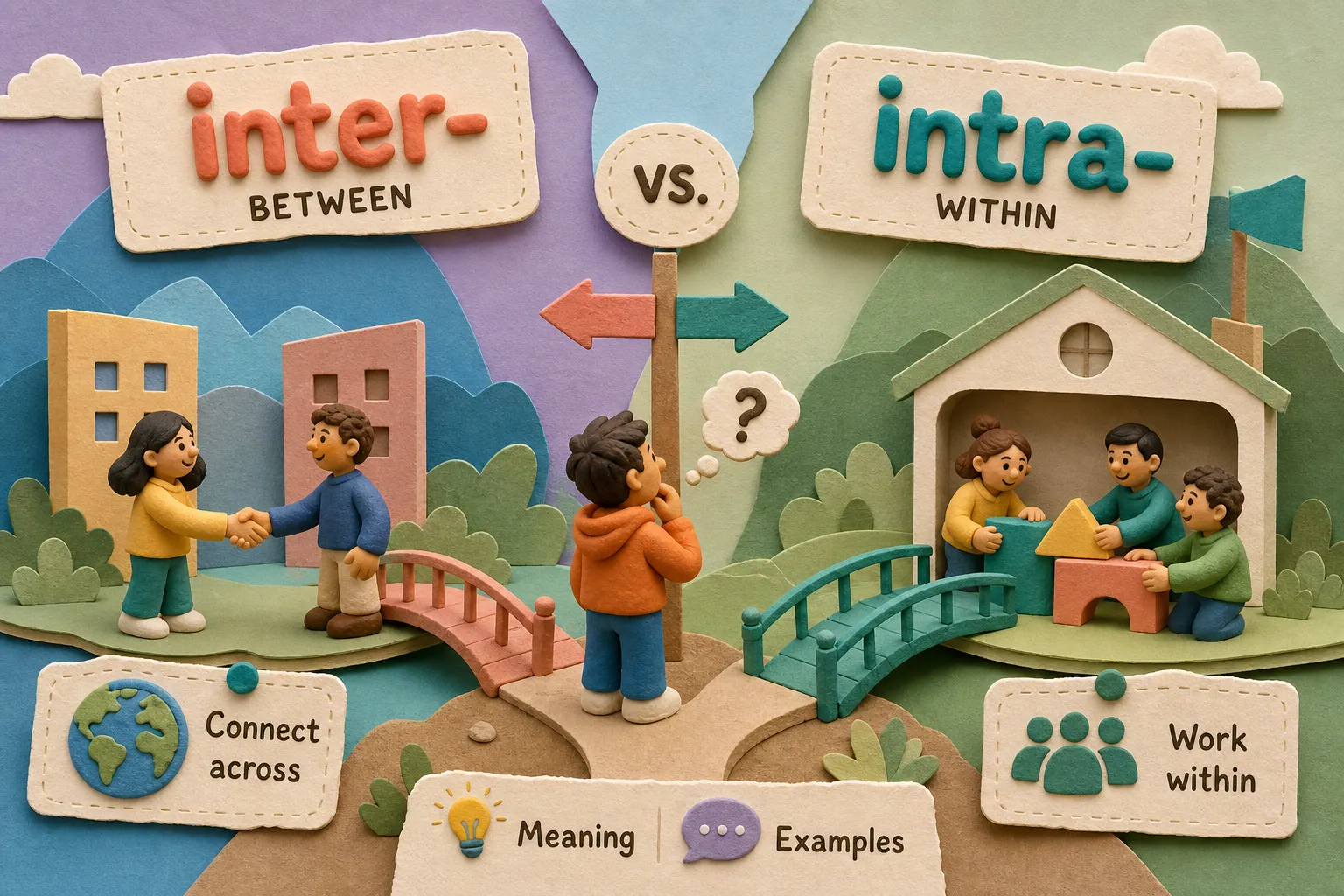
Inter- means “between” two or more separate things. Intra- means “within” just one thing. A quick memory note: think of intra- as “inside” (both start with “in”). Here are four parallel pairs that show the difference clearly:
| Inter- (between) | Intra- (within) |
|---|---|
| International (between nations): “an international treaty” | Intranational (within one nation): “intranational trade” |
| Interstate (between states): “Take the interstate highway.” | Intrastate (within one state): “an intrastate bus line” |
| Interdepartmental (between departments): “an interdepartmental report” | Intradepartmental (within one department): “an intradepartmental meeting” |
| Internet (network between organizations): “Search on the internet.” | Intranet (network within one company): “Log into the company intranet.” |
Common mistakes and how to avoid them
Many learners use inter- when they mean intra-, especially in workplace or academic writing. The principle is straightforward: use inter- when something crosses between separate groups, and use intra- when it stays inside just one. For example, an inter-office memo travels between separate offices or locations, while a message that stays within a single team or organization would be described as intradepartmental, internal, or in-house. Before you write, ask yourself: “Is this happening between separate groups, or inside just one?” That single question resolves most mistakes and will save you from an embarrassing error in a professional email. If you struggle with common pronunciation or usage pitfalls, our guide on English Words Non-Native Speakers Mispronounce Most Often can help you spot related errors and practice them deliberately.
For a concise online definition you can refer to while checking usage, see the Dictionary.com entry for “inter-“.
For more examples and a focused comparison of how people commonly confuse these prefixes, this comparison of inter vs. intra is a useful companion.
30+ common inter- words, grouped by topic
Everyday life and general English
| Word | Short definition | Example sentence |
|---|---|---|
| Intersection | Where two roads cross | “The café is at the intersection of Main and Oak.” |
| Interval | Time between two events | “Rest at regular intervals.” |
| Intermission | Break during a show | “We talked during intermission.” |
| Interrupt | Stop someone mid-speech | “Please don’t interrupt the speaker.” |
| Interstate | Highway between states | “Take the interstate to save time.” |
| Interlude | Short pause between events | “There was a musical interlude between acts.” |
| Intermediate | Level between two extremes | “She’s in the intermediate English class.” |
| Intermingle | Mix together | “The guests intermingled at the party.” |
| International | Between nations | “It’s an international brand.” |
| Internet | Global connected network | “Check the internet for directions.” |
Academic and professional settings
| Word | Short definition | Example sentence |
|---|---|---|
| Interdisciplinary | Crossing subject areas | “The team took an interdisciplinary approach.” |
| Intercultural | Between different cultures | “Intercultural skills are valuable at work.” |
| Interdependent | Relying on each other | “The two teams are completely interdependent.” |
| Intervention | Action taken to change a situation | “Early intervention helped the student succeed.” |
| Interpretation | Explaining the meaning of something | “Her interpretation of the data was clear.” |
| Intercede | Act between two sides in a dispute | “She asked HR to intercede.” |
| Interject | Speak during a conversation | “He interjected with an important point.” |
| Interfere | Get in the way of something | “Don’t interfere with their process.” |
| Interagency | Between agencies | “Interagency cooperation improved the response.” |
| Intercollegiate | Between colleges | “They won the intercollegiate debate.” |
A few advanced words worth knowing
These words appear less often, but you’ll encounter them in formal writing, academic texts, and news articles:
- Interlocutor: a person taking part in a conversation; common in linguistics and diplomacy (“The two interlocutors reached an agreement.”)
- Intersperse: place things at different points within something (“She interspersed examples throughout her presentation.”)
- Interregnum: a period between two rulers or governments; used in history and politics (“The interregnum lasted six months.”)
- Interpolate: add something between two existing points; used in math and data (“The software interpolates values between data points.”)
- Interchange (noun): a highway junction where roads connect (“Take exit 14 at the interchange.”)
How knowing prefixes builds your vocabulary faster
The bigger principle behind inter- prefix learning
English has around 30, 50 high-frequency prefixes that educators focus on: inter-, un-, re-, pre-, mis-, dis-, and many more. Each one appears in hundreds of words. Learning what one prefix means gives you a tool to decode all those words at once. That’s a much faster approach than trying to memorize every word on its own. Morphological awareness, understanding word parts, helps learners read faster and retain more vocabulary over time. The inter- prefix is a great place to start because it’s both common and consistent.
A simple practice routine to lock this in
Here are three steps you can do this week to make inter- stick in your memory:
- Find 5 inter- words in something you read or watch this week. A news article, a work email, or a TV show all work well.
- For each word, pause and think about what the prefix is adding to the root. Ask: “What two things is this word placing between?”
- Write one original sentence using each word in a situation from your own life, whether that’s work, school, or a daily conversation.
This active practice builds strong, lasting memory. You’ll start noticing inter- words everywhere, and each time you do, your vocabulary grows a little more. That’s not an accident. That’s a system working for you.
If you’d like extra interactive spelling and prefix practice, try this interactive prefixes practice to reinforce what you’ve learned.
You now have a real vocabulary tool
By now you have three things you didn’t walk in with: the Latin origin of the inter- prefix and what it means, a clear way to separate it from intra-, and a working list of 30+ words you can start using today. One question, “Is this between groups or inside one?”, handles most of the confusion between the two prefixes.
Recognizing prefixes pays off whether you’re reading a report, sitting in a meeting, or drafting an email. You don’t need to memorize every word alone when you understand the building blocks behind them. One inter prefix unlocks many words, and that efficiency compounds the more prefixes you learn.
If you work with American colleagues or are building toward a new job, Your Daily American organizes practical, real-world American English in a clear, logical way, the kind of vocabulary work designed for exactly that kind of progress.