You’re at work and want to leave a little early. Do you say “Can I leave early?” or “Could I leave early?” or “May I leave early?” All three sentences use modal verbs, and all three are grammatically correct. But each one sends a different social signal to your manager. That small difference matters a lot in American English.
By the end of this guide, you’ll be able to identify the core modal verbs and semi-modals, use them correctly for ability, permission, obligation, and probability, form negatives and questions without common errors, and practice with a short exercise at the end. No heavy grammar jargon. Just clear rules and real examples you can use right away.
What modal verbs are and how they always work
Modal verbs, also called modal auxiliary verbs, are helper verbs. They go before the main verb and change its meaning. They tell your listener whether something is possible, necessary, allowed, or expected. The good news is that all modals follow the same three rules, which makes them very predictable once you know those rules.
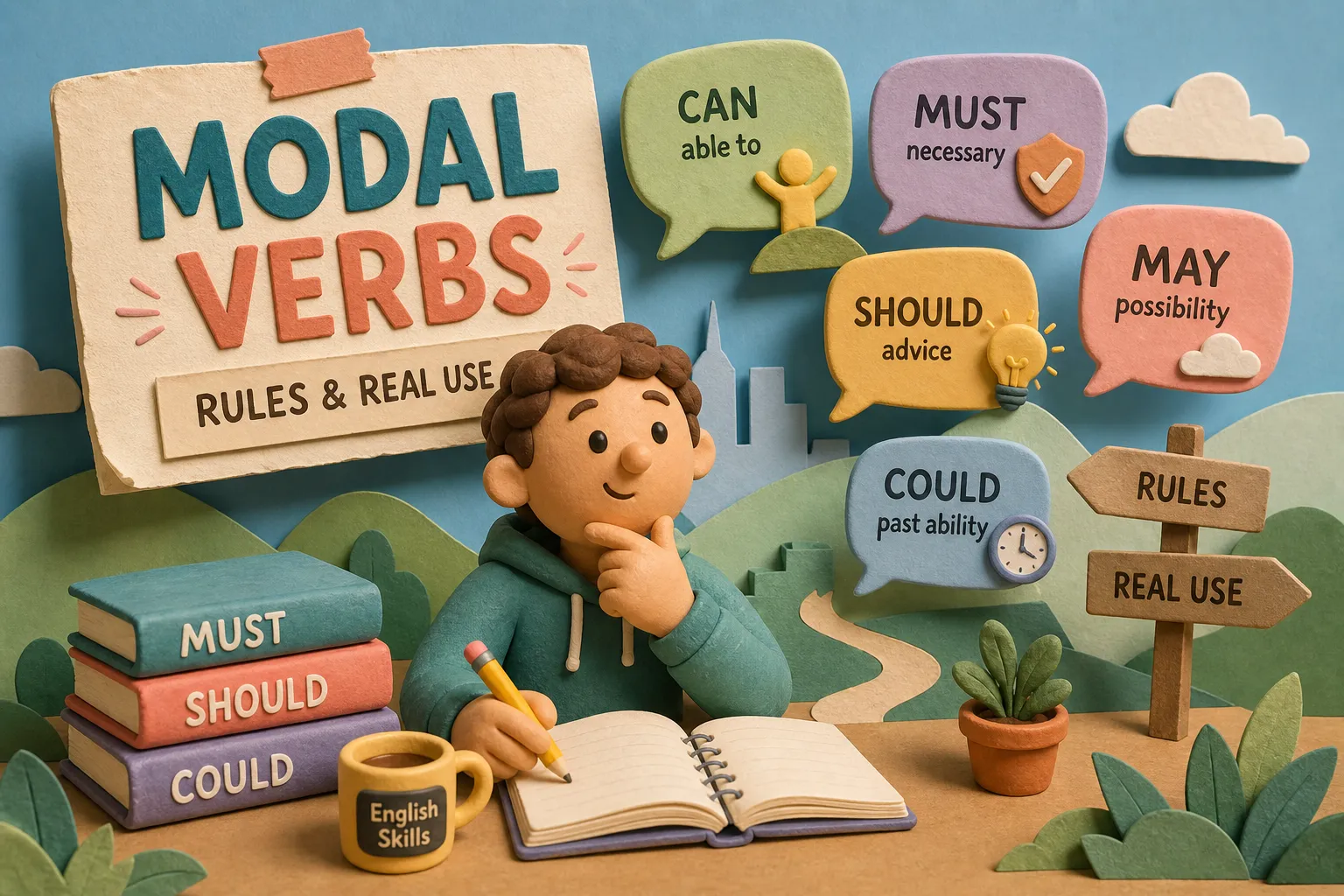
The nine core modals in English are: can, could, may, might, must, shall, should, will, would. Each one covers a specific function. Note that “shall” is rare in everyday American English, you’ll mostly encounter it in formal writing or legal documents, not in daily conversation. “Would” and “could” also carry important conditional uses, which you’ll see in the sections below.
You’ll also hear semi-modals constantly in American speech. Semi-modals are helper phrases that express the same kinds of meaning as core modals, but they behave more like regular verbs. The most common ones are have to, need to, and ought to. For example: “I have to finish this today” or “You need to call them back.” These phrases are everywhere in spoken American English, so learning them is just as important as learning the core nine.
The three grammar rules every modal follows
These three rules apply to all core modals, every time, no exceptions. Breaking any one of them is the most common mistake intermediate learners make, so it’s worth reviewing them carefully before moving on.
- No -s for third person: “She can swim”, not “She cans swim.”
- No “to” after the modal: “He must leave”, not “He must to leave.”
- No do/does in negatives or questions: “Can you help?”, not “Do you can help?”
These three rules are what make modals different from regular verbs. Once you internalize them, forming correct sentences becomes much faster. For a concise grammar explanation of modal forms and usage, see the Cambridge Dictionary guide to modal verbs and modality.
The four main jobs modal verbs do
Modals do four main things in English: they express ability, permission, obligation, and probability. Understanding these four categories helps you choose the right modal for any situation.
Ability and permission
For ability, use can for the present and could for the past. For other tenses, use be able to. For example: “I can drive.” / “I could drive when I was sixteen.” / “I’ll be able to drive after I pass the test.” Each sentence shows a different point in time, but all three express the same core idea: having a skill or capacity.
For permission, the modal you choose signals how formal you are. “Can I use your phone?” is casual and works fine between friends or coworkers. “Could I use your phone?” is slightly more polite and works well with someone you don’t know well. “May I use your phone?” is formal and sounds professional. In everyday American speech, “may” for permission is not very common, you’ll hear it more in formal writing, professional emails, and polite workplace requests.
Obligation, necessity, and advice
For strong obligation, must and have to both express that something is necessary, but they come from different sources. “I must finish this report” sounds like internal pressure, a personal decision or strong feeling. “I have to finish this report by Friday” suggests an external requirement, something your boss said or a deadline set by someone else. In everyday American conversation, “have to” is much more common than “must.”
For advice and mild obligation, use should. It is the standard word for advice in American English. “You should call her.” “You should eat breakfast.” “Ought to” carries the same meaning but sounds slightly more formal or serious, almost like a moral expectation. “You ought to apologize” has a stronger ethical tone than “You should apologize.” In daily speech, “should” is almost always the better choice.
Probability and possibility
Modals also show how certain you are about something. Must expresses near certainty based on evidence, for example, when the facts strongly point to one conclusion. Might and may express a real but uncertain possibility, and could signals that something is possible but less certain than “may.” Here’s a short example that puts all three to work: “She’s not answering her phone. She must be in a meeting. She might call back later.” Each sentence reflects a different level of confidence about the same situation.
How modals signal tone and politeness in American speech
Native speakers of American English don’t just use modals for grammar. They use them to control tone. The modal you choose tells the other person how polite, urgent, or confident you are. This is the social layer of modals, and it matters as much as the grammar.
From casual to polite in everyday conversation
Look at the same workplace request across different registers. “Can you send me that file?” is casual and direct, fine between coworkers who know each other well. “Could you send me that file?” is a bit more polite, a good choice when talking to someone you don’t know well or want to show respect. “Would you mind sending me that file?” is formal and respectful, appropriate for a manager or an important client.
The practical rule is simple: could and would almost always sound more polite than can and will, even when the meaning is the same. Switching “can” to “could” in your requests is one of the fastest ways to sound more professional in American English. For ready-made polite expressions you can memorize, check the 75 American English Phrases for ESL Beginners. For additional tips on making polite requests using modal verbs, see this guide from ABC Learning English: How to make polite requests in English using modal verbs.
Modals at work: emails, meetings, and requests
Modal choice matters most in writing, because the reader can’t hear your tone of voice. “You must send this today” in an email can sound aggressive, even if that wasn’t your intention. “Could you send this today?” sounds collaborative and respectful. The words are nearly identical, but the social effect is very different. If you want to put these modal patterns to work in real professional situations, the Professional English, Your Daily American gives you applied practice with real email phrases, meeting expressions, and workplace requests. It’s the natural next step after understanding the rules here.
How to build negatives, questions, and past modal forms
Making negatives with modal verbs
To make a modal negative, add “not” directly after the modal. You do not need “do” or “does.” The most useful contractions are: can’t, couldn’t, won’t, wouldn’t, shouldn’t, mustn’t, might not, and may not. For example: “She can help” becomes “She can’t help.” “He should go” becomes “He shouldn’t go.”
There is one critical distinction you must understand: mustn’t and don’t have to are not the same. They are actually opposites. “You mustn’t sign that document” means it is forbidden. “You don’t have to sign that document” means it is optional. Confusing these two causes real communication problems, especially in workplace and legal situations.
Forming questions with modals
To form a question, put the modal before the subject. That’s it, no “do” or “does” needed. “Can you help me?” / “Should we call first?” / “Could she join the meeting?” You can also use contracted negatives in questions to express surprise or check information: “Can’t she just send an email?” sounds different from “Can she send an email?” The contracted form adds a tone of mild disbelief or frustration.
Perfect modals: should have, could have, must have
Perfect modals talk about past situations, things that didn’t happen or that we’re now sure about. The structure is: modal + have + past participle. “You should have called” means the call didn’t happen, and it was a good idea. “He could have finished” means finishing was possible, but he didn’t. “She must have left already” means you’re almost certain she left, based on the evidence you see.
Negatives follow the same pattern: add “not” directly after the modal. “You shouldn’t have said that.” “He couldn’t have known.” One thing to notice in natural American speech: “shouldn’t have” is almost always reduced to “shouldn’t’ve” in casual conversation, so don’t be surprised when you hear it that way in real exchanges. For a technical overview of how modal auxiliary verbs are described in grammar references, see the Wikipedia article on English modal auxiliary verbs.
The modal pairs that confuse most ESL learners
Must vs. have to (and their very different negatives)
Use must when the obligation comes from your own judgment or strong feeling. Use have to when the obligation comes from outside: a rule, a schedule, or another person. “I must do better” feels personal and internal. “I have to be there at 9 a.m.” reflects an external requirement. In conversation, “have to” is the more natural everyday choice.
One important tense note: “must” doesn’t have a past or future form on its own. For past obligation, use had to: “I had to work late.” For future obligation, use will have to: “She’ll have to retake the test.” For a clear, accessible guide to English tense forms, see 12 English Verb Tenses: A Pocket Guide for Non-Native Speakers, Your Daily American.
For extra practice and comparisons of “must” and “have to” in exercises, try this Wall Street English resource: the difference between must, have to, shall, need and may.
May vs. might, and should vs. ought to
May suggests a higher chance; might suggests a lower or more uncertain one. “I may come to the party” sounds fairly likely. “I might come” sounds less sure. In everyday American speech, “might” is the more common word for expressing possibility. “May” is more common in formal writing or when asking for permission: “May I ask you something?”
Should and ought to mean almost the same thing, but “should” is the natural American English choice in almost every situation. “Ought to” sounds formal or slightly old-fashioned in spoken conversation. The practical guidance is simple: use “should” in conversation, and save “ought to” for formal writing.
Common mistakes and a quick practice section
Five modal errors to stop making now
These are the most common modal errors at the intermediate level. Check your own writing and speaking against each one.
- “She can to swim” → She can swim. Never add “to” after a core modal.
- “He musts go” → He must go. Modals never take -s, even in third person.
- “I don’t can understand” → I can’t understand. Add “not” to the modal; no “do” needed.
- “I will can go” → I will be able to go. Never stack two modals together.
- “She must of left” → She must have left. Always use “have,” not “of,” in perfect modal forms.
Try it yourself: modals examples and exercises
Fill in the blank with the correct modal. The answers appear right below each sentence.
- When I was a child, I _____ ride a bike but I _____ swim.
Answer: could / couldn’t - “_____ I use your computer for a minute?” (polite request)
Answer: Could - You _____ be here by 8 a.m. It’s a company rule.
Answer: have to - She’s not in her office. She _____ be at lunch.
Answer: might / may / could - “_____ you send me the agenda before the meeting?” (professional email)
Answer: Could / Would
Now try one open challenge: write two sentences using a modal you found difficult in this lesson, one positive and one negative. Reading a grammar rule helps, but producing the language yourself is what makes it stick.
You now have a clear framework for modal verbs
Modal verbs are not random. They follow clear grammar rules, and the one you choose tells your listener exactly how certain, polite, or urgent you are. That’s a skill native speakers of American English use constantly, in every conversation, every email, every meeting. Now you have the framework to do the same.
The best habit you can build from here is active listening. Every time you hear a modal in a conversation, podcast, or American TV show, ask yourself one question: what function is it serving? Ability? Permission? Obligation? Possibility? That practice, done consistently, builds real fluency faster than any drill.
When you’re ready to apply these modal patterns in professional situations, the Professional English, Your Daily American content takes you straight into real workplace scenarios: making requests in meetings, writing professional emails, and communicating clearly with American colleagues. Head there to put today’s lesson to work right away.