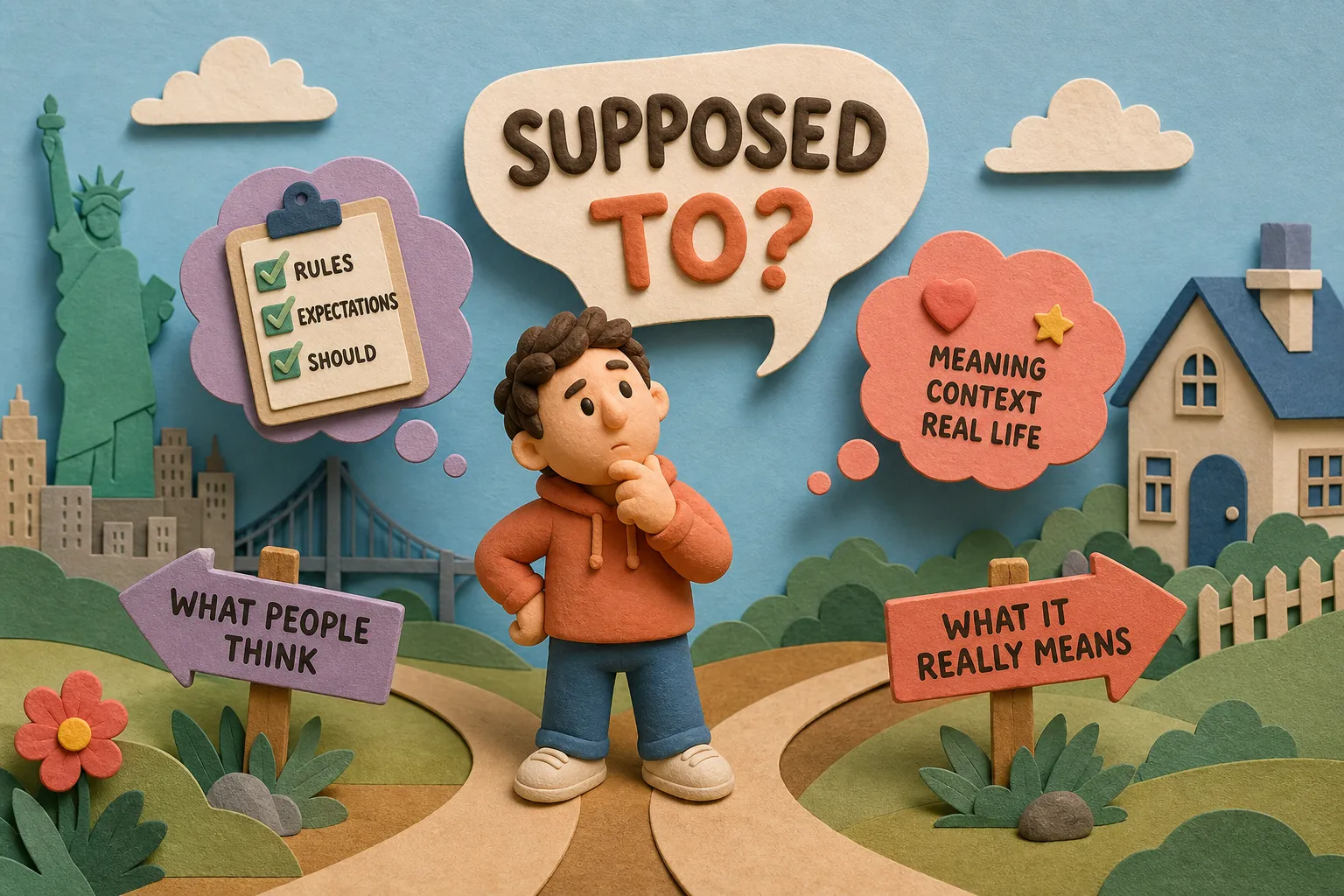
By the end of this article, you’ll be able to define “supposed to,” use it correctly in three different situations, avoid the most common spelling mistake, and say it the way real Americans say it every day. This phrase comes up constantly in American life: at work, at home, in conversations with friends, and even in signs on the wall. It’s one of the most common expressions in everyday American English, you’ll hear it in nearly every real conversation.
The expression does more work than most learners expect. It signals obligation, expectation, and broken rules, three very different ideas, all packed into two small words. This article covers the grammar, the correct written form, pronunciation, and real examples so you can start using it right away.
What “supposed to” really means: three uses you need to know
“Be supposed to” is a modal expression, a phrase that shows duty, expectation, or possibility. This one, specifically, tells you that something is required, planned, or being broken as a rule. The key word is “be”: the phrase always needs a form of “be” in front of it: am, is, are, was, were. For a concise dictionary definition, see Merriam-Webster’s definition of “be supposed to”.
Obligation: something you are required to do
The expression can signal a rule, instruction, or duty that comes from someone else, a manager, a doctor, a school, or a social norm. The obligation comes from outside you, not from your own choice. Compare these two sentences: “I have to finish this report” sounds like a strong personal obligation. “I am supposed to finish this report by Friday” sounds like a rule someone gave you.
Here are clear examples of this use:
- “You’re supposed to submit the form before noon.”
- “Employees are supposed to wear badges at all times.”
- “The doctor said I’m supposed to drink more water.”
Expectation: something that was planned or predicted
The phrase also describes what someone expects to happen, often based on a schedule or agreement. The important thing here is that it tells you the plan, not the result. The action may or may not actually happen. “The meeting is supposed to start at 10” means it is scheduled for 10, but nobody knows yet if it will start on time.
More examples:
- “The package is supposed to arrive today.”
- “She is supposed to call me this afternoon.”
In each case, someone made a plan or a prediction. The expression reports that plan.
Broken rules: “you’re not supposed to”
The negative form is one of the most common uses in real American speech. “You’re not supposed to” tells someone they are doing something wrong or breaking a rule. “You’re not supposed to park here” means parking here is against the rules. This form appears constantly in daily life, at work, and with children.
Notice that this use is polite but firm. It is softer than “you can’t” or “you must not,” which is why Americans use it often in public spaces and shared environments.
Suppose to vs. supposed to: the error to fix right now
Writing “suppose to” is a very common mistake learners make with this phrase, and it is easy to understand why. In fast American speech, the “d” in “supposed” almost disappears before the word “to.” When you listen to native speakers, the phrase can sound like “suppose to.” Because of this, many learners write “suppose to” in messages, emails, and notes. For a clear explanation of this common error, see Linguix’s guide to the “suppose to” mistake.
This form is always incorrect in writing. Whether your writing is formal or informal, the correct form is always “supposed to,” with the “d” at the end.
A quick test to get it right
Use this simple rule: if you can replace the expression with “expected to”, or even “meant to”, and the sentence still makes sense, the correct written form is “supposed to.” Try it: “I am supposed to call him” = “I am expected to call him.” Both sentences work. So “supposed to” is correct. Note that “meant to” works in similar situations: “I was meant to call him” carries the same basic idea, though it can sound slightly more British. In American English, “supposed to” is the everyday choice.
Here is the comparison you need to remember:
- ✅ “I am supposed to go to the meeting.”
- ❌ “I am suppose to go to the meeting.”
The second sentence is always wrong. No exceptions.
How to form negatives and questions across tenses
Because this expression uses the verb “be,” you treat “be” as the working verb when you build negatives and questions. The word “supposed” itself never changes. Only “be” changes. For more on forming questions and negatives like these, consult the British Council’s grammar reference on questions and negatives.
Present and future forms
To make a negative in the present, add “not” after “be”: “She isn’t supposed to leave early.” To ask a question, move “be” in front of the subject: “Are you supposed to be here right now?” These are the two patterns you will use most often.
For future situations, the full form is “will be supposed to.” In everyday speech, though, Americans usually use the present tense even when talking about future plans: “The new policy is supposed to start next month.”
Past tense and the signal that something didn’t happen
This is the most important tense to understand. When you use “was/were supposed to,” the sentence often means the action did not happen. “He was supposed to call me last night” strongly implies he didn’t call. “We were supposed to meet at noon” suggests the meeting fell through. The past form frequently carries a built-in signal of disappointment or failure.
Negatives and questions in the past follow the same pattern:
- “You weren’t supposed to be there.”
- “Was she supposed to come?”
Practice these forms because they appear constantly in real conversations when something goes wrong or a plan falls through.
How Americans actually pronounce it in conversation
In natural American speech, the full phrase is almost never fully pronounced. Native speakers reduce it quickly, and if you listen closely, you will hear something that sounds more like “supposta” or “supposeta.” The “d” disappears and the word “to” becomes a soft “uh” sound at the end.
IPA: /səˈpoʊstə/. Simple phonetic guide: suh-POWS-tuh. The stress falls on the second syllable. Note that vowel quality can vary slightly by region, but the core reduction, the dropped “d” and the schwa at the end, is consistent across American English. If you want to study common pronunciation problems in more depth, see our article on English words non-native speakers mispronounce. This reduced form belongs in conversation only. In formal writing, emails, and professional documents, always write out the full “supposed to.”
Contractions you’ll hear every day
When you combine this reduction with common contractions, here is how it sounds in real sentences:
- “I’m supposta be there at 8.”
- “You’re not supposta do that.”
- “He’s supposta call back.”
This pattern follows the same logic as other common reductions: “gonna” (going to), “wanna” (want to), and “hafta” (have to). If you already know those reductions, “supposta” works the same way. Connect the new sound to what you already know, and it will feel natural faster. For more examples of conversational reductions and filler words, check our guide to Filler Phrases Every American English Learner Should Know.
Real examples: at work, in social life, and at home
Grammar gives you the rules. Real examples show you how the phrase actually lives in conversation. Here are examples from three common contexts.
At work
“Supposed to” is direct and neutral in professional settings. It doesn’t sound rude, and it doesn’t sound too formal. That makes it a useful phrase for everyday workplace communication. Listen to how naturally it fits:
- “You’re supposed to CC the manager on those emails.”
- “The system was supposed to update overnight, but it didn’t.”
- “Are we supposed to join the 3 o’clock call?”
Notice that the second sentence uses the past form. The system didn’t update, and “was supposed to” tells us that immediately, without extra explanation.
In social situations and daily life
Outside of work, the expression shows up in casual conversations all the time. You use it to talk about plans, correct a friend’s behavior, or describe something that didn’t go as expected. Here are a few everyday examples:
- “You’re not supposed to take photos in here.”
- “She was supposed to pick me up at 6.”
- “I’m supposed to bring something to the party, what should I get?”
One useful cultural note: “You’re not supposed to” is the polite, low-pressure way Americans correct behavior in public. It’s softer than “you can’t” or “stop that.” You’ll hear it at restaurants, in museums, in offices, and anywhere rules need to be explained without creating a conflict. Knowing this helps you understand when someone says it to you, and use it appropriately yourself.
Practice it now: three quick situations
The fastest way to lock in a new phrase is to use it yourself. Try writing or saying one sentence for each of these situations. There is no single right answer, focus on using the correct form.
- You arrive 15 minutes late to a meeting. What were you supposed to do?
- A friend parked in a no-parking zone. Tell them they’re not supposed to park there.
- Your package hasn’t arrived yet, but it was scheduled for today. When is it supposed to arrive?
Check your answers by using the quick test: can you replace “supposed to” with “expected to” and still have a correct sentence? If yes, you used it correctly.
You now know how “supposed to” really works
Here is a quick summary of the key points. “Be supposed to” expresses three things: obligation (a rule or duty given by someone else), expectation (a plan or prediction), and broken rules (the negative form). In writing, the correct form is always “supposed to,” never “suppose to.” The past form “was/were supposed to” frequently signals that something didn’t happen. And in spoken American English, the phrase sounds like “supposta.”
Expressions like this one are exactly what separates learners who sound correct from learners who sound natural. One is about grammar. The other is about knowing how real Americans actually speak, in real situations, every day. If you want to keep building on what you learned here, Your Daily American covers exactly this kind of practical, everyday English: from expressions and pronunciation to the cultural context that makes language actually make sense.