By the end of this lesson, you’ll know the dare meaning in American English, how to say it, how to use it correctly in a sentence, and which grammar pattern to reach for in everyday conversation. You’ll also learn the grammar rules that trip up even advanced learners, plus four common idioms that come up all the time in real American conversations.
Here is the tricky part: “dare” is not just one word with one job. It works in two different grammatical ways in American English, and each way follows different rules. Many learners overlook this difference, which leads to errors that are easy to avoid once you know what to watch for.
Stick with this lesson and you’ll walk away ready to use “dare” with confidence, whether you’re watching an American TV show, writing an email, or having a conversation with a native speaker.
Dare meaning: the core definition
The basic verb meaning
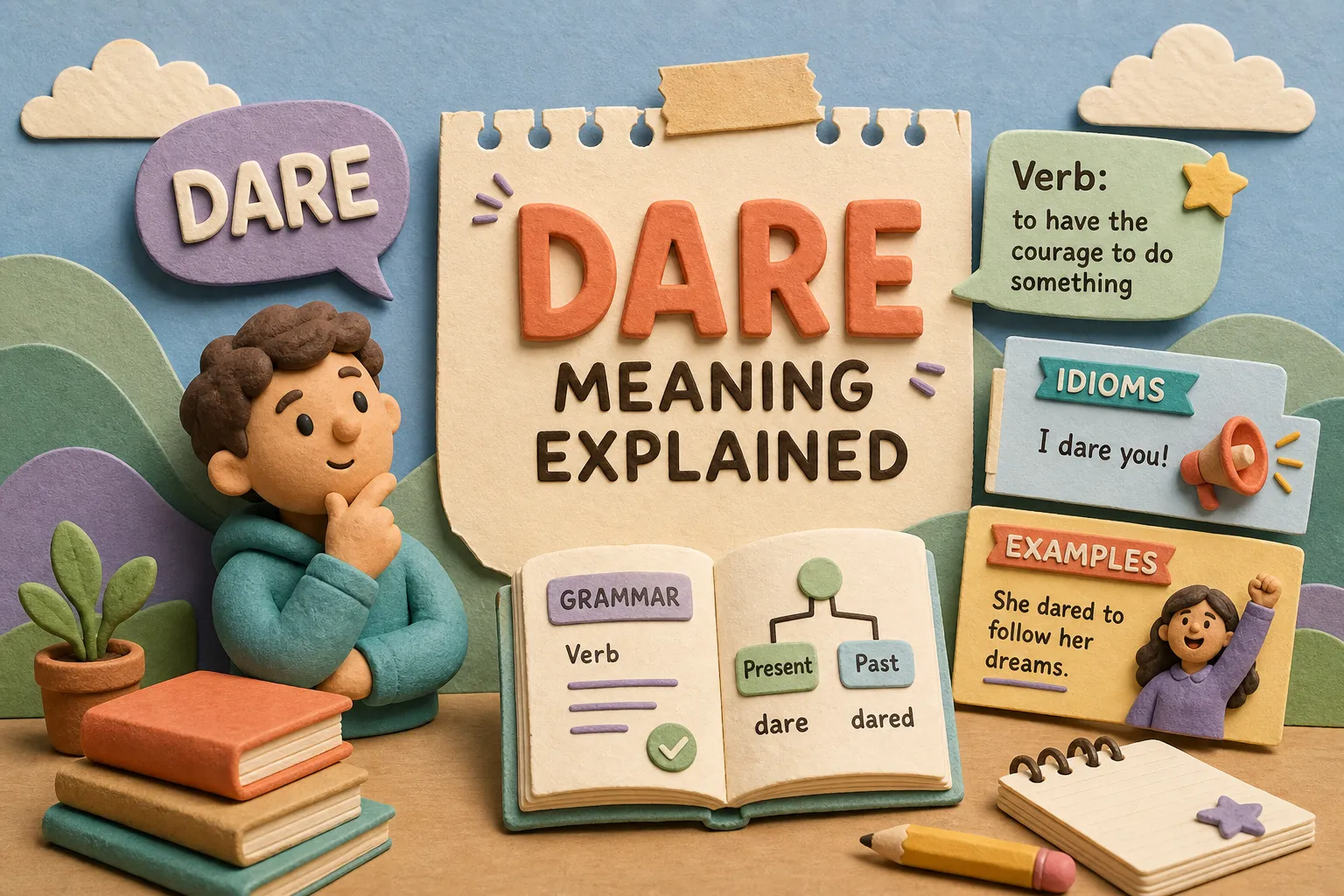
“Dare” is a verb with two main senses. First, it means to be brave enough to do something risky or difficult. Second, it means to challenge someone else to do that thing. Both senses involve courage and risk. For a quick historical look at how the word developed, see its etymology on Etymonline.
Here they are side by side:
- Sense 1 (be brave enough): “She dared to speak up in front of the whole team.”
- Sense 2 (challenge someone): “He dared her to try the spiciest dish on the menu.”
“Dare” also works as a noun. A dare is a challenge someone gives you, usually to do something bold or uncomfortable. Example: “He swam across the river on a dare.”
Dare meaning, pronunciation and usage
“Dare” has one syllable. The IPA pronunciation is /dɛɹ/. The phonetic respelling is “dehr.” The vowel sounds like the “e” in “bed” or “head.” It does not sound like the “a” in “name.”
To say it correctly, open your mouth slightly, keep your tongue low, and end with a clear American /r/ sound. In General American English, the accent most commonly associated with standard broadcast speech, the final /r/ is pronounced fully. Some regional U.S. dialects are non-rhotic and may soften that /r/, but in most American contexts you will hear it clearly. In British English, the IPA is /dɛə/, and the final /r/ is much softer or nearly silent. For standard dictionary pronunciations and usage notes, see the Cambridge Dictionary entry for “dare” and the Merriam-Webster definition.
Dare meaning: verb vs. noun
Dare as a main verb, the form most Americans use
In American English, “dare” most commonly functions as a regular main verb. That means you use the helping verbs do/does/did in questions and negatives, and you typically follow “dare” with “to” plus another verb. The bare infinitive (without “to”) is also possible in some contexts, but the to-infinitive is the standard choice in everyday American speech.
The pattern is: subject + do/does/did + (not) + dare + to + verb.
- Negative: “She doesn’t dare to speak up in meetings.”
- Question: “Did he dare to ask for a raise?”
- Affirmative: “He dares to go where others won’t.”
Notice the third-person -s in the affirmative: “she dares,” “he dares.” This follows the same rule as any regular English verb.
Real-life examples across contexts
Here are four example sentences that show “dare” working in everyday situations:
- “She dared to quit her job without a backup plan.”
- “Do you dare to try the hottest sauce on the menu?”
- “My colleague doesn’t dare to disagree with the manager in public.”
- “They dared to launch their startup with almost no funding.”
These sentences feel natural because they use the standard main verb pattern. This is the form you should reach for in almost all spoken and written American English.
Dare as a modal verb: formal, literary, and rare in American speech
How the modal form works
“Dare” can also work as a semi-modal verb, a verb that behaves partly like a modal such as “must” or “need.” In this role, it follows different rules. There is no helping verb, no -s in the third person, and the verb that follows uses the bare infinitive (a verb with no “to” in front of it).
Here is how it looks:
- Negative: “He dare not mention it again.” (In the semi-modal pattern, no -s is added; the main-verb equivalent in AmE would be “he doesn’t dare to mention it.”)
- Question: “Dare anyone go in there alone?”
The contraction “daren’t” means “dare not.” It is standard in British English but sounds unusual to most American ears. You will see it in British books and TV shows, but American speakers almost never use it.
Why this matters for American English learners
American speakers rarely use the modal form in everyday conversation. You will encounter it in formal writing, literary fiction, older films, and British English content. Still, it is worth recognizing when you read or listen.
The practical rule: in spoken American English, prefer the main verb pattern. Say “doesn’t dare to” and “do you dare to” rather than “dare not.” Keep in mind that “dare not” does still appear in formal written contexts, journalism, academic prose, and rhetorical writing, so it is not wrong, just uncommon in everyday American speech. If you want to go deeper into grammar patterns like this one, the grammar track at Daily Grammar, Your Daily American breaks down exactly these kinds of subtle rules, the ones native speakers follow without thinking about them.
Key idioms and fixed expressions with “dare”
“How dare you”, indignation with a grammar rule attached
“How dare you” is a strong expression of anger or shock at someone’s behavior. You use it when someone does something that surprises or offends you deeply.
Here is the grammar rule to know: after “how dare you,” always use the bare infinitive. Never add “to.”
- Correct: “How dare you say that to me.”
- Incorrect: “How dare you to say that to me.”
This is one of the few places where the semi-modal pattern shows up clearly in everyday American English. Adding “to” is always wrong here, so treat this as a fixed rule.
“I dare you” and “Don’t you dare”
“I dare you” means you are challenging someone to do something risky to prove their courage. The tone can be playful, competitive, or provocative.
Short dialogue:
A: “I dare you to go talk to him.”
B: “Fine. Watch me.”
“Don’t you dare” is a strong warning. You use it to tell someone not to do something, with a clear sense that there will be a consequence.
Short dialogue:
A: “Don’t you dare eat the last slice of pizza.”
B: “Too late.”
“On a dare” and “I dare say”
“On a dare” means you did something because someone challenged you. Example: “She got the tattoo on a dare.” This phrase usually answers the question “Why did you do that?”
“I dare say” means something like “I think probably” or “I suppose.” This phrase is older and more formal. American speakers use it rarely, but you will see it in British media and formal writing. Example: “I dare say he’ll be late again.” For related conversational fillers and expressions that often appear with these idioms, check out Filler Phrases Every American English Learner Should Know.
Dare as a noun: taking a dare
What it means to accept a dare
A dare (noun) is a challenge someone gives you, usually to do something risky or uncomfortable as proof of bravery. Common collocations, natural word pairings, include “take a dare,” “accept a dare,” and “do something on a dare.”
Here are three example sentences:
- “The kids took a dare to knock on the old abandoned house’s door.”
- “He jumped into the pool with his clothes on, all on a dare.”
- “She accepted the dare without hesitation.”
How the noun shows up in everyday conversation
The noun “dare” appears most naturally in casual speech and storytelling. You also recognize it from the classic children’s game Truth or Dare, where choosing “dare” means accepting a challenge from another player. In that game, “dare” is exactly this same noun: a challenge to act boldly.
D.A.R.E. and “dare”: two completely different things
What the D.A.R.E. program is
D.A.R.E. stands for Drug Abuse Resistance Education. It is a school-based program in the United States designed to teach children about the dangers of drugs and violence. It started in 1983 as a partnership between the Los Angeles Police Department and the Los Angeles Unified School District. According to D.A.R.E. America, the organization currently uses an updated curriculum and reports reaching over one million K-12 students across all 50 U.S. states. For an authoritative overview of the program, see the Drug Abuse Resistance Education (D.A.R.E.) article on Britannica.
If you searched for what “dare” means and were thinking of this program, now you know: D.A.R.E. is a proper noun and an acronym. It has nothing to do with the English verb or noun.
Why it’s worth knowing
Many Americans grew up with D.A.R.E. in elementary school, so you may see the acronym on old T-shirts, in movies, or in conversations about American childhood. If someone mentions “D.A.R.E.” in conversation, they are almost certainly talking about the program, not using the word “dare.” Knowing this helps you follow the conversation and shows cultural awareness.
Frequently asked questions about “dare”
Does “dare” always take “to”?
Not always. In the main verb pattern, the standard choice in American English, “dare” typically takes the to-infinitive: “She doesn’t dare to ask.” However, the bare infinitive is also grammatically possible in some contexts. In the semi-modal pattern and in fixed expressions like “how dare you,” no “to” is used at all.
Is “daren’t” used in American English?
Rarely. “Daren’t” is a contraction of “dare not” and is standard in British English. Most American speakers would say “doesn’t dare to” instead. You may encounter “daren’t” in British books, films, or TV shows, but it is not part of everyday American speech.
What does “dare” mean in the phrase “how dare you”?
In “how dare you,” “dare” functions as a semi-modal verb expressing strong indignation. The dare meaning here is closer to “how can you have the nerve to…?”, it signals shock or outrage at someone’s behavior. Grammatically, it always takes the bare infinitive, never “to.”
Now you can use “dare” correctly
Understanding the full dare meaning in American English means knowing both its grammatical roles and its most common expressions. As a main verb, “dare” follows the standard do-support pattern: “doesn’t dare to,” “did you dare to,” “she dares to.” As a semi-modal, it drops the helping verb and the “to”, but that form is largely reserved for formal writing and British English.
You also learned four key expressions: “how dare you” (never add “to” after it), “I dare you” (a challenge), “don’t you dare” (a strong warning), and “on a dare” (because of a challenge). And you can now tell the difference between the word “dare” and the D.A.R.E. program acronym. For additional reputable dictionary perspectives on the word, see the Cambridge Dictionary entry and Merriam-Webster.
Your practice prompt for this week: Write two sentences. Use “dare to” in the first one, and “how dare you” in the second. Then say them out loud. If you want more lessons like this one, with grammar explanations, real examples, and pronunciation guides built for everyday American English, visit Your Daily American and explore the full grammar track.