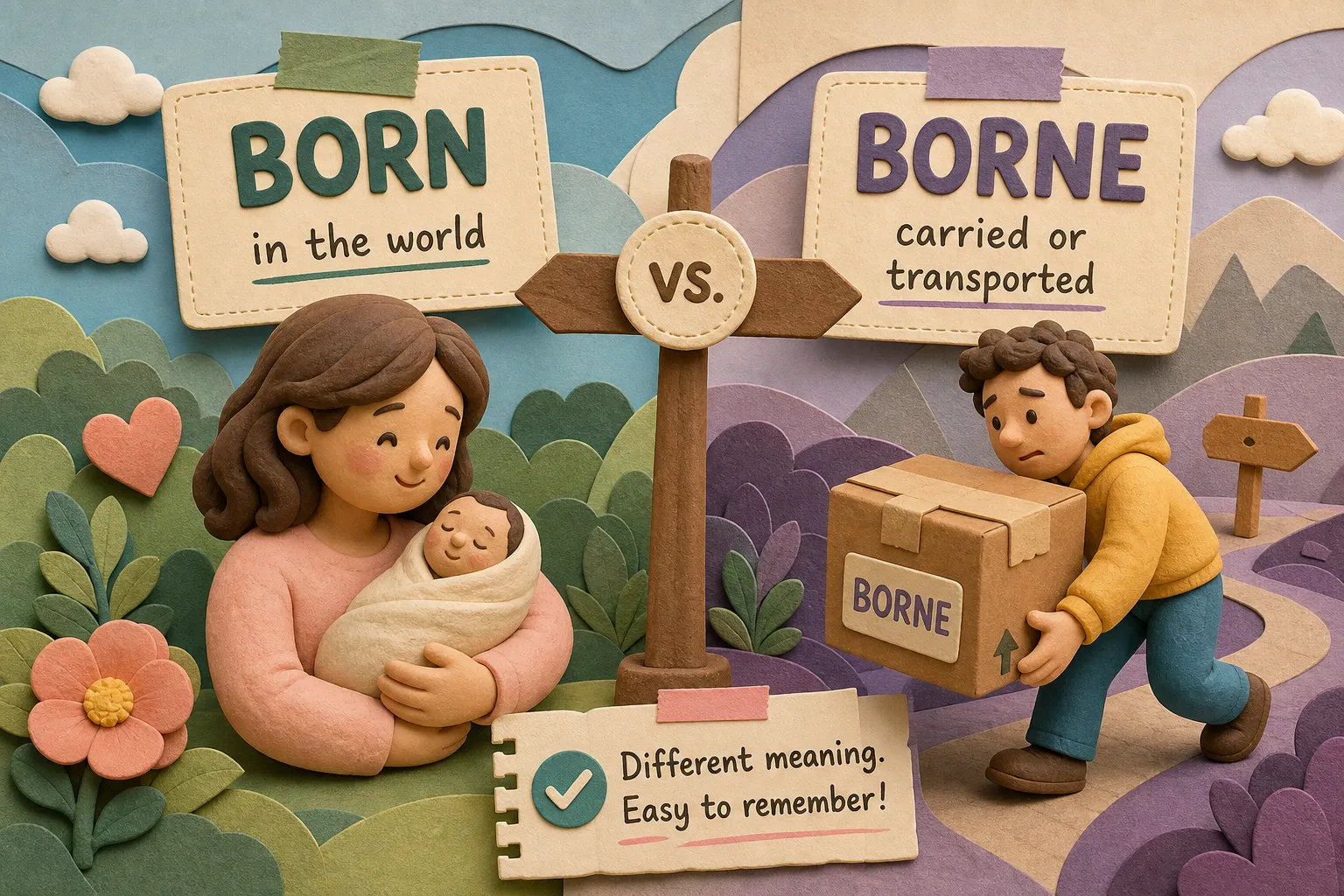
These two words look almost the same, and many English learners use them interchangeably. They shouldn’t. Born and borne have different meanings and different grammar rules, and mixing them up is a common mistake even for advanced writers. This guide breaks down borne vs born with a one-line rule, real examples, and a short practice section so you can test yourself before you finish.
One word is about birth and coming into existence. The other is the past participle of the verb “bear” in all its other meanings: carrying something, enduring something, or transmitting something. These are exactly the kinds of small details that move your English from correct to truly natural.
What “born” means and when to use it
Born in birth constructions
“Born” is almost always used in passive voice sentences about birth. The typical structure is was/were + born. The subject is the person, animal, or thing that came into the world.
- She was born in Chicago in 1994.
- The puppies were born on a cold Sunday morning.
- The twins were born two minutes apart.
- A new movement was born from that protest.
Notice that last example. “Born” works for figurative birth too, when something new comes into existence. The key connection is always creation or origin.
Born as an adjective
“Born” also works as an adjective. When you say someone is a “born leader” or a “born teacher,” you mean they have a natural talent for it; it feels like they were made for that role. This use is common in American English and sounds confident and fluent.
- She is a born communicator.
- He’s a born athlete; he makes everything look easy.
- A Nigerian-born scientist won the award.
- The film was directed by a Paris-born artist living in New York.
In the last two examples, “born” is part of a compound adjective showing where someone is from. The connection to birth and origin is always there. That is the consistent thread with every use of “born.”
What “borne” means and how it differs
Borne meaning “carried” or “transmitted”
“Borne” is the past participle of the verb “bear” when it means “to carry” or “to transmit.” This is not the bear that is an animal; it is the verb “to bear,” which has several meanings in English. When something is moved from one place to another, or when a disease passes from one person to another, the correct word is “borne.”
- The news was borne across the country by travelers.
- The virus is borne by mosquitoes in tropical regions.
- Seeds are borne on the wind for miles.
- Pollen borne by bees plays a key role in farming.
This is also where compound words like “airborne” and “waterborne” come from, and we will cover those in detail in section five.
Borne meaning “endured” or “supported”
When “bear” means “to endure” or “to support a cost or weight,” the past participle is also “borne.” This pattern is often found in formal registers such as legal or business writing, legal documents, business reports, and journalism all use it regularly.
- The financial cost was borne by the company, not the employees.
- She has borne a lot of pressure this year without complaining.
- The risks of the project were borne by the investors.
- He has borne the responsibility alone for too long.
Many ESL learners overlook this use because they associate “bear” only with the animal. But “to bear a burden” is a real and common pattern in American English, especially in formal writing. Learning it will make your professional emails and reports sound much stronger.
The simple rule that makes the choice easy
The one-line rule for borne vs born
Here is the rule you can apply every time: Born = birth or coming into existence. Borne = everything else. When you are not sure which word to use, ask yourself one question: “Does this sentence have anything to do with being born or coming into existence?” If yes, use “born.” If no, use “borne.” Three side-by-side comparisons show the rule in action:
- “She was born in 1988.” (birth, use born) vs. “The disease is borne by insects.” (carried, use borne)
- “He is a born leader.” (natural talent, connected to birth, use born) vs. “The cost was borne by the team.” (endured, use borne)
- “A new tradition was born that night.” (came into existence, use born) vs. “The message was borne to the village.” (carried, use borne)
This rule covers the vast majority of situations you will encounter. It is fast and easy to apply whether you are writing or speaking.
The mother exception: active vs. passive voice
There is one case where “borne” appears in a birth context. When the mother is the subject of an active sentence, meaning she is the one performing the action, the conventional word is “borne.” Usage notes in major references, including Merriam-Webster, support this distinction, though it is most relevant in edited, formal writing.
- “She has borne four children.” (The mother is the subject. She did the bearing.)
- “Four children were born to her.” (The children are the subject. Passive voice, use born.)
In edited, formal writing this distinction is more relevant; many speakers follow it intuitively. If you write professional reports, formal letters, or academic essays, it is worth knowing.
Fixed phrases: born vs borne in “born of” and “borne of”
When “born of” is the correct phrase
“Born of” is the standard American English phrase when something comes from or results from something else. Major dictionaries, including Merriam-Webster, support this form for expressing origin and emergence. The phrase is common in professional and literary writing. For guidance on standard usage, see the MLA style discussion of “born” and “borne”.
- a friendship born of shared struggle
- confidence born of years of practice
- an idea born of necessity
- a policy born of compromise
These phrases work because the thing is “coming into existence” from a source. That connects directly to the birth and origin meaning of “born.” When you use them naturally in your writing, you sound fluent and precise.
Why “borne of” is usually the wrong choice
“Borne of” appears in some writing, but it is not the standard form for expressing origin. Merriam-Webster and other major sources treat “born of” as the correct phrase for this meaning. In most contexts, “borne of” will be judged nonstandard or archaic for expressing origin.
One place where “borne” is correct in a fixed phrase is “borne out,” which means confirmed or proven by evidence, a different phrase with a different meaning: “The results were borne out by the data.” Here, “borne” is correct because the idea is being “carried forward” and proven. It connects to the carrying and supporting meaning. The rule is simple: for origin, always use “born of.” For anything else, check which meaning of “bear” you need.
Compound words with “borne”: airborne, waterborne, blood-borne
Why these compounds use “borne”
All of these compound words mean “carried by” something. They come directly from “bear” in the sense of “to carry.” Since the meaning has nothing to do with birth, the rule is clear: use “borne,” not “born.”
A common spelling mistake is to write “airborn” without the final e, or “water-born” with the wrong word. Neither is correct in standard American English. Merriam-Webster lists “airborne” and “waterborne” as the preferred closed forms. Here are the most important compounds to know:
- Airborne: carried through the air. “The virus is airborne.” “The helicopter was airborne within minutes.” Written as one word in American English.
- Waterborne: carried or transmitted by water. “Waterborne diseases are common in areas without clean drinking water.” One word in modern usage.
- Blood-borne / bloodborne: transmitted through blood. “HIV is a blood-borne virus.” Both the hyphenated and closed forms appear in American English; “bloodborne” is common in medical writing.
- Food-borne / foodborne: transmitted through food. “Foodborne illness is a leading public health concern in the United States, according to the CDC.”
In every compound, “borne” signals “carried by” or “transmitted by” the noun before it. Once you see that pattern, these words become easy to understand and use.
Practice: test yourself with these sentences
Choose the correct word: five sentences
Choose “born” or “borne” for each sentence. The answers are below.
- He was _____ in Seoul and moved to the United States at age twelve.
- The extra costs will be _____ by the department that made the decision.
- Some diseases are _____ by insects that carry them from person to person.
- Their partnership was _____ of mutual respect and a shared goal.
- She has _____ the responsibility of managing the team since her promotion.
Answers and explanations
- Born. This is a birth sentence. The structure is “was born” in passive voice, the standard pattern for talking about where someone was born.
- Borne. The meaning here is “endured” or “supported.” The costs are being carried by the department. This is not about birth.
- Borne. The meaning is “transmitted” or “carried.” This is the same meaning behind compound words like “airborne” and “waterborne.”
- Born. “Born of” is the standard phrase for expressing origin or emergence. The partnership came into existence from mutual respect.
- Borne. The meaning is “endured” or “supported.” She has carried that responsibility. The mother exception does not apply here, she is not giving birth.
If you got four or five right, you have a solid grasp of the rule. If you missed one or two, go back to the section that covers that specific use and read the examples again. For another clear explanation and extra examples, see this helpful born vs borne guide.
Putting it all together
The core borne vs born rule is straightforward: “born” is for birth and coming into existence; “borne” is for everything else that the verb “bear” can mean, including carrying, transmitting, and enduring. Keep two edge cases in mind: the mother exception (she has “borne” children, but the children were “born”) and the “born of” vs. “borne of” distinction (origin always takes “born of”).
Native speakers make these choices automatically. When you make them correctly too, your writing sounds genuinely fluent, not just grammatically right.
At Your Daily American, we cover dozens of distinctions like this one: the small grammar and vocabulary differences that make a real difference in how natural your writing and speech sound. Explore more lessons to keep building your fluency, one clear rule at a time, and if you’re curious about other common confusions, check out our short guide on Are You Using “Good” and “Well” Wrong? Here’s the Fix.