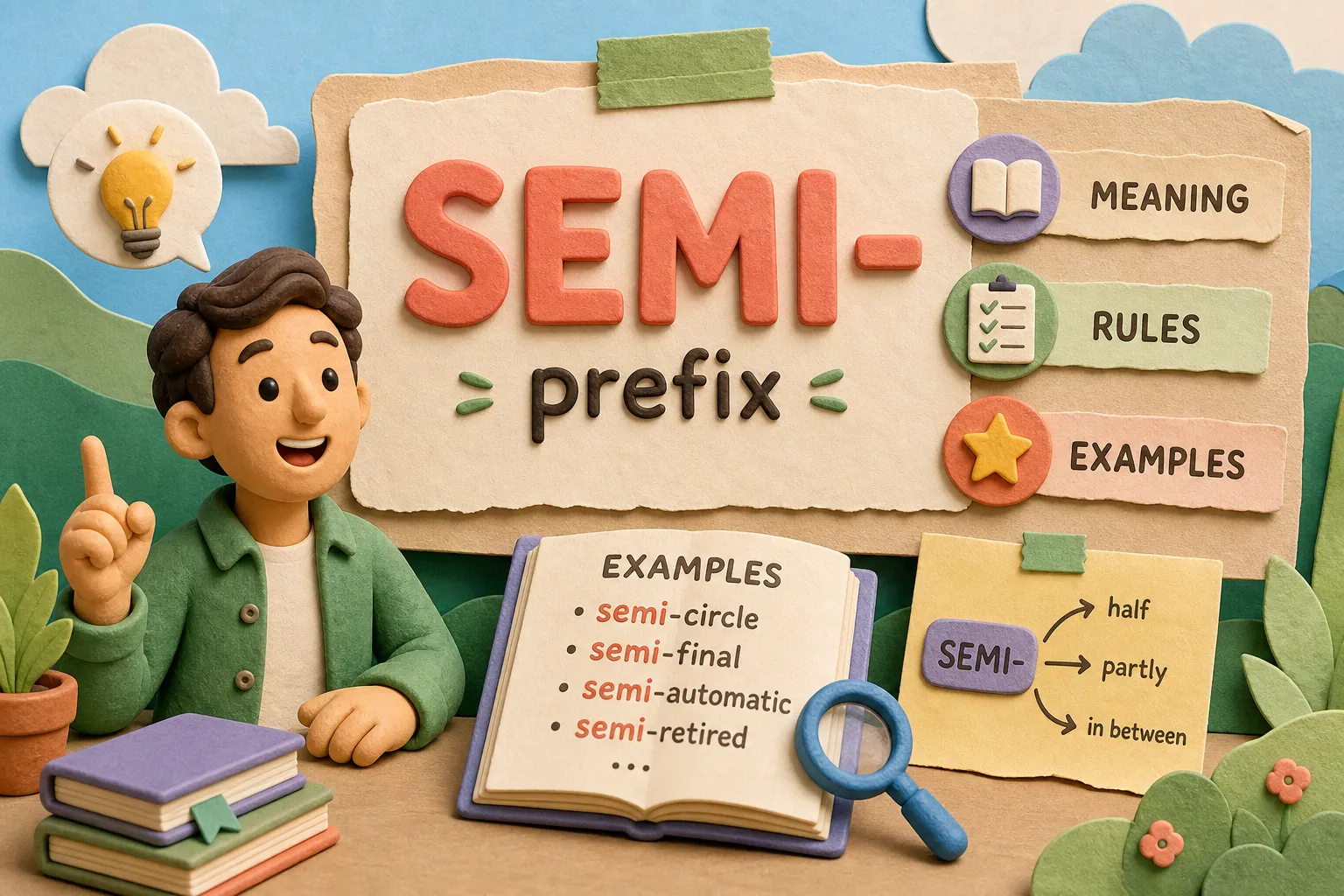
The semi prefix appears in dozens of everyday American English words, and once you know what it means, you can decode all of them instantly. After reading this article, you will know exactly what semi- means, how to spell these words correctly, and how to tell it apart from two similar prefixes: hemi- and demi-. You will also be able to use common semi- words in real sentences right away.
Have you noticed that semifinal, semicircle, semiannual, and semicolon all start the same way? That is not a coincidence. One prefix is doing the work in all of them. A prefix is a word part added to the front of a word to change or add to its meaning. Learning just one prefix unlocks the meaning of dozens of words at the same time.
That kind of pattern-based learning is at the core of what Your Daily American teaches. Instead of memorizing long lists of isolated words, you learn the building blocks, and the words come naturally.
What the semi prefix actually means
The two core meanings: half, and partly
The prefix semi- carries two closely related meanings. The first is a precise “half”: a semicircle is half a circle, and semiannual means every half year. The second meaning is looser: partly, somewhat, or not fully, as in semidarkness (a room that is not completely dark) or semipermanent (lasting a long time but not forever).
Here is a quick example of each type. “The students sat in a semicircle” uses the prefix to mean exactly half. “The room was in semidarkness” uses it to mean partly. One prefix, two related senses, and once you know both, you can decode any word in this family.
From Latin to modern American English
Semi- comes from Latin sēmi-, which simply means half. English borrowed it directly and has used it for centuries, in both technical and everyday contexts. A related Greek form, hemi-, carries the same basic meaning, and you will find more on that, along with the French cousin demi-, in a later section.
Knowing the Latin origin makes the meaning much easier to remember. When you see semi- at the start of a word, ask yourself: “half of what?” or “partly what?” That one question will give you a strong first guess at the meaning of any unfamiliar compound.
How to say it correctly
American English uses two accepted pronunciations for this prefix. The first is /ˈsɛmi/ (“SEH-mee”). The second is /ˈsɛmaɪ/ (“SEH-my”). Both are correct, and native speakers use both. As a general tendency, “SEH-mee” appears more often inside longer compound words like semiconductor or semicircle, while “SEH-my” is more common when the word stands alone as a noun, as in “A semi was parked on the highway.” That said, pronunciation varies by word, context, and region, so both forms are worth knowing. Major American dictionaries, including Merriam-Webster, list both variants for the prefix. For a clear audio demonstration of the common pronunciations, reputable pronunciation guides can help you hear both forms.
20+ semi- words: examples from sports, work, and everyday life
In sports and competition
Sports vocabulary is a great place to see this prefix in action. The word semifinal means the round before the final in a competition. Break it down: semi- (half) + final = the halfway point to the end. “She reached the semifinal of the tournament.” “He lost in the semifinal and did not advance to the championship.”
Two more common sports-related words are semipro and semiretired. Semipro describes a player who is paid but not at the highest professional level. Semiretired describes someone who has stepped back from full-time work but still plays or coaches part time. Notice how the prefix always signals something that is not fully one thing or another.
At work and in business
The prefix shows up often in professional settings. A semiannual report or review happens twice a year, once every six months. “Our team holds a semiannual performance review in June and December.” A semiformal dress code is more polished than casual but less strict than black tie. “The invitation says the event is semiformal, so a blazer is fine.”
You may also encounter semiretirement in workplace conversations, especially in human resources or career discussions. It describes someone who still works part time after leaving a full-time role. “After 30 years with the company, she moved into semiretirement and now consults a few days a week.” These are words you will genuinely see in American emails, job descriptions, and office conversations.
In daily conversation and shopping
These words also appear in everyday life, sometimes without you realizing it. Check a bag of chocolate chips at the grocery store and you will almost certainly see semisweet, meaning slightly sweet, not fully sweet. “He prefers semisweet chocolate in his cookies.”
When someone describes a room arrangement, they often use semicircle: “The chairs were arranged in a semicircle.” The word semidarkness describes a space that is dim but not completely dark. And in American English, the noun semi on its own means a large truck, short for semitrailer. “A semi blocked the exit ramp during rush hour.” That last use is very common in spoken American English and is worth knowing for everyday listening and conversation.
A full list at a glance
Here are 20+ words built with this prefix, grouped by meaning:
- Exactly half: semicircle, semicolon, semiconductor, hemisphere (via hemi-), semiannual, semifinal, semitrailer
- Partly / not fully: semidarkness, semipermanent, semiliterate, semiconscious, semidetached, semiformal, semiskilled, semiretired, semiretirement, semiautomatic, semiautonomous, semisweet, semiprecious, semipro, semi-independent, semi-official
Each entry above contains the same core idea: half of something, or not quite fully something. Knowing the prefix means you can decode any of these words, and new ones, on the spot.
How to spell and hyphenate semi- words
The default rule: check the dictionary first
Most established words with this prefix are written as one closed word with no hyphen. Semicolon, semifinal, semiconductor, semiannual, and semiprecious are all written without a hyphen. This is the standard in American English, confirmed by Merriam-Webster, a widely used dictionary reference for American English writing.
The practical rule: if Merriam-Webster lists the word as a single closed unit, use that spelling. Adding a hyphen just because a word begins with semi- is one of the most common mistakes writers make with this prefix.
When a hyphen is still correct
A hyphen is appropriate when the compound is not yet listed in a standard dictionary, when omitting it would confuse the reader, or when a specific publication’s style guide requires it. For example, semi-independent or semi-official may appear with a hyphen in specialized or formal writing where the compound is new or uncommon. In everyday writing, the closed form is almost always the right choice for recognized words. For practical hyphenation guidance and punctuation overview, consult reputable usage guides that explain when hyphens clarify meaning and when they are unnecessary, such as this hyphen guide.
What AP, Chicago, and Merriam-Webster each say
All three major American style references point in the same direction. AP Style generally omits the hyphen; words like semiautomatic and semiautonomous are written closed. Chicago Manual of Style also favors the dictionary form first. Merriam-Webster lists most common words in this family as closed forms, making it the practical deciding reference for editors and writers. When writing for school, work, or an American audience, check Merriam-Webster first. If the word appears there, follow that spelling. If you are coining a new or rare compound, use a hyphen. Another accessible resource on hyphenation and punctuation can help new writers avoid common pitfalls.
Semi-, hemi-, and demi-: what sets them apart
Hemi-: the Greek counterpart for technical words
Hemi- also means half, but it comes from Greek rather than Latin. You will find it mostly in scientific, medical, and technical vocabulary. A hemisphere is half of a sphere, such as the Northern Hemisphere of the Earth. Hemiplegia (/ˌhɛmiˈpliːdʒə/) is a medical term for paralysis on one side of the body.
Everyday English speakers almost never create new words with hemi-. If you encounter a word beginning with hemi-, it is very likely a scientific or medical term. You do not need to produce new words with it, you just need to recognize it when you read it.
Demi-: the French-influenced half
Demi- entered English through French and also means half. It appears in a smaller, more fixed set of words. A demigod is a being who is partly divine and partly human. Demi-glace is a cooking term for a rich, reduced sauce. Demi-brigade is a military term from French history.
Demi- is not a productive prefix in modern everyday English, meaning people do not use it to build new words. Treat any demi- word as a fixed expression and look it up rather than trying to decode it from the parts alone. For a readable comparison of these related prefixes and their uses, see a concise overview that contrasts hemi-, semi-, and demi- in common English usage.
A simple rule to remember
Use this guide when you are not sure which prefix you are looking at. For everyday English, semi- is almost certainly the right one. For medical or scientific terms, hemi- likely already exists in the language as an established word. For demi- words, treat them as set expressions. As a learner, your main job is building new words with semi-. Hemi- and demi- are for recognition, not production.
Why one prefix is worth more than 20 separate vocabulary words
How prefixes multiply what you already know
Here is the practical math. If you know that semi- means half or partly, you can make a smart guess at any new word in this family. Consider semiliterate (able to read and write, but only at a basic level), semiconscious (partly awake, not fully aware), and semidetached (a house that shares one wall with another house). You may have never seen these words before reading this article, but you can decode them right now because you know the prefix.
This is why learning word parts pays off so quickly. Each prefix or suffix you learn gives you a tool to understand many new words at once, not just one. The more word parts you know, the faster your vocabulary grows, and the less you have to rely on memorizing individual entries.
A smarter way to study vocabulary
That principle is central to how Your Daily American approaches vocabulary instruction. The platform teaches words through patterns, common prefixes, suffixes, and word families, so you build a real system rather than a pile of unrelated entries. Vocabulary content is organized into thematic tracks and study method guides, which means you can start with a pattern like this one and keep building in an organized, lasting way. For a deeper look at prefixes and suffixes across English vocabulary, check this comprehensive guide.
Language educators and curriculum designers have long found that learners who study word parts, prefixes, suffixes, and roots, retain vocabulary more effectively and transfer that knowledge to unfamiliar words far better than learners who study words in isolation. Your Daily American is built around that same instructional logic.
Try it yourself: a short prefix exercise
Before you move on, try these quick practice prompts. They will help you use what you just learned, not just read about it.
- What do you think semiliterate means? Break it into semi- + literate (able to read and write).
- What about semidetached? Think about semi- + detached (separated). What kind of house might this describe?
- Write one sentence using any semi- word from this article. Try to use it in a situation from your own life or work.
Check yourself: semiliterate means able to read and write only at a basic level. Semidetached describes a house connected to one other house by a shared wall. If your sentence made sense, you are already using the prefix correctly.
Take this further with pattern-based learning
Here is a quick summary of what you now know. Semi- is a Latin prefix meaning half or partly, that core sense carries through every word it touches, from semifinal to semisweet to semi (the truck). Most of these words are spelled as one closed word with no hyphen, and when you are unsure, Merriam-Webster is your first stop.
You also know how to tell this prefix apart from its two cousins. Hemi- is Greek and belongs to science and medicine. Demi- comes from French and appears in a small set of fixed expressions. For everyday American English, semi- is the one to know and use.
Now that you see how much power one prefix carries, consider what other building blocks could do for you. Prefixes like un-, re-, pre-, and over- are just as productive. Each one you learn multiplies your vocabulary immediately. Your Daily American covers prefixes, suffixes, word families, and other study strategies built for real-world American English, and it is a great place to keep building the smart way.