Picture this: you’re writing a professional email to your manager. You type “seperate departments,” hit send, and later find out it was wrong. Your spell-check didn’t catch it. Your manager did. That small moment hurts your confidence more than it should.
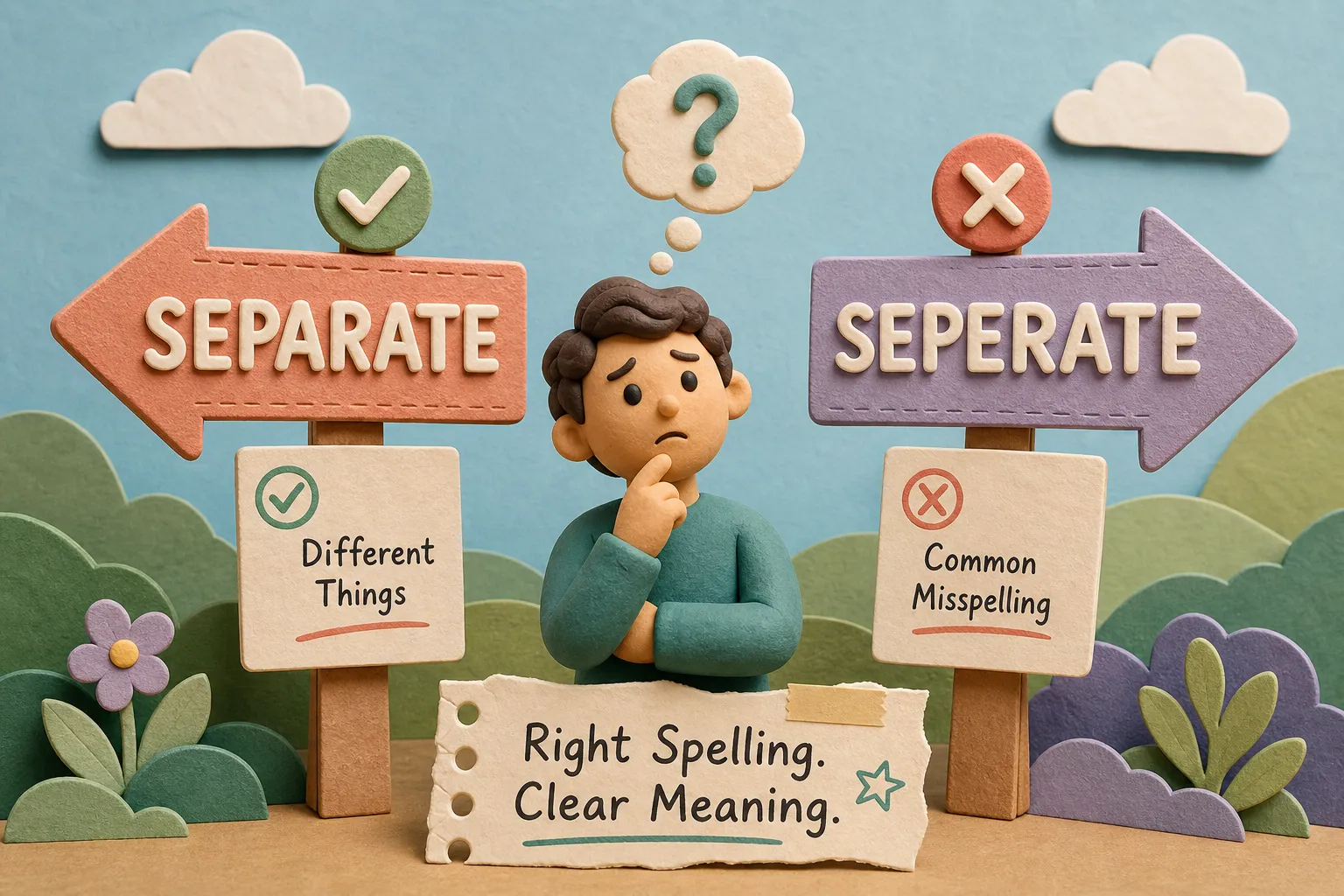
The question of separate vs seperate trips up more people than you might expect. “Separate” ranks among the most frequently misspelled words in English, not just among ESL learners, but among native speakers too. At Your Daily American, it’s one of the spelling errors that appears most often in learners’ writing practice, and it tends to come from the same underlying cause.
By the end of this article, you’ll be able to spell “separate” and its related forms correctly every time. You’ll understand why the wrong version feels so natural, and you’ll have at least one memory tool to lock in the correct spelling from now on.
Separate vs Seperate, Why the Mistake Happens
Many speakers and learners make this mistake at least once, and there’s a clear reason why. The problem starts with how the word sounds in natural spoken American English. When people say “separate,” the middle part of the word is weak and unclear. You hear something close to “SEP-er-it” or even “SEP-rit,” not a clean “SEP-ah-rayt.”
Because the middle syllable sounds like a vague “uh,” your brain reaches for the nearest vowel that seems to match what you heard: “e.” So instead of writing “separate,” you write “seperate.” It feels right because your ears told you it was right.
The pronunciation trap: what you hear vs. what you write
This happens because of schwa reduction, when an unstressed vowel becomes a soft, unclear “uh” sound. In American English, unstressed syllables are often shortened or weakened. The “a” in “sep-a-rate” doesn’t sound like the “a” in “cat.” It sounds like a quick, soft “uh,” and that makes it easy to write the wrong letter. For a deeper explanation of stress and schwa in American English, see Word Stress in American English: A Complete Guide, Your Daily American.
This pattern shows up in many other commonly misspelled words. “Definitely,” “calendar,” and “desperate” all follow the same logic. The spoken vowel is unclear, so writers guess, and sometimes the guess is wrong. “Separate” is one of the most visible examples of this problem.
Why this error is so common for ESL learners
For ESL learners, this challenge can feel even stronger. Many learners try to match spelling to sound carefully, which is a good habit in most situations. But when the sound gives you the wrong signal, careful listening leads you straight to the wrong letter. This is not a beginner mistake. It’s a mistake made by learners at every level and by native speakers frequently. Knowing that is worth something.
The Correct Spelling and Its Word Family
The correct spelling is separate, with an “a” in the middle, not an “e.” That one letter is the difference between right and wrong every time.
The good news is that once you fix the root word, all the related forms become easy to get right.
Separate, separation, separately: getting all three right
Here are the three main forms of the word, with their common misspellings shown alongside:
- separate (not seperate): “These are two separate issues.”
- separation (not seperation): “The separation of duties is important.”
- separately (not seperately): “I’ll send the two files separately.”
The most common error is replacing the first “a” with “e.” Fix it in “separate,” and you’ll automatically fix it in “separation” and “separately” as well. The same rule applies across the entire word family.
A quick look at where the word comes from
The word “separate” comes from the Latin separare, built from se- (meaning “apart”) and parare (meaning “to prepare” or “to arrange”). It traveled through French before entering English, but English kept the Latin-influenced spelling. That “a” in the middle is not a mistake. It has been part of this word for centuries, coming directly from the Latin root parare. You can read the full etymology entry for “separate” for more detail.
This is useful to know because it means you can trust the spelling even when it doesn’t match what you hear. The written form reflects the word’s long history, not just its modern pronunciation.
Three Memory Tricks to Nail Separate vs Seperate
Mnemonics tend to stick better than rote repetition because they connect new information to something you already know. Here are three that work well for “separate.” Pick the one that clicks for you and use it every time. For additional ideas on effective spelling mnemonics, see this practical guide on spelling mnemonics.
1. The RAT trick (the most popular mnemonic)
There is a RAT in sepARATe. Look at the word closely: sep-A-RAT-e. A rat is hiding inside “separate.” If your spelling doesn’t contain a rat, something is wrong. This is a widely used classroom mnemonic for this word. It works because it gives you a visual target inside the word itself, something concrete to look for every time you write it.
2. The symmetrical vowel pattern
Look at the vowels in “separate”: e-a-a-e. They are perfectly symmetrical. Two “a”s on the inside, two “e”s on the outside. Now look at the wrong version, “seperate”: the vowels are e-e-a-e, which breaks that balance. Remember the word is balanced, two “a”s on the inside, two “e”s on the outside, and the correct spelling becomes almost automatic.
3. The self-referential trick
In “separate,” the two “a”s are themselves separated by the letter “r”: sep-a-r-a-te. The word literally shows its own meaning inside its spelling. The two “a”s are kept separate by an “r.” This is a useful logic anchor if you prefer rules over visual images. It connects the spelling directly to the definition in a way that’s easy to remember.
Using “Separate” Correctly in Professional Writing
Knowing how to spell a word is one part of the job. Using it naturally in real writing is the other. At Your Daily American, the focus is always on real-world application. Here are examples you can use directly in your professional communication, not just rules on a page.
Real email and workplace examples
These sentences reflect common professional situations. Read them, understand the structure, and adapt them to your own writing:
- “Please keep these two topics as separate agenda items.”
- “Our marketing and operations teams work as separate departments.”
- “I’ll send the two reports separately to make them easier to review.”
- “We should discuss the budget and the timeline in separate meetings.”
- “The separation of these two processes will reduce errors.”
Each of these sentences is natural, professional, and ready to use. Notice how the word appears both as an adjective before a noun (“separate departments”) and as an adverb (“separately”). Both forms follow the same spelling rule. For more on writing professional emails, see How to Write a Professional Email in American English, Your Daily American.
“Separate” as an adjective vs. a verb
“Separate” works in two roles, and knowing both helps you recognize and use the word more naturally. As an adjective, it describes two distinct things: “These are two separate problems.” As a verb, it describes an action: “We need to separate these files before sending them.”
The pronunciation shifts slightly between the two roles. As an adjective, native speakers usually say “SEP-rit.” As a verb, they tend to say “SEP-uh-rayt.” Both roles share the exact same spelling. Once you know one, you know both.
A Quick Proofreading Habit to Catch Separate vs Seperate Before You Send
Spell-check helps, but it’s not foolproof. Many programs miss “seperate,” particularly in headings, document titles, or short phrases, contexts where auto-correct is less reliable and can sometimes introduce new errors while trying to fix old ones. A personal visual check is your most reliable tool, and it takes almost no time.
The three-second visual check
After you write “separate” or any related form, stop and look for the RAT. If you see “separate,” you’re correct. If you see “seperate,” fix it before you send. This habit takes three seconds, and over time it becomes automatic. You stop needing to check because your eyes know exactly what to look for.
Why spell-check alone is not enough
Spell-checkers are useful tools, but they miss things. In professional emails, your spelling reflects directly on how others see your writing. A visual check gives you a reliable backup that doesn’t depend on software. Resources like Grammarly’s guide to separate vs. seperate explain why this specific mistake persists and how to avoid it. Each time you write this word correctly and confirm it, you strengthen the correct pattern in your memory. Over time, the right spelling feels more natural than the wrong one.
You’ve Got This Word
The separate vs seperate question has a straightforward answer: only one spelling is correct, and now you know exactly why the wrong version felt convincing. Schwa reduction in American speech makes that middle vowel unclear, and your brain fills in the gap with the wrong letter.
You know the correct forms, separate, separation, separately, and you have three memory tools to choose from: the RAT trick, the symmetrical vowel pattern (e-a-a-e), or the self-referential rule (two “a”s separated by “r”). Pick whichever sticks and use it every time.
One word spelled correctly and consistently may seem like a small thing. But in professional writing, small things build credibility. Your reader may not notice a perfect spelling, but they do notice an error. Getting this word right is a concrete step toward writing that reads clearly and professionally.
If you want to keep building your professional English beyond spelling, Your Daily American covers everything from workplace email phrases to pronunciation, vocabulary retention, and the kind of language that makes your writing sound natural and confident. Start with the free CEFR proficiency test to find your level and get a personalized action plan for your English goals. Explore more on our Professional English, Your Daily American page.