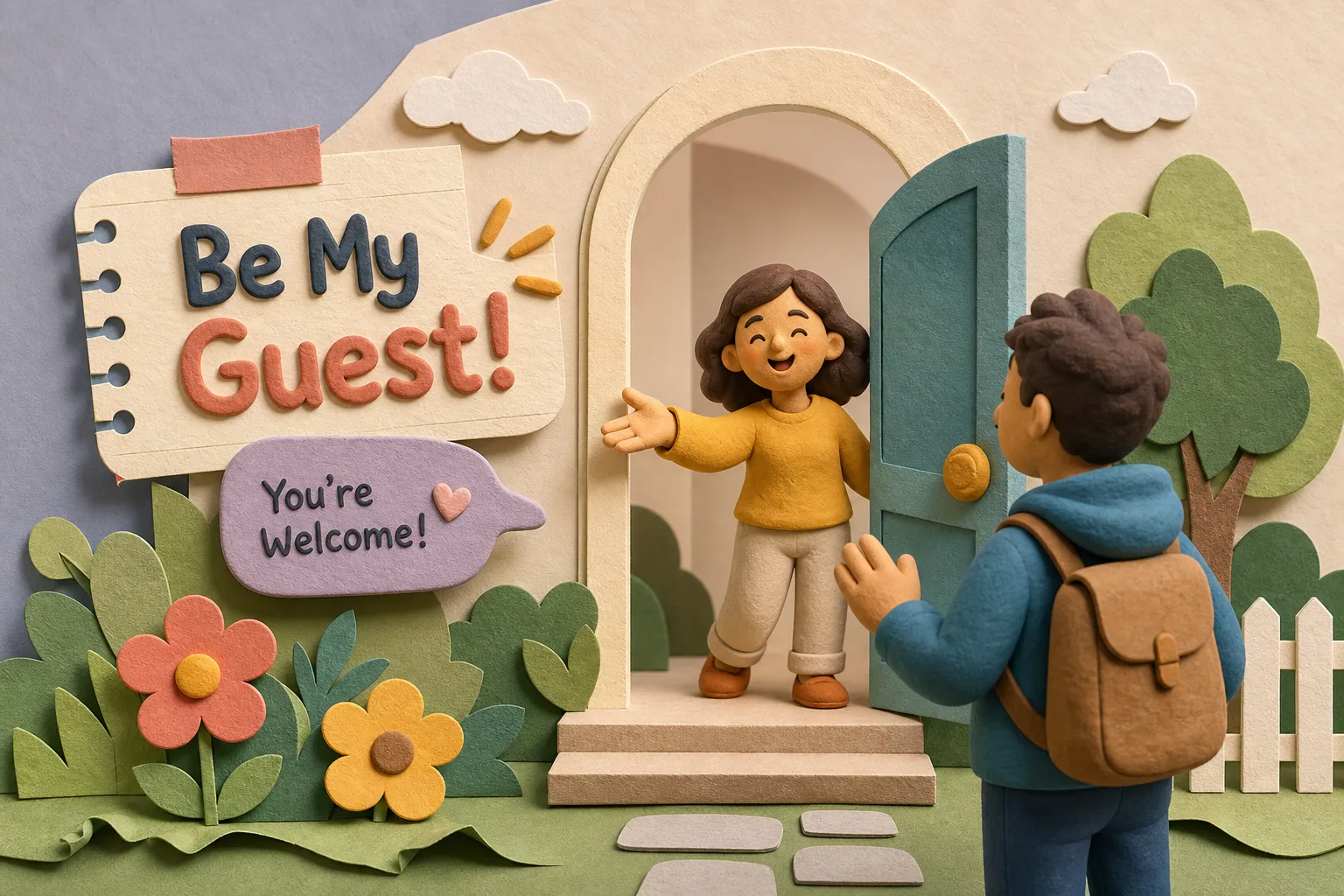
You’re at your coworker’s desk. You ask if you can borrow a pen. She looks up, smiles, and says, “Be my guest.” You say thank you. But inside, you’re not completely sure: was that warm? Was she being a little cold? Did she actually mean it?
That small moment of doubt is very common for English learners. “Be my guest” is one of those phrases that sounds simple on the surface but carries a lot of social information. By the end of this article, you’ll know exactly what it means, when Americans say it sincerely, when they say it sarcastically, and how to use it yourself with confidence. At Your Daily American, this is exactly the kind of phrase we love to break down, not just the definition, but the feeling behind it.
What “Be My Guest” Literally Says vs. What It Really Means
If you look at each word individually, the phrase points to hospitality. A “guest” is someone you invite into your home. The expression originally meant something like, “Treat yourself as if you were a guest in my home. Help yourself.” That warm, welcoming sense is still woven into the phrase today, though its documented origins remain somewhat unclear across major etymology sources.
In modern American English, the expression primarily means one thing: go ahead, you have my permission. It works the same way as “feel free” or “yes, of course.” When someone says it to you, they’re letting you know your request is approved and they have no objection.
So why say it instead of just “yes”? Because the phrase sounds a bit more generous and expressive. It positions the speaker as someone actively offering something rather than simply consenting. That extra warmth is genuine in some situations. In others, that same tone can flip and become sarcastic. The same words can convey very different attitudes depending on tone and context.
When Americans Use It Sincerely
In everyday life, you’ll hear this expression in relaxed, friendly situations where someone asks a small favor and the other person wants to signal openness. Think of it as a verbal door held open, the request is low-stakes, and the reply matches that ease.
Here are a few common situations where the phrase sounds genuinely welcoming:
- Someone asks to borrow a chair from your table at a café.
- A friend wants the last piece of pizza.
- A coworker asks to go first in a meeting presentation.
- A neighbor wants to use your parking space for an hour.
Now look at how these short exchanges actually sound in real life:
At a friend’s house:
“Hey, do you mind if I use your charger for a bit?”
“Be my guest. It’s right by the couch.”
At the office:
“Can I grab one of those pens?”
“Be my guest, I have plenty.”
At a café:
“Is anyone sitting here? Can I take this chair?”
“Be my guest!”
In each of these examples, the speaker is being genuinely helpful. The expression signals openness and ease. For learners who want to understand American social warmth, this is a useful window into how Americans show generosity in small, everyday moments, natural, relaxed, and kind.
When the Tone Flips: The Sarcastic Side
Here is the part that surprises many learners: the exact same words can mean something very different. When Americans say it sarcastically, the meaning shifts to something like, “I disagree with what you’re about to do, but I won’t stop you.” It’s a way of stepping back without giving real approval.
Look at these examples to see the difference:
A friend challenges your decision:
“You know what? I think I can fix this myself without calling the repair company.”
“Oh yeah? Be my guest.”
(Translation: I doubt you can, but go ahead and try.)
A coworker pushes back in a meeting:
“I think I can finish this project faster if I do it my own way.”
“Be my guest. We’ll see how it goes.”
(Translation: I’m skeptical, but I won’t argue.)
Someone is being rude in line:
A person cuts in front of you without asking. You say quietly, “Well, be my guest.”
(Translation: That was rude, but fine, go ahead.)
So how do you tell the difference when you’re listening? Watch for these cues. A flat or dry tone of voice is the strongest signal. A sincere version usually sounds warm and slightly bright. A sarcastic one sounds shorter, flatter, or slower. You may also notice a small pause right before the phrase, almost like the person is taking a breath before responding with mild annoyance.
Context does a lot of the work, too. If someone is replying to a normal, polite request, the expression is almost certainly sincere. If someone is reacting to a challenge or a questionable decision, the sarcastic reading is much more likely. With a little practice, you’ll start to hear the difference right away.
Real-Life Situations Where You’ll Hear This Expression
You can hear it in many different settings across American daily life. At home or with friends, it shows up most often around small favors, food, space, objects, or time. In those settings, it feels casual and warm. Compare these two natural ways it might come up: “The fridge is open, be my guest” or simply “Help yourself to anything in the fridge.” Both land the same way; you’d pick one or the other, not both at once.
In the workplace, the phrase still works, but the tone becomes slightly more measured. When a colleague asks to lead a project or take the first turn in a discussion, a manager might say, “Be my guest.” It sounds professional and polite. That said, in formal business writing, emails, for instance, the phrase is out of place. It belongs in spoken conversation, not written messages.
It also helps to know a few similar phrases Americans use in the same moments. Each one fits a slightly different situation:
- “Go ahead” is the most common everyday alternative. It works for almost any permission situation and feels effortless in speech.
- “Feel free” sounds relaxed and open, good for inviting someone to do something without waiting for formal permission.
- “Help yourself” is especially common with food, drinks, or shared supplies.
- “By all means” sounds slightly more formal, good in professional settings where you want to come across as polished.
Knowing these options gives you a full set of tools. You don’t have to reach for the same expression every time. Mixing these phrases will make your English sound more natural and varied. For a longer list of everyday alternatives, check out Filler Phrases Every American English Learner Should Know.
How to Use It Naturally, and What to Avoid
The most common mistake learners make is treating the phrase too literally. “Be my guest” does not mean “please be a guest in my home.” It’s a fixed expression, and if you try to translate it word by word from your native language, the meaning won’t carry over correctly. Treat it as a unit, the same way you treat “go ahead” or “of course.”
A second mistake is using it in formal writing. If someone emails you asking for permission, replying with “Be my guest” sounds strange on the page. “Of course” or “Please go ahead” are much better fits. Reserve this expression for spoken moments and casual conversation.
Beyond those two pitfalls, consider the stakes of the moment. When a doctor, a manager, or a client asks you a direct question, a plain “yes” or “of course” is usually cleaner. For quick spoken replies that sound natural, see Short answers in English to Sound Like a Native Speaker. This expression shines in relaxed, social, or informal professional moments, not high-formality exchanges where precision matters most.
If you want formal dictionary definitions and short entries to compare meanings, check the Merriam‑Webster entry for “be my guest” or the Cambridge Dictionary entry. These are quick references that confirm the casual permission meaning as the primary sense.
Try It Yourself
Practice is the best way to make a new phrase feel natural. Read each situation below and say the expression out loud, once with a warm tone and once with a flat, dry tone. Notice how your voice changes.
- A friend asks if they can try a bite of your food at a restaurant.
- A coworker says they think they can do your job better than you.
- A neighbor asks to borrow your umbrella on a rainy day.
When you say it sincerely, your voice probably rises slightly and sounds open. When you say it sarcastically, it feels shorter, a little clipped, maybe even a little tired. That shift in your own voice is exactly how you’ll start to recognize it in other people, too.
At Your Daily American, we go deeper into exactly this kind of real-world language: the tone, the context, and the cultural meaning behind everyday American expressions. If you want to move past word-for-word definitions and start understanding how Americans actually communicate, explore more lessons on the platform at Professional English, Your Daily American.
Start Listening for It Everywhere
“Be my guest” is a small phrase with two very different personalities. Sincere, it’s warm and generous. Sarcastic, it signals doubt or mild frustration. The words never change, the tone and the context do all the work.
The best next step is to start listening for it actively. Watch an American TV show or movie and notice when a character uses the expression. Ask yourself: was that warm or dry? Did they mean it, or were they stepping back? You might even look for clips from shows like Be My Guest with Ina Garten on Food Network, or read a recent Variety article about the show’s season news, where the phrase is used as a genuine, welcoming invitation, a great contrast to the sarcastic version. That kind of active, attentive listening builds your ear fast.
Understanding phrases like this one is how you move from knowing English to sounding like someone who lives it. It’s not about collecting more vocabulary. It’s about learning how real language feels in the moment, and that’s the kind of fluency that holds up in real conversation. That’s what we focus on at Your Daily American.