You’ve probably seen both “toward” and “towards” in books, articles, and English lessons, and wondered which one is actually correct. Are they both okay? Does it matter which you use? These are fair questions, and you deserve a clear answer.
By the end of this lesson, you’ll know exactly which form to use in American English, why it’s the standard, and how to apply one simple rule every time you write. If you studied British English first, “towards” probably feels natural to you. That makes sense. But American English has its own specific conventions, and mastering them is what makes your writing sound fully natural to American readers. At Your Daily American, we focus on exactly these kinds of details: the small but important rules that separate confident, natural-sounding American English from writing that feels slightly off.
Both spellings are correct, so why does it matter?
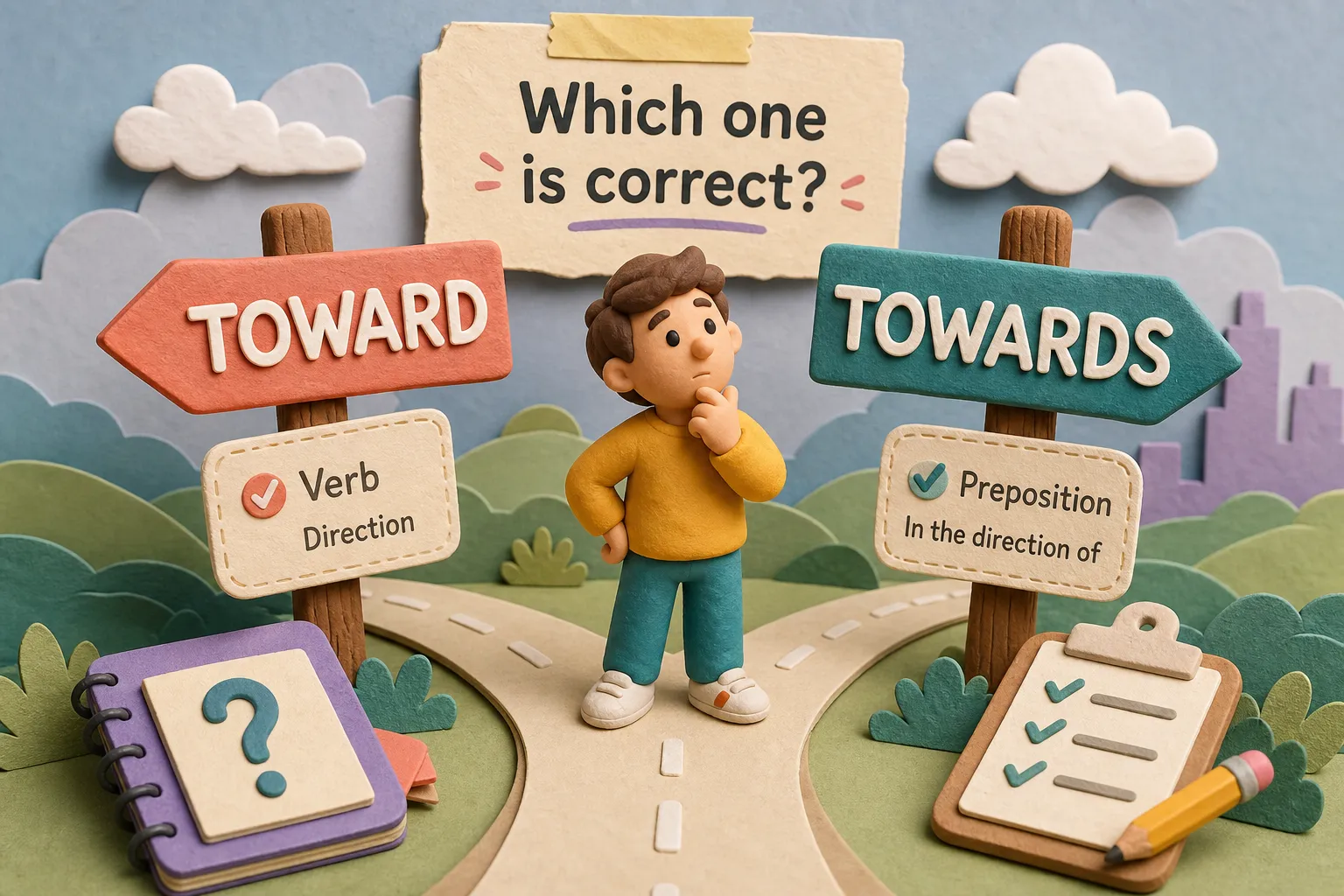
This is not a right-vs-wrong situation. Both “toward” and “towards” are real English words with exactly the same meaning and the same grammatical function. Neither one is a spelling error. You will find both in published books, respected newspapers, and edited writing from around the world.
Same meaning, same grammar
Both words are prepositions. They carry the same meanings: moving in a direction, having a feeling about someone, contributing to a goal, or getting close to a point in time. You can swap one for the other in any sentence without changing the meaning at all.
So what is the difference?
The only real difference is regional preference. One form is standard in American English; the other is standard in British English. This is a style choice, not a grammar rule. But that style choice matters when you want your writing to sound natural and professional to American readers, editors, and teachers.
How American and British English split on this word
This is the key part of the lesson. The split is real and consistent, and it’s supported by large databases of actual English writing.
“Toward” is the American form
In American English, “toward” is the standard form. Large databases of American writing, including the Corpus of Contemporary American English (COCA), show that American writers use “toward” far more often than “towards.” This preference is strong across American books, newspapers, and professional writing, it’s not a close split. “Toward” is the clear dominant form in American English.
“Towards” is the British form
In British English, “towards” is the standard form. British writing databases show the opposite pattern: “towards” appears much more often than “toward.” This same preference holds in other varieties of English outside North America, including Australian English. Canada falls somewhere in the middle but generally leans toward the American style.
How the split developed over time
In the 1800s, both forms were common in American writing. Over time, American writers moved toward the shorter form without the “s.” By around 1850, “toward” was already becoming the dominant written form in American English, and by the late 1800s it was firmly established. Today the difference between American and British edited writing is very clear on both sides of the Atlantic.
What major style guides recommend
If you write for school, work, or any American publication, you probably follow a style guide. Here is what the major ones say, in plain terms.
AP, Chicago, and MLA all prefer “toward”
The AP Stylebook, which American journalists follow, uses “toward” and not “towards.” The Chicago Manual of Style, which American book publishers and academics follow, also favors “toward.” MLA style, used for academic papers in the U.S., follows standard American English conventions, so “toward” is the right choice there as well. Three major American style guides, and they all point in the same direction.
What Merriam-Webster says
Merriam-Webster, the standard American dictionary, lists both forms as valid. It notes clearly that “toward” is more common in the U.S. and Canada, while “towards” is preferred elsewhere. This confirms the regional pattern without overcomplicating things. The dictionary is not telling you one is wrong, it’s telling you which one fits American English.
The British side: Oxford
British dictionaries favor “towards.” If you are writing for a British publication or following British conventions, “towards” is the right choice. But for American English, “toward” is the safe, standard pick. The rule is simple: match your spelling to your audience.
“Toward” in real American English sentences
Knowing the rule is useful. Seeing it in real sentences is even better. Here is “toward” across its different uses in everyday American English.
Direction and movement
The most common use of “toward” describes physical movement in a specific direction. It shows up constantly in everyday writing and speech:
- She walked toward the door.
- The car moved slowly toward the intersection, then stopped.
- He turned and looked toward the window.
Feelings and attitudes
“Toward” also describes how one person feels about another person or situation. The pattern “attitude toward” or “feeling toward” is especially common in professional and academic writing, you’ll see it in performance reviews, research papers, and formal reports.
- He has always been kind toward his coworkers.
- The new policy felt unfair toward younger employees.
- Her attitude toward the project shifted noticeably after the meeting.
Working toward a goal
When someone is making progress on a goal or putting money aside for something specific, “toward” is the natural word. This pattern works whether the effort is financial or abstract:
- We’re saving money toward a down payment on a house.
- The team worked hard toward a solution and eventually found one.
- She is contributing toward a better future for her community.
Near a point in time
“Toward” can also describe an approaching moment in time. You’ll see this pattern in storytelling, news reports, and casual conversation:
- Toward the end of the meeting, everyone was tired.
- It started raining toward midnight.
- Toward the close of the fiscal year, the team scrambled to hit its targets.
In all of these examples, “towards” would not be wrong. But an American reader, editor, or teacher would typically expect “toward.” The meaning stays exactly the same, only the regional preference changes. As you read American articles, emails, and news stories each day, notice how often “toward” appears. You’ll start to see it everywhere.
Where the “toward” rule shows up in American writing
This rule is not just for grammar exercises. It shows up in the real writing situations you face every day.
Academic papers and school writing
American professors and writing instructors expect standard American English. If your university follows Chicago or MLA style, using “toward” keeps your writing consistent with what your teacher or editor expects. Using “towards” in a U.S. academic paper won’t earn you a failing grade, but it signals a British English habit that can feel out of place in an American classroom.
Professional and workplace writing
Emails, reports, and presentations in American workplaces follow American writing norms. Using “toward” in professional writing is a small detail, but small details accumulate. Over time, they are exactly what separates writing that sounds fully natural in American English from writing that reads as slightly foreign, the kind of thing a careful American editor would quietly fix.
Why small conventions matter for fluency
Many learners focus on big grammar rules and miss the smaller stylistic differences that experienced American readers notice. The toward vs. towards choice is a perfect example. It’s not a major error. But getting it right consistently is part of what fluency actually looks like in practice. Your Daily American is built specifically to teach these kinds of American conventions, so you can close that gap and write and speak with real confidence.
One rule to use every time
The one-sentence rule
If you are writing American English, always use “toward.” No “s.” That’s the whole rule. This choice aligns with AP, Chicago, and MLA. It matches what American dictionaries describe as the preferred U.S. form. And it matches what readers of American English simply expect to see.
If you ever write for a British audience, switch to “towards.” But for school papers, work emails, and everyday writing in the U.S., “toward” is your answer every single time.
Try it yourself
Practice is what makes a rule stick. Complete these sentences using the correct form for American English:
- She felt very grateful _______ her mentor.
- They are saving _______ a vacation next summer.
- He walked quickly _______ the exit.
- _______ the end of the year, things got very busy.
The answer in every case is “toward.” If you filled in all four correctly, you’ve already internalized the rule, which means it’s ready to use the next time you sit down to write.
The bottom line
Both “toward” and “towards” are correct English words with the same meaning. The difference is regional: American English uses “toward,” and British English uses “towards.” Every major U.S. style guide, AP, Chicago, and MLA, backs “toward.” If you’re writing for an American audience, that’s always the right call.
Details like this one are part of what makes writing sound natural and professional in American English. Knowing which form to use in the toward vs. towards question is not just a spelling rule. It’s an example of the specific, practical knowledge that builds real fluency: not just grammar rules, but the conventions that native American speakers take for granted and notice when they’re missing.
This is exactly the kind of lesson you’ll find at Your Daily American: real rules, clear examples, and practical guidance built around the language as it’s actually used in the U.S. For further reading, see Every Day or Everyday? A Simple Grammar Guide and Word Stress in American English: A Complete Guide, Your Daily American to expand your understanding of American usage and pronunciation.