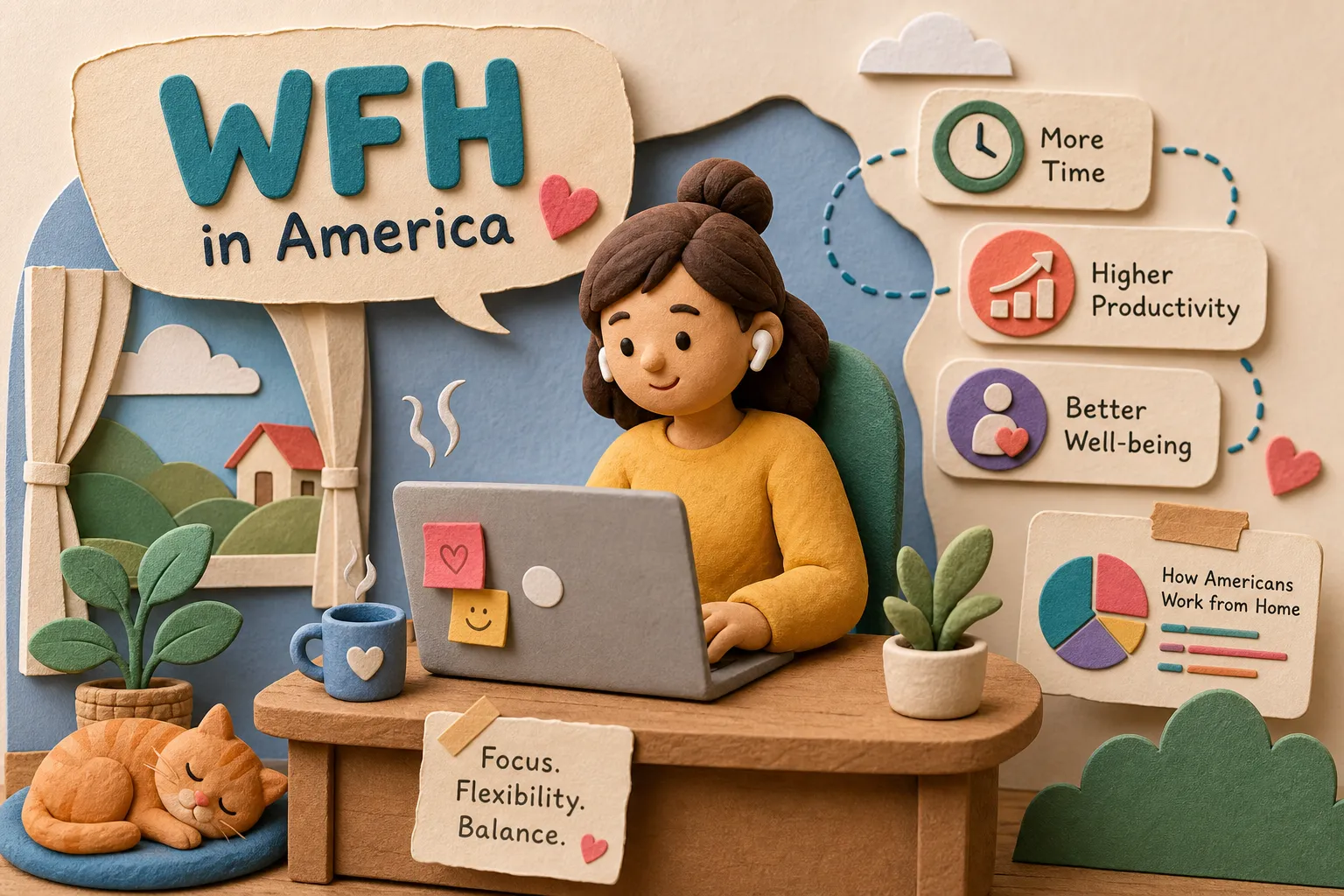
You’re reading a message from a coworker: “I’ll be WFH tomorrow, ping me on Slack.” You understand each word, but you pause. What exactly does WFH mean? Do you need to do anything? How do you reply? Many non-native speakers report that brief moment of hesitation in American workplaces, and this article will clear it up.
WFH stands for “work from home.” It is one of the most common terms in U.S. workplace communication today, and it comes with its own set of phrases, habits, and unspoken rules, status updates, logging-off phrases, meeting etiquette, and more. By the end of this article, you will know the WFH meaning, how it differs from related terms like remote work and hybrid, and which phrases Americans actually use in emails, chats, and meetings. At Your Daily American, this kind of practical professional English is what we teach every day: not just vocabulary, but the full context behind it.
WFH meaning: what the acronym stands for and how it works
WFH stands for “work from home.” Acronyms like this appear constantly in American workplace writing: Slack messages, calendar notes, email subject lines, and text messages. In spoken conversation, however, people often say the full phrase rather than spelling out the letters. You would say “I’m working from home today,” not “I’m W-F-H today.”
In terms of formality, WFH meaning sits comfortably in the middle. It is casual enough for a quick Slack message to a coworker, but it also appears in official HR documents, company policy pages, and internal announcements. Knowing this range helps you decide when to use the short form and when to write it out in full. Here are two quick examples:
- Casual (Slack to a coworker): “WFH today, but I’m around. Message me anytime.”
- More formal (email to your manager): “I’ll be working from home on Friday and will be fully available by email and phone.”
Both are correct. The choice comes down to your relationship with the reader and how formal the channel is, a Slack message to a friend-colleague calls for something different than a note to your director.
WFH vs. remote work, hybrid, and WFA: knowing the difference
These four terms are related, but they do not mean exactly the same thing. Americans use them in specific ways, and mixing them up can cause confusion at work. A common real-world example: calling yourself a “remote employee” when your company actually considers you hybrid, and missing an in-office requirement as a result.
WFH (work from home) is the most specific term. It means your home is your workplace for a day or a period of time. It does not always mean your job is permanently remote. Many employees who normally go into the office will say they are WFH on a particular day because of a delivery, a repair person coming, or simply a preference to focus at home.
Remote work is the broader category. It means doing your job outside a traditional office, from home, a coffee shop, a coworking space, or while traveling. If WFH is a type of remote work, remote work is the bigger picture. In HR policy, a “remote employee” usually has an official arrangement to work off-site full-time. You may also see the terms telecommuting and telework in older HR documents or government policy pages; these mean essentially the same thing as remote work, though they tend to appear in more formal or legal contexts. For a practical comparison between remote work and flexible work arrangements, see this guide on remote work vs. flexible work.
Hybrid means the employee splits time between the office and a remote location, usually on a regular schedule. A company might require employees to be in the office on Tuesdays and Thursdays, with the rest of the week remote. According to Gallup’s 2024 State of the Global Workplace report, hybrid workers are defined as those who work from home or a remote location between 10% and less than 100% of their time.
WFA (work from anywhere) is the most flexible arrangement. It means no fixed location is required at all. Some companies offer WFA as a limited benefit, where employees can work from a different city or country for a few weeks per year, usually with approval. Example sentence: “Our team has a WFA policy, so I’m working from Portugal this month.”
Keep in mind that employers sometimes use these terms loosely, so confirming the specifics with your HR department is worth doing before you assume full flexibility.
How Americans use WFH meaning in emails and chat messages
When someone plans to work from home, they often send a short message to their manager or team. In American workplace culture, this message is usually brief, polite, and positive. You do not need to write a long explanation, just state the plan and confirm that you will be available.
WFH email examples: short to detailed
- “Hi Sarah, I’m working from home today and will be reachable by email if anything comes up.””Hi David, I’ll be WFH on Thursday. I’m available by email and Slack as usual.”
- “Hi Maria, I wanted to let you know I’ll be working from home this Friday. I have all my files and will be on video for our 2 p.m. meeting.”
WFH chat and Slack status examples
In chat tools like Slack or Microsoft Teams, WFH messages are even shorter. People use quick status updates, brief team channel posts, or simply set their Slack status to a house emoji with the text “WFH.” Here are five examples you can copy and use right away:
- “WFH today, feel free to message me.”
- “Working remotely this week, but I’m fully available.”
- “I’m remote today. Ping me on Slack if you need anything.”
- “WFH this morning, in the office after lunch.”
- “Working from home today. Available all day.”
Setting a Slack status is widely practiced in U.S. companies. It signals to your whole team that you are working remotely without needing to message everyone individually. A house emoji or the text “WFH” in your status is enough.
WFH language in scheduling and meetings
Americans also note their work location directly in shared calendars and meeting invites. You might see calendar entries with titles like “WFH day,” “Remote,” or “Out of office / WFH.” Here are two examples of what a calendar entry description might say:
- “Working from home today. Available for calls and video meetings.”
- “WFH, remote all day. No in-person meetings.”
- “Ping me” means: send me a quick message. Example: “I’ll be in a meeting until 3. Ping me after that.”
- “I’m heads-down until noon” means: I am focused on work and not easily available. Example: “I’m heads-down on this report until noon, then I’m free.”
- “I’ll be on and off today” means: I am available, but with some interruptions. Example: “I have some appointments this afternoon, so I’ll be on and off.”
- “Async” is short for asynchronous (not at the same time). It refers to communication that does not happen live. Example: “Let’s handle this async, no need for a meeting.”
- “I’m signing off for the day. Talk tomorrow.”
- “I’m wrapping up now. See you all tomorrow.”
- “EOD” (end of day), often used in deadlines: “I’ll send it to you by EOD.”
- “I’ve got a hard stop at 5” means you must stop at exactly 5 p.m. Example: “I can talk, but I’ve got a hard stop at 5.”
- “I’ll get back to you first thing tomorrow morning.”, a polite way to say you cannot respond today.
Being clear about your location in a shared calendar is considered professional, not unnecessary. It helps your team plan meetings, know when to expect you in person, and understand your availability.
Phrases for joining a meeting remotely
When you join a meeting from home, there are standard phrases Americans use to start naturally. For example: “I’m joining from home today,” or “I’m remote this week, so I’ll be on video.” If your connection drops, a straightforward way to handle it is: “Can you repeat that? My connection cut out for a second.”, it is a common, colloquial way to explain the issue and keep the conversation moving.
A few quick etiquette points for remote meetings in U.S. companies: mute your microphone when you are not speaking, turn your video on when possible (especially in smaller meetings), and if you want to speak, type “hand” in the chat or wait for a pause and say “I have a quick point.” These small habits signal that you are engaged and professional.
Common WFH-related phrases you’ll hear at American workplaces
Beyond the basic WFH announcement, American coworkers use a set of specific phrases to talk about availability, focus time, and checking in during the day. These are worth learning because you will hear them often.
Phrases about availability and checking in:
Phrases for logging off and setting boundaries:
One challenge of working from home is that the end of the workday can feel unclear. Americans use direct, friendly phrases to signal when they are done. You will hear these in Slack messages, brief emails, or end-of-day check-ins:
These phrases help you set clear limits around your work hours, which is seen as organized and professional in American workplace culture.
Keep building your professional American English
WFH phrases are one small but important part of how Americans communicate at work. Meetings, emails, performance reviews, and everyday small talk all come with their own vocabulary and unspoken rules. For non-native speakers, learning this layer of language makes a real difference in how confident and clear you sound to coworkers and managers. It is not just about understanding, it is about being able to respond quickly and naturally, without that moment of hesitation.
This is exactly what Your Daily American is built for. The Professional English section of the platform covers real situations: writing clear emails, speaking up in meetings, handling small talk before a video call, and much more. Every lesson is based on how Americans actually communicate at work, not just textbook grammar. Visit yourdailyamerican.com, explore the Professional English track, and try one lesson today. Each one gives you language you can use right away.
Now you know WFH meaning: a quick review
WFH meaning, in plain terms: work from home. It belongs to a family of related terms, remote work (working outside the office from any location), hybrid (a mix of office and remote days), WFA (work from anywhere, usually a limited, approved exception), and older equivalents like telecommuting and telework. Americans use WFH in emails, Slack messages, calendar entries, and meetings, and each context has its own natural phrasing.
The goal here was never just to define a term. It was to give you language you can actually use the next time a coworker says “I’ll be WFH tomorrow.” Now you know what WFH means, how to reply, and how to say it yourself.
Try this now: Write one sentence telling a colleague you will be working from home tomorrow. Keep it short, clear, and natural. Something like: “Just a heads-up, I’ll be WFH tomorrow, but I’m available on Slack all day.” That is real American professional English, and you can use it today.