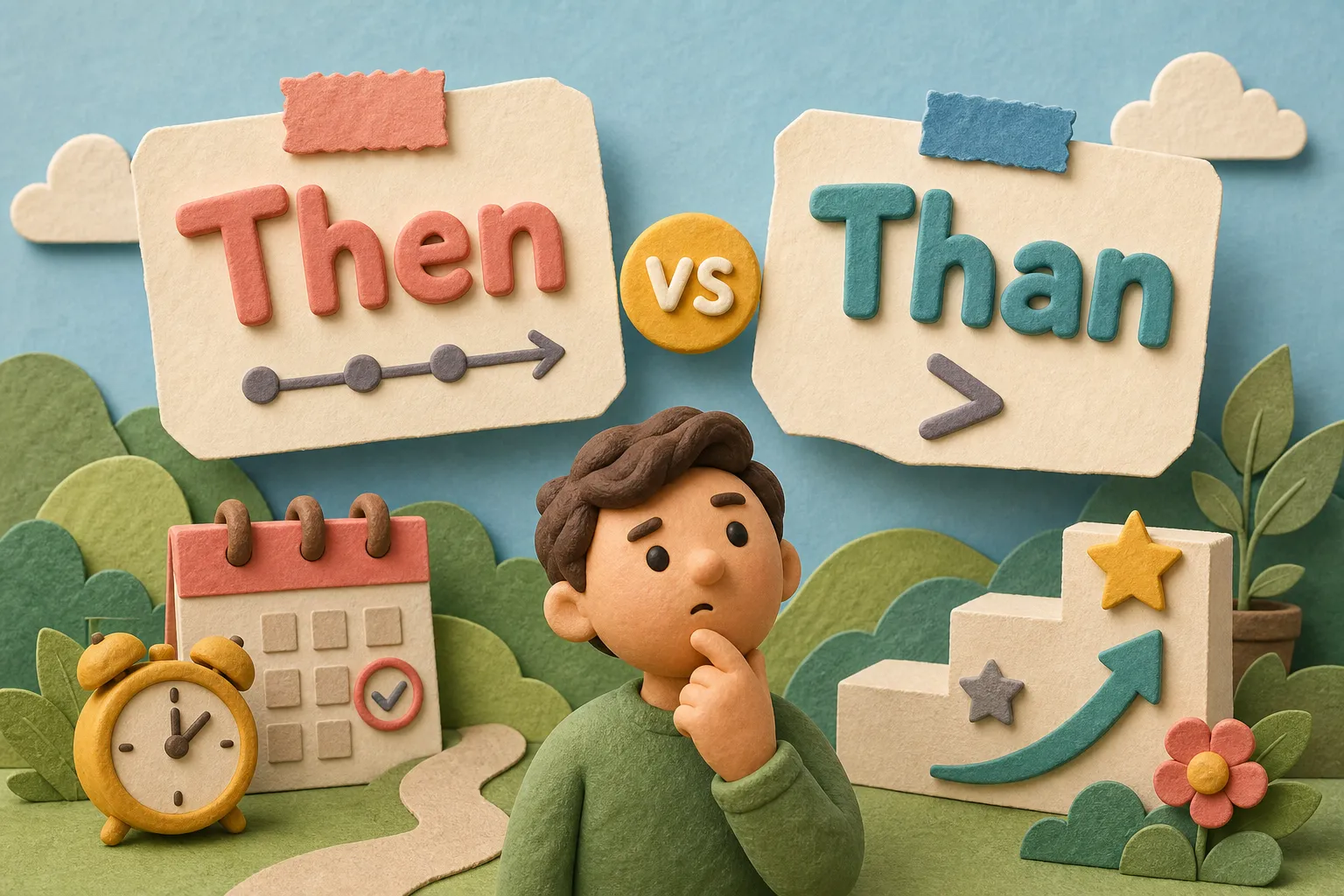
Confused about then vs. than? These two words look almost identical on the page, and that’s exactly the problem. Then and than are separated by a single vowel, but they do completely different jobs in a sentence. Swapping them is one of those small errors that can make an otherwise polished email or report feel careless to a native speaker, even when every other word is correct.
Then vs. than is a frequent grammar question among intermediate learners, and that’s not surprising. Both words are short, both are common, and both show up in sentences where you’re moving quickly and not stopping to think. This lesson aims to give you a one-line rule, two memory tricks, and a look at the edge cases that trip up even fluent speakers.
What “then” means and when to use it
Most of the time, “then” is an adverb. Its job is to locate something in time, show what comes next in a sequence, or signal a logical consequence. Once you recognize those three functions, “then” becomes easy to spot.
Then as a marker of time and sequence
“Then” is the right word when you’re pointing to a specific moment in time or putting events in order. Think of sentences like: “Back then, I could barely hold a conversation in English” or “We finished the presentation, then answered questions from the team.” If you can swap the word with “at that time” or “next” and the sentence still sounds natural, you’re looking at a “then” situation.
This use shows up constantly in storytelling, instructions, and step-by-step explanations. “Open the file, then save a copy” and “I lived in Mexico City then” both rely on “then” to orient the reader in time.
Then in if-then logic and cause-and-effect
“Then” also appears in conditional sentences to show a result. You’ve heard this pattern hundreds of times: “If you want to improve your writing, then you need to read carefully too.” The word doesn’t describe time here; it signals consequence. Something happens, and “then” marks what follows as a logical result.
This structure is common in both formal writing and everyday American speech. You’ll hear it in professional conversations: “If the client approves the scope, then we can start next Monday.” Getting comfortable with it is especially useful for workplace communication.
Fixed phrases that always use “then”
Several American English phrases are locked with “then.” Recognizing them as units stops the guessing. Here are the most common ones:
- Back then: “Back then, nobody used smartphones at the dinner table.”
- Now and then: “I still make that mistake now and then.”
- Then again: “I thought about skipping the meeting. Then again, my manager would notice.”
- Right then and there: “She decided right then and there to apply for the job.”
- Until then / by then / since then: “We hadn’t met until then.” “By then, it was too late.” “I’ve been more careful since then.”
What “than” means and when to use it
“Than” has one core purpose: comparison. It connects two things, people, amounts, or actions that are being measured against each other. It’s not about time at all.
Than in straightforward comparisons
Any time you say something is more, less, better, worse, bigger, faster, or otherwise different in degree from something else, “than” is the word that follows. “Her pronunciation is clearer than mine.” “It took longer than I expected.” “He’d rather work early mornings than stay late.” Each of those sentences puts two options side by side and measures the gap between them.
The practical shortcut here is reliable: whenever you see a comparative adjective or adverb (words ending in -er, or phrases beginning with “more” or “less”), expect “than” to follow shortly after. It’s nearly automatic.
Than in preference and contrast phrases
“Than” also appears in a few fixed patterns where the comparison is more about preference or exclusion than a simple measurement. The phrases rather than and other than are the most common. “I’d rather send a follow-up email than wait for a reply.” “There was no better candidate than her for the role.” These are everyday professional phrases, and they all use “than” because a contrast between two choices is always present, even if the sentence doesn’t have an obvious adjective like “bigger” or “faster.”
Then vs. Than: The One Rule That Makes This Easy
You don’t need to memorize grammar definitions to get this right. Here’s how it works in practice: one question handles almost every case you’ll encounter.
The one-line test you can use right now
Ask yourself: Am I comparing two things? If yes, use than. If the word means “at that time,” “next,” or “in that case,” use then. Take these three examples: “She is more experienced ___ me.” Are you comparing? Yes. Use than. “We signed the contract, ___ scheduled a kickoff call.” Is this a comparison? No, it’s a sequence of events. Use then. “If the budget is approved, ___ we can move forward.” No comparison, this is a consequence. Use then. That single question handles the vast majority of real-world cases quickly, with no grammar jargon required.
Memory tricks that actually stick
If you want a backup when you’re moving fast, these two mnemonics hold up under pressure. First: then = time (both words contain the letter E); than = comparison (both words contain the letter A). Second: “then” rhymes with “when,” and “when” is always about time. Whenever you connect those two, you’re reminded of the time-based function.
A third option works well for sentence-level checking: try replacing the word with either “at that time” or “compared to.” One of those substitutions will always fit, and whichever one sounds right tells you which word to use. “She is more experienced compared to me” makes sense. “She is more experienced at that time me” does not, that substitution breaks the sentence, which tells you than is the right choice. For a short guided lesson on the differences, see Study.com’s lesson on when to use then vs. than.
Then vs. Than: Common Mistakes That Hurt Your Credibility
This is where the lesson gets practical. Seeing the errors clearly, with an explanation of why they happen, builds the pattern recognition that prevents you from repeating them.
The most frequent swap errors and what they look like
Here are four real-sentence comparisons in before-and-after format:
- Wrong: “She is more experienced then me.” Right: “She is more experienced than me.” (Comparison follows “more experienced”; “then” signals time, which is irrelevant here.)
- Wrong: “We signed the contract, than scheduled a kickoff call.” Right: “We signed the contract, then scheduled a kickoff call.” (This is a time sequence, not a comparison.)
- Wrong: “The new system runs faster then the old one.” Right: “The new system runs faster than the old one.” (The comparative adjective “faster” signals a comparison.)
- Wrong: “Back than, we didn’t have remote work.” Right: “Back then, we didn’t have remote work.” (“Back then” is a fixed time expression.)
A common explanation for these errors is that the words’ visual similarity causes readers moving quickly to miss the problem. Slowing down for one second and running the comparison test eliminates all four. (See Grammarly’s guide to commonly confused words.)
Why this specific mistake signals incomplete fluency
Many readers notice this error even when they don’t comment on it. It’s the kind of detail that makes someone pause, re-read the sentence, and quietly update their impression of your writing. Mastering details like this is exactly what separates someone who “knows English” from someone who communicates with real confidence. The gap between B2 and C1 English, as defined by the CEFR, is largely a grammar accuracy gap: at C1, you use complex structures flexibly and consistently. Consistently correct usage of small words like these is part of what that looks like in practice.
Tricky cases where even fluent speakers get caught
Once you have the basic rule solid, it’s worth knowing the patterns that don’t follow it neatly.
“No sooner…than” and why it surprises people
This fixed idiom trips up a lot of learners because it uses “than” to describe a time sequence, which seems to contradict the basic rule. The example: “No sooner had I sat down than the phone rang.” That sentence is describing timing, not comparison, yet “than” is correct. The reason is that “no sooner…than” is a frozen idiomatic structure. The language locked it in place centuries ago, and “than” is simply the required word inside that particular frame. The solution is to memorize this phrase as a unit rather than trying to apply the standard rule to it. When you see “no sooner,” expect “than” to follow.
Edge cases: “than” as a preposition and “then” as an adjective
“Than me” versus “than I am” is a question that comes up in professional writing. Both are correct in modern American English. “Than I am” is the formal version, where “than” functions as a conjunction introducing a clause. “Than me” is the everyday version, where “than” functions as a preposition taking an object. Merriam-Webster accepts both. In most workplace communication, “than me” sounds natural and isn’t marked as an error.
“Then” can also function as an adjective, modifying a noun to mean “belonging to that time.” You’ll see it in formal writing and news coverage: “the then-CEO announced the merger” or “the then-president signed the bill.” This use looks nothing like the time-sequence “then” most learners know first, which is why it causes confusion even at advanced levels. When you see “then” directly before a job title or position, it’s simply marking that the role belonged to a specific past time period.
A quick self-check to lock in what you learned
Choose the correct word for each sentence, then check your answers below.
- “This project is more complex ___ we originally thought.”
- “She reviewed the draft, ___ sent it to the client.”
- “If the flight is delayed, ___ we’ll need to reschedule the meeting.”
Answers:
- than. The word “more” signals a comparison between the project’s actual complexity and the original estimate.
- then. This is a sequence of two actions in time order: first she reviewed, next she sent.
- then. This is an if-then conditional: a delay leads to a consequence.
Finding the grammar gaps you don’t know you have
The difference between then vs. than is one of dozens of grammar details that can quietly slow an intermediate learner down in professional and academic settings. Some of those gaps are obvious; most aren’t. You often don’t know what’s holding you back until something specific surfaces in your writing or a conversation doesn’t go the way you expected.
Your Daily American offers a free proficiency test that goes deeper than a single grammar point. It assesses reading, listening, writing, and speaking across CEFR levels and gives you a personalized result with a clear action plan. If you want to keep building on what you’ve learned here, and discover what else might be worth your attention, Free American English Level Test, Check Your Proficiency Now and find out where you stand. That’s the most direct way to turn scattered practice into a focused, efficient path toward the fluency you’re building.