If you’ve ever paused mid-sentence wondering whether to write “the agreement between the three departments” or “the agreement among the three departments,” you’re not alone, and the confusion almost certainly traces back to a rule that doesn’t tell the full story. The between vs. among question trips up English learners at every level, but the fix is simpler than most textbooks make it sound.
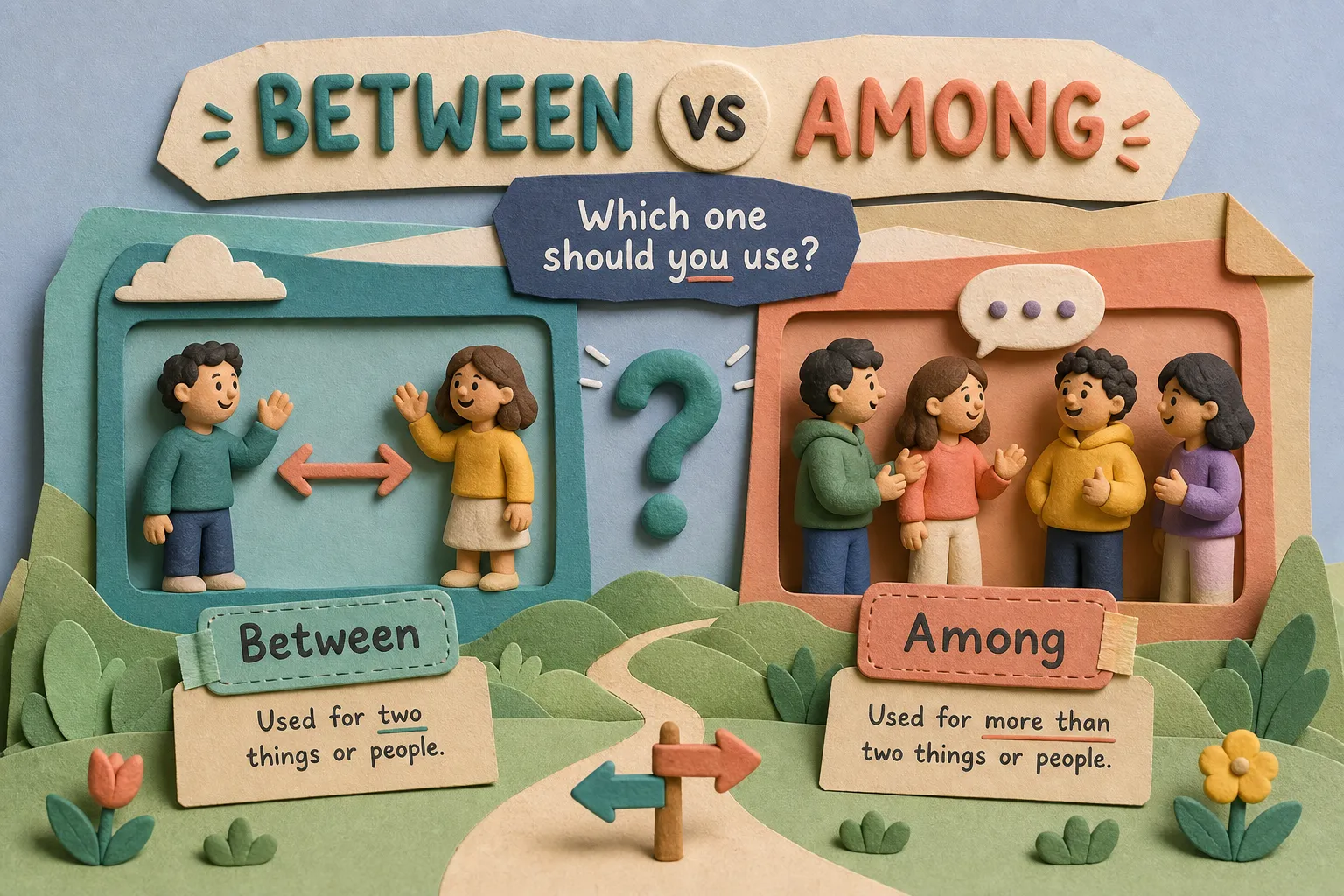
The two-versus-three rule gets repeated in classrooms and textbooks worldwide, but native speakers use “between” with three, four, even five items regularly, and they’re not wrong to do so. The real rule is about the type of relationship, not the number of items involved. By the end of this lesson, you’ll know exactly how to choose, and the choice will feel natural instead of stressful.
At Your Daily American, this is the kind of grammar we focus on: rules that reflect how American English actually works in real life, not simplified shortcuts that leave you second-guessing yourself. Here’s how “between” and “among” actually function.
The Rule Most People Learn Is Incomplete
The “Two vs. Three” Shortcut, and Where It Falls Apart
The classic classroom rule goes like this: use “between” for two things and “among” for three or more. Clean, simple, easy to memorize. The problem is that it produces errors in perfectly normal English sentences. Take this one: “The deal was signed between the three companies.” Most learners who follow the simple rule would flag “between” here as a mistake. It isn’t. Merriam-Webster calls the strict two-vs.-three rule “persistent but unfounded,” and the Chicago Manual of Style agrees. Both authorities back “between” in that sentence completely.
So if the number of items doesn’t settle the question, what does?
The Real Distinction: One-to-One vs. Collective Relationships
Between signals an individualized, one-to-one relationship where each item connects separately to the others. Among signals a collective, group-focused relationship where the items are treated as a whole. Look at these two sentences side by side: “She had to choose between a promotion, a transfer, and early retirement” versus “There was a lot of confusion among the new employees.” In the first sentence, each option is distinct and the choice is personal and specific. In the second, the employees are treated as a group, and the confusion is distributed across that whole group. That contrast is the real rule, and it holds regardless of whether two or ten items are involved.
Between vs. Among: When to Use Each
Distinct Choices, Comparisons, and One-to-One Relationships
The clearest signal for “between” is any situation where the items are individually identified and the relationship is direct. Choices are the most obvious case: “He had to choose between a train, a bike, and a taxi.” Each option is distinct, and the choice applies to them individually. The same logic applies to comparisons and negotiations: “Negotiations between the three member states collapsed” works because each state is a separate party in its own pairwise relationship with the others. The Oxford English Dictionary traces this usage back centuries, describing “between” as expressing a relation to things “severally and individually.” That’s the key phrase: severally and individually.
Legal and contract language commonly uses “between” when parties are named because each party is treated as a distinct, individually identified entity, and the relationship between them is direct and structured. “This agreement is between Party A, Party B, and Party C” is standard legal English, as noted in major style guides including Chicago. Switching to “among” in that sentence would sound odd to most native speakers, because the relationship is clearly structured and individual rather than collectively distributed. (Drafting conventions can vary by jurisdiction, but this pattern holds across the vast majority of professional legal writing in the U.S.)
Between in Time, Space, and Workplace Language
Time spans typically use “between”: “The meeting is scheduled between 9 a.m. and noon.” Physical location follows the same pattern when two clear reference points define a space: “The printer is between the kitchen and the copy room.” These are established patterns in American English that you’ll encounter constantly in professional settings. In workplace emails, reports, and contracts, “between” is the more common choice, because business communication tends to deal with specific parties, defined time windows, and distinct options rather than vague group dynamics.
When “Among” Is the Word You Need
Distribution Across a Group
The clearest signal for “among” is sharing, distributing, or spreading something across a group where individual distinctions don’t matter. “Divide the workload among the team” doesn’t specify who gets what from whom; it just means the work spreads across everyone. “The information was shared among all department heads” works the same way. The group receives something collectively, and the individual one-to-one connections aren’t the focus.
Two fixed phrases you’ll encounter constantly in American English follow this same logic. “Among others” signals that you’re naming some members of a larger group: “The committee included engineers, attorneys, and financial advisors, among others.” The phrase “among other things” works identically: “The proposal covered budget, timeline, and risk management, among other things.” These are set expressions in American professional writing, and knowing them will make your output sound natural and polished.
Membership, Inclusion, and Being Surrounded
“Among” also handles membership in a category and the sense of being located within a group of things. “It’s among the best workplace dramas ever made” places the film inside a set without ranking it precisely. “She felt comfortable among colleagues” describes being in the middle of a group, surrounded by them. “The error was buried among hundreds of lines of code” conveys the same sense: something is lost inside a collective whole, not positioned between two clearly defined points.
The unifying idea here is that the group is not broken down into individual parts. The items blend together, and that collective, undifferentiated sense is exactly what “among” communicates.
Mistakes That Trip Up ESL Learners
Overcorrecting to “Among” Every Time There Are Three or More Items
This is the most common error, and it’s completely understandable. After years of hearing “three or more means among,” learners feel nervous about “between” the moment a third item appears. The result is sentences like “There’s a strong connection among teamwork, communication, and results”, when “between” would be far more natural, because those three concepts are being treated as distinct, individual factors in a relationship. The fix is to ask whether the items relate to each other individually or as part of a group. If they relate individually, “between” is right even with three, four, or more items. If they form a collective whole, go with “among.”
“Between” vs. “Amongst”: What American English Actually Does
A quick note on “amongst”: you’ll encounter it occasionally, especially in British writing, but in American English it sounds old-fashioned and can even read as affected in professional contexts. Many American usage guides, including Merriam-Webster and Garner’s Modern English Usage, treat it as uncommon in U.S. prose and more at home in literary or archaic registers. “Amongst” isn’t strictly wrong, but if you’re targeting American English fluency, “among” is almost always the better call. It’s the form that reads naturally in everyday speech and professional writing alike. For a practical overview of commonly confused words like this one, see this guide on commonly confused words.
How This Plays Out in Real American English, at Work and in Conversations
Workplace Emails and Professional Documents
In professional writing, the between vs. among distinction shows up constantly. Compare these two sentences from a real project update: “The responsibilities are divided among the three coordinators” versus “The agreement between the marketing and legal teams was finalized this morning.” The first describes shared distribution across a group. The second describes a direct relationship between two named parties. Both are correct, and getting them right signals professional-level command of written American English. When your emails read naturally at this level, colleagues and managers notice, even if they can’t explain exactly why.
Group Conversations and Everyday Spoken English
The same rules apply in casual speech. “So the plan is to split the cost among all five of us” treats the group collectively: each person’s share comes from the whole, and individual pairings aren’t the point. “I couldn’t decide between the chicken sandwich and the burger” focuses on a direct, personal choice between two distinct options. Generally, the same between vs. among distinction applies in speech as in writing, there’s no separate spoken rule to memorize. Building this instinct into your grammar is part of what the grammar curriculum at Your Daily American is designed to develop.
Quick Self-Check: Test Yourself Right Now
Five Fill-In Sentences to Try
Read each sentence and choose “between” or “among” before looking at the answers below.
- The budget will be divided _____ the five project teams.
- There’s a clear difference _____ the two proposals.
- The contract is _____ our company, the supplier, and the logistics firm.
- She is well-known _____ her colleagues for staying calm under pressure.
- I had to choose _____ accepting the offer, negotiating the terms, or walking away.
Answers:
- 1. Among, the budget is distributed collectively across a group, with no pairwise breakdown.
- 2. Between, two distinct items are being compared directly.
- 3. Between, three named, individually identified legal parties in a direct, one-to-one relationship.
- 4. Among, she is a member of a group; the relationship is collective, not individualized.
- 5. Between, three distinct options are treated individually; this is a direct choice between separate alternatives, each considered on its own terms.
The One-Question Test You Can Use Anytime
Whenever you’re unsure, ask yourself one question: “Am I describing a relationship between distinct, individual things, or am I talking about a group as a whole?” If the answer is individual and distinct, “between” is almost always correct. If the answer is group-focused, distributed, or collective, “among” is the right call. This test works whether two items are involved or twenty, and it aligns with how Merriam-Webster, Chicago, and real American English speakers use these words.
The Takeaway: Think Relationship, Not Count
Summing up the between vs. among distinction: the two-vs.-three rule isn’t worthless, it points you in the right direction much of the time. But it breaks down the moment a sentence involves three or more distinct, individually identified parties or options. The real question is always about the type of relationship: individualized and direct, or collective and group-wide.
You’ve now seen both words in workplace writing, formal documents, casual conversation, and legal language. The self-check above gives you a concrete way to confirm whether the rule has clicked. The next time you pause over a sentence, run the one-question test and trust what it tells you.
Grammar rules like this one become intuitive when you’ve seen enough real examples in context. Picture yourself drafting a project update six months from now, reaching for “between” or “among” without breaking your train of thought, because the distinction has become part of how you process English. That’s what usage-level fluency looks like, and it’s exactly what the curriculum at Your Daily American is built to help you get there.