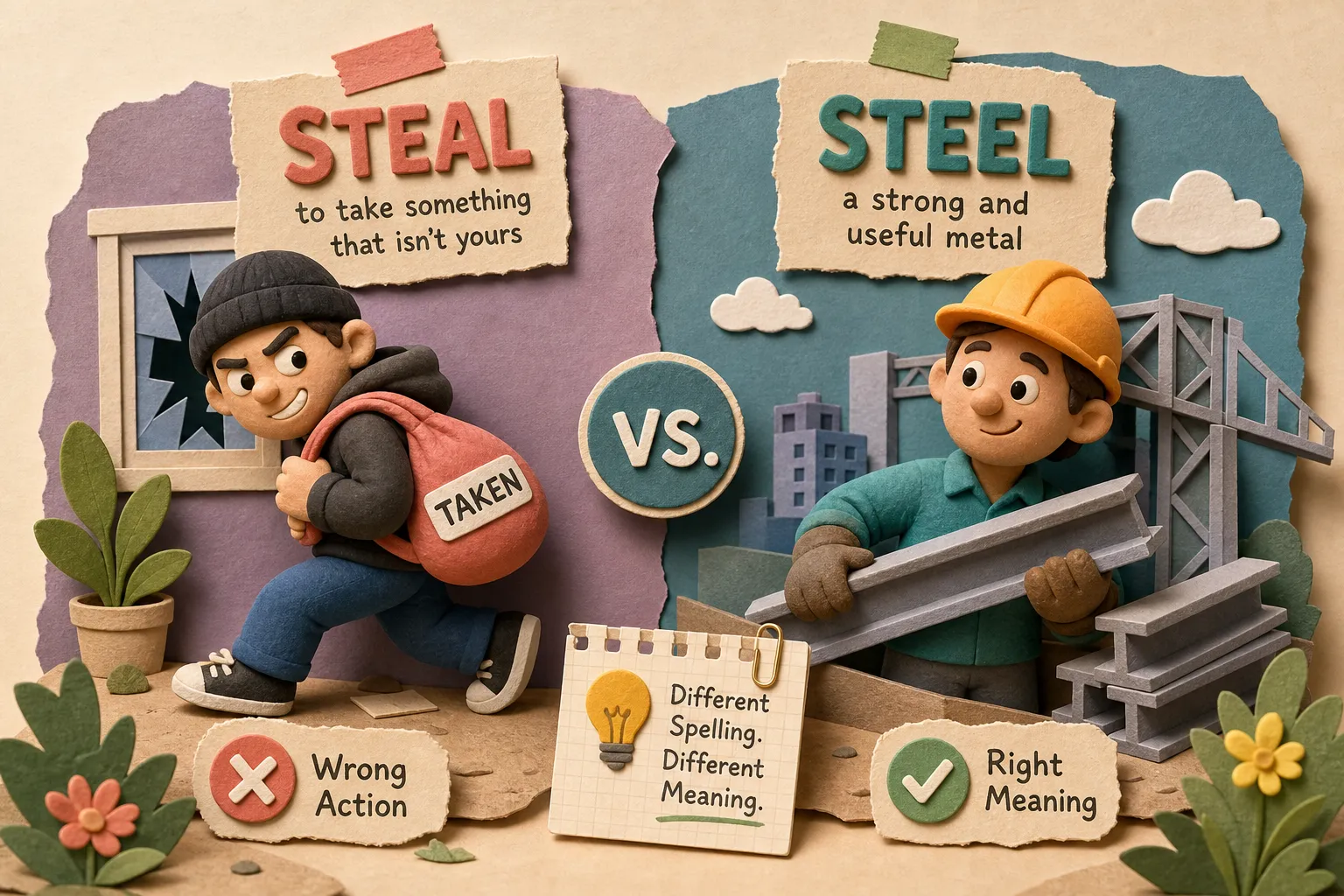
Steal and steel sound exactly the same when you say them out loud, and that is precisely what makes the steal vs. steel confusion so common in writing. In conversation, no one will notice which one you mean. But on the page, the wrong spelling changes your meaning completely. That is why getting the spelling right actually matters.
By the end of this lesson, you will know the meaning and part of speech for both words, how to pronounce them correctly, and at least two memory tricks to pick the right spelling every time. Homophone pairs like this one appear regularly in professional emails, job applications, and everyday messages. At Your Daily American, real-world accuracy like this is a core part of the learning path, because small spelling mistakes can quietly undermine an otherwise strong message.
Steal vs. Steel: Meanings and Usage
Steal as a verb
The most common use of steal is as a verb. It means to take something that belongs to someone else, without permission. Here are three clear examples:
- “Someone stole my wallet on the subway.”
- “He stole credit for my idea in the meeting.”
- “The runner stole second base.”
Notice that the past tense is stole, and the past participle is stolen. You would say, “He has stolen before,” not “He has stealed.” This is an irregular verb, so it is worth memorizing.
Steal as a noun
The word can also function as a noun. The most common noun use in everyday American conversation is to describe a very good deal. If something is priced much lower than its real value, you can call it a steal, “This laptop is a steal at $200″ or “Those concert tickets were a real steal.” This use is casual and enthusiastic, signaling genuine excitement about a price.
A second noun use comes from baseball. When a runner advances to the next base without the ball being hit, that move is called a steal. “He had 40 steals this season.” You don’t need to memorize this meaning right away, but it is good to recognize it when you hear it.
What “steel” means and when to use it
Steel as a noun: the metal
Steel is a noun that refers to a strong metal made from iron and carbon. It appears in construction, manufacturing, and everyday objects. Some clear examples:
- “The bridge is built with steel.”
- “My knife has a steel blade.”
- “Steel is one of the most important materials in modern construction.”
Remember that the metal is a specific alloy, a mix of iron and carbon, not just any metal. That distinction matters when you are writing about materials or manufacturing. For a concise dictionary entry, see the Merriam‑Webster definition of steel. For practical information about steel types and uses in manufacturing, Xometry’s materials guide is a useful resource.
Steel as an adjective and a verb
Learners who only know the noun form are missing two uses that appear often in American English. As an adjective, the word describes color or material: “steel-gray walls,” “steel doors.” These compound forms are common in design and architecture.
As a verb, “to steel yourself” means to mentally prepare for something hard. “She steeled herself before walking into the interview.” “He steeled himself and made the difficult phone call.” This verb form fits naturally in both casual conversation and professional writing, so it is worth learning.
Steal vs. Steel Pronunciation
They are homophones: what that means
A homophone is two words that share the same sound but have different spellings and meanings, and that is exactly what steal and steel are. Both words are pronounced /stiːl/. In most major American English accents, including those from Texas, New York, and California, no regional difference distinguishes them. If you say either word out loud, a listener cannot tell which one you mean.
Mouth position and the dark L
Here is how to produce /stiːl/ correctly. Start with the /s/ sound, then a clear /t/, then hold the long “ee” vowel, as in the word see. Don’t cut the vowel short. Then finish with the American “dark L.”
The dark L (/ɫ/) is a specific sound in American English. To produce it, keep your tongue tip down behind your lower front teeth while pulling the back of your tongue up toward the soft palate. The result has a slightly “ul” quality at the end. A useful practice technique: say “fee-yol” slowly, paying attention to how the back of your tongue rises before the L. Since both words share the same pronunciation, getting comfortable with one means you have both covered. For a deeper look at stress and related pronunciation patterns, see Word Stress in American English: A Complete Guide, Your Daily American.
Real sentences using both words in context
Steal in everyday situations
Here are five natural example sentences:
- “Don’t steal your coworker’s ideas and present them as your own.”
- “She stole the spotlight at the company event with her presentation.”
- “Someone stole the packages from the front porch.”
- “This restaurant is a steal. Three courses for $20 is unbelievable.”
- “The shortstop has already stolen three bases this game.”
Notice how the word appears in a physical theft situation, in a figurative sense (stealing attention), and as a noun meaning a great price. All three uses are common in everyday American speech and writing.
Steel in everyday situations
Here are five natural example sentences:
- “The new skyscraper uses steel and glass in its design.”
- “The surgeon uses a steel instrument for the procedure.”
- “The apartment has steel-gray walls and dark wood floors.”
- “She steeled herself and walked into the boardroom.”
- “The mechanic replaced the old parts with steel components.”
The metal shows up in material descriptions, color references, and mental-preparation contexts. That range shows the word is more flexible than many learners expect.
Memory tricks to always pick the right word
The “A in steal, A in deal” trick
Look at the word steal. It contains the letter A. Now look at its synonym when used as a noun: deal. That word also has an A. And if you are hungry and have no money? You might take a meal, another word with an A.
Write them side by side and you will see the pattern: ste-A-l / de-A-l / me-A-l. When the meaning involves taking something or getting a great price, reach for the spelling with A: steal.
The “EE in steel, EE in reel” trick (and the stolen-E trick)
The second trick covers the metal and the verb form. Look at steel: it has a double E. Think of a reel, the cylinder that cables wrap around. Both words share the double E: st-EE-l / r-EE-l / wh-EE-l. When the meaning points to the metal or to mental preparation, use the double E: steel.
There is also a bonus image that sticks well: someone stole the second E from steal. That is why one word has only one E, while the other kept both. It is a simple story, but simple is what makes it work. Both tricks rely on visual spelling patterns, so you can apply them any time you are writing and hit a moment of doubt. If you want a short comparison that highlights the common confusion, check out Grammarly’s article on “steal vs. steel”.
Quick practice: choose the right word
Fill-in-the-blank sentences
Read each sentence and decide whether to fill the blank with the verb, the metal, or the bargain. Try each one before checking the answers below.
- “Don’t _______ your coworker’s ideas.”
- “The new phone is a _______ at that price.”
- “The building uses _______ and concrete.”
- “The shortstop made a _______ at second base.”
- “She _______ herself and walked into the interview.”
Answer key and reflection prompt
- steal, verb, to take something without permission.
- steal, noun, a very good deal or bargain.
- steel, noun, the strong metal used in construction.
- steal, noun, a baseball base advance without a hit.
- steeled, verb, to mentally prepare for something hard.
How did you do? Think about which use of the metal word was new for you, then try writing one sentence with it today. If “to steel yourself” was the surprise, write about a time you had to prepare mentally for something difficult. You can also review additional examples and definitions at the Vocabulary.com entry for “steal”.
Confusing word pairs are a normal part of learning English, and getting them right sets your writing apart. At Your Daily American, this kind of real-world word work is a regular focus, because accuracy in writing is exactly what moves a learner from intermediate to advanced. For more articles on common pronunciation and listening topics, visit our Pronunciation & Listening, Your Daily American category, and to read about typical errors learners make, see English Words Non-Native Speakers Mispronounce Most Often, Your Daily American.
The short version to remember
When you think about the steal vs. steel difference, two spelling clues do all the work. One word is about taking something without permission or scoring a great price, it has the letter A, just like deal and meal. The other is the strong metal, or the act of preparing yourself mentally, it has a double E, just like reel and wheel. Both words are pronounced /stiːl/, so spelling is the only thing that separates them in writing.
Use the memory tricks: A for actions and bargains, EE for the metal and mental strength. Apply them every time you write, and the right choice will start to feel automatic. Getting small details like these right is what makes your English writing feel natural, clear, and professional.