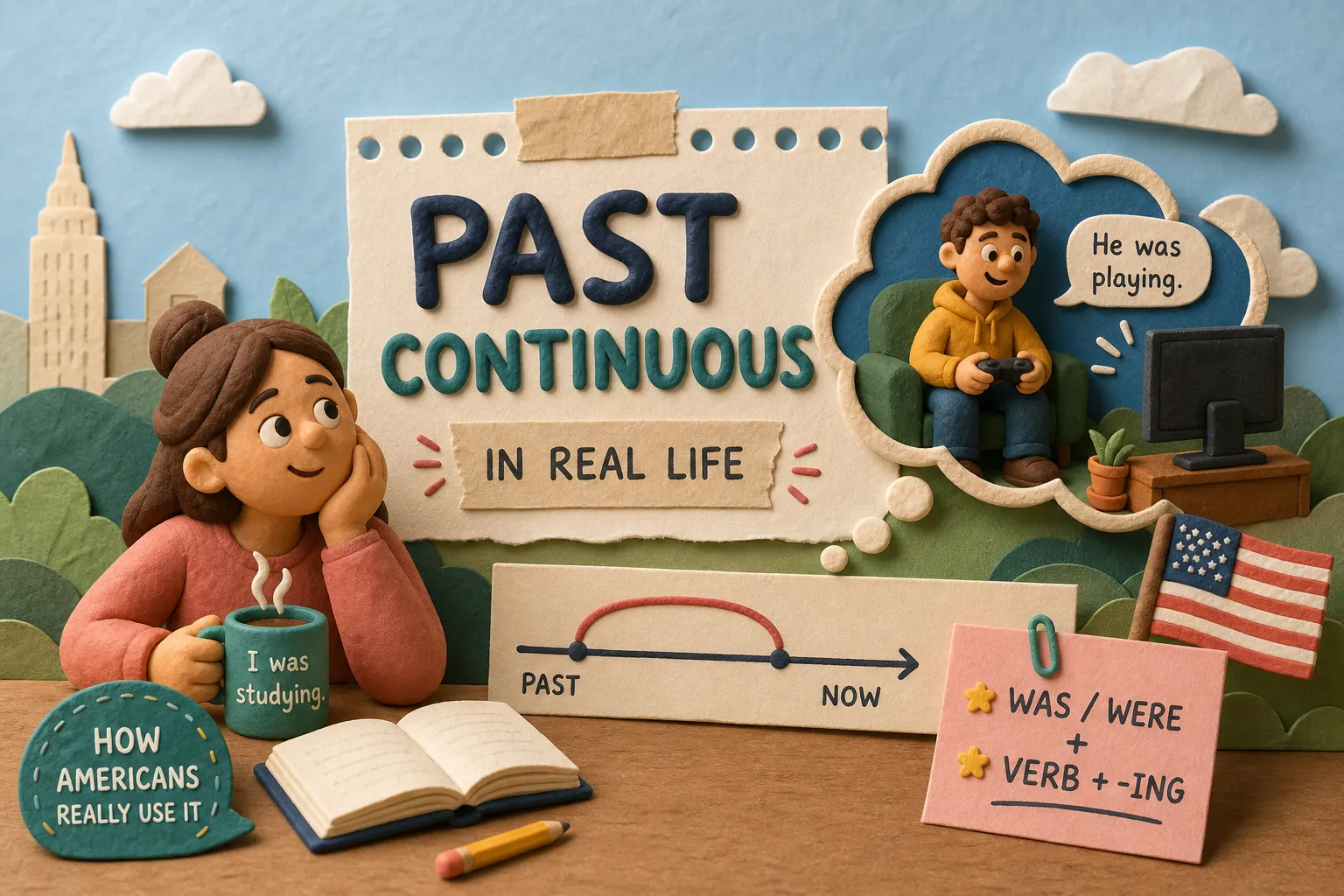
“I was making coffee when my phone rang.” That one sentence tells a whole story. It shows what was happening, what interrupted it, and exactly how the two moments connect. That’s the power of the past continuous tense, also called the past progressive.
By the end of this lesson, you’ll be able to build correct affirmative, negative, and question forms. You’ll also use this tense in real American situations and avoid the mistakes that make sentences sound unnatural. That’s a practical goal, and you can reach it today.
Grammar rules are easier to remember when you see them in real situations, not just on a chart. So this lesson focuses on how Americans actually use the past continuous in daily life, at work, and in conversation.
How to build the past continuous
The basic pattern: was/were + verb-ing
The formula has three parts: subject + was/were + main verb + -ing. Use was with I, he, she, and it. Use were with you, we, and they. Keep that rule in mind and the structure becomes automatic.
A few examples from everyday American life:
- She was working from home.
- They were watching the game.
- I was making coffee.
Negative and question forms
To make a negative, add not after was or were. In spoken American English, contractions are common, you’re far more likely to hear wasn’t and weren’t than the full forms in casual conversation.
- She wasn’t sleeping.
- They weren’t waiting.
For questions, move was or were to the front of the sentence, before the subject. The -ing verb stays in place.
- Was he driving?
- Were they studying?
One verb group to avoid: stative verbs
Stative verbs describe a state, not an action. Common examples include know, like, believe, need, want, and understand. These verbs don’t work in the past continuous because they describe conditions that simply exist rather than events actively unfolding in time, there’s no “in progress” quality to grab onto.
This is one of the most frequent errors ESL learners make. The fix is to use the simple past instead:
- ❌ “I was knowing the answer.”
- ✅ “I knew the answer.”
- ❌ “She was wanting a coffee.”
- ✅ “She wanted a coffee.”
When something interrupts what you were doing
The “when” pattern in everyday American life
This is one of the most common uses of the past continuous in American English. One action was already in progress when a second, shorter action happened. The word when connects the two. The longer action uses the past continuous; the shorter, interrupting action uses the simple past.
Some natural scenarios:
- I was eating dinner when my sister called.
- She was driving home when it started raining.
- He was sleeping when the alarm went off.
How to identify which action was longer
Ask yourself: “Which action was already happening?” That one gets the past continuous. The action that came in and stopped it gets the simple past. Once you ask that question, the choice becomes clear.
Look at two versions of the same moment:
- “I was eating dinner when my sister called.” (eating was in progress; the call interrupted it)
- “I ate dinner. My sister called.” (two separate, finished events)
The first version tells a richer story. It shows the relationship between two moments in time. The second version simply lists two facts. That difference matters when you’re speaking or writing in English.
Setting the scene and showing two things at once
Background descriptions: what was already happening
Writers and speakers use the past continuous to paint a picture of what was going on before the main event. Think of it as describing everything already in motion when you arrived or when something happened.
- “The kids were laughing, the music was playing, and the smell of food was filling the room.”
- “When I walked into the office, people were typing, some were talking on the phone, and the manager was giving directions.”
Both sentences use several past continuous verbs together. This creates a vivid, detailed picture, and it’s a technique you’ll find throughout American storytelling, from casual conversation to written narratives.
Parallel actions: two things happening at the same time
When two longer actions happen simultaneously, both use the past continuous. The key word here is while, which signals that the actions overlap and neither one interrupts the other.
- I was studying while he was cooking.
- She was texting while we were talking.
This is different from the interrupted-action pattern. With parallel actions, both things keep going. With interruptions, one action stops the other. The word you choose, while or when, signals exactly which situation you mean.
The polite use often skipped in grammar charts
“I was wondering if…” and why Americans say it this way
Americans often use “I was wondering” and “I was hoping” to make a request sound softer and more polite. This use has nothing to do with the past. It’s a social function of the tense, and it’s very common in daily American life and at work, even if it doesn’t always get much attention in basic grammar lessons.
The two sentences below mean the same thing, but they feel very different:
- “Can you send me that file?” (direct)
- “I was wondering if you could send me that file.” (polite, softer)
The second version sounds friendlier and less demanding. You can put it to use right away:
- “I was hoping we could reschedule.”
- “I was thinking we might grab coffee sometime.”
- “I was wondering if you could take a look at this.”
Where you’ll hear this in American life
You’ll encounter this pattern at the office when asking a colleague for help, in social settings when starting a conversation, and even in text messages when making plans. It works in spoken and written English equally well. Using it correctly signals that you understand not just the grammar, but the culture behind American communication, and that kind of real-world awareness is what separates textbook knowledge from genuine fluency.
Past continuous vs. past simple: how to choose
Signal words that point to each tense
Two small words do a lot of work here. “When” usually introduces the shorter, interrupting action, so the verb in that clause goes in the simple past. “While” usually introduces the longer, ongoing action, so that verb goes in the past continuous.
Notice how the signal word changes the whole sentence:
- “I was reading while she was cooking.” (both verbs are ongoing: past continuous for both)
- “I was reading when she arrived.” (reading was ongoing; arrival interrupted it: past continuous + past simple)
Time expressions like “at 7 PM,” “all morning,” and “for hours” usually point to the past continuous. They describe a stretch of time in progress, not a single completed moment.
For a clear, side-by-side comparison of these two forms, see the Cambridge Dictionary’s explanation of past continuous vs. past simple, which gives short examples and useful guidance for choosing the right tense.
How the same moment can be told two ways
The tense you choose tells the listener how you see the action, still going on, or completely done? Ask yourself: “Was the action still happening when something else occurred?” That question will guide your choice every time.
- “I was reading when she arrived.” (reading was in progress; her arrival stopped it)
- “I read. She arrived.” (two separate, completed events with no connection between them)
Both sentences are grammatically correct, but they communicate different things. The first version is richer and more connected. The second is simply a list of facts. Your choice depends on the story you want to tell.
Past continuous examples, common mistakes, and a quick practice
The mistakes that come up most often
Stative verb error: Using the past continuous with verbs that describe states, like know, like, need, and believe. Always switch to the simple past for these, for example, “I was believing the story” should be “I believed the story.” Always switch to the simple past for this verb group.
Habits and routines: Using the past continuous for regular past habits. The simple past handles habits; the past continuous handles actions in progress. “I was walking to school every day” should be “I walked to school every day.”
Missing was or were: Dropping the auxiliary verb completely. The formula always needs was or were, so “She walking home” becomes “She was walking home.”
For extra examples and practice exercises that show common student errors and corrections, check out Grammarly’s guide to the past continuous tense, which highlights typical mistakes and how to fix them.
Past continuous exercises: try it yourself
Write one sentence for each prompt below. The goal is to get comfortable using the past continuous in your own words, with your own experiences.
- What were you doing at 8 PM last night?
- Describe a time when something interrupted you while you were in the middle of a task.
- Write a polite request using “I was wondering.”
Say your sentences out loud after you write them. That step helps your brain connect the grammar to real speech. For additional practice questions and explanations tailored to learners preparing for exams, see Magoosh’s how and when to use the past continuous.
Keep going beyond the grammar
The past continuous tense handles several important jobs: showing interrupted actions, setting background scenes, connecting parallel events, and softening requests with phrases like “I was wondering.” These patterns cover many of the common situations you’ll run into in American English.
Grammar rules give you the starting point. Real fluency comes from hearing and using these patterns in actual American conversations, stories, and everyday situations. At Your Daily American, every lesson is built around real language use, from workplace emails to casual conversations to pronunciation practice, so you can feel how tenses work in context, not just on paper. If you want focused practice that ties tenses together, take a look at our 12 English verb tenses: a pocket guide for clear comparisons and quick reference.
Here’s a simple next step: pick one of the main uses from this lesson and write a sentence about your own day. Use the interrupted-action pattern, the background description, or the polite “I was wondering” form. Write it down, say it out loud, and notice how natural it starts to feel. That’s where real progress begins. You can also study common everyday phrases that pair well with these tenses, like those in our article on Common American Expressions, to make your speech sound more natural.
For a concise technical reference that lists forms and additional examples, EnglishPage’s past continuous reference is a useful, no-frills resource you can return to while you practice.
Frequently asked questions about the past continuous
When do I use the past continuous vs. the past simple?
Use the past continuous for an action that was in progress at a particular moment in the past. Use the simple past for a completed action or event. When both appear in the same sentence, the past continuous typically describes the longer background action and the simple past describes what interrupted it: “I was cooking when the phone rang.”
Can stative verbs use the -ing form?
Generally, no. Stative verbs like know, believe, need, and want describe conditions rather than events unfolding over time, so they don’t work in the past continuous. Use the simple past instead: “She wanted coffee,” not “She was wanting coffee.”
What are the signal words for the past continuous?
Common signal words include while (for parallel or background actions), when (for interrupted actions), and time expressions like “at 7 PM,” “all morning,” and “for hours” that suggest an action was ongoing.
Does “I was wondering” refer to the past?
Not exactly. When Americans use “I was wondering if…” or “I was hoping…,” they’re using the past continuous as a politeness strategy, not to describe a past event. The past tense creates a softer, less direct tone that’s widely used in American workplaces and social settings.