Imagine you find a job posting that says: “We are looking for a bilingual candidate for our biannual review process. Pay is biweekly.” Three words. One pattern. If you can read that pattern, you have already started to understand dozens of English words at once.
That pattern is the bi prefix, written bi- when attached to a word. It is one of the most useful word-building tools in American English. This article covers exactly what bi- means, how to say it, how to use it at work and in daily life, and how to avoid the handful of tricky words that confuse even native speakers.
At Your Daily American, we teach vocabulary through prefixes, suffixes, and roots because this method works. A widely cited analysis of English vocabulary found that the top 20 prefixes account for about 97% of all prefixed words in the language. Learning one prefix like bi- gives you a key that opens many doors at once.
What the bi prefix means and where it comes from
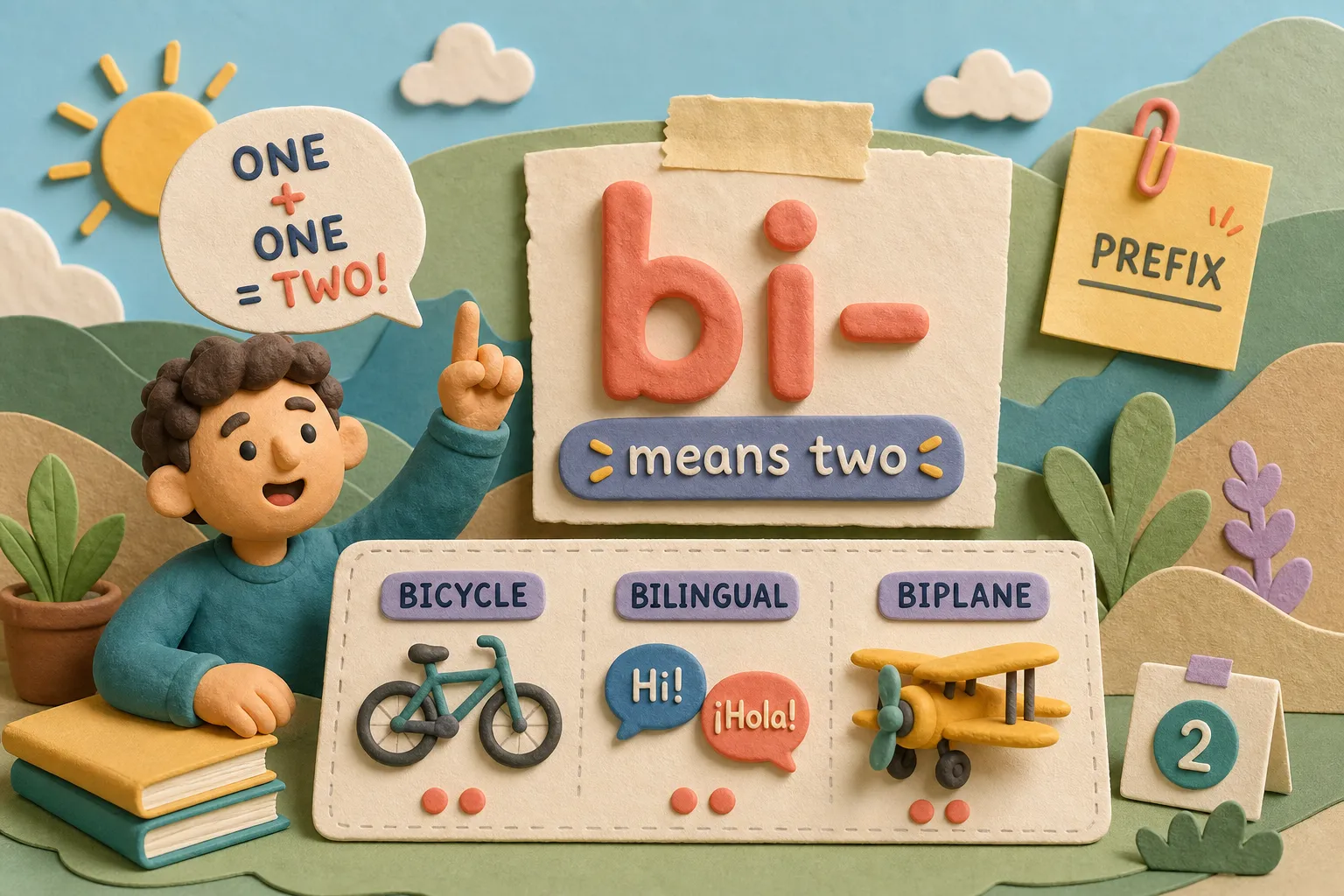
The prefix bi- comes from Latin. The original Latin word was bis, which meant “two” or “twice.” When you see bi- at the start of a word, something about the number two is almost always involved. Think of bicycle: two wheels. Or bilingual: two languages. The connection is clear and consistent.
The Latin root bis itself came from an even older source: the Proto-Indo-European word dwi- (an ancient ancestor language that gave rise to many modern languages), which simply meant “two.” That same ancient root produced the Greek prefix di-, which also means two. English borrowed bi- from Latin beginning in the 16th century, a history well documented in the Oxford English Dictionary, which is why it appears everywhere today, from textbooks to job ads to medical reports.
Bi- works in two different ways, and this is important to understand early. First, it can mean “having two” of something: bifocal (glasses with two focus points), biceps (a muscle with two heads). Second, it can mean “occurring twice or every two” of a time period: biweekly, biannual. This second meaning is where learners often get confused, but we will cover that clearly in a moment.
How to say bi- correctly every time
The pronunciation rule is simple and consistent: bi-, as a prefix, is almost always pronounced like the word “buy.” In linguistics, that sound is written as /baɪ/, the same sound Merriam-Webster records for bicycle, bilingual, and biannual. You do not say “bee-cycle” or “bee-lingual.” You say BI-cy-cle (/BAI-sih-kul/), bi-LIN-gual (/bai-LING-gwul/), and bi-AN-nu-al (/bai-AN-yoo-ul/).
Many ESL learners say “bee” instead of “buy” for this prefix. This often happens because of similar sounds in their native language, or because words like “being” start with a /biː/ sound. The fix is straightforward: when bi- is a prefix meaning “two,” say it like “buy.” Practice with these three words out loud: bicycle, bilingual, biannual. All three start with the same /baɪ/ sound.
When to hyphenate bi-
Most established bi- words do not use a hyphen: bicycle, bilingual, biannual, bipartisan. Hyphens are generally added in three situations: before a capitalized word (bi-American), to prevent a confusing double vowel (bi-ionic rather than bionic, which is a different word entirely), or to prevent misreading when the unhyphenated form could be confused for another word. When in doubt, check Merriam-Webster, if the dictionary lists the solid form, use it. Style guides like the AP Stylebook and the Chicago Manual of Style agree on this general rule, though Chicago tends to be slightly more conservative about dropping hyphens in new coinages. For more on this kind of word-building strategy, see our Prefixes and Suffixes: Unlock Thousands of English Words.
Bi- words you will use in daily life and at work
The words below are the ones you will see and hear in everyday American life. Each one clearly shows the “two” meaning.
Everyday words
- Bicycle: a vehicle with two wheels. “She rides her bicycle to work every morning.”
- Bifocal: glasses with two different lens strengths, one for reading and one for distance. “My grandfather needs bifocal glasses.”
- Binary: a system with two parts (often used in technology: zeros and ones). “Computers read everything in binary code.”
- Binoculars: a tool with two lenses that makes far objects look closer. “We used binoculars to watch the birds.”
- Biceps: a muscle with two heads (two points of origin) in your upper arm, commonly called the biceps brachii. “He did exercises to build his biceps.”
Professional and news vocabulary
These words come up often in professional settings and news writing. They are worth knowing for your career.
- Bilingual: able to speak two languages. “We are looking for a bilingual candidate who speaks English and Spanish.”
- Bicultural: familiar with two cultures. Often used alongside “bilingual” in job postings.”
- Bipartisan: supported by both political parties. “The senators reached a bipartisan agreement.”
- Bilateral: involving two sides or two countries. “The two companies signed a bilateral trade deal.”
- Bicameral: having two separate legislative chambers (law-making groups). “The United States has a bicameral Congress: the Senate and the House of Representatives.”
Quick reference
- Bisect: to cut or divide into two equal parts
- Bipolar: having two opposite poles or extremes
- Bigamy: the crime of being married to two people at the same time
- Biplane: an airplane with two sets of wings
- Bivalve: a sea creature with two hinged shells, like a clam or oyster
- Binomial: a math expression with two terms
- Bimodal: having two most common values in a data set
- Bidirectional: moving or working in two directions
- Bipartite: divided into two parts
The tricky pairs: biannual, biennial, biweekly, and bimonthly
These four words cause confusion for native speakers and ESL learners alike. The good news is that the rules are clear once you see them.
Biannual vs. biennial
Biannual means twice a year, so about every six months. Biennial means every two years. Here is the difference in action: “The company holds biannual reviews, one in June and one in December.” vs. “The art festival is biennial, so it happens every two years.” A useful memory tip: biennial contains the letters “ennial,” which is close to “annual.” Think of it as one full annual cycle that takes two years to complete. Because the difference is so easy to miss, many writers use semiannual instead of biannual when they mean “twice a year.” Semiannual is completely unambiguous. If you are writing a work email or report, it is the safer choice. For a quick practical guide with examples, see Grammarly’s guide to biannual vs. biennial.
Biweekly and bimonthly
These two words have a well-known problem. Merriam-Webster, one of the most trusted American dictionaries, lists two definitions for each: biweekly can mean “twice a week” or “every two weeks,” and bimonthly can mean “twice a month” or “every two months.” This is not a learner mistake. It is a genuine gap in standard English. The practical solution is simple: avoid these words when clarity matters. Instead of “we meet biweekly,” say “we meet twice a week” or “we meet every two weeks.” Your message will be clear every time, especially in workplace contexts like scheduling and pay cycles.
Bi- vs. di-: two prefixes, one meaning
You may have noticed that some English words use di- where you might expect bi-. Both prefixes mean “two,” but they come from different languages. Bi- entered English through Latin. Di- came through Greek. Both trace back to that same ancient root, dwi-, but they traveled different paths into modern English. For a concise root overview that traces these origins, see Membean’s page on the “bi-” root.
In everyday American English, bi- is far more common: bicycle, bilingual, biannual. Di- shows up more often in scientific and academic writing: diameter (the distance across a circle, measured through two sides), dioxide (a chemical compound with two oxygen atoms), dilemma (a situation with two difficult choices). You do not need to memorize rules about which one to use. Focus on bi-, since it is the prefix you will encounter most often in general American English. Di- will come naturally as you read more in science, math, or academic subjects.
Why learning one prefix is worth your time
Every bi- word in this article followed the same logic: bi- means two, so the word means something with two of whatever follows the prefix. You did not memorize each word from scratch. You used one piece of knowledge to unlock many words. This is exactly the strategy that experienced language learners use, and it is the approach we build on at Your Daily American.
Vocabulary researchers have consistently found that adult ESL learners who study common prefixes and roots decode unfamiliar words significantly faster than those who study isolated word lists. The top 20 prefixes in English cover nearly all prefixed vocabulary. Bi- is one of them. Once you add Un- prefix: The Simplest Way to Expand Your Vocabulary, di-, re-, pre-, and a few others to your toolkit, you have a real advantage when reading news articles, work documents, or academic texts. For a compact list of bi- root examples, see this root words: bi overview.
Before you move on, test yourself with these questions. You can answer them in your head or write them down.
- What does “bicameral” mean? Think about the word “camera” (a room in Latin) and the prefix bi-. What does the U.S. Congress have two of?
- A company holds its all-staff meeting bimonthly. Does that tell you exactly how often? What would you say instead to be clear?
- Which word means “every two years”: biannual or biennial?
(Answers: 1. Two chambers or law-making groups. 2. No, bimonthly is ambiguous. Say “every two months” or “twice a month.” 3. Biennial.)
Keep building from here
The bi prefix is a simple, powerful tool. It means two or twice, it almost always sounds like “buy,” and it appears in dozens of words you will use at work and in daily life. Note that time-related bi- words can be tricky: biweekly, bimonthly, and even biannual all carry potential for confusion, so defaulting to plain language, “twice a week,” “every two months,” “twice a year”, is the professional standard in clear writing.
Real fluency is not about memorizing word lists. It is about understanding the patterns behind the language. Prefixes like bi- give you those patterns. This week, look for bi- words in the emails you read and the news you follow. You will start to notice them everywhere.
At Your Daily American, we have more lessons on prefixes, vocabulary strategies, pronunciation, and real-world American English for daily life and work. If you want to keep building your vocabulary systematically, explore our study tips and vocabulary lessons on the platform via our Blog, Your Daily American. Each lesson is designed to give you something you can use right away.
Frequently asked questions about the bi prefix
Does bi- always mean two?
Almost always, yes. In the vast majority of English words, bi- signals the number two: two wheels, two languages, two chambers. The rare exceptions are older words where the prefix has been absorbed into the base word and the “two” meaning is no longer obvious. When you see bi- at the start of an unfamiliar word, starting with “two” is a reliable first guess.
Is biweekly twice a week or every two weeks?
Both, and that is exactly the problem. Merriam-Webster officially recognizes both meanings, which is why professional writers avoid the word altogether. Say “twice a week” or “every two weeks” instead.
What is the difference between bi- and semi-?
Semi- means “half” or “partially,” not “two.” Semiannual means “half a year”, in other words, twice a year. Biannual also means twice a year. In practice, the two words overlap, but semi- is the cleaner choice when you need to express “twice a year” without any ambiguity.
When should I hyphenate bi-?
For most common words, bicycle, bilingual, bipartisan, no hyphen is needed. Add a hyphen before a capitalized word, to separate a confusing double vowel, or to prevent a misleading reading. When in doubt, check Merriam-Webster.
What is the difference between bi- and di-?
Both mean “two,” but bi- came into English through Latin and di- came through Greek. Bi- is common in everyday vocabulary; di- appears more often in scientific and technical terms. You do not need to choose between them, usage is fixed by convention in each word.