Picture this: you’re in a meeting and someone says, “We’re already over budget and the team is overwhelmed.” You understand each word on its own, but the pattern with over keeps showing up in different ways. That pattern is the over prefix, and it quietly shapes dozens of common American English words. Once you see how it works, a large part of the vocabulary you hear at work and in daily life starts to make much more sense. At Your Daily American, this kind of pattern-based learning is a core part of how we teach real, practical American English.
This article covers what the over- prefix adds to a word and why, the most common over- words in work and everyday conversations, and the mistakes that trip up learners most often. By the end, these words stop feeling like a random list to memorize and start working like a system.
What the over- prefix actually means, and where it came from
The over prefix traces back to the Old English word ofer, meaning “above” or “beyond.” Over centuries of use, that spatial sense expanded into two main jobs in modern American English: signaling excess (“too much”) and indicating position or authority (“above, in charge”). Both meanings are alive in everyday speech today, which is why the same prefix can appear in words as different as overjoyed and oversee.
The most common meaning: too much or too far
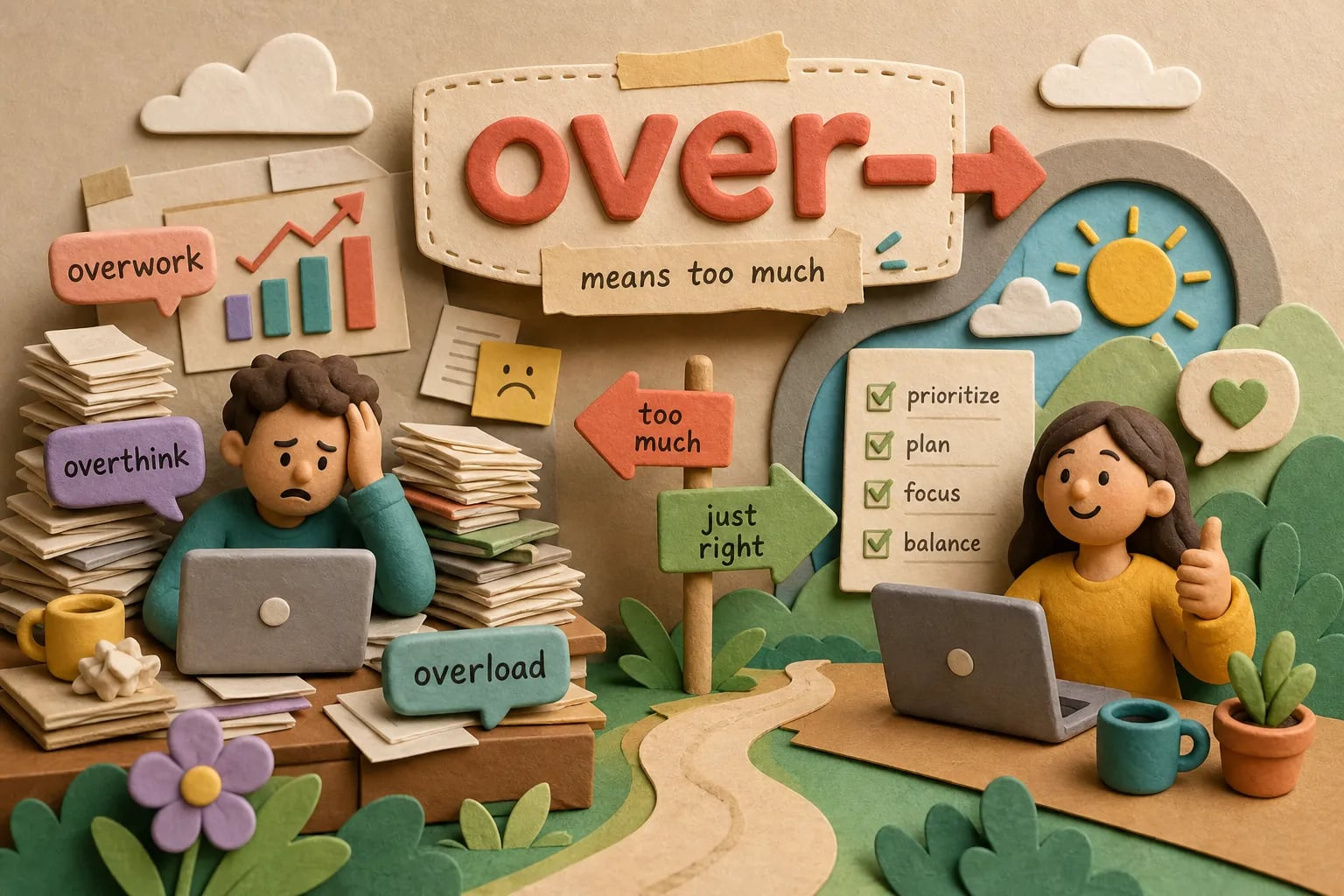
In most modern American English words, over- means too much or beyond a normal limit. Add over- to a verb and it usually means doing that action to excess. Think of words like overwork (to work too much), overeat (to eat too much), overcharge (to charge someone too much), and overreact (to react more strongly than needed). The pattern is simple: over- plus a verb equals doing that thing more than you should.
- “He overworks himself every week.”
- “They overcharged me for the delivery.”
- “She overreacted to the small mistake.”
The second meaning: above, in control, or in charge
In some words, over- does not mean “too much.” Instead, it signals being above something, looking down on it, or holding a position of authority. Words like oversee, overview, overhead, and override use this sense. The idea here is about position or power, not excess.
Oversee trips up many learners because it does not mean “to see too much.” It means to supervise or manage, the way a manager watches over a team. “She oversees the sales team.” The “over” in oversee means looking from above with authority, not looking too hard.
A quick note on how the over- prefix attaches to words
Learners often ask: does over- need a hyphen? Most of the time, no. Most modern style guides, including the Chicago Manual of Style and the AP Stylebook, prefer closed compounds: overload, overlook, overtime, overjoyed. That holds true even when over- comes before a vowel, as in overeat or overuse. A hyphen is occasionally used when omitting it would create confusion, when the base word is a proper noun (as in over-Shakespearean), or when a style guide specifically calls for it. But for the words covered in this article, the everyday work and life vocabulary you’ll actually use, the closed form is correct and standard. For a practical hyphenation reference, see this hyphen guide.
Over prefix in work vocabulary
These are words you will hear in meetings, read in emails, and use in conversations with coworkers. Learning them in context makes them much easier to remember and use correctly. For more workplace-focused lessons, see our Professional English section.
When deadlines and hours go over limits
Overdue means something was supposed to happen but did not happen on time. “The report is three days overdue.” This word almost always signals a problem. Overtime means hours worked beyond the normal schedule. “I worked overtime last Friday to finish the project.” Overtime is neutral or even welcome, some workers earn extra pay for those hours. Overdue suggests a negative situation; overtime does not.
When work feels like too much
Overwhelmed describes an emotional or mental state, what happens when there is too much to handle internally. “I’m overwhelmed by everything I need to do this week.” Overloaded describes a situation where the amount of work or data exceeds what a system or schedule can handle. “My inbox is completely overloaded.” These two words are similar but not interchangeable. Use overwhelmed for emotional states and overloaded for quantities and systems.
If you want practical tips for managing that feeling in a work setting, this piece on being overwhelmed at work offers useful strategies.
When someone’s decision gets canceled or someone supervises
Override means to cancel or replace a decision using higher authority. “The director overrode the committee’s decision.” This is common in meetings and in tech settings. Oversee means to manage or supervise a team or process. “She oversees the whole marketing department.” Neither of these words means “too much.” Both use the authority sense of the over- prefix.
Over- words for everyday life
Outside of work, over- words show up in casual conversations, stories about your day, and descriptions of how you feel. Here are the most common ones.
Things that go wrong in the morning
Oversleep means to sleep too long and miss something. “I overslept and missed my 8 a.m. class.” Americans use this word constantly, especially when explaining why they were late. Overlook means to miss something without intending to. “I overlooked the appointment on my calendar.” It simply means to forget or miss something by accident.
Feelings and reactions
Overreact means to respond too strongly to something small. “Sorry, I overreacted. It wasn’t a big deal.” This shows up constantly in everyday American conversation. Overthink means to analyze something so much that it creates stress or confusion. “Stop overthinking it. Just send the email.” You’ll hear this often in informal speech and see it everywhere on social media.
Overjoyed means extremely happy. “She was overjoyed when she got the job offer.” Compare this to overwhelmed: both use the over- prefix, but overjoyed is purely positive while overwhelmed usually describes stress. Same prefix, very different emotional direction.
Situations and conditions
Overcast describes a sky full of clouds. “It’s overcast today, so bring a jacket.” Overcrowded means a place has too many people. “The subway was overcrowded during rush hour.” Both of these are adjectives, not verbs. You would not say “It overcasts today.” You say “It is overcast today”, a distinction that trips up many learners.
Over- phrasal verbs Americans use naturally
There is one more category worth knowing: phrasal verbs where “over” appears as a separate particle, not as a prefix. A phrasal verb is a two-word verb that acts as a unit with its own meaning. These work differently from over- prefix words, but they use the same word “over,” so the confusion is easy to understand.
The difference between over- as a prefix and over as a particle
When over- is a prefix, it attaches directly to the base word with no space: overlook, overreact. When over is a particle in a phrasal verb, it is written separately: get over, take over. That space changes everything. Overlook (one word) means to miss something. Look over (two words) means to review something quickly. The space matters.
The most common over phrasal verbs in American English
- Get over: Recover from something, like an illness or a difficult experience. “It took me a week to get over that cold.”
- Come over: Visit someone’s home. “Do you want to come over tonight?”
- Take over: Gain control of something. “He took over as manager last month.”
- Talk over: Discuss something together before making a decision. “Let’s talk it over before we decide.”
- Go overboard: Do something excessively or with too much enthusiasm. “She went overboard with the decorations.”
Where to go deeper with phrasal verbs
Phrasal verbs are one of the biggest challenges for ESL learners because their meanings are often not predictable from the individual words alone. At Your Daily American, the phrasal verbs section breaks them down with full situational examples, so you understand not just the meaning but when and how native speakers actually use each one in real conversations. You can also consult a list of common phrasal verbs such as the 150 most common phrasal verbs for extra practice.
Common mistakes learners make with over- words
These are the patterns that cause the most confusion. Knowing them now will save you real trouble later. If you’re interested in other learner errors, check our article on English words non-native speakers mispronounce most often, which highlights common pronunciation traps that go hand-in-hand with vocabulary mistakes.
Confusing over- (prefix) with over (preposition)
The word “over” as a preposition means “above” or “across.” “The lamp is over the table.” This is not the same as using over- as a prefix. The mistake happens when learners try to attach over- to a word when they really just need the preposition written as a separate word.
- Incorrect: “She put the blanket overthem.”
- Correct: “She put the blanket over them.” (preposition, written separately)
Mixing up over- and under-
The prefix under- means “not enough” or “too little”, the direct opposite of over-. The pair that causes the most mix-ups in real conversations is overestimate and underestimate. If a project costs $10,000 and you said it would cost $15,000, you overestimated. If you said $5,000, you underestimated. Swapping these two in a business conversation can cause genuine misunderstandings, so it is worth getting them straight.
Using over- words as the wrong part of speech
Overwhelm is a verb, but most Americans use the adjective form overwhelmed in daily speech. You will rarely hear “I overwhelm,” but you will hear “I am overwhelmed” every day. Similarly, overtime is a noun or adjective, not a verb. You would not say “I overtime today.” You say “I worked overtime today.” Pay attention to how a word functions in a sentence, not just what it means, and you will start using it naturally.
Over prefix: quick reference and common examples
Before moving on to practice, here is a fast-reference list of the most frequently used over- words grouped by meaning. These are the ones you are most likely to encounter in American English on any given day.
“Too much” meaning: overwork, overeat, overcharge, overreact, overthink, oversleep, overload, overwhelm, overcrowd, overdue
“Above / in authority” meaning: oversee, overview, overhead, override, overlook (in the supervisory sense)
Adjectives describing conditions: overwhelmed, overloaded, overcast, overcrowded, overjoyed, overdue
If you are unsure which category a new over- word falls into, ask: does it describe doing something to excess, or does it describe a position or condition? That single question will get you to the right meaning most of the time.
Practice: try using over- words today
Three sentences to complete
Fill in the blank with the correct over- word. Look back through the sections above to check your answers.
- “The project was due on Monday. Now it’s Thursday. The report is ________.”
- “I set my alarm for 7 a.m., but I still slept until 10 a.m. I ________ again.”
- “My manager has final say on all decisions. She can ________ any choice the team makes.”
One thing to notice today
Set one small goal before you close this page: find one over- word in the next email you read, show you watch, or conversation you’re part of. When you find it, ask yourself: does it mean “too much,” “above or in charge,” or is it a phrasal verb particle written separately? That one question, asked regularly, builds the habit of noticing language patterns. This kind of real-world observation is a core study habit at Your Daily American, where noticing the language around you every day is just as important as structured study.
The pattern is the point
The over- prefix is not random. It follows clear patterns, and those patterns unlock a large part of everyday American English vocabulary. Once you know that the over prefix usually signals “too much” or “in charge,” words like overdue, overwhelmed, oversee, and override stop feeling like separate items to memorize. They become a system you can read and use with confidence.
This article covered over- words for work, over- words for daily life, and phrasal verbs where “over” appears as a separate particle. You also saw the most common mistakes and how to avoid them. Phrasal verbs are the logical next layer, and they’re everywhere in real American speech. The phrasal verbs content at Your Daily American gives you exactly that: real context, natural examples, and the situational detail that turns a definition into something you can actually say and understand.