You walk into a popular brunch spot on Saturday morning. A sign by the door reads: “Seating available on a first-come, first-served basis.” You’ve probably seen this phrase on concert tickets, company emails about training sign-ups, and parking lot notices. It shows up everywhere in American daily life. But do you know exactly what it means, how to write it correctly, and when to hyphenate it?
By the end of this article, you will. You’ll know the correct spelling and grammar, understand the punctuation rules, and have real example sentences ready to use. At Your Daily American, every lesson is built around practical American English in the real situations where you’ll actually hear and use it. Start with the meaning and spelling before moving to punctuation and real-world examples.
What “first come, first served” means
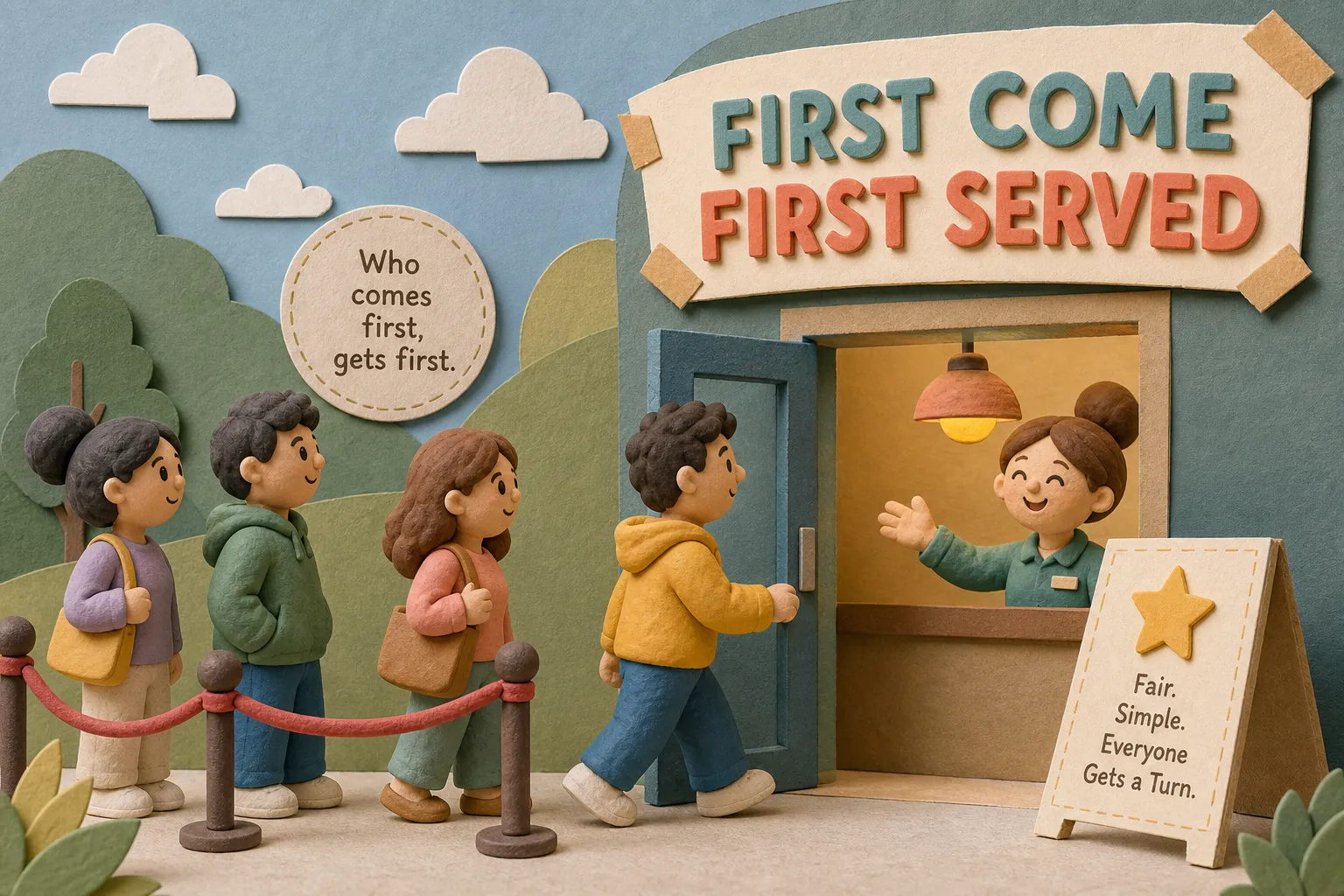
The phrase is simple: the first person to arrive gets served first. When something is limited, seats at a restaurant, tickets to an event, parking spots, or registration slots, people who arrive or sign up earliest get priority. If you arrive late, you may not get anything.
The idea has been around for a very long time. It traces back to a 14th-century proverb in the writing of Chaucer, where the same idea appeared through a mill metaphor: whoever arrives at the mill first gets their grain ground first. By about 1545, the modern English form appeared in print, and over time it moved from a general proverb to a practical rule used by merchants and service providers. Today, you may also see it shortened to FCFS in business and tech environments. In logistics and operations, a related term is FIFO (first in, first out), which describes the same principle applied to queues, inventory, or data processing.
Why “first come, first serve” is wrong (and “first come, first served” is right)
The grammar behind the -ed ending
The correct form is “first come, first served” with a -d at the end. To understand why, look at the full meaning of the phrase: “the first to come will be the first to be served.” In this sentence, “served” is a past participle. It describes what happens to the person who arrives first, that person receives the service. They are served.
When you drop the -d and write “first come, first serve”, the meaning shifts. Now it sounds like the first person to arrive is the one doing the serving, not receiving it. That is the opposite of what you want to say. The -d ending is the standard form in writing; the variant without -d is considered nonstandard.
How native speakers use the wrong form
You will hear “first come, first serve” in casual American speech. Many native speakers say it this way without thinking, and listeners usually understand the intended meaning. In conversation, this is not a major problem. In writing, it is a different story. On signs, in emails, and in professional documents, “first come, first served” is the expected form. Major dictionaries and usage guides list the -d version as standard. The rule for writing is clear: always use -d.
Comma and hyphen rules: how to write “first-come, first-served” correctly
The comma after “come”
The comma between “come” and “served” is part of the standard form. It reflects the original full sentence structure: “the first to come, the first to be served.” In formal and professional writing, keep the comma. You may see it dropped in very informal writing, but standard usage, and all major style guides, retains it. For example: “Seating is available on a first-come, first-served basis.”
When to add hyphens: first-come, first-served hyphenation explained
This is the rule that trips up many writers, including native speakers. When the phrase comes directly before a noun and acts as a modifier, you hyphenate it. When it comes after the verb (the predicative position), you do not.
- “Seating is on a first-come, first-served basis.” (before the noun “basis”, use hyphens)
- “Seating is first come, first served.” (after the verb, no hyphens)
AP Style and the Chicago Manual of Style both follow this compound modifier rule, and MLA applies the same standard. If you learn this one pattern, you can apply it correctly in any American professional writing context. The comma inside the phrase stays in both cases; only the hyphens change depending on where the phrase appears in the sentence.
Real situations where you’ll hear and use this phrase
Everyday life: restaurants, events, and public services
This phrase is part of daily American life. You will read it and hear it across many common situations. Here are real example sentences:
- “The restaurant does not take reservations. Tables are first come, first served.”
- “General admission tickets are available on a first-come, first-served basis. Doors open at 7 p.m.”
- “The parking lot fills up in order of arrival. We cannot guarantee a space for late arrivals.”
- “Free tote bags will be given out on a first-come, first-served basis while supplies last.”
Notice that the second and fourth sentences use the hyphenated form because the phrase modifies a noun directly. The first sentence uses the non-hyphenated form because the phrase follows the verb. Both patterns are correct, you just apply the rule based on where the phrase sits in the sentence.
Professional and workplace settings
The phrase appears frequently in office policies and business communication. Vacation scheduling and time-off requests are among the most common workplace applications: when only a few employees can take the same week off, many companies assign priority in the order requests are received. Conference room bookings and shift-scheduling preferences often follow the same approach.
- “Conference rooms are available on a first-come, first-served basis. Please book through the calendar system at least 24 hours in advance.”
- “Registration for the Q3 training session is open. Spots will be filled in the order sign-ups are received, so register early.”
- “Preferred parking passes are limited and will be distributed on a first-come, first-served basis starting Monday.”
In professional writing, the hyphenated form before a noun is almost always what you will see in official policies and company emails. When in doubt, use the hyphenated form before “basis,” “policy,” or “system.”
How to write it on signs, notices, and in emails
Ready-to-use sign copy
Sign copy in American English is short, direct, and clear. Here are examples you can use or adapt:
- “Seating available on a first-come, first-served basis.”
- “Free samples available while supplies last, first-come, first-served.”
- “Parking is first come, first served. No reservations accepted.”
The hyphenated form works well on signs when the phrase functions as a compound modifier before a stated or implied noun, “first-come, first-served basis,” “first-come, first-served parking,” and “first-come, first-served seating” are all correct. When the phrase is used predicatively (that is, after a linking verb with no noun following), omit the hyphens, as in “Parking is first come, first served.”
Using it in professional emails and policies
In emails and formal documents, the phrase fits naturally into a complete sentence. Always use the hyphenated form when it modifies a noun. Two clean examples:
- “Registration is open on a first-come, first-served basis. Once all 20 spots are filled, the form will close automatically.”
- “Vacation requests for the December holiday period will be approved on a first-come, first-served basis, subject to minimum staffing requirements.”
These sentences are ready to use in professional writing. They are clear, grammatically correct, and appropriate for any American workplace context.
Alternatives when you need a different way to say it
Clearer options for formal writing
Sometimes the phrase appears too many times in one document, or it feels too casual for a contract. Here are natural alternatives with example sentences:
- “In order of arrival”, “Attendees will be seated in order of arrival.”
- “In the order requests are received”, “Applications will be reviewed in the order requests are received.”
- “While supplies last”, “Free gift with purchase, while supplies last.” (Best for product-related notices.)
- “On a rolling basis”, “Admissions decisions are made on a rolling basis.” (Best for applications and registrations.)
Each alternative fits a specific context. “In order of arrival” is clear and formal. “While supplies last” is more common in retail and marketing copy. “On a rolling basis” is standard in academic admissions and job applications. Choose the one that matches your tone and situation.
A note on FCFS and FIFO in business and tech
If you work in operations, logistics, software development, or a multinational company, you may encounter the abbreviations FCFS (first come, first served) and FIFO (first in, first out) in technical documents and system descriptions. Both describe the same core principle: requests or items are processed in the order they arrive. Knowing these abbreviations helps you follow technical discussions without confusion.
Recognizing and using phrases like this correctly is part of what makes your English sound natural and professional in American contexts. This is exactly the kind of practical, real-world English that Your Daily American is built around, not just vocabulary, but the grammar rules, punctuation details, and situational knowledge that let you use the language with real confidence.
Quick summary and your practice moment
Here are the key points to take away. The correct form is “first come, first served”, with a comma and a -d ending. Before a noun, hyphenate it: “first-come, first-served.” After a verb, no hyphens are needed. AP Style and the Chicago Manual of Style are explicit about this compound-modifier rule, and MLA follows the same standard. You will find the phrase in restaurants, event venues, workplace policies, and professional emails alike.
Now try it yourself. Write two sentences: one using the predicative form (after a verb, no hyphens) and one using the compound adjective form (before a noun, with hyphens). You could write about a seat at a workshop, a parking spot at work, or a limited product at a store. Writing the phrase in your own sentences is the fastest way to make it stick.
Frequently asked questions
Is it “first come, first served” or “first come, first serve”?
The correct form is “first come, first served” with a -d ending. “Served” is a past participle meaning the person receives the service. The form without -d (“first serve”) implies the person is doing the serving, which reverses the meaning. Use the -d form in all writing.
When do I hyphenate “first-come, first-served”?
Hyphenate the phrase when it appears directly before a noun as a compound modifier: “a first-come, first-served basis.” Leave the hyphens out when the phrase follows a linking verb: “Seating is first come, first served.” The comma between “come” and “served” stays in both cases.
Is “first come, first serve” acceptable in everyday speech?
Many native speakers use the -serve form in casual conversation, and listeners generally understand the intent. It is not standard, however, and should be avoided in writing. On signs, in emails, and in any professional context, always write “first come, first served.”
What does “first-come-first-served” mean as a policy?
A first-come, first-served policy (also abbreviated FCFS) means that access to a limited resource, seats, spots, items, or time slots, is granted strictly in the order that people arrive or submit requests. No reservations or special priority are involved; arrival order determines access.