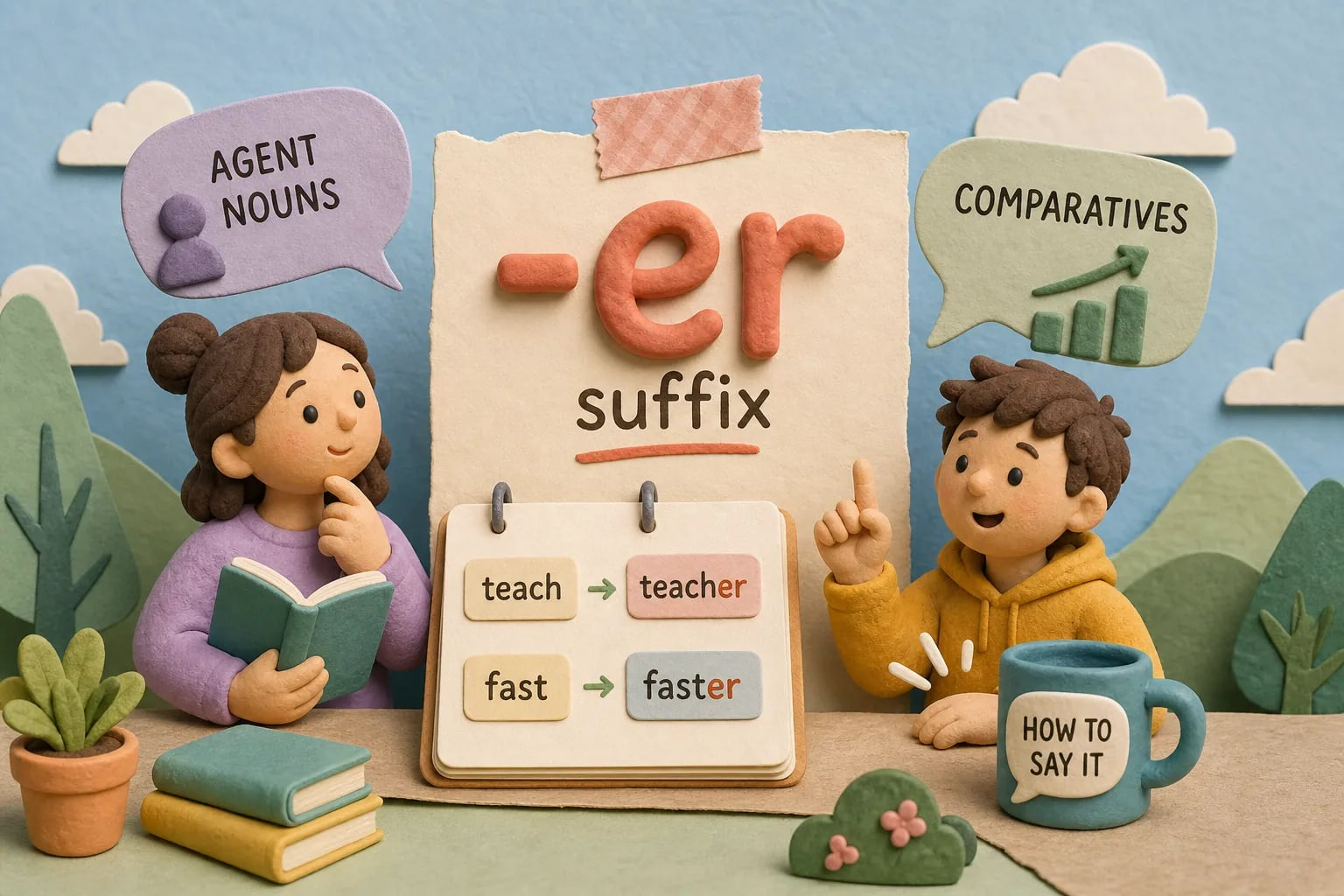
Look at these three words: teacher, faster, runner. They all share the -er suffix, but each one is doing something different. In teacher, the -er tells you this is a person who teaches. In faster, the -er tells you something moves with more speed than something else. Same ending, two completely separate jobs.
That is what makes this suffix worth understanding. Once you learn how -er works, you can build hundreds of new words correctly, compare things naturally, and spell those words right the first time. At Your Daily American, pronunciation is always part of the grammar lesson, because the way a word sounds shapes how well you remember and use it. So this article covers all three: meaning, spelling, and sound.
What the -er suffix does in American English
A suffix is a word part added to the end of a base word. The -er suffix has two very different jobs in English, and knowing which job it is doing changes everything about how you use the word. For a broader look at how suffixes work across English, see a comprehensive guide to suffixes.
Job 1: It turns a verb into a noun that means “a person or thing that does this action.” Linguists call this an agentive suffix, and the words it creates are called agent nouns. Teach is a verb. Add -er, and you get teacher, a noun. Drive is a verb. Add -er, and you get driver. The new word names someone or something that performs the action.
Job 2: It modifies an adjective to show comparison, meaning “more of this quality.” Tall is an adjective. Add -er, and you get taller, which means “more tall.” Fast becomes faster. Old becomes older. This is called a comparative adjective.
Why does this matter? If you add -er to a verb, you get a noun. If you add -er to an adjective, you get a comparative. Mixing these up leads to errors like “more taller” (doubling the comparison) or “quickener” (treating an adjective like a verb). Knowing the category helps you choose the correct form every time.
Using -er to form agent nouns
The pattern: verb + -er = a person or thing that does the action
This pattern is one of the most productive in English. You can apply it to hundreds of everyday verbs. Here are some common examples:
- teach → teacher
- write → writer
- manage → manager
- drive → driver
- build → builder
Agent nouns do not always describe people. A blender blends. A dishwasher washes dishes. A printer prints. The -er ending works the same way for machines and tools. “She put the vegetables in the blender.” “The office printer is out of paper.”
High-frequency agent nouns for work and daily life
These are the agent nouns you will hear and read most often in American English. Learning them as vocabulary will help you understand job titles, news articles, and everyday conversations.
- teacher, worker, manager, speaker, writer
- player, builder, traveler, reader, listener
One spelling note: in American English, the word is traveler with one L. In British English, it is traveller with two L’s. This difference comes up in professional writing, so it is worth knowing. American English generally does not double the final L when adding a suffix to words like travel.
When English uses -or instead of -er
Some verbs take -or instead of -er to form agent nouns. These words usually come from Latin roots. Common examples include act → actor, direct → director, visit → visitor, and create → creator.
There is no simple rule that tells you which ending to use. The best approach is to memorize the most common -or words as vocabulary items. When you are unsure, -er is the safer choice for everyday English verbs. A common question is whether to write visitor or visiter. The correct form is visitor, because the verb visit comes from Latin. For a newer, everyday verb like text, you would say texter, not textor.
Using -er to build comparative adjectives
Short adjectives take -er for comparison
One-syllable adjectives almost always take -er to form the comparative. This is one of the most consistent rules in English grammar. You can see it clearly with words like fast → faster, small → smaller, bright → brighter, and old → older. You use these forms when comparing two things: “This road is faster than the highway.” “The second apartment was smaller than the first.”
Many two-syllable adjectives also take -er, especially those that end in -y. The -y changes to -i before you add -er: happy → happier, busy → busier, early → earlier, crazy → crazier. You will also see -er with two-syllable adjectives ending in -ow or -le, such as narrow → narrower and simple → simpler.
When to use “more” instead of -er
For longer adjectives, three syllables or more, you use more instead of -er. You say “more beautiful,” not “beautifuler.” You say “more comfortable,” not “comfortabler.” Some two-syllable adjectives also prefer more: more modern, more careful, more recent.
One of the most common learner errors is doubling the comparison: “She is more faster than me” or “He is more bigger.” This is incorrect because you are applying the comparison twice. Use either -er or “more,” not both. “She is faster than me.” “He is bigger.” It is also worth noting the -er vs. -est distinction: -er is for comparing two things, while -est is for comparing three or more (“the fastest runner in the race”).
Irregular comparatives to memorize
A small group of common adjectives do not follow the -er pattern at all. They use completely different word forms because they come from different historical word roots. You need to memorize these:
- good → better
- bad → worse
- far → farther / further
- little → less
- many / much → more
Saying “more good” or “more bad” is always incorrect. In American English, both casual and formal, you use better and worse. “The new version is better.” “The weather is worse today than yesterday.” For additional examples and explanations of irregular comparative adjectives, see this practical guide.
Spelling rules for the -er suffix
Rule 1: Drop the silent -e
When a base word ends in a silent -e, drop that -e before adding -er. The suffix already starts with a vowel, so the silent -e is not needed. Bake → baker. Make → maker. Write → writer. Drive → driver. Keeping the -e produces a double vowel that does not exist in English: “writeer” is not a word.
Rule 2: Change -y to -i
When a base word ends in a consonant followed by -y, change the -y to -i before adding -er. This applies to both agent nouns and comparatives. Happy → happier. Busy → busier. Crazy → crazier. Early → earlier. There is one exception: if the -y follows a vowel, keep the -y. Play → player, not “plaier.” Note that enjoyer (from enjoy) follows the same rule, though it is rare in everyday use, most native speakers would phrase it differently.
Rule 3: Double the final consonant
For one-syllable words with one short vowel and one final consonant, double that consonant before adding -er. This rule protects the short vowel sound. Big → bigger. Run → runner. Hot → hotter. Thin → thinner. Without the doubled consonant, “biger” would suggest a long vowel, like the word tiger.
Do not double the final consonant if the word ends in w, x, or y. New → newer. Slow → slower. And remember the American English rule for words ending in -l: do not double it. Travel → traveler, not “traveller.” This is one clear difference between American and British spelling. For official classroom-friendly lists of common spelling rules, see the Colorado Department of Education’s spelling rules resource.
Pronouncing the -er suffix in American English
The American -er sound: the rhotic /ɚ/
In American English, the -er ending is pronounced as /ɚ/. Linguists call this a rhotic vowel, a vowel with a strong “r” quality built into it. In simple phonetic terms, it sounds like “ur” at the end of a word. Teacher sounds like “TEE-chur.” Faster sounds like “FAS-tur.” Runner sounds like “RUH-nur.” Better sounds like “BEH-dur.”
This is one of the most recognizable features of the American accent. The “r” is fully pronounced and shapes the vowel itself. The -er ending does not sound like a plain “uh”, it has that clear “r” color throughout. For a technical overview of rhoticity and how accents differ, see the article on rhoticity in English. You can also read our focused piece, The American R: Why It Sounds So Different, Your Daily American, for practical tips and audio-friendly descriptions.
Why this sound is hard for many learners
Many languages do not have this rhotic vowel sound. Speakers of Spanish, French, and Portuguese, as well as Japanese and Mandarin speakers, often pronounce the -er ending as a flat “eh” or a plain schwa “uh,” without the “r” quality. This can make words like teacher and better harder to understand for American listeners.
To produce the /ɚ/ sound, curl your tongue tip slightly back toward the roof of your mouth, or bunch the back of your tongue upward. The key is that the “r” shapes the vowel from the inside, it does not come after the vowel. Say “TEE-chur” slowly and feel how the “r” quality is part of that final syllable, not tacked on at the end.
Practice the American rhotic “r” with Your Daily American
The American rhotic “r” is one of the most covered sounds at Your Daily American, and for good reason. It appears in hundreds of common words, not just -er endings. You hear it in words like bird, work, first, world, girl, and throughout connected speech. Getting this sound right changes how natural you sound to American listeners.
Pronunciation & Listening, Your Daily American covers the rhotic “r” in depth, with IPA symbols, phonetic respellings, descriptions of mouth and tongue position, and guidance on connected speech and T-flapping. If you want to sound more natural in American English, that section is a strong place to continue after this lesson.
What to do next: a short practice activity
To close this lesson, try this short exercise. Pick five verbs, for example: teach, build, write, manage, listen. Turn each one into an agent noun by adding -er, and apply the correct spelling rule where needed. Then pick five adjectives, for example: fast, happy, small, hot, old, and write a comparative sentence for each one. “My new laptop is faster than my old one.” “She seems happier at her new job.”
Once you have written all ten sentences, say them out loud. Focus on the -er ending each time. Keep your tongue in that rhotic position. Say “TEE-chur,” “FAS-tur,” “HAP-ee-ur.” The more you connect the written form to the spoken sound, the more natural both will feel.
The -er suffix is small but does a lot of work in American English. Knowing how it operates across agent nouns, comparative adjectives, and pronunciation gives you a concrete edge in both writing and speaking. Come back to Daily Grammar, Your Daily American whenever you want to go deeper into pronunciation, grammar, or vocabulary.