You’re writing a professional email. Everything is going well until you hit that one word. The cursor blinks. You type “please insure” and immediately think, “wait, is that right?” So you delete it, type “please ensure,” and then start doubting that too. Sound familiar? Knowing when to use ensure or insure, or assure, for that matter, is one of the vocabulary questions we hear from learners most often at Your Daily American. The good news: the rule is simpler than it looks.
By the end of this lesson, you’ll be able to choose confidently between ensure, insure, and assure in any sentence, back up your choice with a style-guide rule, and stop second-guessing yourself. We’ll cover clear definitions, a quick-reference comparison table, real examples from professional emails and workplace conversations, the most common mistakes ESL learners make, and a short practice check to lock it all in.
What “ensure,” “insure,” and “assure” actually mean
Ensure: making something certain to happen
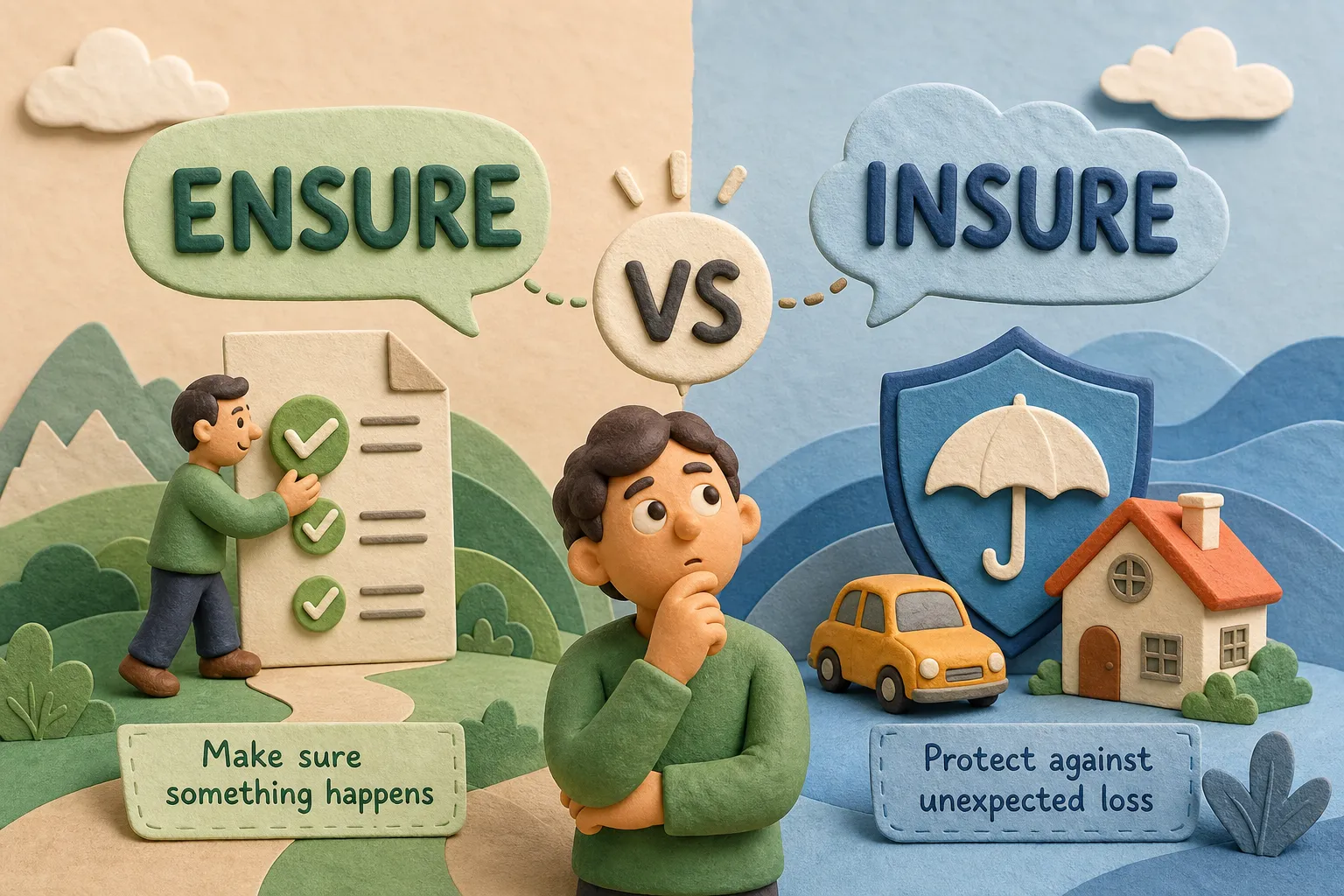
Ensure means “to make certain that something happens or is the case.” It’s your all-purpose word when you want to guarantee an outcome, whether you’re writing an email to your team or setting up a checklist before a big presentation. For an accessible explanation of the differences among these three verbs, see the Merriam‑Webster guide to insure, ensure, and assure.
Here it is in action. Casual: “I double-checked the form to ensure everything was filled in correctly.” Workplace: “The project manager created a review process to ensure quality across all deliverables.” Notice that neither sentence involves money, a policy, or an insurance company. That’s the first signal you need to use ensure.
Insure: protecting against financial loss
Insure belongs in a much more specific lane. It means arranging financial protection, whether that’s buying a policy, providing coverage, or underwriting risk for property, health, vehicles, or life. The moment money and coverage are involved, insure is the right word.
Two quick examples: “You are required to insure your vehicle before it can be registered in this state.” And: “The shipping company insured the package for its full replacement value.” Words like policy, coverage, premium, and claim naturally cluster around insure. If those words appear anywhere nearby, you’re almost certainly in insure territory.
Assure: removing a person’s doubt
Assure does something different from the other two. It’s about communication between people, telling someone something confidently to remove their worry or build their trust. The key detail is that assure almost always takes a person as its object.
Example: “I assure you the package will arrive by Friday.” You’re speaking directly to a person, removing their doubt. This is why assure gets tangled up with the other two: it sounds formal and confident, so learners sometimes reach for it when they really mean ensure. The object tells you everything. Person? Use assure. Outcome or event? Use ensure.
Ensure or insure, a quick-reference table to keep all three straight
Side-by-side comparison
| Word | Core meaning | Typical context | Example sentence |
|---|---|---|---|
| Ensure | Make certain | Any situation where you want to guarantee an outcome | “Please ensure the report is submitted by Friday.” |
| Insure | Provide financial protection | Insurance, coverage, financial risk | “We insured the equipment for its full replacement value.” |
| Assure | Relieve someone’s doubt | Direct communication with a person | “I assure you the package will arrive on time.” |
When you’re writing and aren’t sure which word to reach for, one quick mental test covers almost every situation: Is there a financial arrangement involved? Use insure. Are you reassuring a specific person? Use assure. Are you making sure an outcome happens? Use ensure.
A memory trick that makes the difference stick
For insure: the “in” at the start connects directly to insurance. If your sentence isn’t about an insurance policy or financial coverage, insure is almost certainly wrong. For assure: your object is always a person. If you’re reassuring a human being, assure is your word. Everything else? Default to ensure. It’s a simple three-way split, and once it clicks, you won’t hesitate again.
How these words appear in real sentences and professional writing
Ensure in professional emails and workplace instructions
Ensure is the dominant word in business writing because it signals accountability and action without implying anything financial. It shows up in project management, safety protocols, onboarding documents, and quality control language, practically everywhere professionals write.
Here are four realistic workplace examples:
- “Please ensure all team members have reviewed the updated guidelines before Monday’s meeting.”
- “The safety officer is responsible for ensuring that all equipment passes its annual inspection.”
- “Our onboarding checklist is designed to ensure new hires have everything they need on day one.”
- “We have added an extra review step to ensure consistency across the final report.”
Each of these sentences is about guaranteeing an outcome. No money, no policy, no person being reassured. That’s exactly where ensure belongs.
Insure in contracts, financial talk, and everyday situations
Outside the insurance industry, insure shows up less often in everyday writing, but when it does appear, the financial context is always present. Three examples:
- “You are required to insure your vehicle before it can be registered.” (legal/regulatory context)
- “The logistics company will insure the shipment against damage or loss in transit.” (business contract)
- “After the flood, many homeowners discovered their policies did not insure against water damage.” (insurance policy)
Notice that policy, coverage, vehicle, and damage or loss appear naturally alongside insure. If those words are in your sentence, you’re in the right territory.
Assure in conversations and confidence-building messages
Assure carries a warmer, more personal tone than ensure or insure. It’s about the relationship between people, not logistics or finance. A manager might use it with a nervous employee; a customer service rep might use it with a frustrated client.
- “I assure you that your concerns have been heard and will be addressed by end of week.” (manager to employee)
- “The technician assured the client that the repair would be completed before the weekend.” (professional reassurance)
- “The doctor assured the patient that the procedure was routine and carried minimal risk.” (trust-building communication)
Each sentence has a person on the receiving end, and that’s the defining feature of assure every time.
Common mistake patterns and why they happen
Why “insure” ends up in the wrong sentences
The most frequent error is writing insure where ensure belongs, especially in professional instructions and formal emails. It happens because insure sounds more official or serious to some learners, and the two words look almost identical on the page.
Here are three common errors with corrections:
- Wrong: “Please insure the files are backed up before shutdown.” Right: “Please ensure the files are backed up before shutdown.”
- Wrong: “We will insure that all deadlines are met.” Right: “We will ensure that all deadlines are met.”
- Wrong: “The checklist helps insure nothing is missed.” Right: “The checklist helps ensure nothing is missed.”
Mixing these up in a professional context genuinely confuses native-speaker readers, who may stop and wonder if a financial arrangement is being described. That’s the kind of distraction you want to avoid in a business email or formal document.
American vs. British English: a small but important difference
British and American English sometimes treat these words differently. British English keeps insure strictly for financial and insurance contexts and does not use it to mean “make sure.” American English has historically been more permissive, allowing some overlap, but even in American usage, ensure is the standard and preferred choice for non-financial meanings.
The practical takeaway: whatever your audience, defaulting to ensure for “make certain” is always acceptable and always clear. Using insure in a non-financial sentence is never universally correct, and in edited professional writing, it reads as an error.
What major style guides recommend
AP Stylebook and Chicago Manual of Style rules
The rule you’ve learned isn’t just common sense, it’s the standard that professional editors, journalists, and publishers follow every day. For a clear, practical rundown of the three verbs and how writers commonly confuse them, see the Grammarly guide on assure, ensure, and insure.
- AP Stylebook: use ensure to mean guarantee; reserve insure for references to financial insurance specifically.
- Chicago Manual of Style: same position, ensure for “make certain,” insure for underwriting financial risk.
- MLA and most academic writing guides: follow the same distinction.
This alignment across style guides matters. When you choose ensure over insure in a business email or a formal report, you’re writing the way professional editors would write it. In high-stakes writing, grant applications, cover letters, or legal correspondence, the wrong word introduces ambiguity and signals careless writing. Getting it right from the start removes that risk entirely.
Why following the style-guide rule protects your professional image
Imagine submitting a grant proposal that reads: “We will insure that all funds are allocated appropriately.” A reviewer may pause and wonder if a financial arrangement is being described instead of a commitment to careful management. One word creates confusion where none should exist.
Knowing the rule lets you write with authority on the first draft. You don’t need to second-guess yourself or rely on a spell-checker that won’t catch this error anyway. You know the rule, you apply it, and your writing communicates exactly what you mean.
Try it yourself: a quick practice check
Fill in the blank: choose the right word
Read each sentence and choose between ensure, insure, or assure. The answers are below.
- “The manager wanted to ______ the client that the project was on track.”
- “All contractors must ______ their equipment before arriving on-site.”
- “The team leader made a checklist to ______ nothing was missed.”
- “By law, you must ______ your car before driving it.”
- “Could you ______ that the meeting room is booked for Thursday?”
Answers:
- assure, the object is a person (the client), and the goal is to remove doubt.
- insure, equipment coverage is a financial/risk context.
- ensure, guaranteeing an outcome (nothing missed); not financial, not a person.
- insure, a legal insurance requirement for a vehicle.
- ensure, making certain a result happens; no person being reassured, no insurance involved.
Wrapping up
Here’s the core of everything you learned today: ensure means make certain, insure means financial protection, and assure means reassure a person. Run that three-way check every time, and you’ll get it right on the first try. Now that you know when to use ensure or insure, and when assure is the better fit, you can write with confidence in any professional setting.
Word pairs like this one come up constantly in professional and everyday American English. If you want to sharpen your feel for tricky vocabulary contrasts, Your Daily American covers dozens of them through practical, context-driven lessons built exactly for situations like this one, from “affect vs. effect” to “bring vs. take.” For related pronunciation and stress guidance, see our Word Stress in American English: A Complete Guide, Your Daily American.
You’ve got the rule, you’ve seen the examples, and you’ve tested yourself. The next time your cursor blinks at that blank, you’ll know exactly what to type.