Picture this: an American friend opens the door, sees you standing there, and says, “Better late than never!” You smile and nod, but on the inside, you are not completely sure what that meant. Was it a compliment? A small criticism? A joke? That moment of uncertainty is very common for English learners, and this lesson explains exactly what the phrase means and how to use it.
By the end of this article, you will know what “better late than never” means, where it comes from, how Americans use it every day, and when it sounds friendly versus when it signals quiet frustration. This phrase illustrates how tone and indirectness can change meaning in American English, sometimes dramatically.
Phrases like this one are everywhere in daily American life. At Your Daily American, our focus is on teaching the idioms (fixed expressions whose meanings you cannot guess from the individual words alone) and cultural patterns that make English sound natural, not just correct. This is one of those phrases you genuinely need to know.
What “better late than never” actually means
The core idea in plain English
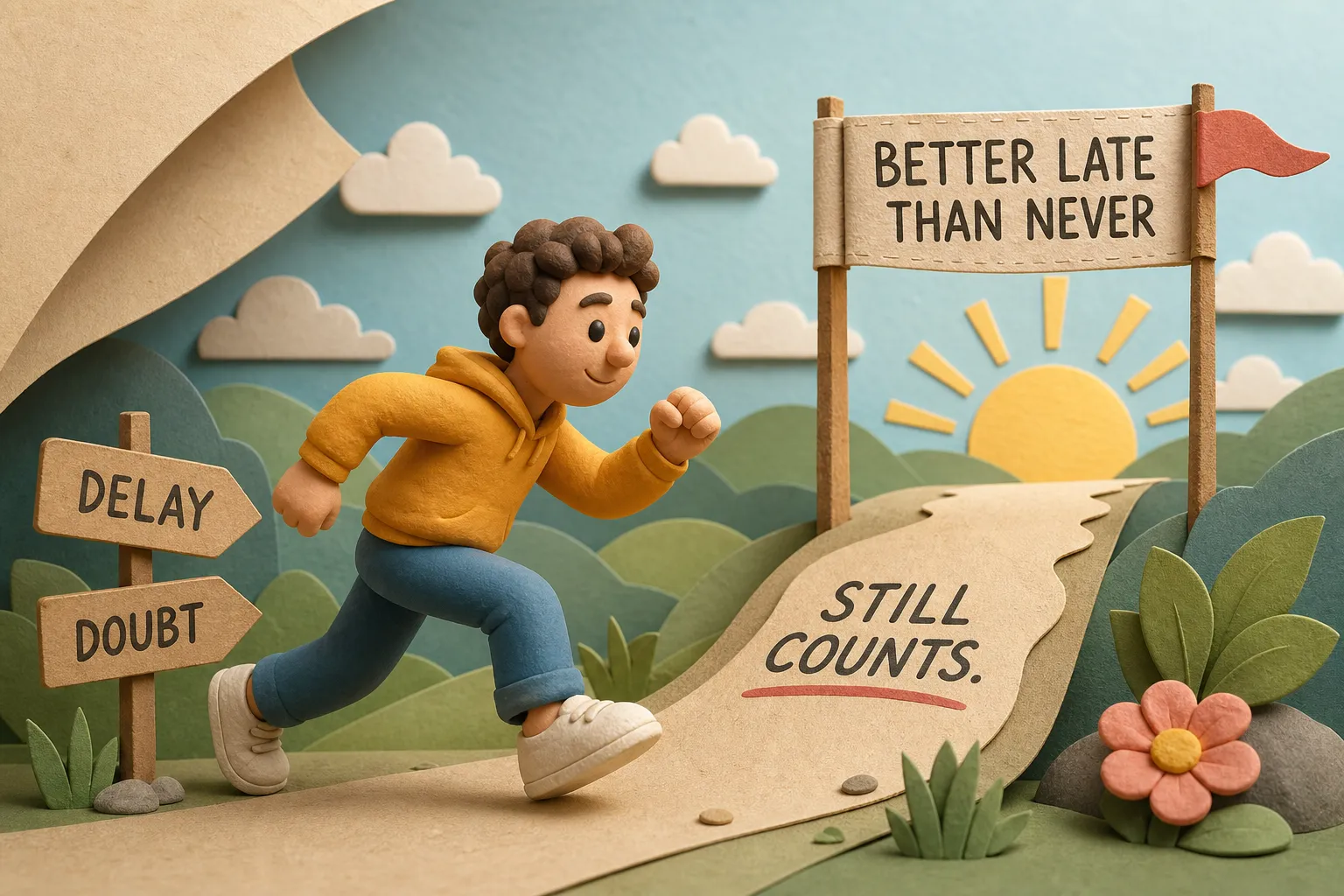
The phrase means: doing something late is still better than not doing it at all. Americans use it to accept a delay, forgive someone for being late, or celebrate finally doing something after a long wait. Here is a simple example: “I finally called my grandmother after forgetting for two weeks. Better late than never.”
This phrase is about second chances and moving forward. It focuses on the action that happened, not on the delay, saying, in effect: you did it, and that is what counts. Rather than excusing the delay, it redirects attention toward the positive outcome.
The two ways it is used: sincere and sarcastic
“Better late than never” can mean two opposite things depending on how it is said. When someone says it with a warm tone, it is encouraging and forgiving. When someone says it with a flat or dry tone, it signals the opposite: “You really should have done this much sooner.”
Notably, the same four words can show kindness or frustration, and the distinction is almost entirely in delivery. A full explanation of the sarcastic use comes in section five, but keep this in mind as you read through the lesson.
Where this phrase originally comes from
The ancient roots of the phrase
“Better late than never” is a proverb, a short, common saying that expresses a general truth. It is attested in English as early as the 14th century: Geoffrey Chaucer used a close version in his Canterbury Tales (specifically the Canon’s Yeoman’s Tale), writing: “for bet than never is late.” Scholars and etymologists point to this passage as one of the earliest documented appearances of the idea in English.
The concept is older still. The Roman historian Livy recorded a very similar thought in Latin, potius sero quam nunquam, meaning “rather late than never”, placing the core idea well over 2,000 years ago. The fact that both ancient and medieval writers arrived at the same sentiment independently suggests how fundamentally human it is to value a late effort over none at all. For a concise modern treatment of the idiom’s meaning and usage, see Grammarist’s idiom article on “better late than never”.
How it became part of everyday American conversation
Proverbs travel through generations by repetition. People hear them, use them, and pass them on. Over time, “better late than never” became so common in American English that most speakers reach for it without thinking about its history. It stopped being a formal saying and became natural, everyday speech.
Today the phrase turns up in casual conversation and in professional emails alike. Its familiarity is exactly what makes it useful to learn. Once you recognize it, you will start noticing it in American movies, podcasts, and everyday exchanges around you. If you want to see some of the well-known quotations and uses of this proverb, you can explore a short collection of famous quotations of “better late than never”.
The everyday situations where Americans say “better late than never” most
Personal and social life
The most natural social uses happen around delays and second chances. A host says it warmly when a guest shows up 45 minutes late to a birthday party. A friend says it with genuine encouragement when someone finally starts going to the gym after talking about it for years. A person sends a long-overdue apology, and the other person replies with it.
In all these cases, the phrase signals acceptance and goodwill. The speaker chooses to focus on the positive: the person showed up, the action happened, the relationship moves forward. There is no dwelling on the delay.
Using “better late than never” at work and in learning
In professional settings, the phrase is commonly used in written communication such as email. A manager might reply to a delayed report with “Thanks, better late than never!” That usually reads as supportive, though it may carry a light reminder that the delay was noticed. Spoken aloud in a tense meeting, however, the same words can land very differently.
For language learners, the proverb fits naturally when someone finally starts something they put off for a long time. An adult who waited years to begin an English course tells a friend. The friend responds: “Better late than never!” It is a warm, genuine celebration of starting, even if the start came late.
For more workplace-focused language guidance and examples, check our Professional English, Your Daily American resources which include common phrases and email language used in U.S. workplaces.
Real dialogues: the phrase in action
Dialogue 1: Arriving late to a party
Marco: “I’m so sorry I’m late. Traffic was terrible.”
Lisa: “Better late than never! Come in, come in.”
Marco: “I feel bad. Has everyone already eaten?”
Lisa: “We saved you a plate. Get in here!”
Lisa’s response signals that there are no hard feelings. The focus is on the fact that Marco arrived at all. The phrase creates a welcoming moment and moves the conversation forward without awkwardness or tension.
Dialogue 2: Finally picking up a new skill
Priya: “Guess what? I finally signed up for a Spanish class. I’ve been saying I would for three years.”
Jake: “No way! Better late than never, right? That’s awesome.”
Priya: “I know. But I’m doing it now.”
This use is purely positive. Jake is not making fun of Priya’s three-year delay, he is celebrating that she started. The word “right?” at the end invites Priya to agree, which makes the whole exchange feel supportive and easy.
Dialogue 3: The text message version
Carlos: “Hey! I just realized I totally forgot your birthday last month. Happy belated birthday!! I’m so sorry 😬”
Aisha: “Haha better late than never!! Thank you 🎂”
Notice the exclamation points and the emoji. In text messages, visual cues carry the tone that voice would carry in person. Aisha’s response is clearly warm and forgiving, the punctuation and emoji do real work here. Without those signals, the exact same words could read as cold or passive-aggressive. Pay attention to these details when reading written American English.
When it sounds sarcastic: how tone changes everything
The same words, a completely different meaning
Imagine a manager who has been waiting four hours for a file. When the employee finally sends it, the manager walks over and says, slowly: “Better… late… than never.” That is not a compliment. The slow pace, the pauses, and the flat tone all signal frustration. The words say one thing; the delivery says something else entirely.
The same dynamic plays out when a friend waits alone at a restaurant for 30 minutes. When you finally arrive, they look up from their phone and say, “Better late than never,” with no smile. You know immediately they are not pleased. This is one of the most common ways Americans express frustration without stating it directly.
How to read the situation correctly
There are clear signals to look for. A sincere use sounds warm and quick, often with a smile or a wave. A sarcastic use sounds slower, flatter, and usually follows visible frustration. Pay attention to the speaker’s face and voice, not just their words. In American English, tone carries as much meaning as vocabulary.
The best way to build this skill is to listen for the phrase in American movies, TV shows, and real conversations. When you hear it, ask yourself: does the speaker sound relieved and warm, or slow and dry? That active listening practice helps you recognize the difference much faster than studying rules on paper.
How to keep learning American idioms like this one
Why idioms deserve their own attention
Idioms are different from grammar rules. You cannot figure out what “better late than never” means by looking at each word separately. Idioms must be learned in context, with real examples and real situations. That is why studying them on a platform built specifically for this purpose makes such a practical difference. See our 75 American English Phrases for ESL Beginners for a set of practical, everyday expressions you can practice right away.
At Your Daily American, idioms and everyday expressions are a central part of what we teach, alongside pronunciation, workplace English, and study methods. The goal is always the same: to help you use American English naturally, not just correctly. If this lesson gave you a clearer picture of how Americans really talk, there is much more waiting for you there.
A simple practice step to try right now
Write two sentences using the phrase: one sincere and one sarcastic. Choose situations from your own life. Your sincere sentence might describe finally starting a project you delayed for months. Your sarcastic one might describe waiting a long time for something that should have arrived sooner.
Then, this week, watch one episode of an American TV show or a short video and listen for the proverb. When you hear it, ask yourself: is the speaker warm or flat? Smiling or serious? That kind of focused listening strengthens your ability to understand real spoken American English far faster than reviewing word lists alone. For a short, learner-friendly audio explanation of this expression, check out an All Ears English lesson on the slang “better late than never”.
Quick review: what you learned about “better late than never”
Here is what this lesson covered: the phrase means doing something late is better than not doing it at all. It traces back to at least the 14th century in English, with even older Latin roots. Americans use it in social and professional settings alike. It can be sincere or sarcastic, and the difference comes primarily from tone and context. You saw it in three realistic dialogues, and you have a clear practice step to use right now.
Learning one phrase like this teaches you something larger. It shows you how Americans use language to forgive, to encourage, or to signal frustration, sometimes all with the same four words. That kind of understanding is what makes real conversations feel natural and comfortable.
If you have been putting off working on your English, well, you already know exactly what to say about that. Visit About, Your Daily American to explore more idiom lessons and everyday American expressions. Each one you learn brings you one step closer to the natural, confident English you are working toward.