Consider these two sentences: “Let’s eat, Grandma” and “Let’s eat Grandma.” The first is an invitation to a meal. The second is something far more alarming. One comma changes everything.
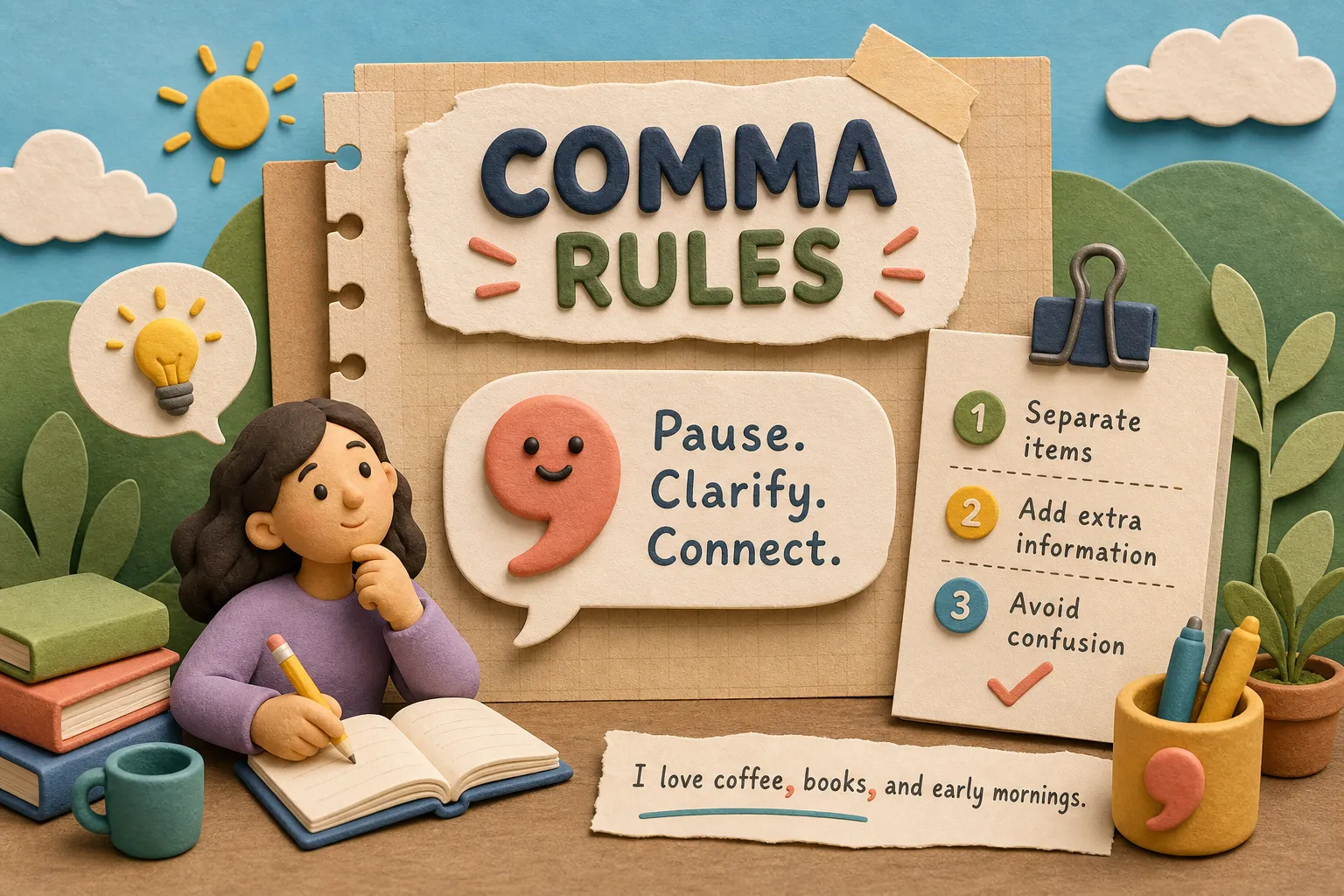
By the end of this article, you’ll understand the rules about using commas in American English and know exactly when to add one and when to leave it out. You’ll learn the five most important comma rules, each explained with real examples you can use right away. Grammar rules are easiest to understand when you see them in real sentences. That’s the approach at Your Daily American: rules taught in context, not as abstract items to memorize.
This guide covers commas in lists, commas after introductory elements, commas before coordinating conjunctions, commas with nonrestrictive clauses and appositives, and the most common comma mistakes. Work through each section in order, and you’ll have a clear, reliable system for comma placement in American English.
Rules About Using Commas: Why Placement Changes Your Meaning
How one comma shifts meaning
Look at these two sentences about the same person. My sister who lives in Boston is a doctor. My sister, who lives in Boston, is a doctor. In the first sentence, the phrase “who lives in Boston” tells the reader which sister you mean, implying you have more than one. In the second sentence, the commas show that “who lives in Boston” is just extra detail. You have one sister, and the reader already knows who she is.
The same shift happens in everyday contexts: emails to a manager, cover letters, messages to clients. Correct comma placement is not a minor detail. It tells the reader exactly what you mean and prevents your sentences from being read the wrong way.
How American style guides approach commas
Most American style guides, including the Chicago Manual of Style, the APA Publication Manual, and the MLA Handbook, agree on the core comma rules. The main area where they differ is the serial comma, also called the Oxford comma, which is covered in the next section. While style differences on a few points (notably the serial comma and some comma-omission preferences for short introductory phrases) still exist and matter depending on your audience or house style, one consistent set of rules covers almost every situation you’ll face in professional and academic writing.
The Serial Comma: How to Punctuate Lists
What the serial comma is
The serial comma is the comma placed before the final “and” or “or” in a list of three or more items. Without it: I want to thank my parents, the director and the coach. This sounds like your parents are the director and the coach. With it: I want to thank my parents, the director, and the coach. Now three separate people are clearly listed. The serial comma removes the ambiguity.
Rules About Using Commas in Lists: What American Style Says
The Chicago Manual of Style, the APA Publication Manual, and the MLA Handbook all recommend using the serial comma. The AP Stylebook generally leaves it out in simple lists but adds it when omitting it would create confusion. For ESL learners writing in American English, the safest choice is to use the serial comma consistently. The serial comma matches the style used in many American academic and book publishers’ guidelines and professional documents, and it almost never creates confusion. For a quick explanation of why some writers call it the Oxford comma, see this short guide to the Oxford comma.
ESL learners and list commas: a common error
Two errors come up often in ESL writing. The first is dropping all commas in a list because the learner’s first language does not use a comma before “and.” For example: I like coffee tea and juice. The correct version is: I like coffee, tea, and juice. The second error is adding a comma between only two items: I like coffee, and tea. No comma is needed there. Only use list commas when you have three or more items.
Commas After Introductory Elements
Introductory clauses
An introductory clause is a group of words that comes before the main sentence. It usually starts with a word like because, when, if, although, or after. These are often adverbial clauses, and you should add a comma after them to separate them from the main clause. For example: When the meeting ended, I sent a follow-up email. And: Because the report was late, my manager called me. The comma tells the reader where the introduction ends and the main action begins. For more detailed guidance on comma rules, see Purdue OWL’s extended rules for commas.
Introductory phrases and single words
Transition words like however, first, and finally take a comma after them when they open a sentence. Participial phrases do as well: After finishing the presentation, we answered questions. Short introductory prepositional phrases are a little more flexible, in formal American writing, a very short prepositional phrase may omit the comma, though adding one is rarely wrong. When you are not sure, use the comma. It is almost always acceptable, and it keeps your meaning clear.
Why this rule trips up ESL learners
In many languages, a subordinate clause before the main clause does not need a comma. This leads learners to write: When I arrived at the office I checked my email. The correct version is: When I arrived at the office, I checked my email. A practical heuristic: if you naturally pause after reading the opening phrase before the main action, that pause usually signals a comma. Keep in mind that speaking pauses do not always map perfectly to punctuation, especially with short prepositional phrases, but for introductory clauses and longer phrases, your speaking instinct and your writing should generally match.
Commas Before Coordinating Conjunctions
The independent clause test
The coordinating conjunctions are and, but, so, or, yet, for, and nor. Use a comma before one of them only when both sides of the sentence are complete sentences that could stand alone. If the second part is not a full sentence, no comma is needed. This is the most important concept in this section, and it applies to nearly every sentence you write that contains these words.
Example sentences showing the difference
When both sides are complete sentences, the comma is required: I finished the report, and I submitted it to my manager. Each half works independently. When the second part has no subject and cannot stand alone, the comma is not needed: I finished the report and submitted it to my manager. The same logic applies to but: She wanted to attend the meeting, but she had another call needs a comma. She wanted to attend but couldn’t does not.
A quick self-check for learners
Cover the first half of the sentence with your hand. Read only the second half. Does it have a subject and a verb? Can it stand alone as a complete sentence? If yes, add the comma before the conjunction. If no, leave it out. This fast check works reliably for most sentences you write and takes only a moment to run.
See our guide to compound sentences for more examples that illustrate when two clauses form a compound sentence and therefore need a comma before the conjunction.
Now that you know when a conjunction needs a comma, the next section looks at a related concept: how commas work with clauses and phrases that add extra information to a noun.
Commas With Nonrestrictive Clauses and Appositives
Essential vs. nonessential: the removal test
Some clauses are essential. They identify which person or thing you mean. Remove them, and the sentence refers to a different or unknown person. These are called restrictive clauses, and they do not take commas. Other clauses are nonessential. They add extra detail, but the noun is already identified without them. These are called nonrestrictive clauses, and they need commas on both sides.
Compare: The employee who filed the complaint was transferred (no commas, restrictive: tells you which employee). And: Maria, who filed the complaint, was transferred (commas, nonrestrictive: Maria is already identified; the clause adds detail). Remove the clause from the second sentence, and it still clearly refers to Maria.
“That” vs. “which” as a guide
In standard American usage, that typically introduces a restrictive clause and which typically introduces a nonrestrictive clause, a distinction recommended by the Chicago Manual of Style and the APA Publication Manual. This is a reliable shortcut for you as an ESL writer. The laptop that I ordered arrived today has no commas because “that I ordered” tells you which laptop. My laptop, which I ordered last week, arrived today uses commas because the laptop is already clear from context. As a general rule: when you use “which,” add commas; when you use “that,” leave them out. Note that some style authorities accept “which” in restrictive clauses, but in American academic and professional writing, following the that/which distinction is the safest approach.
Appositives with commas
An appositive is a noun phrase placed next to a noun to rename or describe it. A nonessential appositive needs commas: Dr. Reyes, our team’s physician, reviewed the results. An essential appositive, one that identifies the noun, does not need commas: My colleague Dr. Reyes reviewed the results. This pattern comes up frequently in professional writing when you mention someone’s name and title together.
Common Comma Mistakes and How to Correct Them
The comma splice: what it is and how to fix it
A comma splice happens when two complete sentences are joined with only a comma and no conjunction. It is one of the most common errors in ESL writing. Here is an example: I finished my essay, I submitted it. Both halves are complete sentences, so a comma alone is not enough. You have four clean ways to fix it:
- Period: I finished my essay. I submitted it.
- Semicolon: I finished my essay; I submitted it.
- Coordinating conjunction: I finished my essay, so I submitted it.
- Dependent clause: After I finished my essay, I submitted it.
All four versions are correct. Choose the one that fits the tone of your writing. The period is the simplest fix. The dependent clause version often sounds the most natural in spoken American English.
Missing commas and overcorrecting
Two opposite errors are both common. The first is leaving out the comma after an introductory phrase: After the meeting we reviewed the notes. Add the comma: After the meeting, we reviewed the notes. The second is adding a comma where none belongs, especially between a subject and its verb: The manager, approved the budget. Remove it: The manager approved the budget. As a general rule, a comma should not separate a subject from its verb. (Parenthetical phrases that fall between subject and verb are a deliberate stylistic exception, but in standard writing, keeping the subject and verb connected is the right call.)
Using a cheat sheet to self-edit
A one-page comma reference works best as a revision tool. After you finish writing, read your draft one time looking only at commas. Check each one against the five rules you’ve learned here. This focused pass catches most errors in just a few minutes. Learning grammar through real examples, the way it’s practiced at Your Daily American, turns these rules into automatic habits over time. The goal is not just to know the rules. It’s to use them without thinking about them.
Putting It All Together
You’ve now covered the five core rules: the serial comma in lists, commas after introductory elements, commas before coordinating conjunctions when both sides are complete sentences, commas with nonrestrictive clauses and appositives, and how to fix comma splices. Each rule has one clear purpose: to signal structure and meaning to the reader.
This week, pick one rule and look for it in something you read or write every day. You might check a news article for the serial comma, review your own emails for introductory phrases, or compare date formats as you read. Small, focused practice like this builds the awareness that makes correct comma usage feel natural over time.
Understanding the rules about using commas is not about passing a grammar test. It’s about writing clearly so your reader understands exactly what you mean. Practice these rules about using commas and you’ll find that the comma becomes a tool you control, not a detail you guess at.