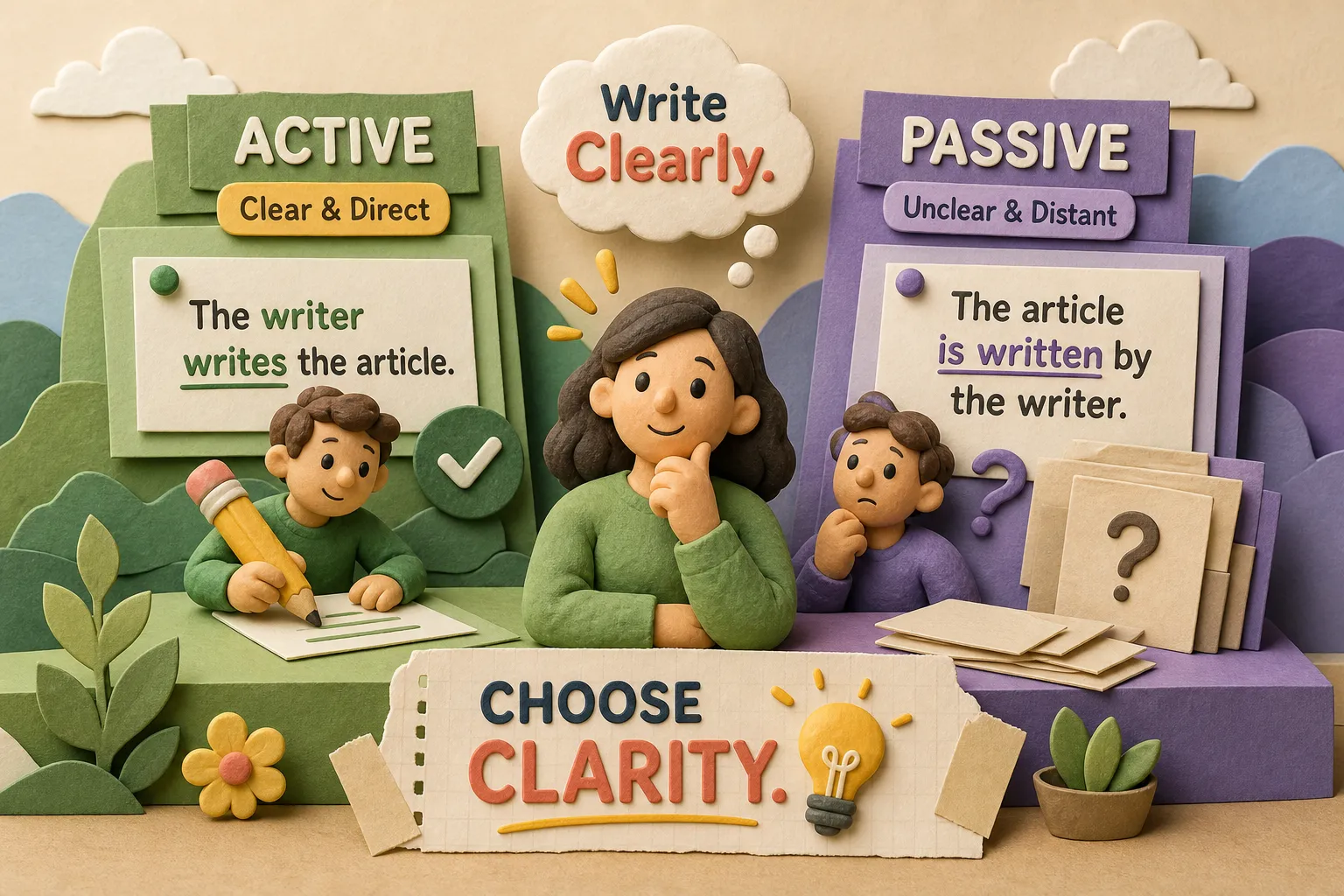
You write an email at work. You proofread it. The grammar looks correct. But something feels slow, unclear, or too indirect, and you don’t know why. Choosing active vs. passive structures is often the culprit. This is a common problem intermediate ESL learners face in professional writing, and the fix usually comes down to one grammar decision: using passive voice when active voice would be clearer and stronger.
This is one of the most practical grammar lessons you can study, because it directly affects how people read your emails, reports, and messages every day. After working through this, you’ll be able to spot active and passive voice on sight, choose between them deliberately, and rewrite any passive sentence in seconds. This lesson is part of Your Daily American’s grammar and professional English track, built to help you use grammar in real workplace situations, not just pass a test.
What active and passive voice actually mean
The subject does vs. receives the action
In active voice, the subject performs the action. The sentence follows a clear pattern: subject + verb + object. Look at these two examples: “The manager sent the email.” “The children ate the cookies.” In both sentences, the subject (the manager, the children) does the action.
In passive voice, the subject receives the action instead. The doer moves to the end of the sentence or disappears completely. The same two sentences become: “The email was sent by the manager.” “The cookies were eaten.” Notice how the second example removes the doer entirely, the reader has no idea who ate the cookies.
Why this difference changes how readers feel
The structure you choose affects more than grammar. Active voice is shorter and easier to follow because the reader knows immediately who did something. Passive voice makes the reader work harder to find the actor. In professional American English, that extra effort matters: unclear writing slows people down and can make you sound less confident.
Compare these two versions of the same workplace email line. Passive: “The deadline has been moved to Friday by the project lead.” Active: “The project lead moved the deadline to Friday.” The active version is three words shorter and easier to read at a glance. That difference adds up across an entire email or report.
Active vs. passive: how to recognize each one quickly
The be + past participle pattern
The main grammar signal for passive voice is a form of “to be” followed by a past participle (a verb usually ending in -ed, or an irregular form). The forms of “to be” to watch for are: am, is, are, was, were, been, being. Here are three workplace examples of this pattern:
- “The report was submitted on time.” (was + submitted)
- “A decision has been made.” (has been + made)
- “The files were deleted.” (were + deleted)
In each example, the actor either comes after the word “by” or is missing completely. When you see a be-verb followed by a past participle, ask: who is doing this action? If the sentence doesn’t clearly answer that question, it is almost certainly a passive construction. For a concise reference on the active vs. passive distinction, see active vs. passive voice.
A quick test to confirm the voice in grammar
Try the “by zombies” test, a popular rule of thumb among writing instructors. Add the words “by zombies” to the end of your sentence. If it still makes grammatical sense, it is passive. If it sounds wrong, it is active. Keep in mind this is a rough heuristic, not a foolproof rule, so use it alongside the be + past participle check.
“The report was submitted by zombies.” That works, passive confirmed. “The manager wrote the report by zombies.” That doesn’t work, active confirmed. One important note: a be-verb alone does not always signal passive voice in grammar. “She is happy” uses the word “is,” but it is not passive; there is no past participle following it. The pattern you need is always be-verb + past participle together. For more examples and explanations of active and passive constructions, see the active and passive voice guide from the Montana State University Writing Center.
When passive voice is the right choice in professional writing
Situations where passive works better
Passive voice is not always wrong. There are clear situations where it is the correct choice. Use it when the doer is unknown: “The window was broken overnight.” You don’t know who broke it, so there is no subject to put first. Use it when the doer is unimportant: “The data was collected over six months.” The focus here is on the data and the timeline, not on who collected it.
Passive voice also works well when the result matters more than the person who produced it. This is common in formal documents and scientific reports: “The vaccine was tested across three countries.” In that sentence, the testing process and its scope are what matter. Many business reports follow this pattern when describing processes, findings, or outcomes. Recognizing these situations helps you use the passive construction on purpose, not by accident.
What American style guides recommend
APA, Chicago, and MLA all prefer active voice for clarity, but all three allow passive voice when it serves a clear purpose. In everyday American professional writing, emails, meeting summaries, project updates, active voice is almost always the stronger choice for most business communications and routine correspondence. For official guidance on when to use active vs. passive voice, consult the APA guidance on active and passive voice.
One common misunderstanding is that passive voice sounds “more formal.” It doesn’t. It just sounds different. More importantly, it can sound vague or indirect, especially in American workplace culture, where clear and direct communication is valued. The key question is always: does the reader need to know who did this? If yes, lean on active voice. This pattern shows up frequently in emails; to avoid common tone and form mistakes in workplace messages, review resources like 8 common faux pas in English business emails.
How to convert passive to active: a four-step method
The rewriting process
You can convert almost any passive sentence to active voice with four steps. Work through them in order, and the process becomes second nature faster than you might expect, most sentences only need one or two small changes once you know where to look.
- Find the doer. Look for a “by…” phrase. If there isn’t one, ask yourself: who did this action?
- Make the doer the subject. Move that person or thing to the front of the sentence.
- Change the verb. Remove the passive construction (be + past participle) and use an active verb instead.
- Place the object after the verb. The thing that received the action goes after the verb.
Before-and-after sentence pairs
Here are four examples from professional and everyday contexts. Study the pattern in each one.
| Passive voice | Active voice |
|---|---|
| The letter was written by the manager. | The manager wrote the letter. |
| The report was completed by the team. | The team completed the report. |
| Mistakes were made. | The team made several mistakes. (You must add a subject.) |
| Your request has been received. | We received your request. |
Notice the third example. “Mistakes were made” has no doer at all. To make it active, you have to add a subject. This is actually a useful editing moment: if you can’t name who did something, ask yourself whether the reader needs that information. If they do, the sentence needs a subject, not just a grammar fix.
Common mistakes ESL learners make with voice
Using passive to sound more formal or polite
This is the most common error. Many ESL learners believe passive voice sounds more professional or academic in American writing. In most cases, the opposite is true. Active voice sounds more direct, confident, and clear. Compare these two sentences from a workplace email. Passive: “It is recommended that the proposal be reviewed before the meeting.” Active: “We recommend you review the proposal before the meeting.” The second version is shorter, warmer, and more natural in an American professional context.
This pattern shows up frequently in emails. Many ESL writers shift to passive without realizing it weakens their message. “The issue was looked into by our team” sounds vague. “Our team looked into the issue” sounds clear and accountable. When writing to a colleague or client in American English, direct language builds trust. Passive voice can make you seem less certain, even when that’s not your intent.
How to build this skill with real practice
The best way to improve is to practice with real writing, not grammar worksheets. Take one email or message you wrote this week and find two sentences that use passive voice. Rewrite each one using the four-step method above. Then read both versions out loud, you will hear the difference immediately. For practical guidance on composing workplace messages, see How to Write a Professional Email in American English, Your Daily American.
Your Daily American’s grammar and professional English sections teach these voice distinctions through real workplace scenarios: emails, meeting summaries, reports, and written requests. The lessons are built around how American English is actually used at work, so you can apply what you learn right away. If you want to keep building this skill in context, start with our 12 English verb tenses guide to reinforce your verb choices.
Active vs. passive: what to do right now
Pull up one email or message you wrote this week. Look for two passive sentences using the be + past participle pattern, then rewrite each one as active using the four-step method. Check which version is clearer and shorter, you’ll often find the active version reads better. That single habit, practiced consistently, is what moves your writing from technically correct to genuinely clear.
The core ideas to hold onto: active voice means the subject does the action; passive voice means the subject receives it. Passive is appropriate when the doer is unknown, unimportant, or when the result matters more than the actor. And any passive sentence can be rewritten by finding the doer, making it the subject, fixing the verb, and placing the object after it.
When you’re ready to keep going, visit Daily Grammar, Your Daily American and the site’s professional writing lessons. You’ll find more lessons built around real American workplace English, the kind that helps you write with confidence, not just follow rules.