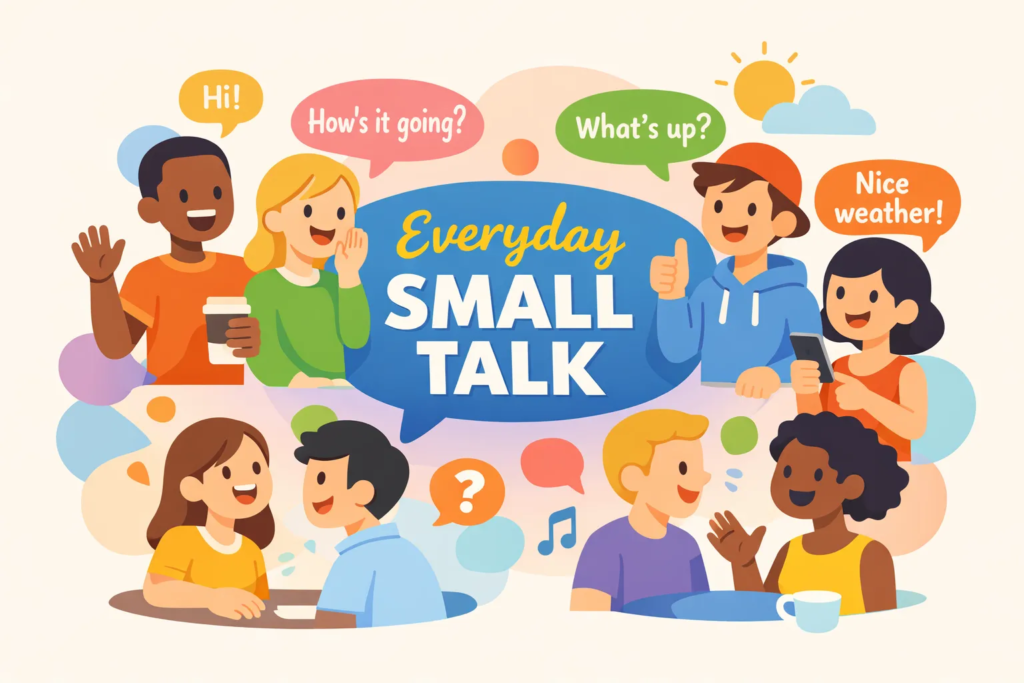
Picture this: your American coworker turns to you and says, “You’ve been to New York before, right?” You know the answer. You know the word “yes.” But something stops you, and you say just “Yes”, and the conversation goes quiet. It felt awkward, and you weren’t sure why. This is exactly where short answers make all the difference.
The problem isn’t your vocabulary. It isn’t confidence. The problem is a small grammar pattern that native speakers use automatically, dozens of times every day. Once you learn these short reply patterns, your English starts to sound much more natural.
In this lesson, you will learn exactly how to form yes/no short answers, how to respond to tag questions (like “right?” and “isn’t it?”), and how to use concise answers that feel warm and real. At Your Daily American, we connect grammar rules to real spoken American English, and this is a perfect example of how a small pattern makes a big difference.
What short answers are and why “yes” alone isn’t enough
A short answer is a brief reply that includes the subject and an auxiliary verb (a helping verb like do, is, can, have). It is not a full sentence, and it is not just one word. Short answers sit right in the middle: short enough to feel natural, long enough to sound complete. That said, a single “Yes” or “No” can work fine in very casual or quick exchanges, but in most everyday conversations, the fuller short-answer form is more natural and expected.
In many contexts, especially with acquaintances or in professional settings, a single-word answer can sound curt, even when you mean to be polite. Fuller short replies simply feel more natural. Compare these two responses:
- “Do you live near here?” → “Yes.” (can sound flat or abrupt)
- “Do you live near here?” → “Yes, I do.” (sounds natural and friendly)
The difference is small, but the effect is real. Short answers are common across many spoken contexts: casual conversations with friends, quick exchanges with coworkers, small talk at a store, and check-ins during a meeting. Once you recognize the pattern, you will notice it everywhere.
Yes/no short answers: the grammar rule that makes them work
The rule is simple: a short answer repeats the auxiliary verb from the question. It does not repeat the main verb. The structure is: Yes/No + subject + auxiliary (+ not).
Here are the most common types with example dialogues:
With “be” (am/is/are)
“Are you ready?” → “Yes, I am.” / “No, I’m not.”
With “do/does/did”
“Do they know yet?” → “Yes, they do.” / “No, they don’t.” “Did she call?” → “Yes, she did.” / “No, she didn’t.”
With modal verbs (can, will, should)
“Can she help?” → “Yes, she can.” / “No, she can’t.” “Will you be there?” → “Yes, I will.” / “No, I won’t.”
With “have/has”
“Have you met him?” → “Yes, I have.” / “No, I haven’t.”
A note on contractions: in informal American speech, negative short answers commonly use contractions, “No, I’m not” rather than “No, I am not.” The full uncontracted form is also used in more formal contexts or for emphasis, but in everyday conversation the contracted version is the natural, expected choice. The same applies to “No, she isn’t,” “No, they don’t,” and so on. Get comfortable with these contracted forms. They are standard in casual spoken American English.
For a focused guide to forming yes/no questions and their short replies, see Duolingo’s guide to yes/no questions.
Tag questions and how to respond to them naturally
A tag question is a short question added to the end of a statement. Native speakers use them to confirm information, invite agreement, or keep the conversation going. Tag questions and brief reply forms are common in informal spoken American English.
Common examples:
- “It’s hot today, isn’t it?”
- “You’re from Brazil, right?”
- “She didn’t call back, did she?”
- “You’ve worked here a long time, haven’t you?”
Notice that Americans often use “right?” as a casual discourse tag, it is especially common in informal speech and works across a wide range of everyday situations.
To answer a tag question, use the same auxiliary verb rule. Answer based on the facts, not the grammar of the tag:
- “You’ve been here before, haven’t you?” → “Yes, I have.” / “No, I haven’t.”
- “She’s not coming, is she?” → “No, she isn’t.” / “Actually, yes, she is.”
Here are two quick real-life short-answer examples:
At the office break room: Coworker: “The meeting got moved to Friday, right?” You: “Yes, it did. Two o’clock, I think.”
At the store: Cashier: “You have a rewards card, don’t you?” You: “No, I don’t. Can I sign up now?”
For more on tag structures and how they change meaning, check Duolingo’s explanation of tag questions.
Short replies that show agreement, disagreement, and interest
Short answers aren’t only for yes/no questions. Native speakers also use brief reply forms to agree, disagree, and show they are listening. Two of the most useful are “so do I” and “neither do I.”
Use so + auxiliary + subject to agree with a positive statement:
- “I love this coffee.” → “So do I.”
- “I’m really tired today.” → “So am I.”
- “I’ve seen that movie.” → “So have I.”
Use neither + auxiliary + subject to agree with a negative statement:
- “I don’t like working late.” → “Neither do I.”
- “I’m not ready yet.” → “Neither am I.”
- “I haven’t tried that restaurant.” → “Neither have I.”
In informal American speech, “Me too” and “Me neither” are very common and completely natural. The “so do I” / “neither do I” forms sound slightly more polished and are especially useful when you want to match the tense exactly.
For a compact reference on so/too/neither/either usage, see this reference from Perfect English Grammar.
Another important pattern is the echo question. Echo questions are short reactions that signal surprise or genuine interest, they show the other person you are engaged in the conversation:
- “I got the job!” → “Did you? That’s amazing!”
- “She’s moving to Chicago.” → “Is she? When?”
- “They closed that restaurant.” → “Did they? That’s too bad.”
A rising intonation commonly signals interest or surprise in echo questions, though the exact meaning can shift depending on context and tone. Practice these with a slight upward lift in your voice and they will start to feel natural quickly.
Short answers in real American conversations
Seeing these short-response examples in real dialogues is what makes the patterns stick. Here are three short conversations that show them working together.
At a coffee shop: Barista: “You come in every morning, don’t you?” Customer: “Yes, I do. I can’t start the day without coffee.”. Barista: “Me neither, honestly.”
At work: Colleague: “Have you sent the report to the client?” You: “Yes, I have. I sent it this morning.” Colleague: “Oh, did you? Great, thanks.”
With a neighbor: Neighbor: “It’s been really cold this week, hasn’t it?” You: “Yes, it has. Way colder than last week.” Neighbor: “You’re not from here originally, are you?” You: “No, I’m not. I moved here two years ago.”
Notice how each exchange flows. Each brief reply picks up the auxiliary from the question, keeps the response concise, and opens the door for more conversation. This is exactly the skill that Your Daily American focuses on: connecting grammar rules to the real, spoken exchanges you face every day.
Common mistakes and how to fix them fast
Most ESL learners make the same small errors with short answers. Here are the most common ones, with corrections.
Using the main verb instead of the auxiliary: ❌ “Do you like it?” → “Yes, I like.” ✓ “Do you like it?” → “Yes, I do.”
The main verb (“like”) is not repeated. Only the auxiliary (“do”) carries the answer. Keep that in mind whenever you are unsure which word to use.
Adding unnecessary words: ❌ “Can he drive?” → “Yes, he can drive.” ✓ “Can he drive?” → “Yes, he can.”
The short answer does its job in three words. Adding the main verb again is grammatically possible, but it sounds awkward and unnatural in most contexts.
Using only “yes” or “no” in full conversations: One-word answers are not always wrong. In very casual or quick exchanges, they can work fine. But in most American conversations, especially with coworkers, teachers, or people you are meeting for the first time, a full short answer sounds much warmer and more natural. “Yes, I do” instead of just “Yes” takes less than a second to say, and it changes the whole tone.
Forgetting the negative contraction: ❌ “No, I am not.” ✓ “No, I’m not.”
The contracted form is the natural American choice in everyday speech. “No, I am not” or “No, she is not” are grammatically correct and appropriate in formal contexts, but they can sound overly stiff in casual conversation. Practice “I’m not,” “she isn’t,” “they don’t,” and “he can’t” until they feel automatic.
If you’d like a quick checklist to target frequent errors, this list of common ESL mistakes is useful to review as you practice.
Short answer tips to carry with you
Before you go, here are a few quick short answer tips to keep in mind as you practice:
- Always echo the auxiliary from the question, never repeat the main verb.
- Use contractions in negative short replies for informal speech (“I’m not,” not “I am not”).
- Try echo questions (“Did you? Is she?”) to show you are listening and engaged.
- Use “so do I” / “neither do I” when you want to sound a bit more polished than “me too.”
- In formal contexts, the full uncontracted form is perfectly fine, match your register to the situation.
You’re ready to use short answers today
Go back to the opening question: “You’ve been to New York before, right?” Now you know exactly what to say. If you have, say: “Yes, I have.” If you haven’t, say: “No, I haven’t.” Two short words after “yes” or “no”, and suddenly the conversation feels easy and natural.
Short answers are small, but they do real work. They keep conversations moving and show the other person you are engaged. More than that, they signal that you know American English, not just the grammar rules, but the real, spoken version that people actually use.
Your next step: try one concise answer today in a real situation. Answer a coworker’s question with “Yes, I have” instead of just “Yes.” Respond to a tag question with the full form. Notice how different it feels. For more lessons on conversational American English, including real-life dialogues, pronunciation guides, and practical grammar at every level, visit Your Daily American.
The goal isn’t perfect grammar. The goal is sounding natural, one short answer at a time.