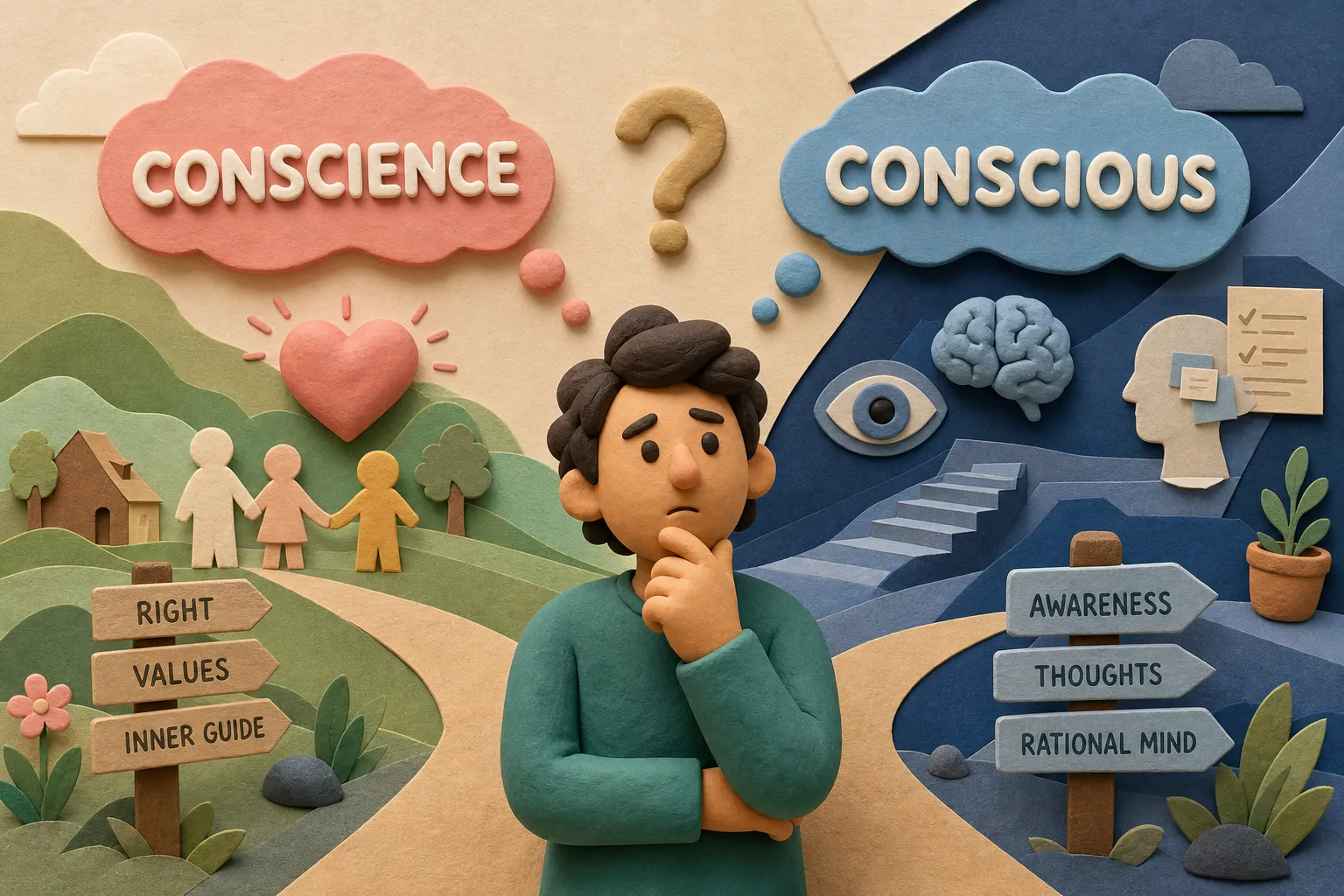
Conscience vs conscious: these two words have tripped up English learners for generations, and it’s easy to see why. Conscience and conscious look almost identical on the page, start with the same sound, and share ancient roots. Yet they mean completely different things and are never interchangeable in a sentence. Swapping one for the other is usually considered a mistake, and native speakers often notice it.
By the end of this lesson, you’ll be able to define both words clearly, identify how each one is pronounced, and choose the right word in any sentence, along with a quick mental trick to stop second-guessing yourself. You’ll also meet two important relatives, conscientious and consciousness, so the whole word family makes sense at once. That’s the approach Your Daily American takes in every lesson: not just what a word means, but how it sounds and when real speakers use it.
Conscience vs Conscious: Meaning and Usage
What “conscience” means and when to use it
Conscience is a noun. It names a thing, specifically, your inner moral sense, the internal voice that tells you whether something is right or wrong. Merriam-Webster defines it as “the sense or consciousness of the moral goodness or blameworthiness of one’s own conduct, intentions, or character together with a feeling of obligation to do right or be good.” In plain terms: conscience is the feeling that pushes you to tell the truth, apologize when you’ve hurt someone, or feel uncomfortable after doing something you know was wrong. It never refers to physical awareness or being awake.
Because conscience is a noun, you’ll always see it paired with articles, possessives, or adjectives. Here are the patterns native speakers use most:
- “My conscience bothered me after I lied, so I told the truth.”
- “She took credit for someone else’s work and had a guilty conscience for days.”
- “I can’t recommend that product in good conscience; I’ve never used it.”
- “He donated to the charity just to have a clear conscience.”
Notice the phrases: guilty conscience, clear conscience, in good conscience, my conscience. These are the chunks native speakers reach for automatically. Learning the phrases, not just the word, is what makes the vocabulary stick.
What “conscious” means and when to use it
Conscious is an adjective. It describes a person or an action; it never names a thing on its own. It has two core meanings, and understanding both is important because many learners only know the first one. The first meaning is physically awake and alert, the opposite of unconscious. The second meaning is deliberately aware or intentional: done with full attention and purpose.
Here’s what each use looks like in a real sentence:
- Awake/alert: “After the accident, she was still conscious and able to answer questions.”
- Awake/alert: “The paramedics checked whether the patient was conscious before moving him.”
- Deliberate/intentional: “He made a conscious effort to arrive early for every meeting.”
- Deliberate/intentional: “I wasn’t conscious of how loud I was speaking until someone told me.”
In both uses, conscious is always an adjective. It either follows a linking verb (“she was conscious”) or modifies a noun directly (“a conscious choice”). If you need a noun to describe the moral voice inside you, conscious will never do the job. That’s the role conscience plays.
Pronunciation, Conscience vs Conscious
How to say “conscience”
The IPA for American English is /ˈkɑn.ʃəns/ (per Merriam-Webster). The simple phonetic respelling is KON-shuns. There are two syllables: KON + shuns. The tricky part is the spelling. In these words, the “sci” combination produces a /ʃ/ (“sh”) sound, not an “s” or “sk” sound. Note that “sc” can produce other sounds in other English words, so this applies specifically here rather than as a universal rule. The final “-ence” is reduced to a quick, soft “-uns” in natural American speech; native speakers don’t give it any extra weight. (In careful or emphatic speech, the ending may be slightly more pronounced.) The word moves fast: KON-shuns. Many ESL learners slow down and try to pronounce every letter, which sounds unnatural and can make it harder for native speakers to recognize the word.
How to say “conscious”
The IPA is /ˈkɑn.ʃəs/ (per Merriam-Webster), and the phonetic respelling is KON-shus. Again, two syllables: KON + shus. Compare the two endings directly: conscience ends in “-uns” and conscious ends in “-us.” That’s the only difference in sound. Both words open with the same “KON-sh”, the distinction lives entirely in those final sounds. Practice saying them back to back: KON-shuns / KON-shus. Hearing that contrast out loud is the fastest way to lock them into memory.
You can also hear pronunciation examples and listen to native pronunciations at the Cambridge Dictionary, which is a helpful complement when you’re training your ear.
Also, if you want to dig deeper into syllable stress and how it affects recognition, see our Word Stress in American English: A Complete Guide, Your Daily American.
Why the spelling fools careful learners
Both words open with “con-sci-,” which is why the visual confusion is so persistent. The shared root is the Latin word scire, meaning “to know” (per Merriam-Webster’s etymology entries). Both words literally grew from the idea of knowing something from the inside, that’s why they look alike; they’re family. But their endings signal completely different grammatical jobs, and training your eye and ear to catch that difference is the key. For a technical look at the word history, see the etymology of “conscience” in the Online Etymology Dictionary.
The memory trick that makes both words stick
The word hidden inside “conscience”
Look closely at the spelling: con-SCIENCE. The word “science” is sitting right there inside “conscience.” This is a mnemonic, a memory aid, not an etymological claim about modern science. Science is the process of investigating what is true and what is false based on evidence. Your conscience does something similar with your own behavior: it examines your actions and gives you a moral verdict. Once you see “science” in “conscience,” you connect the word to its investigative, moral role, and the spelling becomes much easier to remember. Conscience = your inner science of right and wrong.
A quick check for “conscious”
For conscious, the check is even simpler: the word ends in “-ous,” one of the most common adjective endings in English. Think of famous, serious, nervous, obvious. They all describe something. Conscious works the same way. If the sentence calls for an adjective, something that describes a person’s state or characterizes a decision, conscious is your word. If the sentence needs a noun, you need conscience. Run both checks in order: Is there a “science” in the spelling? That’s your moral noun. Does the word end in “-ous” and describe something? That’s your awareness adjective. These two checks will help catch most common conscience vs conscious confusion, though complex sentences may still require a closer look.
Don’t overlook their relatives: conscientious and consciousness
Conscientious: the adjective that means thorough and careful
Conscientious (pronunciation: kon-shee-EN-shus, per Merriam-Webster) is an adjective that describes a person who is diligent, thorough, and takes their responsibilities seriously. It carries the moral-duty flavor of conscience but describes behavior rather than a feeling. A conscientious employee double-checks their work. A conscientious student prepares before class. It is not a synonym for conscious, a common learner mistake. Being conscious means being awake or aware; being conscientious means being careful and responsible.
Here’s how it sounds in context:
- “She is a conscientious worker who never misses a deadline.”
- “He’s conscientious about double-checking his emails before he sends them.”
- “We need someone conscientious for this project because the details really matter.”
Consciousness: the noun form of “conscious”
Consciousness is the noun that names the state of being awake and aware. It pairs directly with conscious: you lose consciousness, regain consciousness, or have a stream of consciousness. Here’s what each use looks like:
- “After the surgery, the doctor confirmed she had regained consciousness.”
- “Lack of sleep can affect your consciousness and make it difficult to focus.”
The full word family, side by side:
- Conscience, noun: your moral sense of right and wrong
- Conscious, adjective: awake, aware, or deliberate
- Conscientious, adjective: diligent, careful, responsible
- Consciousness, noun: the state of being aware or awake
Seeing the family together makes it easier to remember each word separately. They share Latin DNA, but each one has its own job.
FAQ: Conscience vs Conscious
Is conscience a noun or adjective?
Conscience is always a noun. It names your inner moral sense, the feeling that tells you right from wrong. You can say “my conscience,” “a guilty conscience,” or “in good conscience,” but you can never use it as a describing word.
Is conscious a noun or adjective?
Conscious is always an adjective. It describes a person’s state (awake and alert) or characterizes an action (deliberate and intentional). If you need a noun form, that’s consciousness.
What are the most common conscience vs conscious mistakes?
The most frequent errors are writing “I did it with a clear conscious” (should be conscience) or “She wasn’t conscience of the problem” (should be conscious). Mixing up conscientious with conscious is another common slip, they are not synonyms.
How do you remember the difference?
Look for “science” inside the spelling, conscience, to identify the moral noun. Check for the “-ous” ending to identify the adjective. Those two cues handle the majority of cases.
Try it yourself before you go
Choose the correct word for each sentence. Check your answers below.
- “After the fall, the hiker was still ________ and could describe what happened.” (conscience / conscious)
- “She had a guilty ________ after lying to her manager about the deadline.” (conscience / conscious)
- “He made a ________ decision to stop checking his phone during meetings.” (conscience / conscious)
- “I couldn’t accept the bribe in good ________.” (conscience / conscious)
- “The surgeon confirmed the patient had regained ________.” (consciousness / conscientious)
Answers: 1. conscious (adjective: physically awake). 2. conscience (noun: moral guilt). 3. conscious (adjective: deliberate). 4. conscience (noun: moral standard, fixed phrase “in good conscience”). 5. consciousness (noun: state of awareness, pairs with “regained”).
If any of these felt uncertain, go back to the memory tricks: look for “science” to find the moral noun, and look for the “-ous” ending to find the adjective. Those two checks will catch most errors in everyday writing.
Mix-ups like these are rarely just vocabulary problems. More often, they start as pronunciation problems: learners haven’t heard the words spoken enough times to tell them apart by ear. At Your Daily American, vocabulary and pronunciation travel together in every lesson, because understanding a word on the page is only half the job. You need to recognize it when a native speaker says it fast, and you need to say it naturally yourself. If you want to keep building that kind of real-world fluency, you’re in the right place. See our Pronunciation & Listening resources for more practice, and check common errors in English Words Non-Native Speakers Mispronounce Most Often, Your Daily American.
Putting it all together
Here’s the short version of everything covered in this lesson. Conscience is a noun: it names your inner moral sense of right and wrong. Conscious is an adjective: it describes someone who is physically awake and alert, or deliberately aware of something. They come from the same Latin root, scire (meaning “to know”), which explains why the spelling is so similar. But their roles in a sentence are completely different, and no amount of similarity changes that.
Use the two memory tricks when you’re unsure. Spot “science” inside the spelling to confirm you’re looking at the moral noun, conscience. Check for the “-ous” adjective ending to confirm you need the awareness adjective, conscious. Add conscientious (careful, diligent) and consciousness (the state of awareness) to that mental map, and you’ll have the whole family sorted. The conscience vs. conscious confusion stops here.
The next time you reach for one of these words, you’ll know exactly which one fits, and more importantly, why.