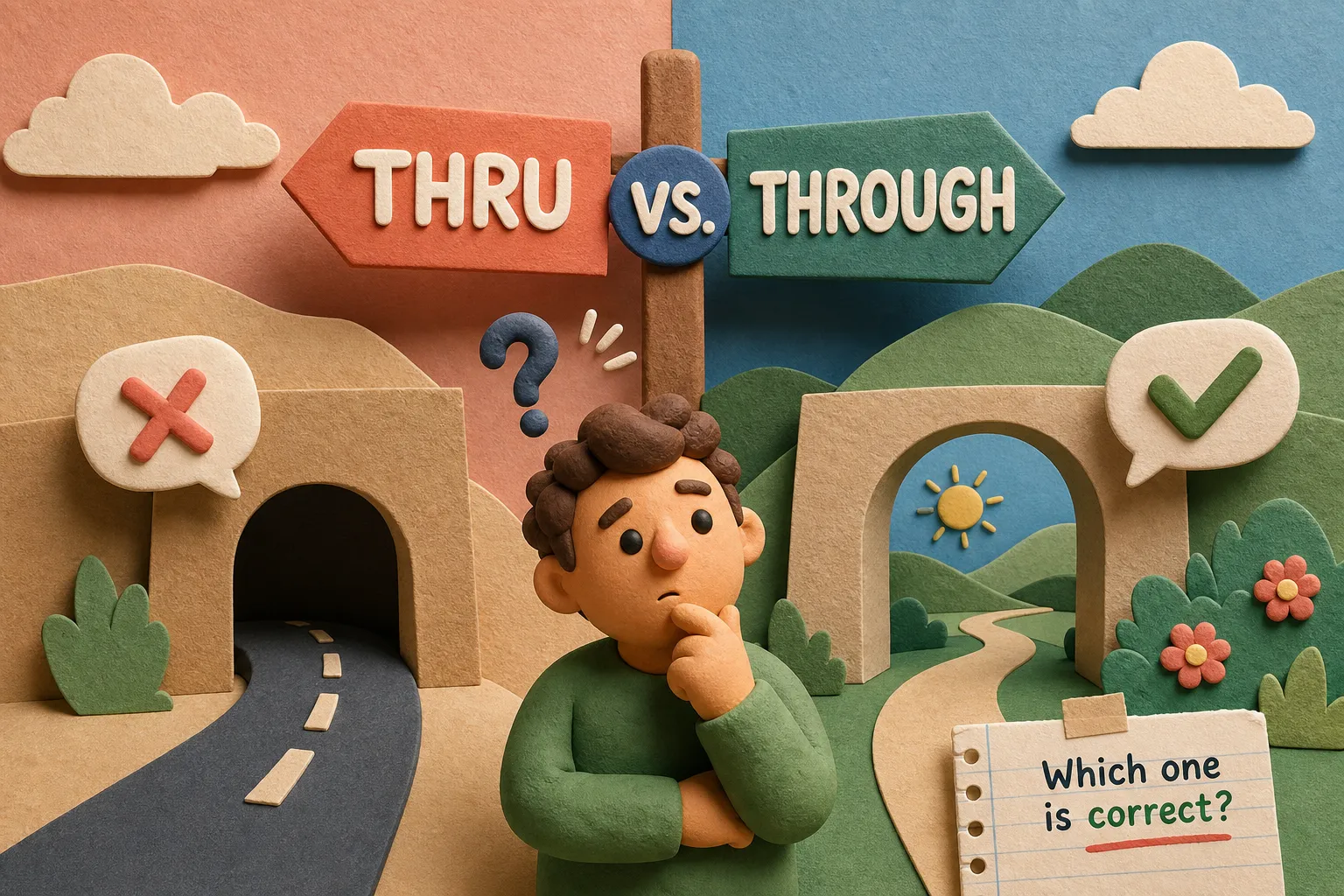
You pull up to McDonald’s, see the bright yellow sign pointing to the “Drive-Thru,” and think nothing of it. Then you sit down to write a work email, type “I went thru the report,” and your colleague flags it as a spelling error. If it’s on a sign, why can’t you use it in a sentence? That’s the thru vs. through question in a nutshell, and the answer comes down to context, not spelling.
This is exactly the kind of real American English question that rarely shows up in traditional grammar primers. At Your Daily American, we cover the language as it actually works in daily life, not just as it exists on paper. By the end of this article, you’ll know when “thru” is perfectly fine, when “through” is the only acceptable choice, and how to make that call every single time.
“Through” and “Thru”: Same Meaning, Very Different Rules
Both spellings refer to the same concept: movement from one side to the other, a span of time from start to finish, or the state of being done with something. The difference is not about meaning. It’s about formality, context, and what kind of writing you’re doing.
“Through” is the standard spelling, rooted in Old English and standardized over centuries of written English. It works in every context, formal, informal, professional, and academic. You can use it anywhere, any time, and no one will ever correct you for it.
“Thru” is an informal American English variant. It first appeared as a simplified phonetic spelling around 1839 (sometimes referenced as early-to-mid 19th century) and gained real traction in the 20th century through signage, advertising, and commercial language. Notably, the Chicago Tribune used “thru” in its house style from 1939 to 1975 as part of a broader spelling reform experiment. The experiment didn’t stick, but the word survived in specific pockets of American life.
Here’s the core idea to hold onto: “thru” is not a typo or a mistake in every situation, but it is only acceptable in specific, limited contexts. Knowing those contexts is what separates a confident writer from one who gets corrections in their inbox.
Where “Thru” Is Genuinely Accepted in American Life
The clearest and most established use is in the compound word drive-thru. Merriam-Webster lists it as a recognized form, and the AP Stylebook accepts “drive-thru” as an alternate spelling of “drive-through.” You’ll commonly see it at fast-food restaurants, bank lanes, pharmacy windows, and coffee shops across the country. Writing “The drive-thru line was wrapped around the building” is perfectly natural in casual writing, news reporting, and everyday conversation.
Beyond that compound, the informal spelling shows up in a few other accepted spots. Road signs sometimes read “No Thru Traffic” to save space, and certain sign standards, including guidelines referenced in the Manual on Uniform Traffic Control Devices, include the shortened form in specific signage contexts, though usage can vary by jurisdiction. Advertising and brand names also use it freely, because branding follows its own rules. In casual texting or social media, it’s common and completely understood: “I’ll come thru later” or “just running thru the store real quick” fit the tone of those formats.
Here’s the critical teaching point: seeing “thru” on a sign or in a text does not mean you can carry it into formal writing. Register matters enormously in American English. The language that works on a highway sign and the language that works in a business proposal are not the same language, even when they describe the same thing.
What Major Style Guides Actually Say
If you write professionally or academically, knowing where the major style authorities stand is essential. Their guidance is consistent.
AP Style, the standard for journalism and much of professional writing, prohibits the informal spelling in standard news copy. Editors default to “through” as the correct form. The one named exception is “drive-thru,” which AP accepts as a compound term. If your writing follows AP style, which is common in journalism and many PR contexts, you use the full spelling for everything except that compound.
The Chicago Manual of Style follows formal prose conventions throughout. The shortened form in a Chicago-style document would only appear in quoted material, a brand name, or a deliberate stylistic choice tied to a specific context. MLA style, used in academic writing, defaults to standard English spelling, meaning “through” is always appropriate and the informal variant would generally be out of place in an academic essay, unless you’re reproducing a source’s exact wording, a title, or a quoted brand name. Merriam-Webster records “thru” as an informal variant, which means the dictionary acknowledges it exists, not that it endorses it for general use.
The practical rule: in any professional report, academic paper, cover letter, or formal document, “through” is the expected spelling. Reserve “thru” for the specific informal and commercial contexts where it genuinely belongs.
When “Through” Is the Only Right Choice
Professional writing is the clearest case. In business emails, reports, presentations, and cover letters, the full spelling is non-negotiable. Look at these two sentences side by side:
- Correct: “Please review the contract through Friday and send your feedback.”
- Incorrect in formal context: “I went thru the report and found three issues.”
The second sentence isn’t unclear, a native speaker will understand it immediately. But it signals carelessness, and in professional communication, that matters. Native speakers read informal spelling in a formal context as a sign that the writer didn’t pay attention, even when the meaning is perfectly clear.
The same rule applies to academic writing and standardized tests. If you’re working on a college essay, a TOEFL writing section, or any kind of professional certification, use “through” every time. ESL learners sometimes carry texting habits into their essays without realizing the register has completely shifted. A quick mental check helps: is this a text or a document? If it’s a document, write “through.”
When you’re uncertain, default to “through.” It is always correct. The informal spelling is only correct in specific contexts. That’s a simple asymmetry worth remembering.
Don’t Mix Up “Thru,” “Through,” and “Threw”
There’s one more confusion worth addressing directly, because it catches a lot of English learners: “threw” and “through” sound identical in American English. Both are pronounced /θruː/, phonetically “THROO.” Same sound, completely different meaning.
“Threw” is the simple past tense of the verb “throw.” It has nothing to do with movement across a space or a period of time. Compare these two sentences:
- “She threw the ball over the fence.” (She tossed it.)
- “She ran through the park.” (She moved across it.)
A common error: “She drove threw the tunnel” instead of “She drove through the tunnel.” The meaning is completely different, and the mistake happens because the two words sound the same at full conversational speed.
Three memory anchors keep all three straight:
- Threw contains “throw” inside it. If someone tossed, pitched, or launched something, use “threw.”
- Through is the full, formal spelling for movement, time spans, and completion. Use it in any standard sentence.
- Thru is the shortcut. Think: texts, signs, drive-thru. If you wouldn’t write it in a job application, don’t write “thru.”
One quick test: can you replace the word with “tossed”? Then it’s “threw.” If not, you want “through”, or the informal shortcut only if the context clearly allows it.
A Simple Rule to Get It Right Every Time
One question settles the choice: is this formal or informal writing? Formal writing always calls for “through.” Informal writing may allow “thru,” but only in specific cases: the drive-thru compound, casual texts, and commercial signage. Everything else gets the full spelling.
Run through this three-second check before you type:
- Is it the compound “drive-thru”? Use the short form.
- Is it a text, a social caption, or informal signage? The short form is fine.
- Anything else, email, report, essay, or test? Write “through.”
Try It Yourself
Pick the correct spelling for each sentence below, then check your answer against the three-second rule above.
- “I’ll pick up the coffee at the drive-_____ on my way in.”
- “The team reviewed the proposal _____ the end of the week.”
- “Just walking _____ the store, be there in 10.”
- “The water flows _____ a series of filtration stages before reaching the tap.”
- “No _____ traffic beyond this point.” (a road sign)
Answers: 1. thru, 2. through, 3. thru, 4. through, 5. thru. If you got all five right, you’ve already internalized the rule.
Use Both Spellings Correctly From Here On
“Through” is the standard spelling for almost everything you write. “Thru” lives in informal contexts: the drive-thru compound, casual texts, road signs, and commercial copy. Major style guides agree, and native speakers notice the difference in professional settings.
Now that you know the distinction, you can move through any writing task with confidence, whether you’re firing off a quick text or drafting a formal report. The sign and the sentence live in different registers, and knowing that difference is exactly what fluent, professional American English looks like.
That’s the thru vs. through question answered. This kind of everyday American English detail, the gap between what’s on a fast-food sign and what belongs in your writing, is exactly what Your Daily American is built to teach. If you want to keep sharpening your sense of formal versus informal English, explore our lessons on professional writing, register, and the real patterns that native speakers use without even thinking about them.