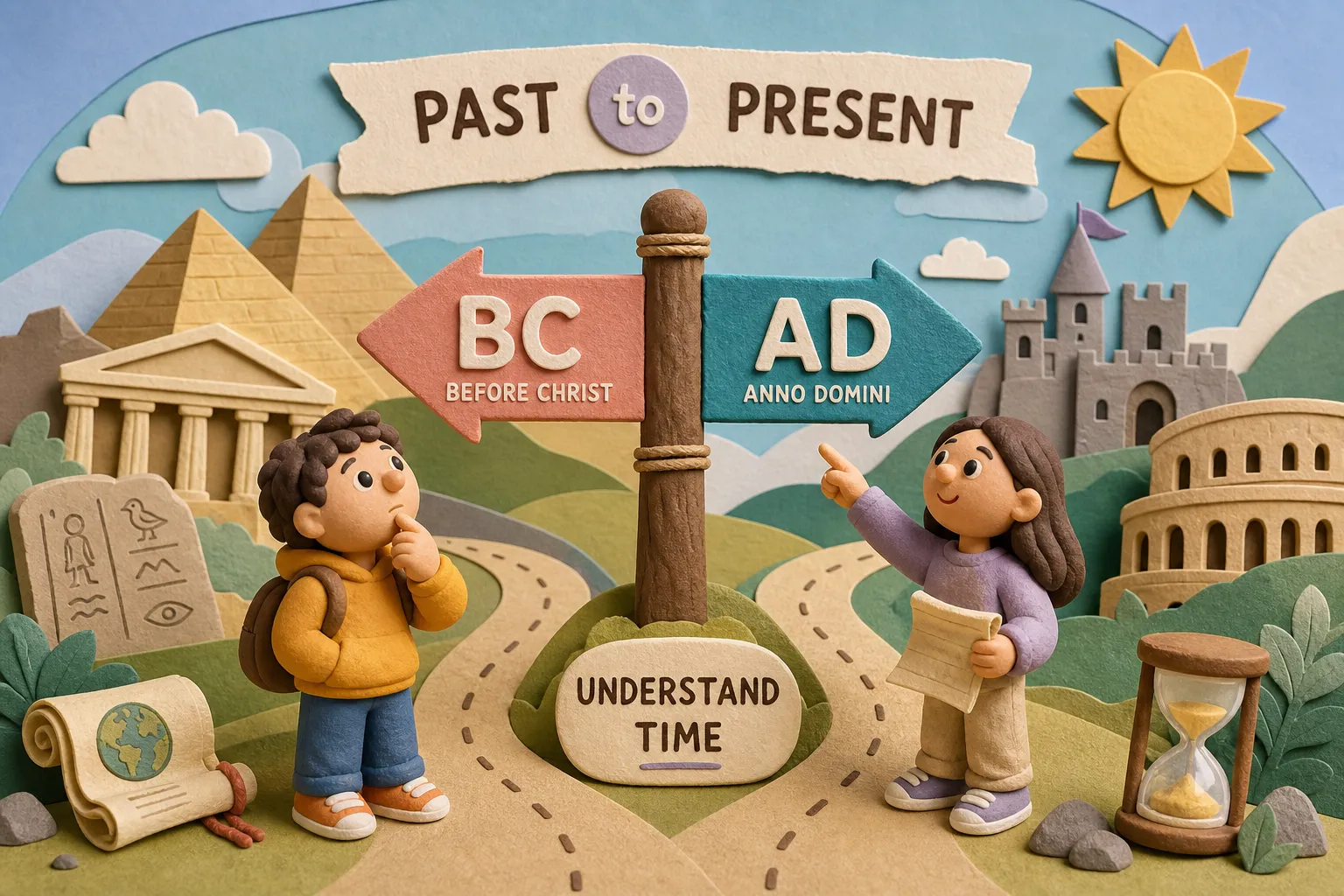
If you’ve ever looked up the meaning of AD and BC and found yourself more confused than when you started, you’re in good company. Most people use these terms their entire lives without knowing what either one actually means. If you just thought “AD means after death,” you’re not alone, but that myth is worth correcting right now. It’s one of the most widespread misconceptions in everyday English, and it fundamentally misrepresents how the calendar works.
By the end of this article, you’ll know exactly what AD and BC stand for, where they came from, why AD is written before the year number, what BCE and CE mean, and how to write historical dates correctly in American English. These terms appear constantly in textbooks, museums, documentaries, and news articles. Understanding them isn’t just trivia; it’s practical English literacy.
AD/BC meaning and origin: what these abbreviations actually stand for
AD stands for Anno Domini, a Latin phrase meaning “in the year of the Lord,” sometimes written as “in the year of our Lord.” The abbreviation kept its Latin form because, when this calendar system was invented, Latin was the language of scholarship across Europe. English eventually took over as the dominant academic language, but the abbreviation stayed. There is no word meaning “after” anywhere in Anno Domini: anno means year, Domini means of the Lord. That’s it.
The system was created by a 6th-century monk named Dionysius Exiguus, who designed it to calculate the dates of Easter. He anchored the calendar to the estimated birth of Jesus, not his death. This is why “after death” isn’t just wrong, the logic falls apart entirely. If AD started at the death of Jesus (scholars estimate this occurred sometime around AD 30, 33, though the exact date is debated), what would you call the years between his birth and his death? The whole framework would collapse. AD 1 marks the beginning of the count forward from the estimated year of Jesus’s birth.
The “after death” myth persists because it sounds plausible. When you encounter an abbreviation without knowing the full phrase behind it, the mind fills in the gap with something that seems to fit. This is exactly why learning vocabulary in full context matters, especially in English, where abbreviations and acronyms are everywhere and the original source language isn’t always obvious.
BC: the simpler half of a very old system
BC stands for “Before Christ.” It labels all years before the estimated birth of Jesus in the AD/BC system. The year immediately before AD 1 is 1 BC. Julius Caesar was assassinated in 44 BC. The Roman Empire’s traditional founding is dated to 27 BC. These are all years counted in reverse, running away from that central anchor point.
BC years count down as they approach AD 1, and that’s where confusion tends to set in. So 500 BC is further in the past than 50 BC. The closer a BC year is to zero, the more recent it is. A simple sequence makes this clear: 100 BC, then 50 BC, then 1 BC, then AD 1, then AD 50, then AD 100. Time moves forward through that list, even though the BC numbers get smaller as it does.
AD BC meaning: AD placement and the year zero rule
If you’ve ever wondered why you write AD 1066 but 44 BC, the answer comes down to two different grammatical traditions preserved side by side. In Latin, the phrase Anno Domini MLXVI (“in the year of the Lord 1066”) puts the label first, just as you’d say “in the year 1066.” AD behaves like an introductory phrase that leads into the number.
BC, on the other hand, is an English phrase that modifies a number, so it follows the number naturally, the way any English modifier would. You wouldn’t say “red the car,” you’d say “the red car.” The number comes first, the descriptor follows. That’s 44 BC. This placement isn’t a typo or an inconsistency; it’s two different linguistic traditions that happen to share the same calendar system.
In practice: AD 476, AD 1066, AD 2026 are the traditional, formally correct forms. Writing 476 AD is technically informal, but many style guides note it appears widely in casual contemporary writing. For BC dates, the number always leads: 44 BC, 753 BC, 3000 BC. If you’re writing for a publication, check their style guide. For general use, the traditional placement still signals that you know the material.
Here is something that surprises almost everyone: there is no year zero in the BC/AD system. The calendar goes 3 BC, 2 BC, 1 BC, AD 1, AD 2, AD 3. Year zero simply doesn’t exist. Dionysius Exiguus didn’t include it because he used 1-based counting, following Roman numerical practice, in which there was no numeral for zero. He counted from one, the way the Romans did. For a concise dictionary note about the abbreviation itself, see the Merriam-Webster definition of “ad”.
This has a practical consequence for anyone calculating time spans across the BC/AD boundary. The distance from 10 BC to AD 10 is not 20 years; it’s 19, because there is no year zero bridging the gap. The formula to remember: add the two year numbers and subtract one. So 10 + 10 − 1 = 19 years. From 500 BC to AD 500 is 999 years, not 1,000.
Astronomers use a different system that does include a year zero, where 1 BC becomes year 0 and 2 BC becomes year −1. This makes astronomical calculations cleaner. But that system applies only in technical scientific contexts. For more on the concept and its effects on chronology, see the year zero article and related astronomical numbering conventions.
BCE and CE: the same calendar with different labels
BCE stands for “Before Common Era.” CE stands for “Common Era.” The year numbers are completely identical to the BC/AD system: 44 BCE equals 44 BC, and 2026 CE equals AD 2026. The calendar itself did not change. The “Common Era” label refers to the calendar’s widespread use across cultures and countries around the world.
These terms are not modern inventions. “Common era” appears in English as early as 1708, and Jewish scholars were using BCE/CE in academic writing well before the terms entered mainstream academia. They became widely used in academic publishing and science during the later 20th century, primarily for one reason: religious neutrality. Anno Domini is an explicitly Christian reference. BCE/CE uses the same epoch without that framing, making it a practical choice for cross-cultural and interfaith academic work. For a deeper look at the origin and history of the BCE/CE dating system, read the related historical overview.
Which should you use? BCE/CE is common in academic publishing and many scientific fields; usage in K, 12 curricula varies by district and publisher. BC/AD remain standard in journalism, popular history, and everyday conversation. Both are correct and both are widely understood. The practical rule is consistency: pick one system and stick with it throughout a piece of writing. If a publication’s style guide specifies one, follow it.
How to write historical dates correctly in American English
A few concrete style rules to keep in mind. AD traditionally precedes the year number: AD 1492. BC, BCE, and CE all follow the year number: 1492 BC, 1492 BCE, 1492 CE. In formal typography, these abbreviations are often set in small capitals, but in everyday digital writing, emails, articles, social media, regular capital letters are completely standard. If you’d like a practical guide for composing clear emails in American usage, see How to Write a Professional Email in American English, Your Daily American.
One point that catches many ESL learners off guard: style guide choice determines whether these abbreviations use periods. Chicago Manual of Style, which governs most American book and academic publishing, uses no periods: AD, BC, BCE, CE. AP Stylebook, used widely in journalism, does use periods: A.D., B.C. Know which guide your publication follows; when in doubt, Chicago’s no-period rule is a safe default for most American academic and general writing.
Terms like these show up across American life constantly: in museum placards, documentary narration, history class textbooks, and news articles covering archaeology or ancient history. Understanding them isn’t a specialized skill; it’s part of reading and listening to American English fluently. This is the kind of cultural and historical context that separates learners who understand English from learners who feel genuinely at home in it.
At About, Your Daily American, this is exactly the territory we cover: not just vocabulary, but the reasoning, history, and convention behind the words, so you can use English with real confidence, not just grammatical correctness. To explore more articles on usage and style, visit our Professional English, Your Daily American category.
Putting it all together
Here’s the full picture in one place. Understanding the meaning of AD and BC comes down to two Latin-rooted abbreviations anchored to the same historical point. AD stands for Anno Domini, a Latin phrase meaning “in the year of the Lord.” It marks years counted forward from the estimated birth of Jesus and is written before the year number. BC stands for “Before Christ” and marks years counted backward from that same point, always written after the year number. There is no year zero in this system: 1 BC leads directly to AD 1, and calculations across that boundary require subtracting one from the sum of the two year numbers.
BCE and CE are secular alternatives with identical year values. They use the same calendar epoch, just without the religious framing. Both systems are correct, both are widely used, and your choice should depend on context and the style guide you’re following. In American English, Chicago style uses no periods inside any of these abbreviations, while AP style does.
And one final word on the myth that started this whole article: the ad bc meaning has nothing to do with death. AD has never meant “after death.” It never will. The next time someone says it does, you’ll know exactly why they’re wrong, and exactly what to say instead.
Frequently asked questions about AD and BC
Does AD mean “after death”?
No. AD stands for Anno Domini, Latin for “in the year of the Lord.” It counts forward from the estimated birth of Jesus, not his death. If it meant “after death,” there would be no way to label the years of his own lifetime.
Is there a year zero?
Not in the standard BC/AD or BCE/CE historical system. The calendar jumps directly from 1 BC to AD 1. Astronomers use a separate notation that includes a year zero, but that convention applies only in technical scientific contexts.
What is the difference between BC and BCE?
BC means “Before Christ” and BCE means “Before Common Era.” The year numbers are identical, 44 BC and 44 BCE refer to the same year. BCE is the secular alternative preferred in academic and scientific publishing.
Why does AD come before the year number but BC comes after?
AD derives from a Latin phrase (Anno Domini) in which the label precedes the year, following Latin grammar. BC is an English phrase that works as a modifier following the number, the same way adjectives typically follow nouns in English descriptions. Both placements reflect the grammatical conventions of their source language.